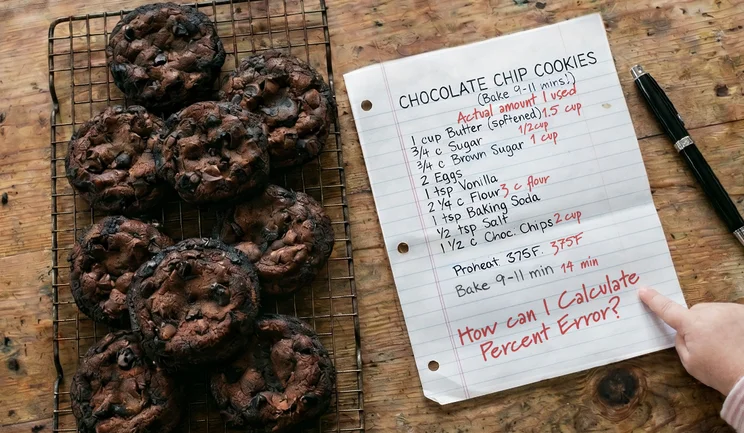
You follow a recipe that says to bake the cookies for 15 minutes. You pull them out right on time, and they're a little overdone.
The recipe was off. But by how much, exactly? That question has a precise answer in math, and it comes in the form of a percentage.
Percent error gives us a way to measure exactly how far off we were. That's what we're here to explore.
Today, Mathnasium tutors break down what percent error means and how to find it step by step, with solved examples, practice problems, and answers to the most common questions students have about it.

What Do We Mean by Percent Error?
Percent error is a way of expressing the difference between a measured or estimated value and the true value as a percentage. It tells us how far off a measurement was, relative to what the actual answer should have been.
What does that look like in practice?
Here are a few situations:
-
A student measures the boiling point of water in a lab and gets 98°C instead of the true value of 100°C
-
A scale shows a bag of flour weighs 490g, but the actual weight is 500g
-
A weather forecast predicts 20mm of rain, but only 17mm falls
In each case, percent error turns that gap into a percentage, so instead of saying "I was off by 10g," you can say "I was off by 2%."We don't know if 10kg is a big error or a small error, but we can tell that 2% is a small error.
That's a number anyone can interpret at a glance. Now, how do we get there?
📕 You May Also Like: 4 Simple Tips to Help Students Figure Out Percentages
How Do We Calculate Percent Error?
Rather than handing you the formula and asking you to follow it, at Mathnasium, we like to build up to it.
Say you were filling a swimming pool and estimated it would take 120 minutes. It actually took 135 minutes.
What's the first thing you can notice? How far off you were. That brings us to the first step.
Step 1: Find the difference
To find the difference, we simply subtract the estimated value from the true value:
135 − 120 = 15
Simple enough.
After finding the difference, we ask: Is 15 minutes a lot or a little?
That depends on what we're comparing it to. To answer that, we need to express that gap relative to the true value, and that's our second step.
Step 2: Divide by the true value
We take the difference and divide it by the true value:
15 ÷ 135 = 0.11
This gives us the error as a proportion of the true value. In other words, the estimate was off by about 0.11, or roughly 11 hundredths (\(\Large\frac{11}{100}\)) of the actual time it took.
That's more meaningful than 15 minutes on its own. But 0.11 still isn't the easiest number to interpret at a glance. That's where our third step comes in.
Step 3: Multiply by 100
To make that proportion easier to read and compare, we multiply by 100 to convert it into a percentage:
0.11 × 100 = 11%
The estimate was off by 11%. That's a number anyone can interpret straight away and compare to other measurements without any extra thinking.
And what if the difference between the estimated and true value came out negative? What if it were 120 − 135 = −15?
Well, it wouldn't change anything. Percent error is about the size of the gap, not which direction it went.
That's why we use absolute value, written as | |, to make sure the result is always positive.
So, let's recap what we did:
-
We found the difference between the estimated value and the true value
-
We divided that difference by the true value to express it as a proportion
-
We multiplied by 100 to convert that proportion into a percentage
Put it all together, and you get the percent error formula:
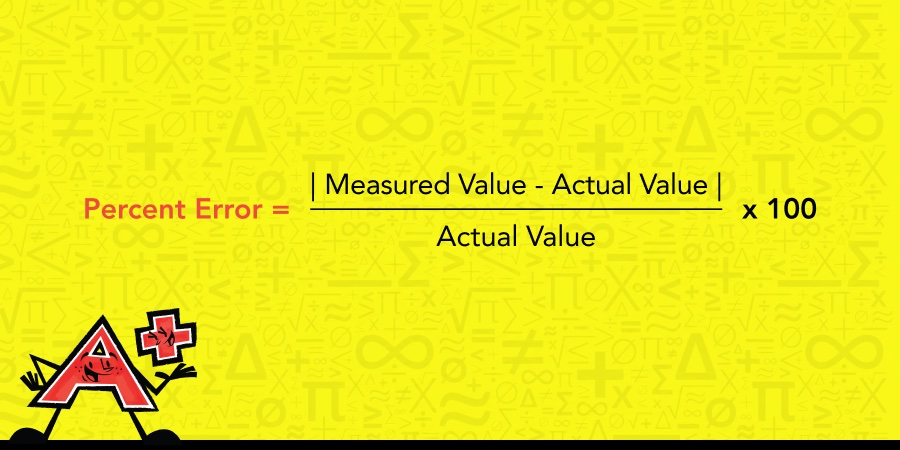
That formula isn't something to memorize and forget. Every part of it comes from the reasoning we just walked through.
📕 You May Also Like: Want a More Intuitive Way to Think About Percentages?
Percent Error: Solved Examples
Explanation covered. Now let's run the formula through a few more examples.
Example 1: The Boiling Point Experiment
Going back to the example from the beginning:
A student measures the boiling point of water in a lab and records 98°C. The true boiling point is 100°C.
Let’s find the percent error.
Here, the measured value is 98, and the true value is 100. We plug both into the formula:
\(Percent\enspace error = \Large\frac{|98-100|}{100} × 100\)
= \(\Large\frac{|-2|}{100} × 100\)
= \(\Large\frac{2}{100} × 100\)
= \(\Large\frac{200}{100}\)
\(Percent\enspace error = 2%\)
The student's measurement was off by 2%.
Example 2: The Marble Jar
A mom asks her child to estimate how many marbles are in a jar. The child guesses 40. When they count them together, there are 65.
What is the percent error?
The measured value, or the kid’s estimate, is 40. The true value, or the actual number of marbles, is 65.
We simply plug both into the formula:
\(Percent\enspace error = \Large\frac{|40-65|}{65} × 100\)
= \(\Large\frac{|-25|}{65} × 100\)
= \(\Large\frac{25}{65} × 100\)
= \(\Large\frac{2500}{65}\)
\(Percent\enspace error = 38.46%\)
So, the kid’s estimate was off by 38.46%. That’s quite a bit further off than the boiling point experiment!
Example 3: The Repair Bill
A mechanic estimates a car repair will cost $180. The final bill comes to $150.
Let’s calculate the percent error.
What the mechanic estimated is our measured value: 180. The final bill is our true value: 150. We plug them in:
\(Percent\enspace error = \Large\frac{|180-150|}{150} × 100\)
= \(\Large\frac{30|}{150} × 100\)
= \(\Large\frac{30}{150} × 100\)
= \(\Large\frac{3000}{150}\)
\(Percent\enspace error = 20%\)
The mechanic's estimate was off by 20%.
📕 You May Also Like: 6 Tips to Help Your Middle Schooler Grasp Probability and Statistics
Your Turn: Can You Work Out These Percent Errors?
Over to you. See if you can work out these percent errors.
-
Challenge 1: A student estimates that it will take him 30 minutes to complete his essay. It actually takes him 42 minutes. What is the percent error?
-
Challenge 2: A scientist predicts an experiment will produce 50ml of liquid. The actual yield is 47ml. What is the percent error?
-
Challenge 3: A family budgets $200 for groceries. The actual bill comes to $235. What is the percent error?
When you’re done, scroll down to the bottom of the guide to check your answers.
FAQs About Percent Error
Curious minds always have follow-ups, and percent error is no exception. Here are the most common questions we hear at our centers.
1. When do students first learn about percent error?
Percent error is typically introduced in 7th grade, often as part of a unit on ratios, proportional reasoning, or scientific measurement.
Students encounter it most frequently in math and science classes, particularly when working with lab experiments or data analysis. It also shows up in later coursework, including statistics and chemistry.
2. Can percent error be negative?
No. Because we use absolute value in the formula, percent error is always expressed as a positive number.
The absolute value removes any negative sign that might result from subtracting a larger true value from a smaller measured value. We care about how far off the measurement was, not whether it was too high or too low.
3. What's the difference between percent error and percent difference?
Percent error compares a measured or estimated value to a known true value.
Percent difference, on the other hand, is used when there is no single "true" value, and you're comparing two measurements to each other.
The formula for percent difference uses the average of the two values in the denominator rather than a known true value.
4. Is a lower or higher percent error better?
A lower percent error is better. It means your measurement was closer to the true value. A percent error of 1% tells you your result was nearly exact.
A percent error of 25% tells you your result was quite far from the true value. In science, a percent error under 5% is often considered acceptable, though the standard can vary depending on the context.

At Mathnasium, every question counts. That's how understanding takes root.
Master Percent Error with Top-Rated Tutors at Mathnasium
Mathnasium is a math-only learning center dedicated to helping K-12 students of all skill levels learn and master math.
We've worked with thousands of middle school students, helping them make sense of concepts across the full spectrum of middle school math, from ratios and proportions to measurement and data, percent error included.
Whatever their goal, we teach for deep understanding, not surface familiarity.
At the core of how we do that is the Mathansium Method™, a proven and proprietary teaching approach.
It begins with a diagnostic assessment, which helps us determine what a student already knows and areas for growth. Using these insights, we design a learning plan customized to their needs.
With the plan in place, our specially trained tutors follow it closely, providing face-to-face instruction in a caring and fun environment.
During sessions, we use a thoughtful balance of Socratic questioning and direct teaching, along with visual, verbal, mental, tactile, and written techniques, so students can see the math from different angles and truly make sense of what they're learning.
Whenever students feel stuck, we break concepts into manageable steps and explain both the how and the why behind each solution, building the problem-solving skills and critical thinking they can use across all areas of math and beyond.
And fun is a big part of the process. Our activities are often game-based and hands-on, and we celebrate every step of progress students make, growing their confidence with every session.
And the results?
-
94% of parents report an improvement in their child's math skills and understanding
-
93% of parents report an improved attitude towards math after attending Mathnasium
-
90% of students saw an improvement in their school grades
Whether your student is looking to catch up, keep up, or get ahead in math, your local Mathnasium center can help. Start by scheduling a diagnostic assessment, and together we'll create a personalized plan for math mastery.

Pssst! Check Your Answers Here
Gave it your best shot? Find your answers below.
Challenge 1:
\(Percent\enspace Error = \Large\frac{|30 - 42|}{42} × 100 = 28.57%\)
Challenge 2:
\(Percent\enspace Error = \Large\frac{|50-47|}{47} × 100 = 6.38%\)
Challenge 3
\(Percent\enspace Error = \Large\frac{|200 − 235|}{235} × 100 = 14.89%\)
How did you do?