Addition, subtraction, and basic multiplication tend to go smoothly in the early years. But when fractions appear, the student who breezed through earlier problems may now second-guess their work or ask to skip certain exercises.
This is because fractions demand something different from what came before. To work fluently with fractions, students need to see how numbers break apart and fit together. They need to recognize when a number can be divided evenly by 3, or why 15 and 20 share common factors. Without this lens, every fraction problem becomes a guessing game.
Divisibility rules provide exactly this missing foundation. When students can quickly identify which numbers divide evenly into others, fractions stop feeling arbitrary. Simplifying, finding common denominators, and comparing fractions all follow predictable patterns instead of requiring memorization or luck.

What Are Divisibility Rules?
Divisibility rules are simple guidelines that help kids determine whether one number can be divided evenly by another without doing the full division. Each rule acts as a quick divisibility test, giving students a reliable way to check if a number breaks into equal groups with no leftovers.
For example, 12 is divisible by 3 because 12 ÷ 3 equals 4 exactly. There is nothing left over. That idea of dividing evenly is at the heart of both divisibility rules and fractions.
Some of the most common divisibility rules students learn early include:
-
Divisible by 2: If a number ends in an even number (0, 2, 4, 6, or 8), it is divisible by 2.
-
Divisible by 3: If the digits of a number add up to a multiple of 3, the number is divisible by 3. For example, we break 111 down to 1 + 1 + 1, and since the result is 3, the number is divisible by 3.
-
Divisible by 5: If a number ends in 0 or 5, it is divisible by 5.
-
Divisible by 10: If a number ends in 0, it is divisible by 10.
At first, these rules can look like shortcuts. Sometimes they are even taught that way. But there’s more to it.
Divisibility rules help kids recognize patterns in numbers, understand how numbers work, and make decisions efficiently. Instead of guessing or using trial and error, students learn to ask, “Does this divide evenly?” and “How do I know?”
That type of thinking becomes especially important once fractions are introduced.
Why Divisibility Rules Are Important for Learning Fractions
Fractions can feel tough because they ask kids to divide numbers in unfamiliar ways. Instead of working with whole numbers, students are deciding how numbers break into equal parts and whether those parts make sense together.
If a child is unsure how division works, even figuring out the starting point can be a challenge.
Divisibility rules make this easier by giving students a clear way to check whether numbers divide evenly or not.
Rather than guessing or trying several options, kids learn how to quickly rule numbers in or out. This helps them focus on understanding the fraction instead of getting stuck on the math around it.
For example, when a student sees the fraction \(\Large\frac{8}{12}\), knowing that both numbers (the numerator and the denominator) are divisible by 2 right away tells them the fraction can be simplified.
If we need a quick refresher on numerators and denominators, here's what they represent in a fraction:
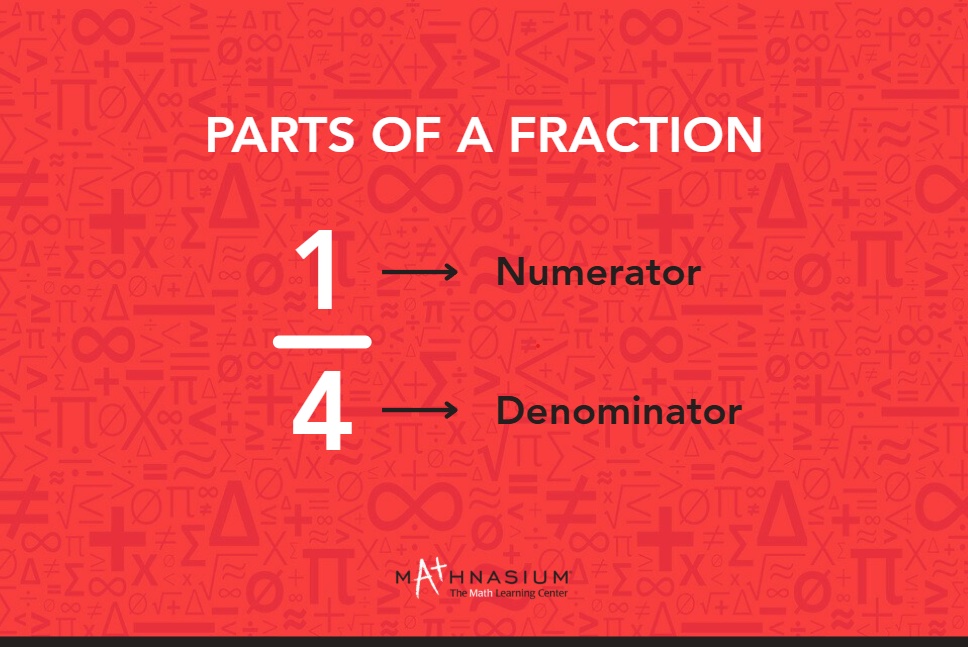
That single insight gives them a place to start and a way to figure out the next step.
Without it, it can feel like shooting in the dark and hoping for the best.
This kind of clarity is what helps fractions feel more manageable. When students understand divisibility, fraction rules stop feeling random and start to make sense.
📕 You May Also Like: How to Add & Subtract Fractions with Unlike Denominators
3 Examples of How Divisibility Rules Are Used With Fractions
Divisibility rules show up constantly in fraction work. Below are a few common situations where understanding whether numbers divide evenly makes a clear difference.
1. Simplifying Fractions
Simplifying or reducing a fraction means dividing the numerator and denominator by the same number. Divisibility rules help students identify which numbers to try.
Take the fraction \(\Large\frac{8}{12}\).
-
A student who knows the divisible by 2 rule can see right away that both numbers are even.
-
Dividing both by 2 gives \(\Large\frac{4}{6}\).
-
From there, the same rule applies again, leading to \(\Large\frac{2}{3}\).
Each step is guided by knowing what divides evenly, not by guessing.
Now consider \(\Large\frac{9}{15}\).
-
These numbers are not even, so dividing by 2 would not make sense.
-
But a student who knows the divisible by 3 rule can see that 9 and 15 are both divisible by 3.
-
Dividing both by 3 leads directly to \(\Large\frac{3}{5}\).
If students do not understand divisibility, simplification can become a matter of trial and error. They may try dividing by numbers that do not work or rely on memorized steps without understanding why the fraction changes.
2. Finding Common Denominators
To add or compare fractions, students need a common denominator. This means finding a number that both denominators divide into evenly.
For example, with \(\Large\frac{1}{4}\) and \(\Large\frac{1}{6}\), a student who understands divisibility can quickly reason through the options. The number 12 works because it is divisible by both 4 and 6. Knowing that 12 is divisible by 2 and by 3 helps students arrive at that answer efficiently.
Without divisibility rules, students may resort to listing multiples and hoping they overlap. This approach takes longer and increases the chance of mistakes.
📕 You May Also Like: What Is the Least Common Denominator? A Kid-Friendly Guide
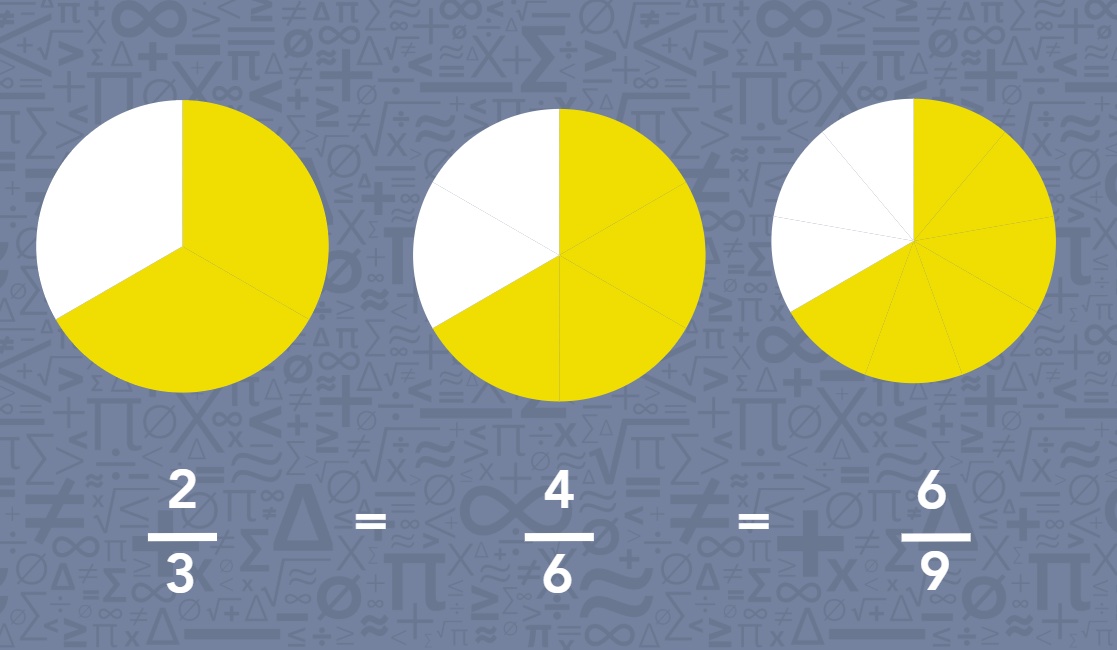
3. Understanding Why Fractions Are Equivalent
Equivalent fractions represent the same amount, even though the numbers look different. Divisibility rules help explain why this works.
For example, \(\Large\frac{2}{3}\), \(\Large\frac{4}{6}\), and \(\Large\frac{6}{9}\) all represent the same value because each numerator and denominator pair divides evenly by the same number. Understanding divisibility helps students see this as a logical relationship rather than a trick.
Kids who can explain why fractions are equivalent are much more likely to apply that understanding correctly in new problems.
Why “Divisible by 2, 3, 5, and 10” Comes Up So Often in Fractions
In early fraction work, certain numbers appear again and again. This is not random. Divisibility by 2, 3, 5, and 10 reflects how numbers most often behave and how fraction problems are designed.
Divisibility by 2
Divisibility by 2 comes up constantly because it is the most common case. Half of all whole numbers are even, which means they are divisible by 2. This makes it the first and most natural check when working with fractions.
It is also especially useful because it can be applied step by step. A student can divide both the numerator and denominator by 2, then check again, and repeat the process until the fraction cannot be simplified any further.
Divisibility by 3
Divisibility by 3 shows up frequently because it is one of the easiest rules to apply for odd numbers. Instead of dividing, students can simply add the digits to see whether a number is divisible by 3.
Aside from 5, divisibility by 3 is usually the most efficient check for odd numerators and denominators, which is why it becomes a common tool in fraction simplification.
Divisibility by 5 and 10
Divisibility by 5 and 10 plays a big role in fractions that connect to real life. Fifths and tenths appear so frequently because they align with money, measurements, and decimals.
Knowing that numbers ending in 0 or 5 divide evenly by 5, and numbers ending in 0 divide evenly by 10, helps students work more confidently with fractions that use larger numbers, such as \(\Large\frac{55}{100}\) or \(\Large\frac{120}{160}\).
Together, these divisibility rules give students reliable starting points. Instead of testing many different possibilities blindly, they can focus on the few checks that are most likely to work, making fraction problems feel more structured and manageable.
📕 You May Also Like: What Is Division in Math? A Simple & Complete Overview
3 Signs a Child Is Missing This Foundation
When divisibility rules are shaky, children tend to struggle with fractions in a few specific ways. These are the three typical signs parents notice at homework time.
-
Hesitation when simplifying. A child may look at \(\Large\frac{12}{18}\) and immediately ask which number they are supposed to divide by. Instead of checking whether both numbers are divisible by 2 or 3, they may try dividing by 4, then 5, then give up. This usually means they are unsure how to identify a shared factor.
-
Uncertainty with multiple fractions. Faced with a problem like \(\Large\frac{2}{3}\) + \(\Large\frac{1}{4}\), a student may start listing multiples of 3 and 4 without knowing what they are looking for. If they lose track or stop early, it can lead to incorrect denominators or incomplete work.
-
Difficulty adapting to new numbers. A child may have successfully simplified a fraction by dividing by 3 in a previous problem, then see a fraction like \(\Large\frac{15}{18}\) and immediately focus on dividing by 5 because one number ends in a 5. When that does not work, they get stuck, even though dividing by 3 would again be the correct choice. This shows that the process is being driven by surface cues rather than a consistent understanding of which numbers divide evenly.
These patterns point to a missing connection between numbers and division. Strengthening that connection allows students to be better equipped to approach fraction problems with clarity instead of uncertainty.

At Mathnasium, we start from the ground up to ensure every child has a rock-solid math foundation.
How Mathnasium Helps Build Divisibility and Fraction Confidence
When a student struggles with fractions, the issue is often a gap in earlier number skills, such as understanding when numbers divide evenly. At Mathnasium, instruction begins by identifying and addressing those gaps before asking students to push forward.
When students come to Mathnasium, whether they are just starting fractions or feeling stuck, we do not use a one-size-fits-all approach. Instead, we use the Mathnasium Method™, a personalized teaching approach designed to build strong foundations and lasting understanding.
To support skills like divisibility and fraction reasoning, our approach includes:
-
Personalized assessments: Each student begins with a diagnostic assessment to help us understand their current knowledge of number relationships, including divisibility, factors, and other fundamental concepts. This allows us to pinpoint any gaps that may have formed.
-
Instruction that builds understanding: We focus on understanding over memorization. Students learn when and why to use divisible by 2, 3, 5, and 10 while working through real fraction tasks like simplifying, finding common denominators, and identifying equivalent fractions.
-
Trained, supportive instructors: Mathnasium tutors are trained to recognize when a student is guessing, memorizing, or relying on cues. They know how to guide students toward understanding without giving away answers.
-
A focus on problem solving: Students work through problems independently and then discuss their thinking with an instructor. This helps them connect divisibility rules to fraction concepts and apply them confidently in new situations.
-
A math-only learning environment: Because math is all we do, our personalized plans are designed to strengthen core skills like divisibility that support success in fractions and beyond.
The Mathnasium Method™ delivers measurable results:
-
94% of parents report an improvement in their child’s math skills and understanding
-
93% of parents report an improved attitude toward math
-
90% of students see an improvement in their school grades
With more than 1,100 centers across the United States, Mathnasium provides trusted, structured math instruction close to home.
For families in or near Denver, CO, Mathnasium of Cherry Hills is a trusted local center with years of experience transforming how students think and feel about math. If your child is ready to catch up, keep up, or get ahead in math, our team is happy to assist.
📅 Schedule a Free Diagnostic Assessment at Mathnasium of Cherry Hills.
Not located near Denver?
📍 Find a Mathnasium Learning Center Near You


 (720) 474-1878
 (720) 474-1878