You study for two hours. Your friend studies for four. A third classmate barely opens their notes.
When the scores come back, they're all different.
Did the studying make a difference? Almost certainly. One thing changed, the hours put in, and something else responded to it: the score.
That relationship is exactly what we mean when we talk about independent and dependent variables in math.
Today, we will break down what each one means, how to tell them apart, and how they show up in equations and on graphs. You'll also get a chance to practice and find answers to the most common questions students ask about this topic.

First, What Is a Variable?
A variable is a symbol, usually a letter like x, y, or n, that represents a number we don't know yet or one that can change. That's actually where the name comes from: its value can vary.
You've already seen variables in action.
-
In an equation like x + 3 = 7, the letter x is standing in for a missing number.
-
In a formula like y = 2x, both x and y are variables, but they're connected. When x changes, y changes too.
And that connection between two variables, one changing, the other reacting, is exactly what we're here to explore.
📕 You May Also Like: How to Solve Basic Equations — A Parent and Student Guide
Independent and Dependent Variables in Math
When two variables are connected, they play different roles. One of them leads. The other follows.
-
The independent variable is the one we control or choose to change. It doesn't rely on anything else in the relationship.
-
The dependent variable is the one that responds. Its value is determined by whatever the independent variable is doing.
Let's look at a simple example.
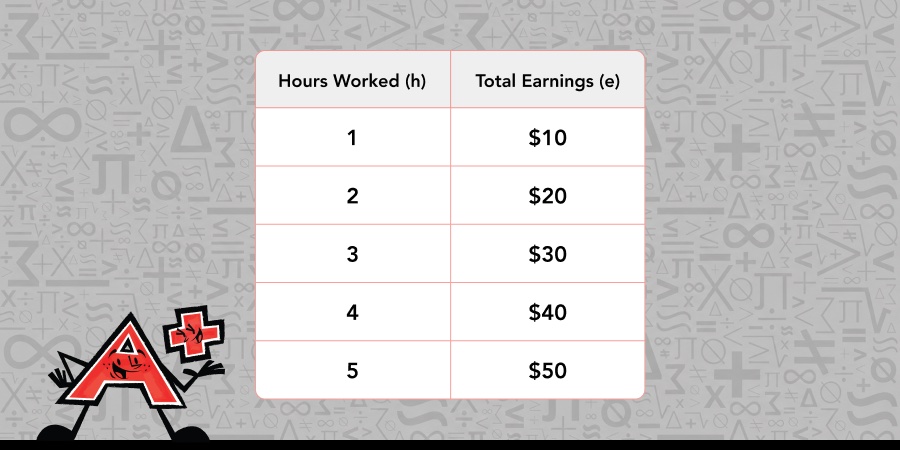
Say you earn $10 for every hour you work. The number of hours you work is your choice; that's the independent variable. Your total earnings respond to that choice; that's the dependent variable.
We can write this as:
\(e = 10h\)
Here, h is the number of hours worked, and e is the total earnings. As h changes, e changes with it.
And how do they show up on a graph?
These variables also have a set place when we graph a relationship.
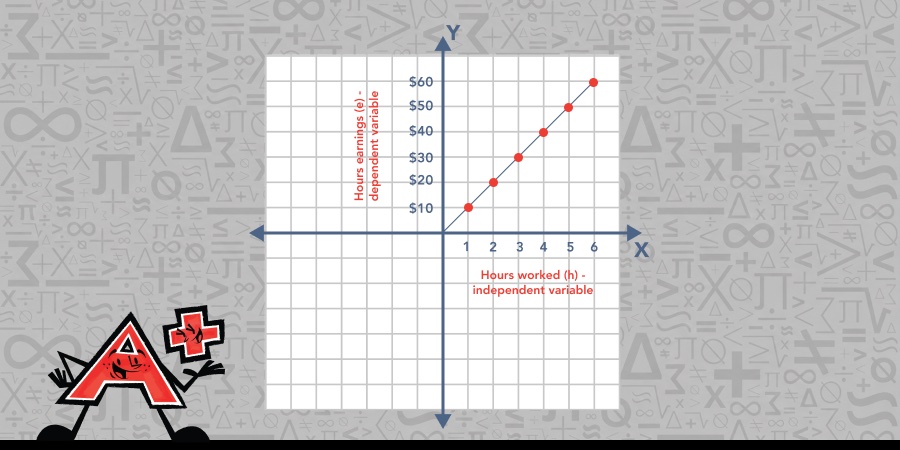
The independent variable goes on the x-axis (horizontal) and the dependent variable goes on the y-axis (vertical). The x-axis holds what we control; the y-axis shows what results.
📕 You May Also Like: How to Read 4 Most Common Graphs - A Kid-Friendly Guide
How to Tell the Difference Between Independent & Dependent Variables
When students aren't sure which variable is which, our tutors suggest thinking about it this way: the independent variable is what changes or is controlled, and the dependent variable is what changes because of it.
In other words, one is the cause, and the other is the effect.
Does that make sense?
A few concrete examples should put it into perspective:
-
You study history for 3 hours; that's the choice being made, so it's the independent variable. You walk away with a score of 85; that score is a direct result of the studying, so it's the dependent variable.
-
Grandma gives a plant 2 cups of water a day; that's what's being controlled, so it's the independent variable. She watches it grow 4 cm in a week; the growth responds to the watering, so it's the dependent variable.
-
Sarah buys 5 items at $3 each; that's the decision, so it's the independent variable. She ends up with a total cost of $15; the cost follows from the number of items, so it's the dependent variable.
That same logic applies to equations. In y = 6x − 2, if we choose x = 3, the equation gives us y = 16. We decided on 3, and the equation produced 16. So x is the independent variable, and y is the dependent variable.
📕 You May Also Like: How to Use T-Charts to Solve (and Graph) Linear Equations
Solved Examples: Let's Figure These Out Together
Nice work getting here. Now that independent and dependent variables make sense to you, let's try a few examples together.
Task 1: Identify the Variables
Read the situation below and determine which is the independent variable and which is the dependent variable.
A taxi charges a base fee of $3 plus $2 for every mile driven. A passenger travels 5 miles and pays $13.
Ask yourself: Which value depends on the other?
The passenger chose to travel 5 miles; that's the decision. The $13 came out of that choice: $3 + (5 × $2) = $13. The cost didn't determine the miles; the miles determined the cost.
Task 2: Write the Equation
A plant grows 3 cm for every cup of water it receives. Write an equation that describes this relationship, then identify the independent and dependent variable.
First, think about what we know. The growth depends on the water; every cup adds 3 cm. So if we call the cups of water w and the growth g, the relationship looks like this:
\(g = 3w\)
Now ask yourself: which variable are we choosing? We decide how much water the plant gets — that's w. The growth follows from that decision — that's g.
Task 3: Find the Value of the Dependent Variable
A cyclist rides at a steady speed of 12 miles per hour. How far will she have traveled after 5 hours? Use a table to map out the relationship, then find the answer.
First, identify the variables.
The number of hours is what we're controlling — that's the independent variable (h). The distance responds to how long she rides — that's the dependent variable (d). Now let's map out the relationship:
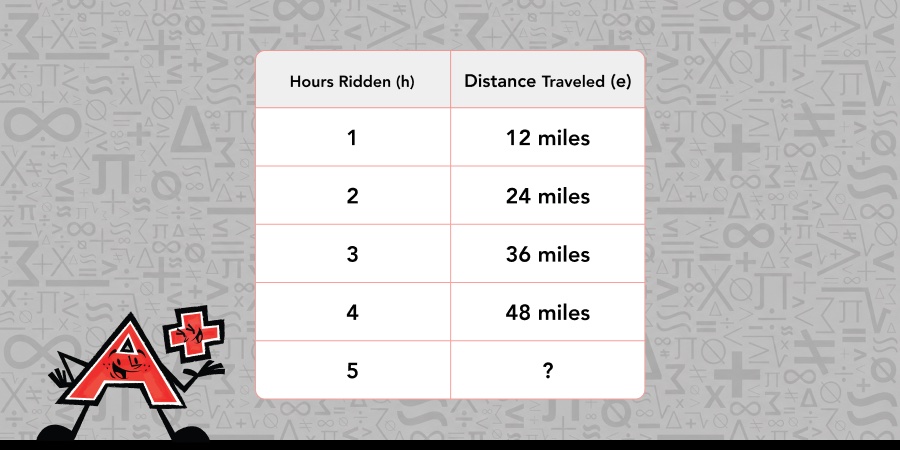
The pattern is clear: every hour adds 12 miles. That gives us:
d = 12h
Plug in 5 hours: d = 12 × 5 = 60 miles.
The cyclist will have traveled 60 miles after 5 hours.
Your Turn: Have a Go at These Variable Challenges
You've seen how it's done; now it's your move. Work through the exercises below. When you’re done, check your answers at the bottom of our guide.
Challenge 1: Identify the Variables
Zoe plants bean seeds in four cups and waters them different amounts each day: 10 ml, 20 ml, 30 ml, or 40 ml. After five days, the plants measure 2 cm, 4 cm, 5 cm, and 3 cm tall.
In this problem, what is the independent variable? What is the dependent variable?
Challenge 2: Find the Value of the Dependent Variable
A car wash charges a flat fee of $8 per vehicle, plus an extra $5 for large vehicles. One afternoon, 3 large vehicles came in. How much did the car wash collect in total?
Use a table to map out the relationship, then find the answer.
Challenge 3: Find the Independent Variable
A baker earns $12 for every cake she sells. By the end of the weekend, he had made $156. How many cakes did he sell?
Challenge 4: Write the Equation
A cyclist's speed increases by 2 mph for every extra gear shifted, starting at 10 mph in gear 1. Write an equation that describes this relationship, then identify the independent and dependent variables.
FAQs About Independent & Dependent Variables
Learning about independent and dependent variables tends to spark a question or two. We've rounded up the most common ones we hear at our centers and answered them clearly below.
1. When do students first learn about independent and dependent variables?
Most students are introduced to variables in 4th or 5th grade, when they begin working with simple expressions and equations. At that stage, a variable typically represents a single unknown value, like x in x + 3 = 7.
Independent and dependent variables come a little later, usually in 6th grade, when students start exploring how two variables can be related to each other.
From there, the concept builds through middle and high school as students work with linear equations, functions, and graphing.
2. Can a variable be both independent and dependent?
Not in the same relationship. That would be like being both the cause and the effect of the same event, which doesn't quite work.
In any given problem, a variable plays one role: either it's the one being controlled or changed (independent), or it's the one responding to that change (dependent). It can't do both at once.
That said, the same variable can play different roles in different problems. In one equation, x might be the independent variable. In another, it might be the one that depends on something else.
The role is always determined by the relationship in front of you, not by the letter itself.
3. Do independent and dependent variables always have to be numbers?
In math, yes. Variables represent numerical values, so the independent and dependent variables in an equation will always be numbers.
But in a broader sense, not necessarily. In science experiments, for example, the independent variable might be something like the type of fertilizer used or the color of light a plant receives, neither of which is a number. What matters is that one thing is being changed or controlled, and another is being observed or measured as a result.
In math class, though, you can count on both variables being numerical. That's what makes it possible to write equations, build tables, and plot points on a graph.
4. Can there be more than one independent variable in a relationship?
In the math problems you'll encounter in middle school, typically no. There’s one independent variable and one dependent variable. That keeps the relationship clean and straightforward.
As math gets more advanced, equations can involve multiple independent variables all influencing the same dependent variable at once. For now, working with one at a time builds the foundation you'll need when you get there.

Questions are always welcome at Mathnasium centers. They're the first step toward deep understanding.
How Mathnasium Helps Students Master Any Math Concept
Mathnasium is a math-only learning center empowering K-12 students of all skill levels to excel in math.
We've worked with thousands of middle school students, helping them build confidence and clarity in topics such as independent and dependent variables, linear equations, ratios and proportions, and introductory algebra.
To build a deep understanding of any math concept, we use the Mathansium Method™, a proven and proprietary teaching approach.
Our approach begins with a diagnostic assessment, which helps us pinpoint what your student already knows and where they could use extra support. Using these insights, we create a personalized learning plan that puts your student on their best path to math mastery.
Once the plan is ready, our specially trained instructors follow it closely, providing face-to-face instruction in a caring and fun environment.
During sessions, we use a thoughtful balance of Socratic questioning and direct teaching, along with visual, verbal, mental, tactile, and written techniques, so students can truly make sense of what they're learning.
When students feel stuck, we break concepts into manageable steps and explain both the how and the why behind each solution. The goal is to help students build strong problem-solving skills and critical thinking that they can use in math and beyond.
Our sessions often include game-based activities and meaningful rewards, helping students stay motivated and enjoy the learning process.
The results speak for themselves:
-
94% of parents report an improvement in their child's math skills and understanding
-
93% of parents report an improved attitude towards math after attending Mathnasium
-
90% of students saw an improvement in their school grades
Whether your student is looking to catch up, keep up, or get ahead in math, your local Mathnasium center can help. Start by scheduling a diagnostic assessment, and together we'll create a personalized plan for math mastery.

Pssst! Check Your Answers Here
If you've given our exercises a try, scroll down to check your results.
Challenge 1
Challenge 2
Each large vehicle costs $8 + $5 = $13.
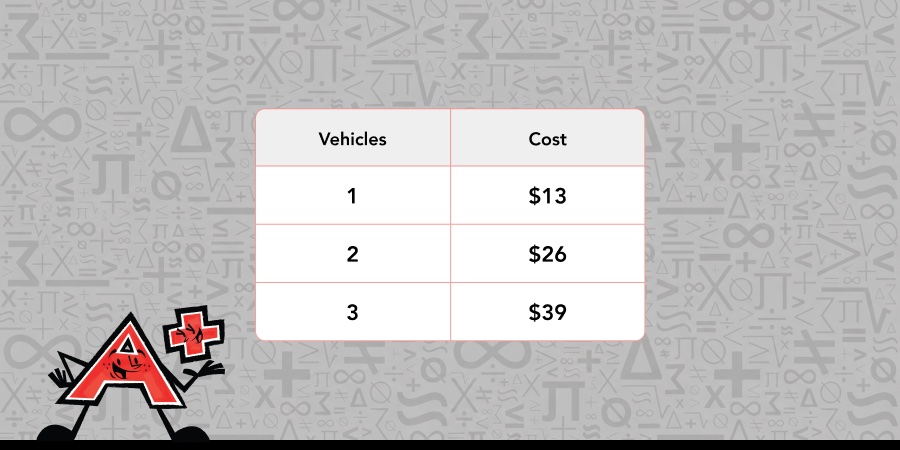
The car wash collected $39 in total.
Challenge 3
Let c = total earned and n = number of cakes sold.
c = 12n → 156 = 12n → n = 156 ÷ 12 = 13 cakes
Challenge 4