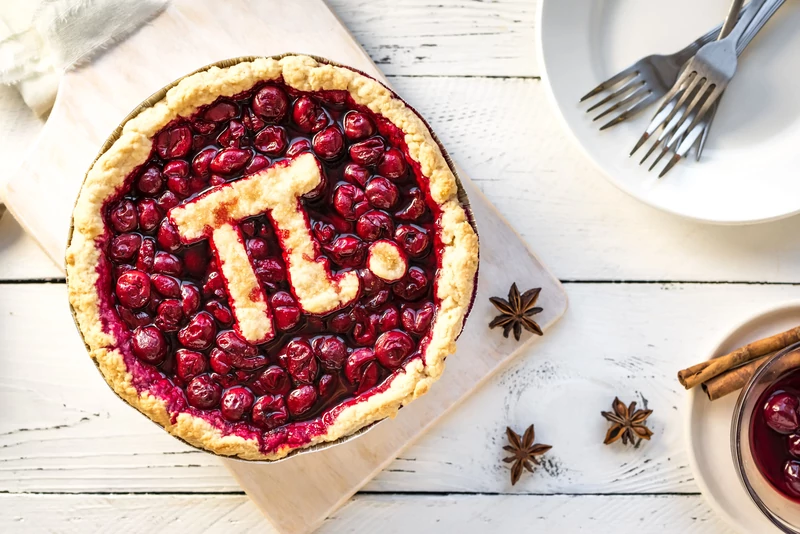
Pi (π) is one of the most famous and mysterious numbers in mathematics. It’s a mathematical constant that appears everywhere—from the shapes of planets and the way waves move to engineering and music.
The name "Pi" comes from the Greek letter π, which is the first letter of the Greek word "perimeter" (περίμετρος). Mathematicians started using π to represent the ratio of a circle’s circumference to its diameter in the 1700s, thanks to the mathematician William Jones. In lay terms, that’s the distance around a circle divided by the distance across the middle of the circle.
For centuries, mathematicians have studied π, trying to understand its nature. We often approximate it using 3.14 or the fraction \( \displaystyle \frac{22}{7} \), but does that mean π is a fraction itself?
Which leads us to an even bigger question: Is π a rational or irrational number?
In this guide, we’ll break down what rational and irrational numbers are, explore the special properties of π, and answer whether π is a rational or irrational number.
Meet the Top-Rated K-12 Math Tutors in Cherry Creek
First, A Quick Recap: What Are Rational & Irrational Numbers?
Before we dive more into the subject of π, let’s remind ourselves of the difference between rational and irrational numbers.
Rational numbers are numbers that can be written as a fraction \( \displaystyle \frac{p}{q} \), where:
- p and q are whole numbers
- q is not zero
All rational numbers have either a terminating decimal (like 0.25) or a repeating pattern (like 0.666...).
Let’s explore some examples and see if we can spot the patterns.
Examples of Rational Numbers
Here are some common rational numbers and their decimal forms:
- \( \displaystyle \frac{1}{2} = 0.50\)
- \( \displaystyle \frac{3}{4} = 0.75\)
What do we notice?
When a fraction has a denominator like 2, 4, 5, 8, or 10, the decimal usually ends cleanly.
- \(-5 \text{ which is the same as } \displaystyle \frac{-5}{1}\)
Whole numbers can also be written as fractions, which makes them rational too!
- \(0.333 \text{ (which is } \displaystyle \frac{1}{3}, \text{ a repeating decimal)}\)
The decimal goes on forever, but it follows a clear pattern of repeating 3s.
What do we see here?
Every fraction, whether it’s a whole number, a terminating decimal, or a repeating decimal, can be written as \( \frac{p}{q} \) —which means it’s rational.
What Are Irrational Numbers?
Irrational numbers are numbers that never repeat and never end—no matter how far we calculate.
An irrational number is a number that:
- Cannot be written as a fraction \( \displaystyle \frac{p}{q} \)
- Has a decimal expansion that goes on forever without repeating
Examples of Irrational Numbers
Now that we know what irrational numbers are, let’s look at some famous examples.
These numbers show up in geometry, science, and even nature—and they all have one thing in common: their decimal digits never stop and never form a repeating pattern.
- \(\sqrt{2}\) (1.41423)
- e (Euler's Number ~ 2.718…)
- π(3.1415926535…)
Is Pi a Rational or Irrational Number?
Yes, you’ve guessed it!
Pi is an irrational number, meaning it cannot be written as a simple fraction of two integers ( \( \frac{p}{q} \)). Instead, its decimal representation goes on forever without repeating: 3.1415926535…
Although \( \displaystyle \frac{22}{7} \) and \( \displaystyle \frac{355}{113} \) are often used as approximations, they are not exact values of Pi.
So let’s recap – Pi is irrational because:
- Its decimal expansion never ends (3.1415926535...)
- It has no repeating pattern in its digits
- It cannot be exactly expressed as a fraction
Pi's Epic Journey: How We Discovered That Pi Is, in Fact, Irrational?
Now, let’s take a closer look at Pi’s epic journey, how it was discovered, and how we determined that it is, in fact, an irrational number.
The idea of π goes back over 4,000 years when the Babylonians and Egyptians studied circles and noticed something interesting:
No matter the size of a circle, the ratio of its circumference to its diameter was always the same.
But they weren’t sure if this number could be written as a fraction.

Even Greek mathematician Archimedes (around 250 BCE) tried to pin it down by estimating π using polygons. He found that π was somewhere between 3.1408 and 3.1429.
That’s close! But is it exact?
By 500 CE, Chinese mathematician Zu Chongzhi improved this estimate to \(\displaystyle \frac{355}{113}\) (which equals about 3.1415929).
So, does that mean Pi is rational after all?
Fast forward to 1768, when Swiss mathematician Johann Lambert proved something surprising—π is actually an irrational number. Johann proved that π can’t be written as a fraction, no matter how hard we try. Its decimal digits go on forever without repeating.
Let’s think about why that matters.
If π were rational, we would eventually see a pattern in its decimal form—just like we do with \( \displaystyle \frac{1}{3} \) (0.3333…) or \( \displaystyle \frac{2}{7} \) (0.285714285714…).
But when we calculate π, the digits never end and never repeat in predictable patterns.
Notice that?
No matter how far we go, we never reach a stopping point!
Later, in 1882, mathematician Ferdinand von Lindemann took things even further. He proved that π isn’t just irrational—it’s transcendental! That means π can’t be the solution to any algebraic equation (like \( \displaystyle x^2 - 4x + 1 = 0 \)).
So, what did we discover?
At first, people thought π might be rational because they could approximate it with fractions. But as mathematicians kept exploring, they found that π’s decimals never follow a repeating pattern—which means it must be irrational. That’s why we write it as π instead of using an exact fraction.
Why Is Pi Important?
Pi (π) is one of the most useful numbers in math. It represents the ratio of a circle’s circumference to its diameter:
\(\displaystyle \pi = \frac{\text{Circumference}}{\text{Diameter}}\)
This means that no matter the size of a circle, if we divide its circumference by its diameter, we will always get π ≈ 3.14159.
Let’s explore some of the most important fields where we use π.
Geometry and Trigonometry
We use π in trigonometry to better understand angles, waves, and motion.
Anytime we’re working with circles, spheres, or curves, we’ll find π in the formulas.
- Circumference of a circle: \(\displaystyle C = 2\pi r\)
- Area of a circle: \(\displaystyle A = \pi r^2\)
- Volume of a sphere: \(\displaystyle V = \frac{4}{3} \pi r^3\)
Physics and Engineering
Many laws of physics and engineering involve π because the universe is full of circular motion and waves.
- Waves and oscillations: Sound waves, light waves, and water waves all follow patterns based on π.
- Circular motion: Planets orbiting the sun, spinning wheels, and roller coasters all use π in calculations.
- Electrical circuits: Alternating current (AC) electricity follows sine wave patterns that involve π.
Without π, many of the things we rely on every day—like WiFi, GPS, and cell phones—wouldn’t work.
Space and Astronomy
Scientists use π to explore the vast universe. NASA uses π when planning space missions, helping spacecraft travel millions of miles through space with precision.
- Measuring planetary orbits: The paths of planets and moons follow elliptical orbits, which require π in calculations.
- Finding the volume of planets: Since planets are roughly spherical, scientists use π-based formulas to estimate their size.
- Understanding black holes: The equations that describe black holes involve π!
Master K-12 Math with Top-Rated Tutors in Cherry Creek
Mathnasium of Cherry Creek is a math-only learning center in Denver for K-12 students of all skill levels.
Our specially math tutors offer personalized instruction and online support to help students truly understand and enjoy math.
Discover our approach to middle school tutoring:
Whether your student is looking to catch up, keep up, or get ahead in their math class, schedule an assessment, and enroll at Mathnasium of Cherry Creek today!
Schedule a Free Assessment at Mathnasium of Cherry Creek


 (303) 333-6284
 (303) 333-6284