We’ve all witnessed it. A child encounters a difficult math problem, and suddenly, anxiety sets in. Their shoulders tense, their breathing changes, and they freeze.
Why does this happen?
When children feel anxious, that anxiety occupies their working memory, the mental space needed to solve problems. Even if they know the math, they struggle to think clearly.
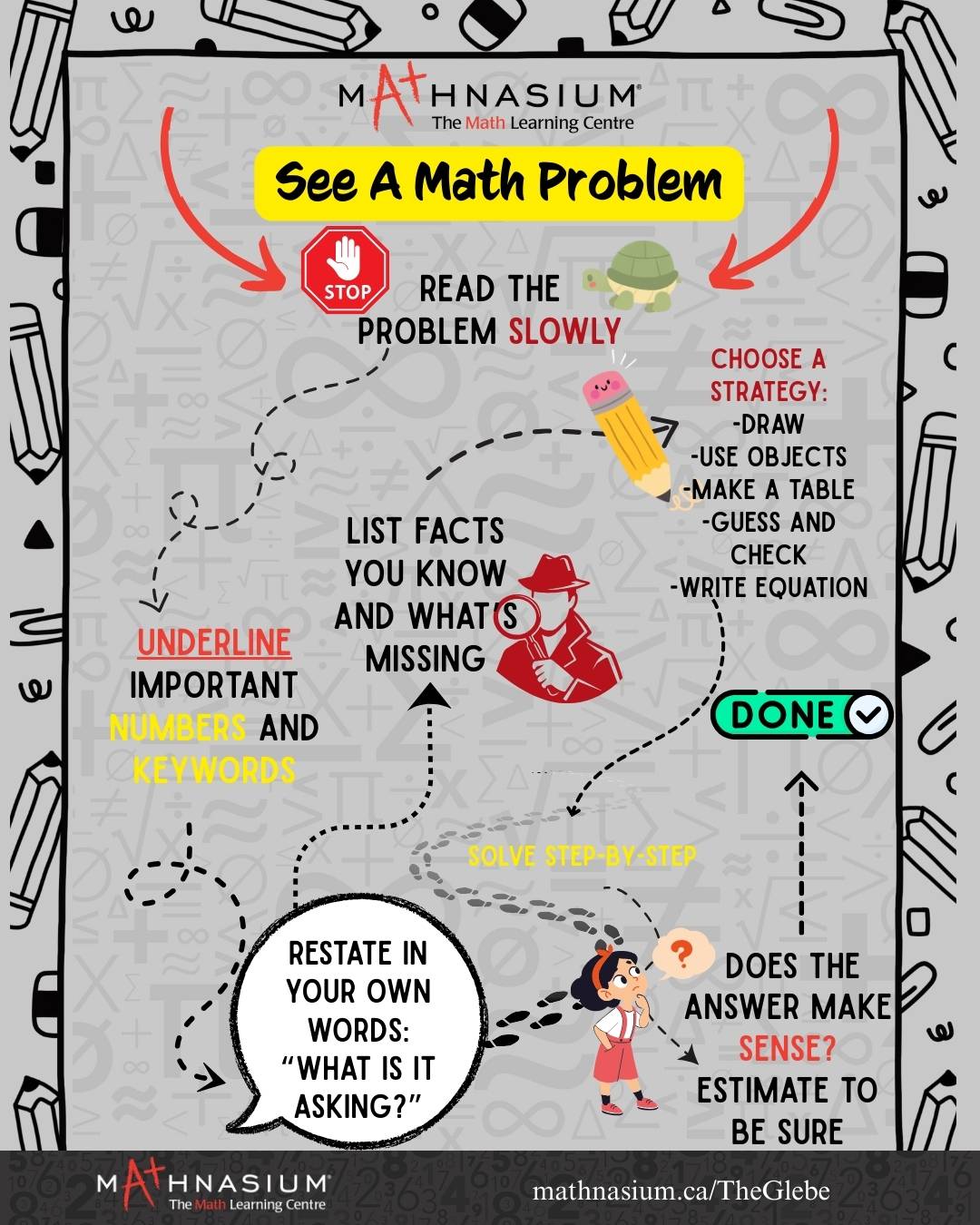
At Mathnasium of The Glebe, we help students replace anxiety with confidence by providing a step-by-step process to follow when they face a challenging problem. That’s where our Math Thinking Map comes in.
Why a Thinking Map Works
When students have a set routine for tackling problems, they don’t feel like they are starting from scratch each time. They understand the steps, allowing them to focus on thinking instead of panicking.
Our Math Thinking Map simplifies problem-solving into five easy steps:
- Read the Problem – Take your time and underline key numbers and words.
- Restate the Problem – Say it in your own words to ensure understanding.
- Identify What You Need – What information is given and what do you need to find?
- Choose a Strategy – Draw a diagram, use objects, make a table, guess and check, or write an equation.
- Check Your Answer – Does it make sense? Estimate to confirm.
How This Reduces Math Anxiety
By teaching children how to think, we eliminate the fear of “I don’t know where to start.” Instead, they learn that:
- Struggle is part of learning.
- Mistakes help them grow.
- Having a process means they are never truly stuck.
The Mathnasium Approach: Concrete → Abstract (CA)
Parents familiar with Singapore Math may know about the Concrete–Pictorial–Abstract (CPA) method. At Mathnasium, we share a similar philosophy but keep it flexible:
-
Concrete – When needed, we start with hands-on activities using objects, counters, or visuals.
-
Abstract – As soon as students are ready, we guide them toward solving with symbols, equations, and mental math.
-
Pictorial – While available as a tool (drawing models, charts, or diagrams), it isn’t required for every student. If a child can progress from concrete understanding to abstract thinking without it, we encourage that efficiency.
This flexibility means students don’t feel “stuck” in one stage — they move forward as their understanding deepens.
The Mathnasium Advantage
Our certified math tutors teach using five powerful modes of learning:
- Tactile learning (hands-on materials)
- Visual learning (pictures and diagrams)
- Verbal learning (talking it out)
- Written learning (writing steps)
- Mental learning (thinking through without aids)
With this approach, students build real thinking skills instead of just memorizing, enabling them to tackle any math problem with confidence.
Want Your Child to Build a Strong Math Mindset?
Our programs run year-round, with regular and summer options. Whether your child needs a confidence boost, help catching up, or enrichment beyond school, we’re here to help.
👉 Book a No-Obligation Assessment Today!


 (613) 439-9823