Permutations and combinations are two of the more commonly mixed-up concepts in high school probability.
They show up in the same unit, they involve the same basic setup of choosing items from a group, and the formulas look similar enough that it's easy to grab the wrong one without realizing it.
It also doesn’t help that differentiating between the two requires reading word problems very carefully. Even just a few small tweaks to the wording of a problem can change whether you need to find the permutations or the combinations.
So, let’s zoom in and see exactly what these two concepts are, when you’re supposed to use which, and go through a few word problems that showcase common setups for both.

When Do We Use Combination or Permutation?
When learning probability and statistics, a question you are likely to come across is “How many possible outcomes are there?”
For example, if you are ordering a pizza and you get to choose 3 out of the 10 available toppings, how many potential topping combinations are there?
Permutations and combinations are the two tools mathematicians use to answer these kinds of questions without manually going over and writing down every possibility.
📕 You May Also Like: How to Find the Probability of Two Events Happening
The One Question That Tells You Which to Use
Combinations and permutations differ in exactly one way: whether the order of items matters. That is to say, whether it would be a problem if you rearranged the items in question.
So, going back to our pizza example, whether you wrote down the toppings as “pepperoni, shredded cheese, tomatoes” or “tomatoes, pepperoni, shredded cheese” is completely irrelevant. At the end of the day, they’re all landing on your pizza anyway, which is the important part.
Since the order doesn’t matter, this is a combination.
Now, let’s use a different scenario. Imagine 10 of your friends are taking part in a race, and you want to calculate how many outcomes there are for people winning medals.
In this scenario, “Mark won first place, Emily won second place, and Andrew won third place” is a completely different outcome than “Andrew won first place, Mark won second place, and Emily won third place."
Unlike with the pizza, the order does matter. This makes it a permutation.
So, when trying to decide which one the problem is asking for, always imagine two or three outcomes and think about whether the order matters or not.
As a general rule, look out for titles, ranks, roles, or rankings, as this is how permutations will usually show up.
📕 You May Also Like: A Kid-Friendly Guide to Multiplication Rule of Probability
How to Calculate Combinations and Permutations
At our centers, students tend to freak out a little when they first see the formulas for combinations and permutations. But trust us, they are all bark and no bite once you understand what you are looking at.
To avoid the initial panic, let’s first talk about the symbol "n!" The exclamation point is called a factorial operation. It basically means multiplying the number by every whole number below it down to 1.
So 4! = 4 × 3 × 2 × 1 = 24, and 5! = 5 × 4 × 3 × 2 × 1 = 120.
With that out of the way, the formulas should look a lot less intimidating.
For permutations, we use:
\(P(n,r) = \Large\frac{n!}{(n-r)!}\)
Here, n is the total number of items to choose from, and r is how many you are choosing.
Back to the race example: 10 runners competing for 3 medals, n = 10 (the total number of runners), and r = 3 (the number of positions that get a medal).
Plugging in those numbers, we get:
\(P(10,3) = \Large\frac{10!}{(10-3)!} = 10 ×9 × 8 = 720\)
That’s 720 possible outcomes.
For combinations, we use an almost identical formula:
\(C(n,r) = \Large\frac{n!}{r!(n-r)!}\)
The only difference from the permutation formula is the extra r! in the denominator. That r! basically accounts for all the duplicates, since “cheese, tomato, pepperoni” is the same as “tomato, pepperoni, cheese."
Let’s now use the actual numbers from the pizza example: 10 toppings, choosing 3.
Here n = 10 (the total number of toppings available) and r = 3 (how many you are picking).
\(C(10,3) = \Large\frac{10!}{3!(10-3)!} = \Large\frac{10 × 9 × 8}{3 × 2 × 1} = \Large\frac{720}{6} = 120\)
That means 120 possible pizzas.
As you can see, even though the two examples use the same numbers (10 and 3), the result is now much lower. This is because we are not counting the differences in order within a group.
📕 You May Also Like: What Are Mean, Mode, Median & Range in Math?
How to Spot the Difference in Word Problems
So far, we’ve used pretty straightforward examples. However, on a test, word problems regarding combinations and permutations tend to be a bit less obvious.
Therefore, to get a better feel of what these word problems can look like, let’s go over three more examples.
Example 1: Prizes
Let’s start with a scenario that is often used in combination and permutation problems: a competition.
-
Problem A: Ten students enter a competition. Three will be selected to each receive a $50 gift card. How many different groups of winners are possible?
-
Problem B: Ten students enter a competition. Three will be selected to receive first, second, and third-place trophies. How many different outcomes are possible?
Let’s break it down.
In Problem A, each winner gets the same prize. That means that the order doesn’t matter. Therefore, it has to be a combination.
In Problem B, on the other hand, we see that there are rankings. This immediately lets us know that the order does matter, and thus this is a permutation.
Example 2: Seating
For this example, we’re going to make things a bit more difficult, as there are no titles or ranks, but rather an arrangement.
-
Problem A: A teacher selects 4 students from a class of 20 to form a reading group. How many different groups are possible?
-
Problem B: A teacher selects 4 students from a class of 20 to sit in the four front-row seats. How many different seating arrangements are possible?
In Problem A, all four students in the group are on the same level. Therefore, no strict order. This is a combination problem.
In Problem B, we want to focus on the wording of the question. It’s asking us how many different seating arrangements are possible, not the different student groups that could be in the first row. Therefore, this has to be a permutation problem.
Example 3: Playlists
Lastly, let’s do a problem where the exact wording is the key to solving it.
-
Problem A: A music app suggests a playlist of 5 songs chosen from your 30 liked songs. The songs play in a fixed order. How many different playlists are possible?
-
Problem B: A music streaming service lets you save 5 songs from a new album of 30 tracks to your library. How many different collections are possible?
If we pay attention to the wording, this example is the most explicit. In problem A, it even mentions that the songs play “in a fixed order” and asks for the number of potential playlists. So, the order matters. We’re looking for permutations.
In problem B, we’re looking for "collections." The order, therefore, doesn’t matter, and we’re looking for combinations.
📕 You May Also Like: 6 Tips to Help Your Middle Schooler Grasp Probability and Statistics
FAQs About Permutations and Combinations
Lastly, let’s go over a few questions that we tend to hear a lot when covering permutations and combinations.
1. Can a combination ever equal a permutation?
Yes, but only when one item is being selected (r = 1). With a single item, there is only one way to arrange it, so the order becomes irrelevant.
Plugging r back into the formula we covered, we will also see that the combination becomes equal to the permutation, as any number multiplied by 1 remains the same.
2. What is a factorial, and why does it appear in both formulas?
A factorial, written as n!, is the number of ways to arrange n items in a sequence.
For example, 3! = 3 × 2 × 1 = 6, which tells you there are 6 ways to arrange three items. Both formulas use factorials because counting permutations and combinations comes down to counting arrangements and then adjusting for whether the order matters.
3. The notation in class looks different from what's used here. Is it the same thing?
Yes. P(n, r), nPr, and Pnr all refer to the same calculation. C(n, r), nCr, and Cnr are also interchangeable. The notation varies by textbook and teacher, but the underlying concept and calculation are identical.

In Mathnasium Learning Centers, our tutors meet each student where they are at and build from there.
Master Probability and Statistics With Mathnasium
Mathnasium is a math-only learning center dedicated to helping K-12 students learn and master math at every level, including the probability and statistics concepts that become increasingly important through high school and beyond.
Topics like permutations and combinations are a good example of where having a solid conceptual foundation makes a difference.
The mechanics are manageable once the underlying logic clicks, but getting there on your own mid-semester, with other topics piling up at the same time, is a different challenge entirely.
Our approach, the Mathnasium Method™, is proprietary, personalized, and designed to build deep understanding of concepts rather than just getting through the current unit.
Each student starts with a diagnostic assessment that identifies exactly where their understanding is solid and where it needs work. From there, our tutors follow a personalized learning plan, working face-to-face in a caring and fun group environment at a pace matched to each student's needs.
And the results speak for themselves:
-
94% of parents report an improvement in their child's math skills and understanding
-
93% of parents report an improved attitude toward math after attending Mathnasium
-
90% of students saw an improvement in their school grades
Mathnasium operates over 1,100 learning centers, bringing the Mathnasium Method™ close to your community.
For families in or near Richardson, TX, Mathnasium of Richardson West is a trusted local center with years of experience transforming how students think and feel about math.
See how one local family describes their experience.
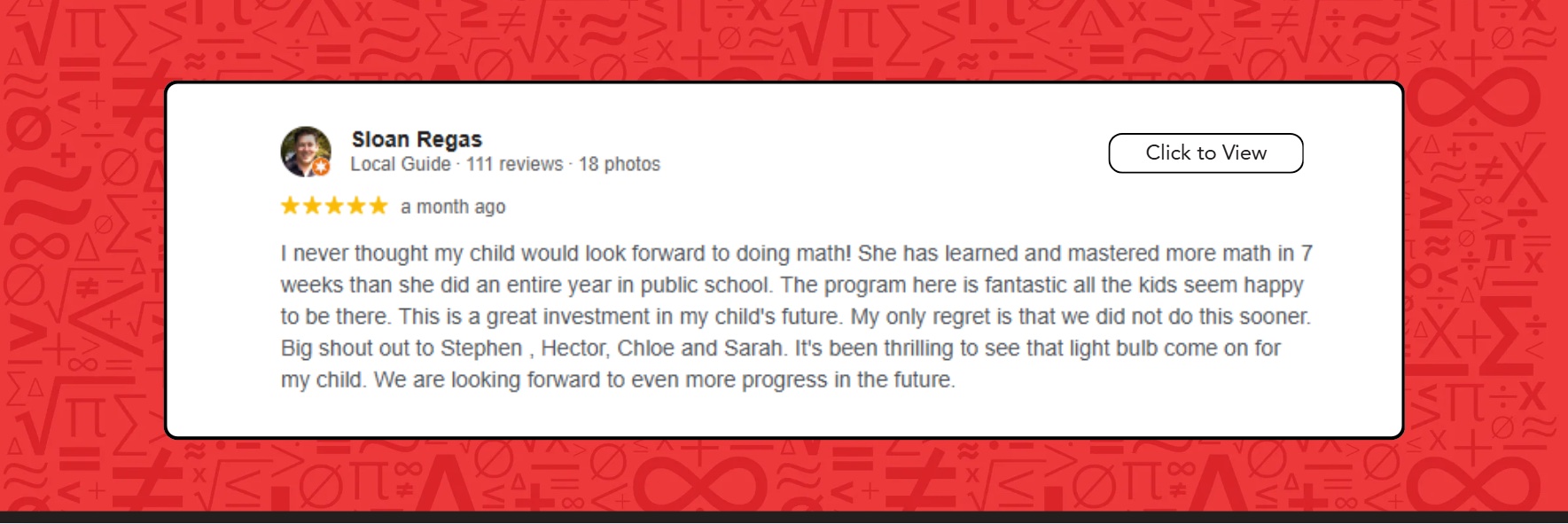
With over 100 five-star Google reviews and multiple Reader's Choice Awards from Living Magazine, it's been recognized for:
If your child is ready to catch up, keep up, or get ahead in math, our team is happy to assist.
📅 Schedule a Free Diagnostic Assessment at Mathnasium of Richardson West
Not located near Richardson?
📍 Find a Mathnasium Learning Center Near You


 (972) 231-6284
 (972) 231-6284