Before students can feel confident in math, they need to first understand it. That often starts when they notice a pattern.
Pattern recognition shifts math from something students have to memorize to something they can predict. It replaces guessing with reasoning. And that shift is where confidence begins.
Read on to explore how pattern recognition drives deeper understanding, where it shows up across math topics, and simple ways to support it at home.
Ways Pattern Recognition Builds Math Confidence
As students notice patterns, math begins to make sense. It becomes something they can follow, predict, and rely on. They start to trust what they see, test their ideas, and move forward with confidence.
Here are five reasons why pattern recognition builds real, lasting confidence in math.
A. Patterns Make Math Predictable
Math can feel overwhelming if every problem seems unfamiliar. But noticing that multiplication facts follow predictable steps, or that even numbers alternate with odd ones, uncertainty gives way to certainty.
Patterns give students something to hold onto, a structure they can trust.
A notable study found that young children who engaged in pattern recognition activities developed number sense faster and richer math vocabulary.
📕 You May Also Like: What Is Number Sense & Why It Matters in Early Math Education
B. Patterns Are a Launchpad for Problem Solving
Students who don't know where or how to start a math task usually get stuck and even overwhelmed.
Pattern recognition changes that. It gives them a place to begin. Recognizing that a sequence adds 5 each time, or that every bar in a graph increases at a regular rate, offers a clear path forward.
Even brief experiences with structured pattern mapping, like comparing equations to graphs or decoding number relationships, help students break down complex tasks more easily.
Research in perceptual learning shows that when students actively engage in recognizing patterns and structures, they develop flexible problem-solving strategies that extend to new and unfamiliar situations.
This kind of thinking, flexible and confident, is exactly what students need to thrive in upper-grade math.
📕 You May Also Like: 6 Activities to Strengthen Math Problem-Solving Skills
C. Early Pattern Play Builds Long-Term Math Skills
Long before children ever solve for x, they’re already thinking like mathematicians.
Simple activities like sorting toys by color, building repeating patterns with blocks, and noticing alternating snack schedules help them make sense of the world through structure.
As they spot patterns and test what comes next, children begin to predict outcomes, refine their thinking, and trust their observations.
This growing ability to notice regularity and anticipate results is how they begin to see themselves as capable problem-solvers.
D. Patterns Reinforce Self-Belief
Finding a pattern, testing it, and confirming it allows students to validate their own reasoning, one of the most powerful ways to build confidence in math.
Instead of waiting for a teacher or tutor to tell them they’re right, they begin asking, “Does this make sense?” and “What happens next?”
That kind of self-checking builds independence. Your child shifts from following steps to thinking through problems.
And that shift is what transforms confidence from something they borrow into something they own.
📕 You May Also Like: Building Confidence in Math: How Tutoring Can Help
E. Patterns Make Math Manageable
As students start to recognize that math follows consistent, predictable rules, it no longer feels like a maze of random problems.
Instead of facing each new problem from scratch, students who develop fluency with patterns begin to recognize familiar structures. That recognition lightens their mental load, making it easier to decide what to do next.
Researchers call this “decision fatigue, a phenomenon where the brain becomes less effective at making decisions after repeated effort. Study in psychology and education has proven that when students face too many unfamiliar choices in a short period of time, their ability to reason clearly decreases, and they may default to guesses or give up more quickly.
But with familiar patterns to guide them, students can conserve mental energy and think more clearly. Kids feel like they’re making progress, and they’re far more likely to stick with the task. That’s the turning point.
How Pattern Recognition Supports Algebra, Geometry, and Logic
Pattern recognition plays a central role in higher-level math thinking. From understanding how numbers behave to reasoning through complex problems, students rely on structured patterns to build and apply new skills.
Algebra, geometry, and logic each depend on this ability in unique but deeply connected ways.
Algebra: Learning to Recognize Relationships
In algebra, patterns reveal how numbers change and interact.
By identifying consistent rules, like “add 4 each time” or “multiply by 2”, students begin to grasp the foundational ideas behind functions and variables. Patterns like these help them see how inputs relate to outputs, setting the stage for deeper algebraic thinking.
This early awareness helps them transition smoothly into writing and solving equations.
Recognizing a number pattern becomes the first step in identifying linear relationships, interpreting graphs, or simplifying expressions. These skills form the core of algebra, and they begin with the simple act of noticing how numbers behave.
Geometry: Seeing Structure in Space
Geometry involves recognizing structure in shapes, sizes, and spatial relationships. Whether it’s identifying symmetry, matching angle measures, or observing how shapes rotate and reflect, students rely on visual patterning to solve problems.
For example, students often learn that certain angles always appear together, or that repeating shapes follow predictable spacing. This recognition helps them classify shapes, calculate area and perimeter, and solve complex multi-step problems with greater accuracy.
Logic: Developing Structured Reasoning
Logic helps students organize their thinking and follow consistent steps.
Students strengthen their ability to reason through new situations by learning to recognize the structure of a problem, the order of steps, the relationship between ideas, or the consistent outcomes of certain operations.
This kind of structured reasoning appears in pattern-based puzzles, sequencing activities, and multi-step word problems.
By spotting logical patterns, students make better decisions and solve problems more efficiently.
📕 You May Also Like: 7 Practical Ways to Help Your Child Get Better at Math

Everyday activities like board games and cooking help kids explore math patterns in a low-pressure way.
How to Boost Math Confidence at Home Through Patterns
You don’t need to be a math teacher to help your child become more confident with numbers. You just need to help them spot patterns in everyday life.
In fact, some of the best math enrichment happens at home, during simple, low-pressure moments of play and routine.
1. Use the Power of Play
Patterns are everywhere, and kids are naturally drawn to them. The key is to give them chances to explore those patterns on their own terms.
Try these easy, fun activities:
-
Board games that involve sequences, counting, or matching (like Connect Four, Set®, or Uno)
-
Jigsaw puzzles and shape-based toys that build spatial awareness
-
Music and rhythm games that follow a beat or repeat lyrics
-
Cooking and baking, where steps follow a consistent order and measurements involve predictable patterns
-
Building activities with blocks to create repeating or symmetrical designs
These activities help your child learn to recognize and test patterns without even realizing they’re doing math.
📕 You May Also Like: How Recognizing & Playing with Patterns Boosts Your Child’s Math Skills
2. Let Routines Reinforce Structure
Daily routines are full of predictable sequences that help children understand how patterns work over time.
You can encourage this by making the most of:
-
Weekly schedules: “We have soccer every Tuesday.”
-
Meal prep: “We always set the table in the same order.”
-
Chores: “We clean up toys before bedtime.”
By drawing your child’s attention to these repetitions, you help them internalize structure, which supports both mathematical thinking and emotional confidence.
3. Create a Low-Pressure Space for Discovery
Some of the most effective math learning comes from exploration. There’s a reason why low-pressure pattern play is so effective: it gives children the freedom to think without fear of being wrong.
This freedom reduces anxiety and strengthens problem-solving habits.
Instead of pushing memorization, focus on offering experiences where your child can:
-
Notice something interesting (e.g., “Look, that shape keeps repeating.”)
-
Ask questions (“What happens if we keep going?”)
-
Try it out without judgment
These moments build the kind of reasoning and self-trust that math confidence is built on.
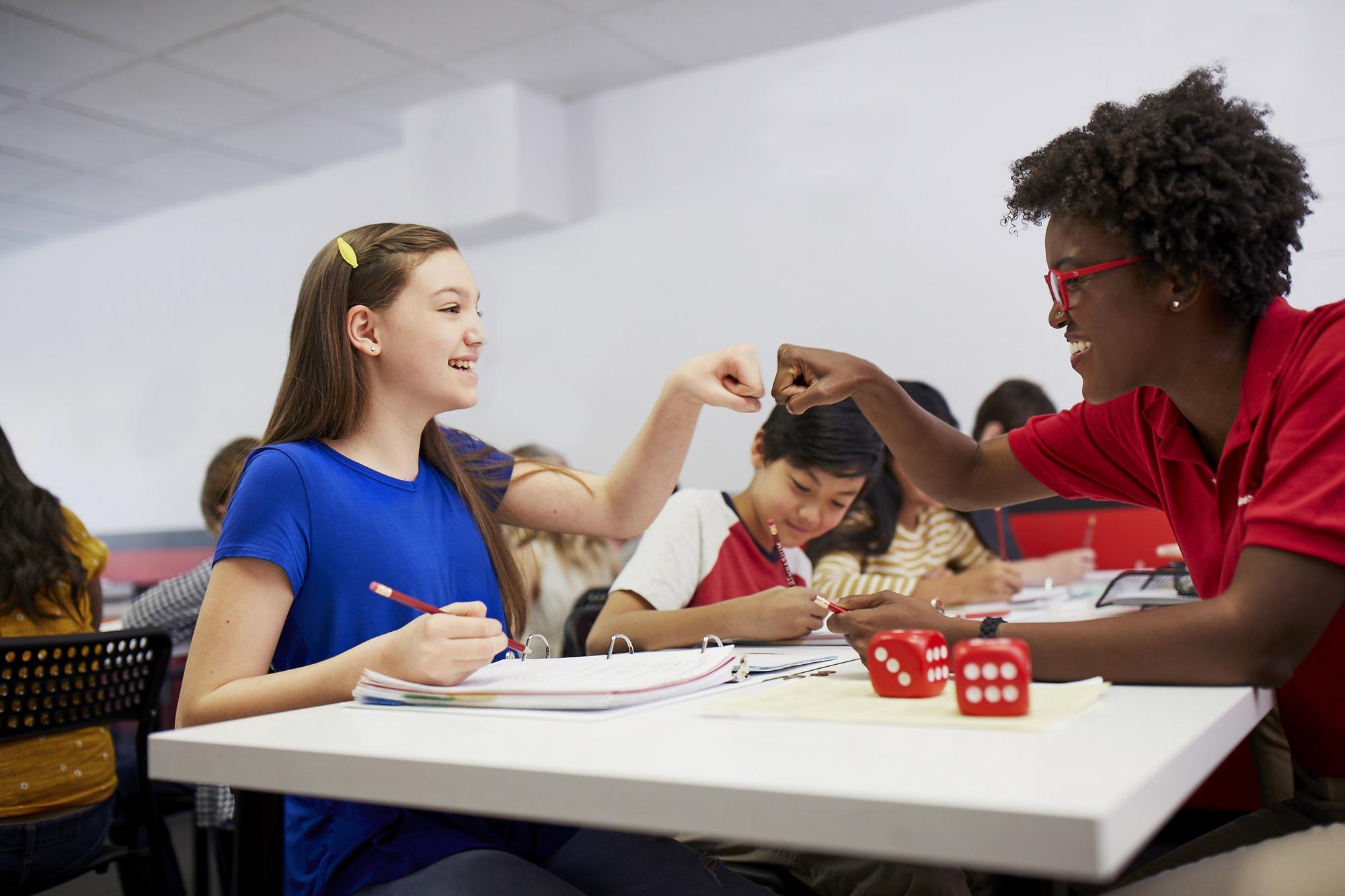
Mathnasium tutors use personalized learning plans to help students connect patterns and build deep understanding.
How Mathnasium Reinforces Pattern Recognition and Builds Confidence
Mathnasium is a math-only learning center focused on helping students of all skill levels catch up, keep up, and get ahead in math.
At the core of our approach is the Mathnasium Method™, a proprietary teaching method designed to develop a deep understanding of math concepts and lasting confidence.
Whether your child is struggling with basic concepts or ready for more advanced challenges, we personalize their learning journey to match their needs.
Every student begins with a diagnostic assessment to identify what they already know, where their knowledge gaps are, and how they learn best.
Based on these insights, we create a customized learning plan focused on building number sense, recognizing structure, and applying patterns to solve real problems.
Students receive face-to-face tutoring in a caring and fun group environment. Our specially trained math tutors use a variety of verbal, visual, tactile, written, and mental techniques to match each student’s learning style and make math make sense.
As students begin to recognize and apply patterns in numbers, shapes, equations, and logic, they become more confident in their ability to figure things out on their own.
Parents see real results:
-
94% of parents report an improvement in their child’s math skills and understanding
-
93% of parents report a more positive attitude toward math
-
90% of students saw better performance in their school grades
With over 1,100 Mathnasium centers nationwide, we bring top-rated math tutoring to families across the country. Mathnasium of Arcadia helps students build math skills and confidence every day.
📅 Schedule a Free Diagnostic Assessment at Mathnasium of Arcadia


 (602) 957-4500
 (602) 957-4500