Students are officially introduced to fractions in third grade. And from that point on, as both parents and our Mathnasium tutors agree, fractions become a common pain point.
That's actually quite understandable. Fractions don't behave like the whole numbers kids have worked with for years. Suddenly, two numbers represent one value, and bigger doesn't always mean bigger (think \(\Large\frac{1}{8}\) and \(\Large\frac{1}{2}\)).
A shaky foundation in fractions early on means struggling with ratios, percentages, decimals, and eventually algebra down the road.
Across our centers, we build fraction understanding from the ground up, using concrete experiences and visual models to help students grasp why fractions work before teaching procedures.
Based on that experience, our tutors are sharing 7 practical tips to help your child build solid fraction understanding that will carry them through middle school math and beyond.

1. Start with Real-World Sharing
Before your child works with fraction symbols on paper, they need to experience what fractions actually mean. Starting with concrete, hands-on sharing builds intuition that makes abstract concepts click later.
Try these at home:
-
Cut food into equal pieces (sandwiches, pizza, fruit)
-
Use measuring cups when cooking or baking together
-
Divide toys, crayons, or snacks equally among siblings or friends
-
Emphasize the word equal: fractions only work when parts are the same size
As you share and divide, narrate what's happening using fraction words: half, third, fourth, eighth. Don't just say "cut it into pieces", say "we're cutting this into fourths."
When kids hear and use these words in context, they develop mathematical vocabulary without it feeling like memorization. Ask questions like: "If we cut this into 4 equal pieces, what does each piece represent?" and let them explain in their own words.
This builds intuitive fraction understanding before symbols like "\(\Large\frac{1}{4}\)" ever enter the picture.
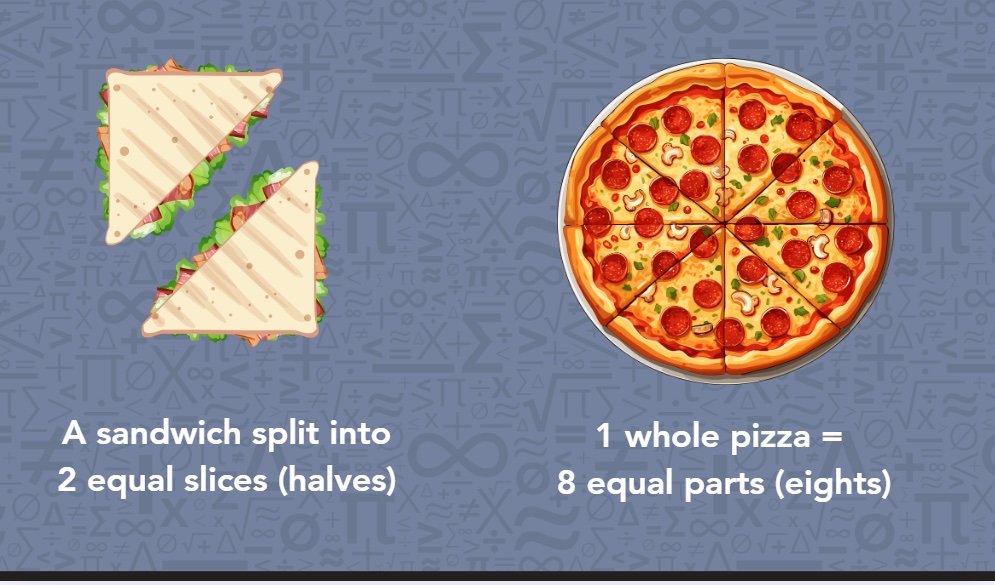
Fractions show equal parts of a whole, like a sandwich split into halves or a pizza divided into eighths.
2. Use Visual Models Before Introducing Symbols
After your child has experienced fractions through real objects, it's time to bridge to pictorial representations. This is where fractions start to look more "math-like," but they're still visual, not yet abstract symbols.
Visual models help children see how fractions work and make comparisons that would be tricky with numbers alone.
We recommend these models:
-
Area models: Circles and rectangles divided into equal parts (like pizza slices or chocolate bars)
-
Fraction strips: Side-by-side bars that show how fractions relate to each other and to one whole
-
Number lines: These are critical for deeper fraction understanding because they position fractions as actual points between whole numbers and show that fractions have a place in our number system
Before your child learns any fraction rules or algorithms, let them compare fractions by looking. Show them \(\Large\frac{1}{3}\) and \(\Large\frac{1}{4}\) using fraction circles or strips and ask: "Which is larger? How can you see it?"
If they can point to the visual and explain their reasoning, they're building the number sense that will make operations easier later.
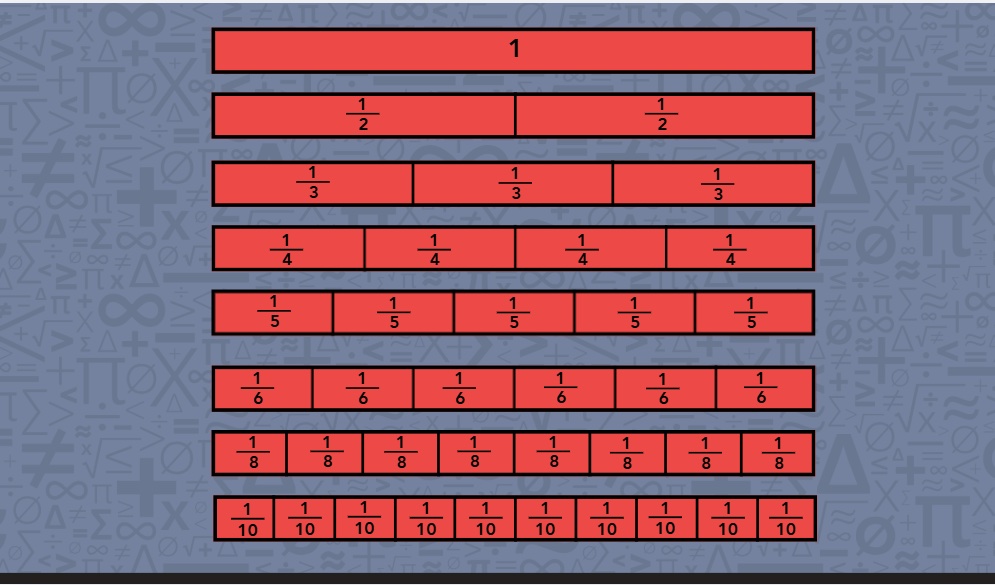
Fraction strips help children see how different fractions compare and how each one relates to a whole.
3. Make Sure They Truly Understand the Numerator and Denominator
Now it's time to introduce the symbols, but only after your child has had plenty of hands-on and visual experience. The structure of a fraction can be confusing if it's taught too quickly, so take time here.
Break it down for them clearly:
For example, in \(\Large\frac{3}{4}\), the 4 means we've divided something into 4 equal pieces. The 3 means we're focusing on 3 of them.
To make these concepts stick, you can:
-
Use color-coding or labels when writing fractions: write denominators in one color, numerators in another
-
Encourage your child to explain what each number means: "What does the 5 tell us in \(\Large\frac{2}{5}\)?"
And finally, address the big misconception that bigger denominators mean bigger fractions early on.
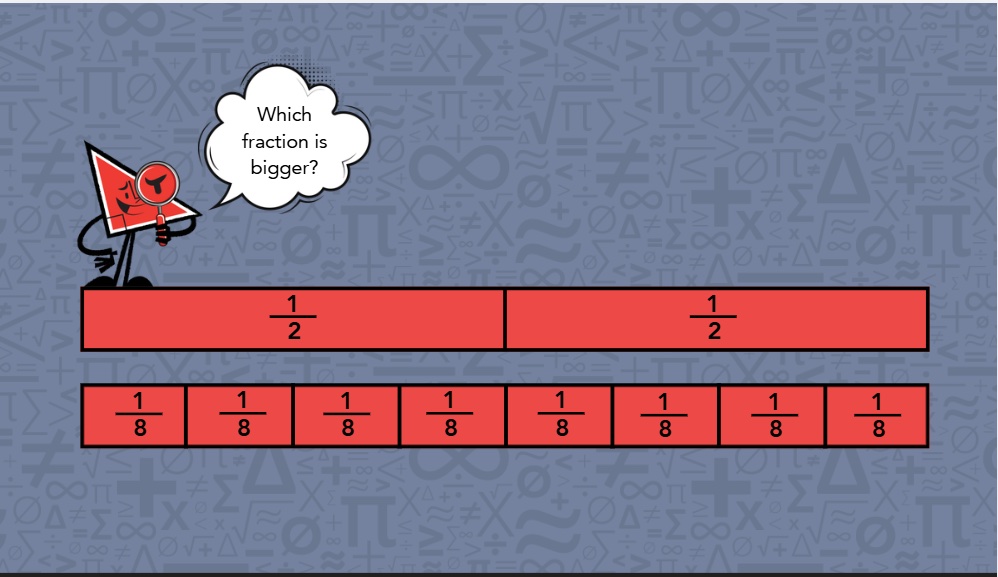
Students tend to think that because 8 is bigger than 2, then \(\Large\frac{1}{8}\) must be bigger than \(\Large\frac{1}{2}\). Connect back to those visual models!
As you divide something into more pieces, each piece gets smaller. This is where those fraction strips really shine since your child can literally see that \(\Large\frac{1}{8}\) is tiny compared to \(\Large\frac{1}{2}\).
4. Connect Fractions to Division
To really pin down the concept of fractions, remind your student that a fraction is division. The fraction \(\Large\frac{3}{4}\) literally means 3 ÷ 4.
Use sharing stories to make it concrete: "If we divide 3 cookies among 4 kids, how much does each get?" The answer? \(\Large\frac{3}{4}\) of a cookie.
You can practice with similar scenarios:
Try it with whole number answers too: 6 ÷ 2 = 3, but also \(\Large\frac{6}{2}\) = 3.
This connection sets your child up for success with improper fractions and mixed numbers later. When they see \(\Large\frac{7}{4}\), they'll understand it means dividing 7 things among 4 people, which naturally leads to "1 whole and \(\Large\frac{3}{4}\) left over."
📕 You May Also Like: 5 Strategies to Help Your Child Make Sense of Division
5. Compare Fractions Through Number Sense
Remember those visual models from Tip 2? Your child used them to see which fraction was larger. Now it's time to develop that skill into number sense or the ability to reason about fractions without always needing a picture or an algorithm.
Before your child learns cross-multiplication or common denominators, teach them to think logically about fraction size.
Build reasoning with these strategies:
-
Same denominator? Compare the numerators. If both fractions are divided into the same number of parts (like \(\Large\frac{3}{8}\) and \(\Large\frac{5}{8}\)), the one with more parts is bigger.
-
Same numerator? Compare the denominators, but remember, bigger denominator means smaller pieces. So \(\Large\frac{3}{4}\) is larger than \(\Large\frac{3}{8}\) because fourths are bigger than eighths.
-
Use benchmarks: Help your child anchor fractions to 0, \(\Large\frac{1}{2}\), and 1. Ask: "Is \(\Large\frac{5}{8}\) closer to \(\Large\frac{1}{2}\) or 1?" If they know \(\Large\frac{4}{8}\) = \(\Large\frac{1}{2}\), they can reason that \(\Large\frac{5}{8}\) is just a bit more, so it's closer to \(\Large\frac{1}{2}\). This kind of exercise develops estimation skills that make fraction operations smoother later.
📕 You May Also Like: How Estimation and Rounding Support Number Sense in Math
6. Help Your Child Understand Why Equivalent Fractions Work
Our tutors usually notice that even students who can confidently compare fractions struggle when asked whether \(\Large\frac{3}{4}\) and \(\Large\frac{6}{8}\) are actually equal. If the numbers look different, how can the value be the same?
This is where fraction understanding deepens.
Equivalent fractions show that the same amount can be written in more than one way. They reveal how fractions can scale while keeping their value.
Start with a simple example:
\(\Large\frac{3}{4}\) × \(\Large\frac{2}{2}\) = \(\Large\frac{6}{8}\)
Ask your child:
“What is \(\Large\frac{2}{2}\) equal to?”
They’ll likely say 1. And that’s the key. When we multiply a fraction by \(\Large\frac{2}{2}\), we’re multiplying by 1. The value stays the same. We are simply expressing the same quantity using more pieces.
Build multiplicative reasoning by asking thoughtful questions:
-
“If we double the number of pieces and double how many we have, what stays the same?”
-
“If each fourth is cut in half, how many pieces are there now?”
-
“Did the total amount grow, or did the number of pieces change?”
Your child begins to notice a pattern. Multiplying both the numerator and denominator by the same number keeps the fraction’s value the same.
The number of pieces increases, but the total amount remains unchanged.
You can also connect this idea to multiplication patterns they already know. If:
Then \(\Large\frac{3}{4}\) becomes \(\Large\frac{6}{8}\). Both numbers increase proportionally, so the relationship between them remains balanced.
Once your child sees that \(\Large\frac{3}{4}\) and \(\Large\frac{6}{8}\) represent the same amount, finding common denominators later makes much more sense. They’ll recognize that they’re simply rewriting fractions so the pieces match.
📕 You May Also Like: What Are Equivalent Fractions? A Kid-Friendly Guide
7. Approach Fraction Operations Conceptually, Not Mechanically
Fraction operations are often where students hit a wall. The procedures can feel like a long list of rules, and it’s easy for the meaning to get lost.
But with the right mindset, operations don’t have to undo everything your child has learned so far.
Instead of memorizing steps, help your child approach each operation with a few guiding ideas.
Addition and Subtraction: You Need the Same-Sized Pieces
Before your child tackles \(\Large\frac{2}{3}\) + \(\Large\frac{1}{4}\), make sure they grasp one fundamental truth: you can only combine pieces that match.
You can build on these core ideas:
-
The denominator tells us the size of each piece
-
Pieces must be the same size before you can add or subtract them
-
Finding a common denominator means rewriting fractions so the pieces match, just like creating equivalent fractions
-
Ask: "Are these pieces the same size? Can we combine them as-is?"
This connects directly back to Tip 6 on equivalent fractions. Your child is using the same scaling concept from equivalent fractions, just in a new context.
Multiplication: Think Groups and Scaling
Multiplication with fractions feels backwards at first. How can multiplying make something smaller?
Help your child see multiplication as transformation, either taking part of something or making groups.
Keep these principles front and center:
-
Multiplication changes the size of what you started with
-
"What is \(\Large\frac{1}{2}\) of \(\Large\frac{3}{4}\)?" means we take part of a part
-
Multiplying by a fraction less than 1 scales down. Multiplying by a fraction greater than 1 scales up.
-
This is the same scaling idea we learned from equivalent fractions, just applied differently
-
Ask: "Will this make our amount larger or smaller? Why?"
If your child expects the operation to transform the original amount, fraction multiplication stops feeling random.
Division: Think Sharing and Measuring
Division is the trickiest operation for most students because it asks a question that sounds backwards: "How many of these fit into that?"
Frame it as a measurement problem, not a procedure.
Build understanding around:
-
Division asks two types of questions: "How many groups?" or "How much in each group?"
-
Frame \(\Large\frac{3}{4}\) × \(\Large\frac{1}{2}\) as: "How many halves fit into three-fourths?"
-
Connect back to Tip 4, where you taught that fractions are division
-
Skip the "invert and multiply" rule for now, focus on what division actually means
This preserves the conceptual foundation you've been building. For a student who understands what fraction division is asking, the algorithm becomes a shortcut, not a mystery.

Through personalized learning plans and multi-sensory teaching techniques, Mathnasium helps students build a deep understanding of math.
How Mathnasium Helps Students Master Any Math Concept
Mathnasium is a math-only learning center with over 20 years of experience helping K–12 students catch up, keep up, and get ahead in math.
When students turn to us for math support, whether that means rebuilding core concepts like fractions or tackling more advanced topics like algebra and geometry, we go far beyond rote drills and memorization. We work with students to build a deep understanding of each concept so they can apply what they learn with confidence.
Our proprietary teaching approach, the Mathnasium Method™, was designed around that idea.
To help students develop a deep understanding of math, our method relies on:
-
Personalized learning plans: Each student begins with a diagnostic assessment that reveals their strengths, gaps, and how they think through problems. Using these insights, we build a customized plan that meets them exactly where they are.
-
Teaching for understanding: Our instructors use everyday language and face-to-face instruction, supported by a mix of verbal, visual, mental, tactile, and written techniques. This helps students truly make sense of the math concepts they are learning.
-
Caring, trained instructors: Our tutors are skilled in both content and connection. They know how to support students who are struggling and challenge those who are ready for more.
-
Independent thinking and critical problem-solving: Each session includes time for students to work independently before reviewing with their instructor. We teach both the how and the why, helping students build the reasoning and problem-solving tools they’ll use in math and beyond.
-
Singular focus on math: We specialize in math and math only. Our curriculum is built from thousands of thoughtfully developed pages, continually refined to reflect how students absorb, learn, and retain math best.
-
A confidence-building, fun environment: Parents frequently tell us Mathnasium sessions don’t feel like lectures. We use game-based activities, small wins, and reward systems to keep students engaged and proud of their progress.
This approach brings measurable results.
-
94% of parents report an improvement in their child’s math skills and understanding
-
93% of parents report improved attitude toward math after attending Mathnasium
-
90% of students saw an improvement in their school grades
With over 1,100 Mathnasium centers nationwide, families across the U.S. trust us to help their children succeed in math.
For families in and near the Arcadia neighborhood of Phoenix, AZ, Mathnasium of Arcadia provides top-rated instruction, personalized learning plans, and a proven path to math mastery.
If your child is looking to catch up, keep up, or get ahead in math, our team is happy to assist!
📅 Schedule a Free Diagnostic Assessment at Mathnasium of Arcadia
Not near Phoenix?
📍 Find a Mathnasium Learning Center Near You


 (602) 957-4500
 (602) 957-4500