Why Can’t You Divide by Zero? The Answer That Finally Makes Sense
May 4, 2026
| Calabasas
What do you get when you divide something by nothing?
It sounds like a trick question, doesn’t it? Perhaps you’ve heard about this rule and learned that it is undefined without thinking much about it.
If you’re curious to understand why division by zero is undefined, stick around!
The real explanation goes back to what division actually is. Today, we’ll help you move beyond just a rule and start thinking of it as an idea. Then we see what happens when zero enters the picture. It’s where the logic we rely on stops working the way we expect.
Let's Start with What Division Really Means
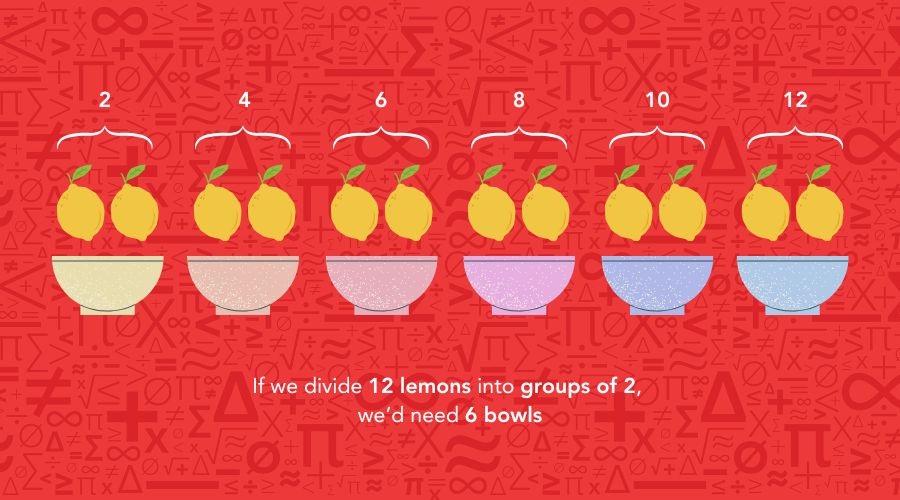
Division is the process of splitting a number into equal groups and finding out how many are in each one. At Mathnasium, we also like to explain it as counting “how many of these are there inside of that.”
Before zero enters the picture, here is a simple way to see division in action:
We can check the answer by working backward, using multiplication.
4 × 3 = 12. It comes out right.
Every division problem can be verified using multiplication.
20 divided by 4 is 5, because 5 × 4 = 20
18 divided by 6 is 3, because 3 × 6 = 18
This connection between multiplication and division is one of the earliest math relationships children build. When it feels shaky, it tends to show up in almost every problem that follows.
We can think of division as: “What number times this gives me back the original number?” And this is what makes dividing by zero impossible, which we’ll show next.
What Is 1 Divided by 0?
1 divided by 0 is the math problem that looks simple but breaks down the moment you try to solve it. The answer does not exist, and here is exactly why.
Assume 1 ÷ 0 = n
Then by definition: n × 0 = 1
But n × 0 = 0 for any number n
So no number works
We end up needing a number that turns 0 into 1, but that’s impossible.
Here’s another practical example. If we have 15 cookies and 3 friends, each friend gets 5 cookies.
Start: 15 cookies ÷ 3 friends = 5 cookies each
Check by multiplication: 5 × 3 = 15
Now let’s try it with zero friends. How many cookies does each person get?
We can think about it this way: if there are no friends, there are no groups. And if there are no groups, the cookies have nowhere to go.
The question has no answer, because there is nobody to give cookies to. They exist, but there are no groups to divide them into.
This is what undefined in standard arithmetic actually means. No number exists that makes the equation true.
If we type 1 ÷ 0 into any calculator, it returns an error that is not a glitch. The calculator is just confirming what the math already showed: there is no solution.
The calculator shows 0, but no number times 0 gives back 1.
If a question leads to two different answers at the same time, something has gone wrong.
That's what happens when we try to divide by zero: the same numbers give you the same answers that contradict each other. Math doesn't ignore that. It draws a line and says this operation isn't allowed. That's why the rule exists.
What About Zero Divided by Zero? This One Is Even Stranger
Zero divided by zero looks like it should be the simplest case of all. Zero divided by zero equals zero.
But what happens when we run it through the same check from before: “What number, multiplied by zero, equals zero?”
Any number works.
1 × 0 = 0
8,000 × 0 = 0
Every number satisfies the equation, so there is no single correct answer to land on.
Here is a way to see why that is a problem.
Imagine you have 0 cookies to share among 0 friends. You could say each person gets nothing. You could also say each person gets 5, or 100, or any number at all, because zero friends times any number still gives you zero cookies. Every answer is technically correct, which makes the question meaningless.
Mathematicians call this indeterminate, which means there are too many possible answers, rather than none at all. It may sound like a technicality, but the distinction matters.
With 1 ÷ 0, the problem is that nothing fits. With 0 ÷ 0, the problem is that everything fits equally well. They're two different problems, and neither has a clean resolution.
This case recurs in calculus and continues to fascinate mathematicians as a rare instance where the language of logic yields an indeterminate result. For a subject built on precision, a question with infinitely many valid answers is about as strange as math gets.
To make this idea clearer, here’s a short video that walks through it.
Common Mistakes Students Make When Division by Zero Appears
The most common mistake is assuming division by zero has a valid answer, especially in algebra, where it appears inside fractions and expressions that seem solvable at first glance.
Imagine a fraction like \(\Large\frac{6}{3-3}\).
The denominator looks like a real number, so it is easy to simplify without much thinking. But 3 - 3 equals zero, and that result means the fraction is undefined: the answer does not exist.
The algebraic version of this same trap looks like \(\Large\frac{(x^2 - 4)}{(x - 2)}\).
When x = 2, the denominator becomes zero again, and the expression breaks down entirely.
You can memorize the rule and get through familiar problems, but knowing why it works helps with new ones.
Division by zero confuses students because they learn the rule before they see why it exists. By the time it shows up in algebra, that gap has already been there since Grade 3, when multiplication and division are first taught together.
There are a few specific reasons this rule baffles students:
Zero looks like a number that should behave like every other number. It has a place on the number line, appears in equations, and follows its own rules in addition and subtraction. When division starts treating it differently, that can feel inconsistent rather than logical.
The rule is almost always taught as a fact to remember rather than a result to discover. Once we see why dividing by zero leads to a contradiction, the rule clicks into place permanently. When we only hear that it is not allowed, it is easy to overlook the point once the problem looks slightly different from what was practiced.
Here in our home state of California, the Common Core State Standards for Mathematics build this relationship grade by grade from the very start. Las Virgenes Unified School District, which serves Calabasas, follows that same progression. A shaky math foundation at that stage tends to resurface in every subsequent math class.
Division by zero is one rule, but the pattern it represents shows up across every grade and every topic. Math rules are often taught without the reasoning that explains them. That is exactly what Mathnasium of Calabasas is built to address.
Curiosity about why a rule works is exactly the kind of thinking the Mathnasium Method™ is built around: a proprietary teaching approach focused on reasoning over memorization.
The Mathnasium Method™ starts with what a student already knows, identifies where the gaps are, and builds from there in sequence. We add new concepts only once the foundation beneath them is solid. The method is delivered by local, highly trained instructors who specialize in math and teach with patience and compassion.
The results reflect it:
94% of parents report improvement in their child's math skills and understanding
93% of parents report an improved attitude toward math after attending Mathnasium
90% of students saw improvement in their school grades
With over 1,100 learning centers across North America, there is likely a Mathnasium close to you.
Families in and near Calabasas trust Mathnasium of Calabasas, a center with years of experience building confident math thinkers in the Las Virgenes Unified School District community.
If your child has been getting the rule without the reasoning, our team is ready to help.
Mathnasium of Calabasas is a math-only learning center for K-12 students in Calabasas,
CA. Trusted by over a million parents, Mathnasium uses personalized learning plans
and the proprietary Mathnasium Method™ to help students catch up, keep up, and get ahead on their math journey.
Our specially trained tutors deliver face-to-face instruction in a supportive and fun small-group environment,
working with students both in center and online to develop a deep understanding of math, build confidence,
and improve academic performance.
Mathnasium education specialists share a practical back-to-school math prep framework to help Calabasas students build confidence and reduce summer learning loss.
Mathnasium tutors explain what percent means, show percent to fraction conversion steps with worked examples, and share the mistakes students make most often.
Mathnasium tutors explain what makes a polygon regular, how irregular polygons differ, and why the distinction matters from grade 3 through middle school.


 (818) 741-2880