What does it actually mean for a child to be good at math?
Most of us grew up equating math ability with speed and memorization.
But researchers who study how children develop numerical fluency tell a more interesting story, one that has real practical implications for every parent trying to support their child's learning.
True math fluency is about whether a child understands the relationships behind a fact well enough to reconstruct it, apply it, and build on it.
Mathnasium's math tutors have prepared this guide to help you recognize the building blocks of real math fluency and spot any gaps before they become harder to close.

What Math Fluency Actually Means
When researchers and educators talk about math fluency, they are describing something more specific than knowing your times tables.
The National Council of Teachers of Mathematics (NCTM) defines procedural fluency as having three components: accuracy, efficiency, and flexibility.
-
Accuracy means getting the right answer.
-
Efficiency means doing so without unnecessary steps or excessive counting.
-
Flexibility means being able to approach a problem in multiple ways and choose the most fitting one for the situation.
Flexibility is the component most frequently missing in drill-heavy approaches, and it is the one that matters the most under pressure.
Think about what this looks like in practice.
That flexibility is what makes numerical fluency durable once the format changes and the math gets more complex.
Math educator Susan Jo Russell has written extensively on this distinction, noting that real fluency requires understanding, not just retrieval.
That being said, memorization is not the villain here.
It is simply incomplete on its own, and understanding is what makes memorized facts both easier to hold onto and easier to recover.
📕 You May Also Like: Critical Thinking vs. Memorizing: What Really Builds Math Skills?
The Foundation Beneath the Facts: What Has to Click First
Here is a question worth sitting with: what if the reason a child is struggling with math facts has nothing to do with the facts themselves?
Before math facts can be learned flexibly and applied reliably, certain foundational understandings have to be in place.
These are mental models that, once built, make everything above them more learnable.
Number Sense
Before a child can work fluently with numbers, they need to understand what numbers actually represent.
The number 8 is a quantity with relationships to other quantities. A child with solid number sense instinctively knows that 8 is close to 10, that it is two groups of four, and that it is one less than 9.
This relational understanding is what cognitive neuroscientist Stanislas Dehaene describes in The Number Sense as the conceptual foundation of all numerical thinking.
Without it, facts are just a list of arbitrary pairs with nothing to hold them together.
Ask yourself: Does your child seem to know where numbers stand in relation to each other, or do they treat each number as its own isolated fact?
📕 You May Also Like: What Is Number Sense & Why It Matters in Early Math Education
Decomposition and Composition
The ability to break numbers apart and put them back together flexibly is one of the most telling signs of developing math fluency.
A child who understands that 13 can be 10 + 3, or 7 + 6, or 8 + 5 has the mental toolkit to derive unknown facts from known ones.
This is what separates a child who is completely stuck if they forget a fact from a child who can work around it.
This flexibility is foundational to everything that follows, and it is a skill that can absolutely be developed with the right kind of practice.
Understanding of Operations
Each operation has its own logic, and a child who understands that logic can reason about whether their answer makes sense:
A child who has that logic internalized can reason about whether their answer makes sense.
Does this result seem too big? Too small? Could I check it a different way?
That kind of self-monitoring is a hallmark of real number fluency, and it is completely out of reach for a child who is working from memory alone.
Ask yourself: when your child gets an answer, do they have any sense of whether it is reasonable, or do they just accept whatever they calculated?
📕 You May Also Like: The Order of Operations in Math — A Complete & Kid-Friendly Guide
Place Value Understanding
Place value is especially critical for multi-digit number fluency.
A child who understands that 47 means four tens and seven ones can reason about addition and subtraction in ways that a child who sees 47 as just a number simply cannot.
Once place value clicks, multi-digit arithmetic starts to make sense.
It is the difference between understanding why carrying works in addition and simply following a procedure that sometimes produces the right answer.
📕 You May Also Like: How to Teach Place Value Using Base-10 Blocks
How Fluency Develops Across the Elementary Years
Number fluency does not arrive all at once.
It builds in a deliberate sequence, with each stage depending on what came before. The Common Core Mathematics Standards outline these expectations by grade level.
This is what that sequence looks like from a parent's perspective.
📕 You May Also Like: What Parents Need to Know About Common Core Math Standards
Kindergarten Through Grade 1: Fluency Within 10
The focus at this stage is fluency with addition and subtraction within 10. The key concepts they should master are:
A student who can look at five dots and know it is five without counting, or who knows that 6 can be 4 + 2 and also 3 + 3, is building the relational foundation that makes everything else possible.
📕 You May Also Like: What Is Subitizing & How Quick Number Recognition Boosts Math Skills
Grades 2 Through 3: Extending to Larger Numbers and Multiplication
At this stage, fluency extends to addition and subtraction within 100, then 1,000, and multiplication begins. The critical clicks are:
-
Place value understanding: Knowing that 58 means five tens and eight ones, not just a number that comes after 57.
-
The logic of equal groups: Understanding that multiplication is about scaling quantities, not just a set of facts to recall.
In our experience, students who arrive at multiplication without these foundations frequently struggle, and the struggle rarely looks like a multiplication problem.
It shows up as confusion and a sense that math is getting unpredictably harder for no clear reason.
📕 You May Also Like: 7 Multiplication Games to Build Times Tables Fluency
Grades 4 Through 5: All Four Operations and the Beginning of Fraction Fluency
This stage brings fluency with multi-digit multiplication and division, and the beginning of fraction fluency.
The critical points to understand are:
-
Inverse relationships: Understanding that multiplication and division undo each other, and that addition and subtraction do the same.
-
Fraction magnitude: Seeing fractions as numbers with a place on the number line, rather than a set of rules about numerators and denominators.
A student who sees \(\Large\frac{3}{4}\) as a quantity sitting between 0 and 1 is thinking very differently from one who sees it as a procedure. That conceptual understanding is what allows fraction skills to transfer and grow.
📕 You May Also Like: How to Help Your Child Make Sense of Wholes and Fractions
What to Watch for at Home: Signs the Click Has Not Happened Yet
You know your child better than anyone.
Here are some specific, observable signs that understanding may be missing.
-
Frequent finger counting: This suggests the underlying number relationships have not been internalized. The facts are being retrieved by memory, without any relational understanding to support them.
-
Trouble across different formats: This is a sign of procedural recall without flexible understanding. The procedure worked, but the concept behind it did not click.
-
Needs frequent help with homework: This suggests the process was followed without the underlying concept being understood. Guided practice is valuable, but it cannot substitute for internalized understanding.
-
Fluency seems to reset after a school break: Memorized facts fade without understanding to anchor them. Facts connected to a web of relationships are far more resilient to time away from practice.
These are signs of a child who has not yet built the foundational understanding that makes math fluency real and lasting, and that understanding can be built deliberately, at any stage.

Math-only centers, like Mathnasium, specialize in building the foundational understanding that children need for more complex math concepts.
How Mathnasium Builds Real Math Fluency
Mathnasium is a math-only learning center dedicated to helping students build the kind of foundational understanding that makes math fluency real and lasting.
When a student comes to us struggling to retain facts or apply concepts flexibly, we do not start with drills. We start by finding out exactly where the understanding broke down.
Our approach, the Mathnasium Method™, is proprietary, personalized, and built around the idea that every student can make sense of math when instruction meets them where their understanding actually is.
To build lasting fluency from the ground up, our approach relies on six core principles:
-
Personalization on a granular level: Each student begins with a diagnostic assessment that goes well beyond grade-level performance, identifying not just what they know but where foundational understanding may have gaps. Tutors then follow personalized learning plans that build missing foundations systematically and at the right pace.
-
Teaching for understanding: We explain math using clear, everyday language and support each concept with visual, verbal, written, mental, and hands-on techniques. This means students do not just follow procedures but rather develop a genuine understanding of why those procedures work.
-
Caring instruction: Our tutors provide patient, encouraging guidance in a fun group environment where students feel supported as they work through material that may have felt confusing or out of reach for a long time.
-
Independent problem solving and critical thinking: Each session includes time for students to work through problems on their own. Tutors guide them to understand both how and why a concept works, which is exactly the kind of flexible thinking that makes math fluency stick.
-
Singular focus on math: Our program spans thousands of pages and has been continuously refined over more than 20 years. That singular focus allows us to take a genuinely deep look at how students absorb, learn, and retain mathematical concepts at every stage.
-
Empowering, fun learning environment: Our environment is designed to be both motivating and enjoyable. Materials are game-based, students can earn rewards, and every session is structured to build the kind of positive relationship with math that keeps students engaged as they advance.
And the results speak for themselves:
-
94% of parents report an improvement in their child's math skills and understanding.
-
93% of parents report an improved attitude towards math after attending Mathnasium.
-
90% of students saw an improvement in their school grades.
With over 1,100 locations, Mathnasium supports students of all ages and ability levels.
For families in and around Carrollton, TX, Mathnasium of Castle Hills brings that same trusted approach to the local community.
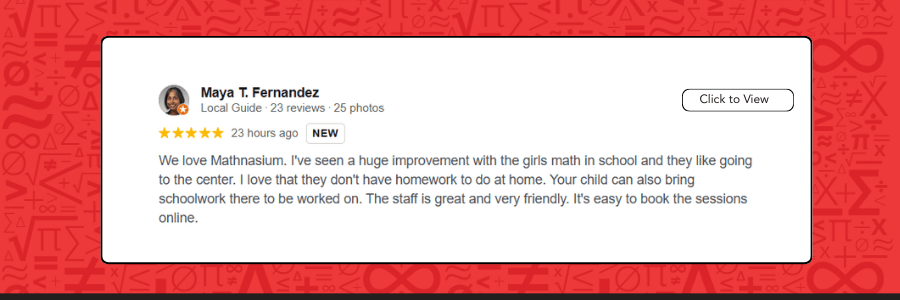
One parent described their child's experience at Mathnasium of Castle Hills this way:
If you're looking to strengthen your child’s skills and build lasting confidence in math, schedule a free assessment at Mathnasium of Castle Hills and see real progress take shape, session by session.
📅 Schedule a Free Assessment at Mathnasium of Castle Hills
Mathnasium of Castle Hills is not your nearest center?
📍 Find a Mathnasium Learning Center in your area.


 (972) 939-6284
 (972) 939-6284