A child can know their multiplication facts and still struggle to finish a third-grade math problem. They may set up the work correctly, solve the first step with confidence, and then stall once a second operation appears or the question asks them to explain their thinking.
In third grade, problems start asking students to hold more information at once: connecting multiplication to division, comparing fractions by size, sorting through extra details in a word problem before choosing an operation. The challenge is rarely the math fact itself. It is the layering of ideas.
At Mathnasium, we see these patterns every day. This guide walks through what's actually shifting in 3rd grade, and how parents can help their child move past the sticking points.
Why 3rd Grade Math Feels Like a Different Subject
Third grade marks a real transition in how math works.
Up to this point, your child has relied heavily on addition and subtraction. The numbers were smaller, the steps were direct, and most problems followed a familiar pattern.
Here’s what’s really shifting in 3rd-grade math, and why it can feel like such a leap at home:
-
Multiplication shifts students from repeated addition to recognizing equal groups, such as seeing 6 + 6 + 6 + 6 as 4 × 6. The focus moves from counting step by step to spotting structure.
-
Division introduces inverse thinking. If 4 × 6 = 24, then 24 ÷ 4 = 6. Students learn to move between operations instead of treating them as separate skills.
-
Fractions challenge whole-number instincts. One-fourth is smaller than one-half, even though 4 is larger than 2. Students must think in terms of parts of a whole rather than digit size.
-
Word problems become longer and more layered, often combining operations and requiring careful reading before solving.
Understanding the shift from concrete calculation to relational thinking gives you clarity to support your child with confidence.
📕 You May Also Like: Must-Know Math Skills: Preparing for the Next Grade (K-12 Guide)

Third grade's three biggest math concepts don't have to be overwhelming.
How to Master the "Big Three": Multiplication, Division, and Fractions
Third grade introduces three concepts that reshape how students think about numbers. Each one requires a change in reasoning, from counting step by step to recognizing structure, relationships, and size.
Multiplication: Organized Groups
Multiplication is just repeated addition with a smarter shortcut. Instead of adding 6 + 6 + 6 + 6 and hoping you don’t lose track, your child learns to see four groups of six right away.
Arrays make this click. Grab a pencil and draw four neat rows with six dots in each row. Suddenly, 6 × 4 is not abstract. It is something you can see. Your child might count across the rows, down the columns, or skip-count by sixes. All paths lead to 24, and that flexibility builds real understanding.
Area models take it one step further. Draw a rectangle. Label one side 6 and the other 4. The space inside represents the total. This simple sketch will be helpful later, once numbers grow larger.
The phrase to keep repeating at home is equal groups. Multiplication is organized grouping, and once that idea sticks, the facts start to make a lot more sense.
Division: Working Backward With Purpose
Division flips the question around. Instead of asking, “How many do I have altogether?” it asks, “How can I split this fairly?”
For example, take 24 ÷ 4. Rather than combining groups, your child is now distributing 24 items into four equal parts. Picture 24 grapes on the table and four kids waiting. How many does each child get? Start handing them out one at a time. The answer, six each, feels fair and concrete.
This is where multiplication and division connect. If four groups of six make 24, then 24 split into four groups must give six.
Writing the related facts side by side makes the connection visible:
-
4 × 6 = 24
-
24 ÷ 4 = 6
-
6 × 4 = 24
-
24 ÷ 6 = 4
Division stops feeling like a brand-new skill and starts to look like multiplication turned around.
Fractions: Rethinking Size
Fractions throw students off because the usual number rules seem to stop working. In whole numbers, 4 is bigger than 2. In fractions, one-fourth is smaller than one-half. That feels backward at first.
The key is helping your child focus on the whole. A fraction tells us how many equal pieces the whole has been divided into. The more pieces you cut something into, the smaller each piece becomes.
Grab a piece of paper and draw two circles. Divide one into two equal parts. Divide the other into four. Shade one piece in each circle. Now look at them side by side. The half clearly takes up more space than the fourth.
That simple comparison matters more than rushing into fraction arithmetic. If your child understands size first, adding and subtracting fractions later will feel far less confusing.
📕 You May Also Like: Critical Thinking vs. Memorizing: What Really Builds Math Skills?
Practice Math Without Worksheets
Once your child understands the core math ideas, the next step is using them in everyday life. Math sticks faster when it feels useful.
The Kitchen Laboratory
The kitchen is one of the best math classrooms in your home. Measuring cups turn fractions into something your child can hold. Ask for \(\Large\frac{1}{2}\) cup of milk, then compare it to \(\Large\frac{1}{4}\) cup. Let them see and feel the difference.
Doubling a recipe can be a great way to bring multiplication to life. If the recipe calls for 3 tablespoons of oil, how much do you need to make twice as many cookies? Now multiplication has a purpose, and the answer actually means something for the cookies.
The Grocery Store Challenge
The grocery store is one of the richest math environments a child can walk through. Prices, quantities, weight, and estimation are everywhere, and unlike a worksheet, the numbers actually mean something because real money is involved.
Start simple. If a bag of apples costs $3, ask your child what three bags will cost before you put them in the cart. That's multiplication with a reason behind it. As you move through the store, invite them to round each item to the nearest dollar and keep a running estimate of the total.
By the time you reach the register, they have a prediction to test against the real number on the screen. That moment of checking "We said about $27, and it came to $29", is more instructive than ten problems on a page, because the feedback is immediate and the stakes feel real.
Clocks and Money
Two concepts that trip up a lot of 3rd graders, elapsed time and making change, are also two concepts your home is perfectly equipped to teach.
Analog clocks are increasingly rare in a world of digital screens, which is exactly why they matter. Put one in a visible spot in your home and bring it into conversation naturally. If dinner goes into the oven at 5:30 and needs 45 minutes to cook, ask your child to figure out when you'll be eating. That's elapsed time in a context they're genuinely motivated by because food is involved.
Money works the same way. Counting change by hand requires your child to hold a target number in their head, work backwards from what they have, and bridge the gap. That's addition, subtraction, and number sense operating simultaneously.
These are small, consistent everyday moments that move math from something that happens at a desk to something that runs through everyday life.
📕 You May Also Like: Family Math Nights: 6 Fun Ways to Learn Together
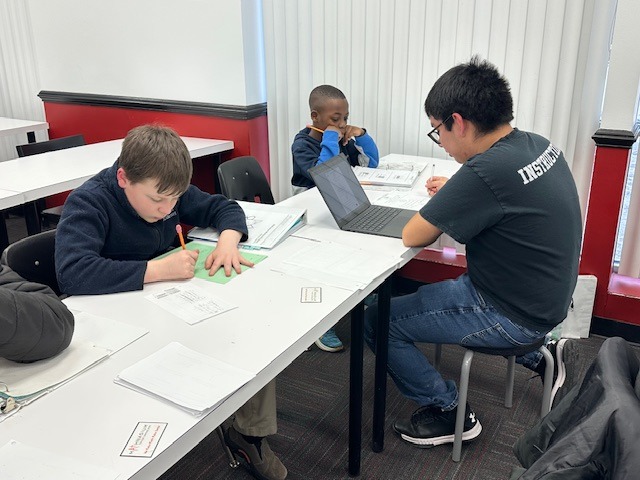
Mathnasium's proven, personalized approach gives elementary students the exact support they need.
How Mathnasium Helps 3rd Graders Succeed in Math
Mathnasium is a math-only learning center helping K–12 students of all skill levels excel in math. For third graders, this is often the year multiplication, division, fractions, and multi-step word problems begin to feel heavier.
Every student starts with a diagnostic assessment so we can see exactly where skills are strong and where support is needed. From there, we build a personalized learning plan that addresses gaps in the right order and strengthens core concepts.
Using the Mathnasium Method™, our proprietary teaching approach, our math instructors teach students to think through problems step by step and truly make sense of what they're learning.
With face-to-face tutoring in a caring, fun group environment, elementary students develop the reasoning skills and problem-solving habits that stay with them.
The result? Real, measurable progress:
-
94% of parents report improvement in their child's math skills and understanding
-
93% of parents notice a more positive attitude toward math
-
90% of students see higher grades in school
With more than 1,100 learning centers, we bring our proven approach close to your community.
For families in or near Columbia, MD, Mathnasium of Columbia MD is a trusted local partner in building math skills and confidence.
If your child is ready to move from stuck and frustrated to confident and capable, we'd love to help.
📅 Schedule a Free Assessment at Mathnasium of Columbia MD
Not located near Columbia, MD?
📍 Find a Mathnasium Learning Center Near You


 (410) 997-6284