Maryland math standards outline what students are expected to understand and demonstrate in math at each grade level. While these standards shape classroom instruction and assessment, they are not always explained in a way that is easy for parents to follow.
What parents often find most challenging is understanding how these expectations translate into daily learning and what it truly means for a student to be “on track.”
We’ve created this guide to give parents a clear overview of how Maryland’s math standards are structured, how math learning progresses across grade levels, and how Mathnasium supports students as they work toward meeting those expectations.

What Are Maryland Math Standards?
Maryland math standards define what students are expected to understand and demonstrate in math at each grade level. They set shared learning goals for schools across the state, so students build skills in a consistent, connected way from year to year.
These standards are part of the Maryland College and Career Ready Standards for Mathematics and are aligned with Common Core math expectations used in many states nationwide.
It’s important for parents to know what these standards do and do not define.
They define learning expectations, but they do not prescribe specific lessons, textbooks, or teaching methods. Schools and teachers choose how instruction is delivered.
At their core, Maryland math standards exist to provide a statewide framework that supports clear progression, long-term readiness, and shared expectations for student learning.

Maryland math standards: clear goals that help students build skills consistently, year by year.
How Maryland Math Standards Are Designed
Maryland math standards are built as a learning progression, meaning skills and concepts are intentionally developed from one grade to the next. Each year builds on what students have already learned, rather than treating math topics as isolated units.
Parents will typically notice three key design principles:
-
Focus on fewer topics: Each grade concentrates on a smaller set of math ideas, so students have time to develop real understanding instead of rushing through content.
-
Coherence from grade to grade: Concepts connect across years. What students learn in one grade prepares them for what comes next, particularly as math becomes more abstract.
-
Rigor through understanding, fluency, and application: Students are expected to understand how math works, build accuracy and efficiency, and apply skills to unfamiliar problems.
This structure is designed to support long-term readiness and help students develop the depth of understanding they need for advanced math.
📕 You May Also Like: Understanding New Math Methods: How Schools Teach Today
How Math Progresses Across Grade Levels in Maryland
Maryland’s math standards are designed as a progression, with each grade building on the last. Skills are introduced, reinforced, and extended over time so students develop understanding before moving on to more complex ideas.
Because high school math standards are organized by course rather than grade level, this overview focuses on the K–8 progression and the skills students are expected to develop before entering high school math.
📕 You May Also Like: How to Track Your Child's Math Progress in Grades 1-8
Grades K–2: Building Number Sense
In the early grades, students focus on understanding how numbers work and how quantities relate to one another. Key skills include:
-
Counting, comparing, and representing quantities
-
Understanding place value in ones and tens
-
Adding and subtracting within increasingly larger ranges
-
Explaining math thinking using drawings, objects, and words
Instruction emphasizes visual models and explanations to help students connect numbers to meaning.
📕 You May Also Like: What Is Number Sense & Why It Matters in Early Math Education
Grades 3–5: Developing Fluency and Structure
Upper elementary math builds on early number sense and introduces more structured problem solving. Students are expected to:
Fractions become a major checkpoint during these years, as they require students to apply earlier concepts in new ways.
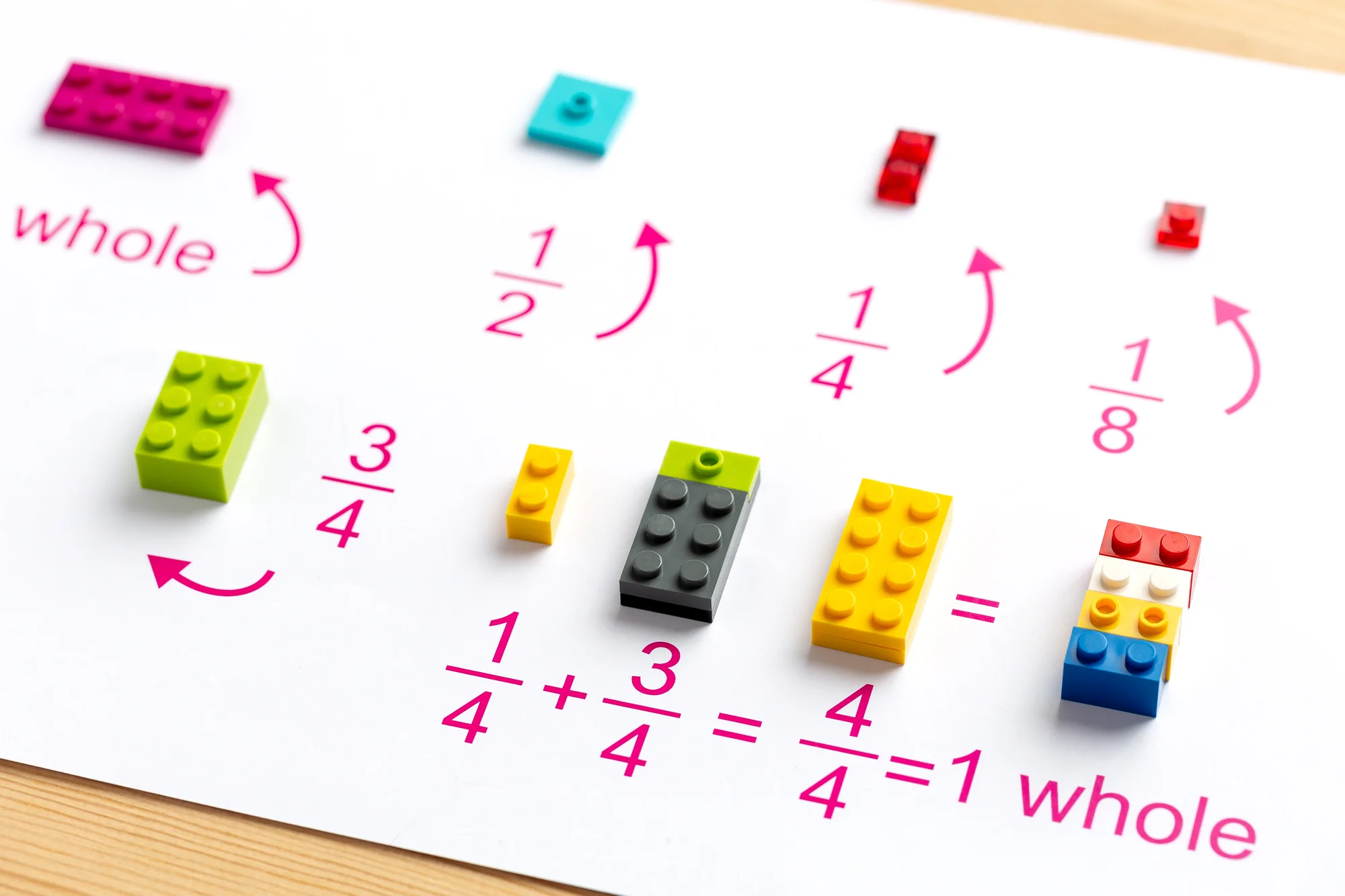
Fractions are a key milestone in grades 3-5.
Grades 6–8: Abstract Thinking and Preparation for High School Math
Middle school math marks a shift toward abstract thinking and algebraic reasoning. During these years, students develop the tools and habits they will rely on in all high school math courses.
Core expectations include:
As students progress, the focus expands from learning individual concepts to using those concepts together. By the end of middle school, students are expected to:
-
Connect equations, graphs, and tables
-
Interpret math in real-world contexts
-
Solve problems using multiple representations
-
Communicate mathematical thinking with clarity
A strong foundation at this stage supports success across high school math courses, regardless of the specific pathway a student follows.
📕 You May Also Like: Is Your Student Ready for Their Algebra Class? [+Quiz]
What It Means to “Meet” Maryland Math Standards
For many parents, this is where confusion sets in. A child may earn solid grades, complete homework, and still be told they are “working toward the standards.” That disconnect often raises questions about what schools are really looking for beyond test scores and report cards.
Meeting Maryland math standards goes beyond getting correct answers. Students are expected to demonstrate understanding, not just follow steps or memorize procedures.
In practice, this means students are asked to:
-
Explain their reasoning, both verbally and in writing
-
Show how they arrived at an answer, not just the final result
-
Apply math to unfamiliar problems or real-world situations
-
Use multiple strategies or representations when solving problems
This emphasis helps distinguish understanding from memorization. A student who understands a concept can adapt when a problem looks different, while memorization alone often breaks down as math becomes more complex.
Parents may notice this change in how homework is structured, how assessments are written, or how work is graded. Questions may ask for explanations, partial credit may be tied to reasoning, and progress may reflect how well a student understands the math.
📕 You May Also Like: 5 Reasons Why Students Should Not Prioritize Speed in Math
How Math Learning Is Evaluated in Maryland
Maryland evaluates math learning using a combination of classroom work and statewide assessments. Together, these tools are designed to show how well students understand the math standards and how they are progressing over time.
Classroom Assessments
Classroom assessments are the most frequent way teachers check learning. These may include quizzes, written explanations, projects, or classwork tied to specific standards.
Teachers use them to see how students reason through problems and apply math skills, not just whether answers are correct.
Statewide Testing (MCAP)
The Maryland Comprehensive Assessment Program (MCAP) provides a broader snapshot of math learning in grades 3–8 and certain high school courses, such as Algebra 1. MCAP is aligned with Maryland’s math standards and measures problem-solving, reasoning, and application.
Scores are reported across four performance levels, from Level 1 to Level 4, reflecting how well a student demonstrates grade-level standards.
Why Progress Over Time Matters
Math learning builds gradually, and a single test cannot capture a student’s full growth.
Maryland places emphasis on progress over time, using classroom data and growth measures to understand how students are developing across the school year.
📕 You May Also Like: SAT® vs. ACT® – Everything You Need to Know in One Guide
Making Sense of Your Child’s Report Card
Many Maryland districts use standards-based grading, which focuses on how well a student understands specific math skills rather than averaging scores across assignments. Instead of just a percentage or letter grade, report cards often reflect levels of mastery tied to Maryland math standards.
Here’s how those levels are typically interpreted:
-
Meets Standards (Level 3): Your child demonstrates grade-level understanding and can apply skills independently, including on multi-step problems. This indicates they are on track.
-
Exceeds Standards (Level 4): Your child shows deeper understanding and can extend or apply concepts in more complex ways.
-
Approaching or Below Standards (Level 2 or lower): Your child is still developing understanding of some skills. This points to specific areas where additional support or reinforcement may be helpful.
Numeric scores may still appear on report cards, but they often represent a snapshot of performance. Teacher comments and standards indicators provide clearer insight into how well your child understands the math and where growth is expected next.
📕 You May Also Like: How to Turn Math Report Cards into Action Plans

At Mathnasium, students develop lasting math skills and confidence in line with Maryland standards.
How Mathnasium Helps Students Meet Maryland Math Standards
Maryland math standards place an emphasis on reasoning, problem solving, and clear mathematical thinking. Supporting students in developing these skills has been central to Mathnasium’s work from the very beginning.
Mathnasium is a math-only learning center dedicated to helping K–12 students build true understanding, confidence, and long-term success in math. Our program is personalized but can align closely with the expectations outlined in the Maryland College and Career Ready Standards for Mathematics.
Our proprietary teaching approach, The Mathnasium Method™, supports students as they work toward Maryland’s math standards by reinforcing skills, strengthening understanding, and building confidence.
The Mathnasium Method™ supports math mastery through:
-
Diagnostic Assessment: Each student begins their Mathnasium enrollment with a diagnostic assessment that helps us pinpoint their strengths and skill gaps, but also how they prefer to learn, whether visually, verbally, auditorily, or through hands-on methods.
-
Personalized Learning Plan: Using insights from the assessment, we create a personalized learning plan tailored to your child’s goals, current level, and learning style, guiding them toward math success at the right pace.
-
Teaching for Understanding: Instead of focusing on rules alone, we help students make sense of math. Through Socratic questioning, hands-on learning, and real-time discussion, students practice explaining their thinking, just as the Maryland math standards ask them to do across grade levels.
-
Supportive and Engaging Environment: Our specially trained tutors provide face-to-face guidance in a supportive, small-group setting. Students receive personalized attention and steady encouragement, helping them build skills as much as confidence.
-
Focus on Problem Solving and Critical Thinking: Rather than relying on rote memorization, we help students explore multiple paths to a solution and talk through the logic behind each one. The aim is to build independent problem-solvers capable of tackling any math challenge both in and out of the classroom.
The results speak for themselves:
-
94% of parents report an improvement in their child's math skills and understanding
-
93% of parents report an improved attitude towards math after attending Mathnasium
-
90% of students saw an improvement in their school grades
With more than 1,100 learning centers across the U.S., Mathnasium brings experienced instructors and a proven teaching approach to families nationwide.
If you are based in or near Columbia, MD, Mathnasium of Columbia MD is a trusted local center with years of experience helping students transform how they think and feel about math.
Whether your child is working to stay on track with Maryland math standards or you want them to build greater confidence in math, you can start with a free diagnostic assessment at Mathnasium of Columbia MD or your nearest Mathnasium center.
From there, a personalized learning plan helps guide meaningful progress toward math mastery.


 (410) 997-6284