How to Move the Decimal Point: A Place-Value Explanation
Jun 30, 2026
| Dunkirk
We learn rules such as "move the decimal one place to the right" without always grasping the reasoning behind them. The challenge begins when we need to apply the same rules to division problems or numbers that require placeholder zeros.
Our tutors at Mathnasium always focus on the reasoning behind the rule. With that in mind, we'll explain what it really means when a decimal appears to move and how place-value helps make sense of every step, with examples and practice problems.
How Powers of Ten Move the Decimal Point
Powersof ten determine how digits change place-value when a number becomes larger or smaller. To illustrate the concept, let's look at what happens when we multiply3.47 × 10.
We usually describe the result 34.7 as "moving the decimal point one place to the right." But a closer look at the place values tells a different story mathematically:
1. The Starting Values
Every digit has a “home” that determines how much it is worth.
3.47 = 3 ones + 4 tenths + 7 hundredths
2. The Multiplication
When we multiply by 10, we are making every part of the number 10 times larger. The added “weight” forces the digits to move into a larger place-value column.
3,47 x 10 = 34,7 = 30 ones + 4 ones + 7 tenths
Remember, in our math system, the column to the left is always 10 times bigger than the column to its right.
3. What Changed?
Because each digit grew by 10, they all had to shift one “chair” to the left to represent their new, larger value:
The 3 moved from the ones place to the tens place. (It grew from 3 to 30).
The 4 moved from the tenths place to the ones place. (It grew from 0,4 to 4).
The 7 moved from the hundredths place to the tenths place. (It grew from 0,07 to 0,7).
Mathematicians don't love the phrase "move the decimal," and our example shows why. The decimal point never actually moved. It stayed right between the ones place and the tenths place the whole time. What changed was where each digit landed, and that's what made 3.47 ten times larger.
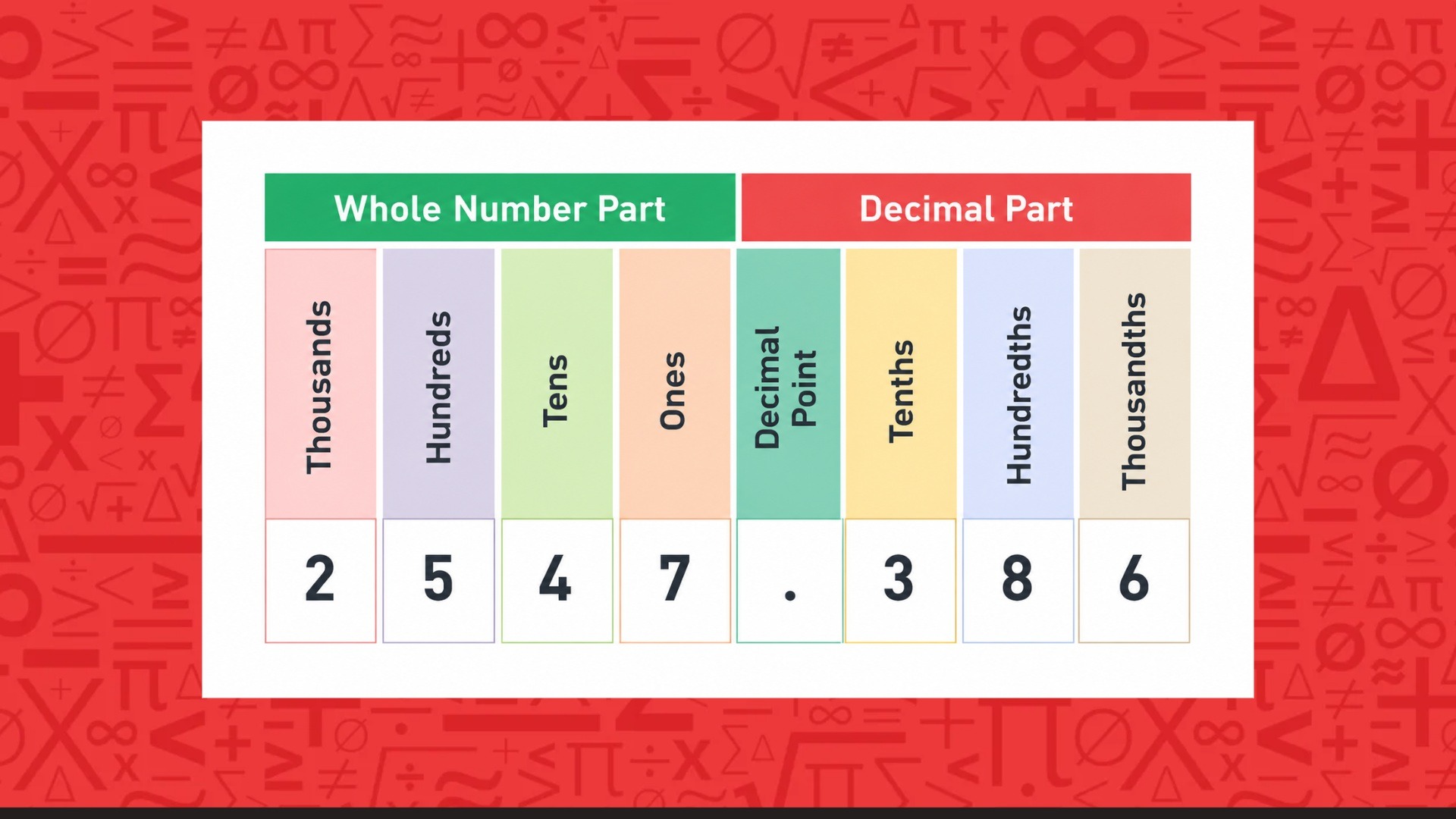
Here's a look at how place-value columns are organized: whole number part on the left, decimal part on the right, with the decimal point marking the boundary between them.
How to Move the Decimal Point: Step-by-Step Examples
The rules for decimal movement come directly from place value. The number of zeros in the power of ten tells us exactly how many place-value columns the digits must move through.
At Mathnasium, we encourage students to solve these problems using a consistent, step-by-step method. This helps reduce errors and strengthens their foundational understanding.
1. Multiplying by 10 (Scaling Up)
When we multiply by 10, each digit moves one place-value column to the left because every digit becomes ten times larger. Since 10 contains one zero, every digit moves exactly one column.
Let's work through 4.56 × 10:
Step 1: Identify the power of ten: The number 10 has one zero, meaning a one-column shift to the left
Step 2: Show the movement:
The digit 4 travels from ones to tens → 40
The digit 5 travels from tenths to ones → 5
The digit 6 travels from hundredths to tenths → 0.6
Step 3: Write the final answer: 45.6
Tutor Tip: Our tutors encourage students to check the answer against the starting number. Multiplying by 10 should make the result ten times larger, so 4.56 becoming 45.6 is a good sign that the digits moved correctly.
2. Multiplying by 100 (Scaling Up Larger)
When we multiply by 100, each digit moves two place-value columns to the left because 100 has two zeros, making the number one hundred times larger.
Let's solve: 2.38 × 100.
Step 1: Identify the power of ten: The number 100 contains two zeros, so the digits move two place-value columns to the left
Step 2: Show the movement:
The digit 2 moves from the ones place to the hundreds place → 200
The digit 3 moves from the tenths place to the tens place → 30
The digit 8 moves from the hundredths place to the ones place → 8
Step 3: Write the final answer: 200 + 30 + 8 = 238
Tutor Tip: One helpful habit is to count the zeros in the power of ten before anything else. Two zeros in 100 means two columns of movement. This quick check helps prevent the most common direction and distance errors.
3. Dividing by 10 (Scaling Down)
Division follows the same place-value logic as multiplication, but in the opposite direction. Because we are making the number smaller, the digits move one place-value column to the right.
Here’s a new example: 24.6 ÷ 10:
Step 1: Identify the power of ten: The number 10 contains one zero, so the digits move one place-value column to the right
Step 2: Show the movement:
The digit 2 moves from the tens place to the ones place → 2
The digit 4 moves from the ones place to the tenths place → 0.4
The digit 6 moves from the tenths place to the hundredths place → 0.06
Step 3: Write the final answer: 2 + 0.4 + 0.06 = 2.46
Tutor Tip: The result of a division problem must always be smaller than the number we started with. If your answer becomes larger, your digits moved in the wrong direction.
4. Dividing by 100 (The Placeholder Zero Problem)
When we divide by 100, the digits move two place value columns to the right. If columns become empty during this shift (such as the tenths place in 0.07), we must use placeholder zeros to preserve the correct value of the number.
Our next example is 7 ÷ 100:
Step 1: Identify how many place-value columns the digit must move. The number 100 contains two zeros, so the digit moves two columns to the right
Step 2: Show the movement: 7 → 0.7 → 0.07. The digit 7 starts in the ones place and ends in the hundredths place
Step 3: Write the final answer: 0.07. The tenths place is empty, so a placeholder zero fills the gap
Tutor Tip: When digits move past the decimal point, we ask students to name every column they cross out loud: ones, tenths, hundredths. Each empty column gets a placeholder zero. Without it, 0.07 accidentally becomes 0.7, which is ten times larger!
Your Turn to Practice: Decimal Movement Challenges
Now it's your turn. We worked through several examples together, so see if you can use the same ideas for the new problems before checking the answers at the end of the article.
Try to identify how many place-value columns the digits move in each problem.
3.6 × 10
7.2 ÷ 10
0.45 × 100
8 ÷ 1000
The examples in this guide reflect the same teaching approach our instructors use every day. Here is a short video showing how we guide the process at Mathnasium:
We will now answer a few questions to clear up any further confusion you may have about decimal movement.
1. Why Do Some Teachers Use the "Move the Decimal" Shortcut?
Many teachers use the phrase "move the decimal point" because it is quick and easy to remember. The shortcut usually produces the correct answer when multiplying or dividing by powers of ten.
However, understanding place value helps students see why the shortcut works and makes it easier to avoid mistakes in more complex problems.
2. Do I Always Need to Count Place-Value Columns?
Not always. With practice, many students begin to recognize common decimal movement patterns without counting every place-value column. However, counting remains one of the most reliable ways to avoid mistakes, especially when working with larger powers of ten or more complex numbers.
3. Can I Use the Decimal Movement Rule With Any Number?
No. The decimal movement rule applies only when multiplying or dividing by powers of ten, such as 10, 100, or 1,000. Other numbers require different calculation methods because the digits do not move a fixed number of place-value columns.
At Mathnasium, our tutors break complex concepts into manageable steps that students can understand and apply independently.
How Mathnasium Teaches the Why Behind Any Math Concept
Mathnasium is a math-only learning center dedicated to helping K-12 students of all skill levels excel in math.
Students come to us with different strengths and challenges. Some need help understanding why decimal movement rules work, while others need more practice applying them consistently.
Our tutors focus on both the reasoning behind the rules and the skills needed to use them accurately. The path forward is built around exactly where each student is.
We build that path through the Mathnasium Method™, our proprietary teaching approach. Here is how it works:
Assessment and Personalized Learning Plans: Each student starts with a diagnostic assessment that identifies current skills, strengths, and gaps. From those findings, we build a personalized learning plan tailored to their goals, whether that means understanding why digits move the way they do, eliminating placeholder errors, or connecting decimal rules to the fraction and division concepts that follow.
Teaching for Understanding: Our specially trained tutors use natural language and a mix of verbal, visual, mental, tactile, and written techniques so each concept lands before we move forward.
Problem-Solving and Critical Thinking: We allow time for productive struggle so students can rely on their own reasoning. When we step in, we make sure to show both the how and the why behind the answer. Over time, this helps students build their own problem-solving skills and critical thinking tools.
An Engaging and Fun Learning Environment: Sessions include games, earned rewards, and consistent celebration of progress. Students build confidence alongside fluency, and many develop a more positive relationship with math over time.
Parents and students consistently report positive outcomes:
94% of parents report improvement in their child's math skills and understanding
93% of parents report an improved attitude toward math after attending Mathnasium
90% of students saw improvement in their school grades
With over 1,100 learning centers across North America, there is likely a Mathnasium close to you.
Families across Dunkirk and Owings, Huntingtown and North Beach, Chesapeake Beach and Lothian, Friendship and Sunderland, and throughout Calvert County and Southern Anne Arundel County trust Mathnasium of Dunkirk to help their children build lasting math confidence at every level.
Whether your student is looking to catch up, keep up, or get ahead in math, our team is happy to assist!
If you've given our challenges a go, check your results here.
36: digit 3 travels from ones to tens, digit 6 travels from tenths to ones
0.72: digit 7 travels from ones to tenths, digit 2 travels from tenths to hundredths
45: digit 4 travels from tenths to tens, digit 5 travels from hundredths to ones
0.008: digit 8 travels from ones to thousandths, two placeholder zeros fill the tenths and hundredths columns
Visit Us at Mathnasium of Dunkirk
Mathnasium of Dunkirk is a math-only learning center for K-12 students in Dunkirk,
MD. Trusted by over a million parents, Mathnasium uses personalized learning plans
and the proprietary Mathnasium Method™ to help students catch up, keep up, and get ahead on their math journey.
Our specially trained tutors deliver face-to-face instruction in a supportive and fun small-group environment,
working with students both in center and online to develop a deep understanding of math, build confidence,
and improve academic performance.
Maryland updated its math standards for the first time since 2010. Our tutors explain what changed, what's coming, and how to support your child through it.
Most kids spell Summertime like this: NO MORE HOMEWORK.
Summertime is a break from tests, a break from worksheets, and according to 37% of kids 13-17, a break from their least favorite subject.... math.
But it's not as simple as just hating math..


 (410) 286-2841