

Foothill Ranch
26746 Portola Pkwy
, #4B
Foothill Ranch, CA 92610
Foothill Ranch, CA 92610

We usually assume spring sunshine and the promise of summer are what pull kids' attention away from school. The reality is a little more specific than that.
By May, cognitive fatigue, motivational collapse, testing pressure, and end-of-year burnout have been building since September and peak at the same time. Math feels it first because it depends more heavily on sustained focus than almost any other subject.
Today, our education specialists at Mathnasium take a closer look at why students check out of math in May and share practical ways to keep focus high through the final stretch.

May sits at the end of nine months of sustained academic effort, and the timing matters. Mental energy runs low, testing pressure peaks, and the social energy of the classroom has already shifted toward summer. Math feels it first, and there are four specific reasons why.
Math is a high-load subject. It draws heavily on working memory, the mental workspace we use to follow a chain of steps without losing track of where we are.
Cognitive Load Theory, developed by educational psychologist John Sweller, established that working memory has a finite capacity. By May, that capacity has been stretched across nine months of lessons, tests, and problem sets. As it runs low, the effect shows up most clearly in math motivation.
Your child can get through a reading passage with partial attention. There is no equivalent shortcut through a multi-step equation.
Behavioral psychologist Clark Hull introduced the goal gradient hypothesis in 1932, showing that motivation increases as we get closer to a goal. May creates a specific dead zone. The end of the school year is visible, yet not close enough to trigger a final push, so the current unit feels less consequential.
Hard math problems take real effort to push through. Once the motivation to do that disappears, those problems are the first ones we skip.
May is also when our children tend to take state tests. For families in our area, the Saddleback Valley Unified School District runs its CAASPP testing windows during this same stretch, adding performance pressure on top of existing fatigue.
The anticipation of being assessed builds anxiety that carries into everyday schoolwork. Once your child sits down to practice math in the evening, they are already thinking of what may happen on tomorrow’s test, which increases pressure.
Research on Processing Efficiency Theory suggests that testing anxiety draws on the same working memory that math problem-solving requires. Once the anxiety shows up, there is little left for an evening homework session. The result is a system running beyond its capacity.
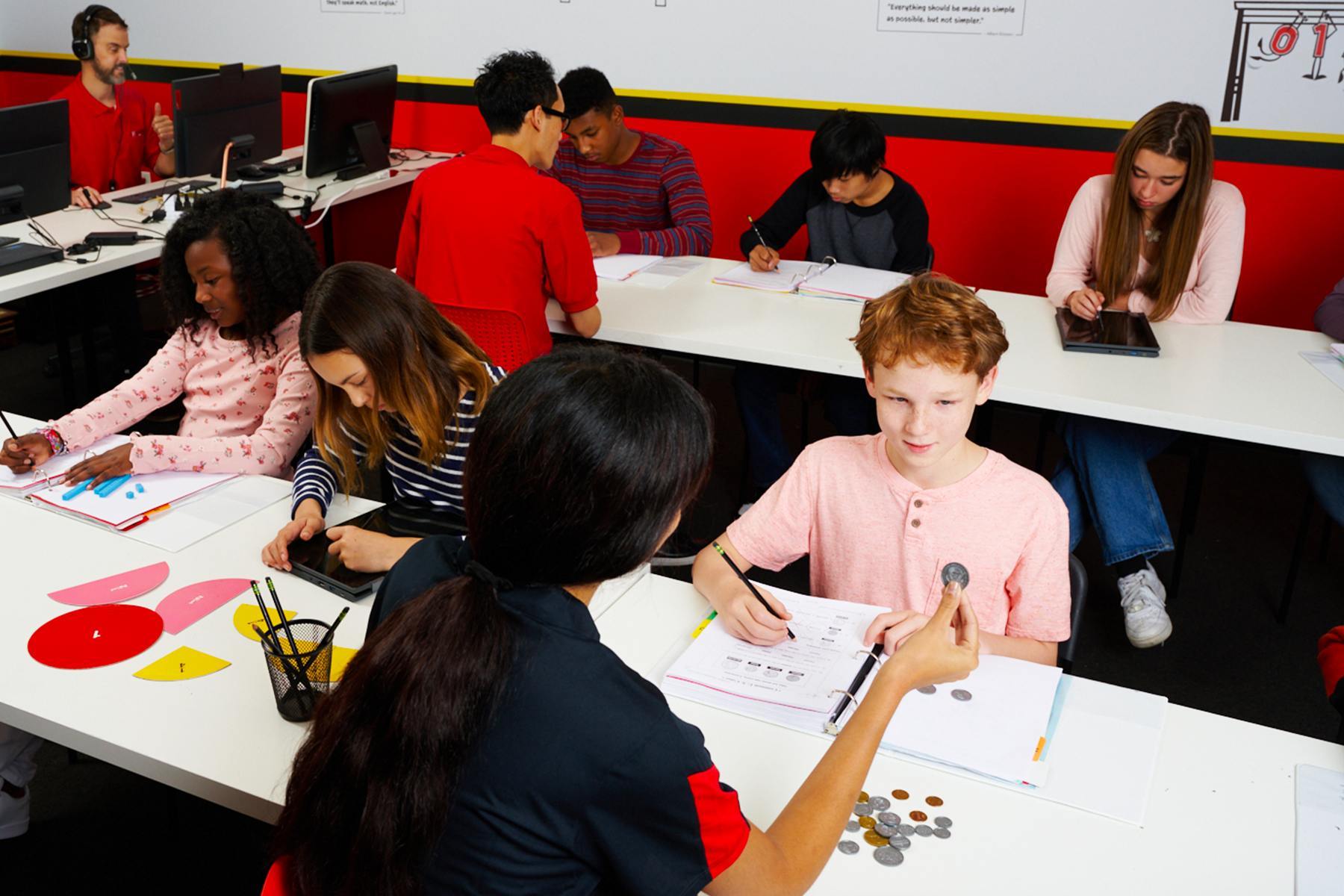
CAASPP testing windows in May add another layer of pressure on top of an already demanding stretch of the school year.
By May, students are experiencing a specific psychological cycle known as academic burnout. It shows as a complete depletion of the energy required to care about the work.
The Maslach Burnout Inventory (MBI-SS), a framework widely used in educational psychology, describes this as a three-part syndrome:
Emotional Exhaustion: This is the "running on empty" phase. Your child breezed through long division in March but stares at the same problem in May and can’t start.
Cynicism: Kids usually check out emotionally to protect themselves from the stress of exhaustion. You’ll hear it in phrases like, "When am I ever going to use this?" or "This doesn't even matter."
Reduced Academic Efficacy: This is the most painful stage. Even if our children get an “A”, they feel like it was a fluke or that they aren't actually good at math.
We see this shift in late spring sessions every year at our Foothill Ranch center because May is the point where a full year of academic pressure lands harder. It's easy to assume that our kids are bored or uncooperative, but it's actually a predictable result of a long year hitting its most demanding month.
It’s a clear sign that they need a different type of engagement, one that prioritizes rebuilding their confidence and curiosity.
📕 You May Also Like: Understanding Math Anxiety and How to Overcome It
The strategies that work best in May are low-pressure, specific, and they overlap closely with what drives lasting math engagement year-round. Here are six that actually work.
If your child mentally checked out of school math, they will still engage when the context connects to something they care about.
If they like baseball, calculate a baseball player's batting average. You can figure out the discount on summer gear together. You can spend an evening with your child, count the days until the last day of school, and work out what fraction of the year remains.
The math is the same, and children's resistance is much lower.
Your child running on fumes in May will shut down in a longer homework block. Fifteen focused minutes with a real break afterward beats an hour of distracted resistance. You keep the habit alive without turning the evening into a battle.
At home, those conditions are harder to replicate than they are in a structured learning environment. Sessions at our Foothill Ranch center run for an hour, and our specially trained tutors know how to keep students engaged and motivated throughout. That level of focus is difficult to sustain at the kitchen table in May. For home practice, shorter and more focused work is better.
📕 You May Also Like: How to Support Your Student's Math Homework [Parent Tips]
A small choice goes a long way in May. Let your child weigh what they feel less confident about against what they’ve recently learned.
Once they feel some ownership over the session, they will be far more likely to engage. That small shift in control also tends to reduce the time spent negotiating and increase the time actually spent on math.
Card games like War and 21 are built on arithmetic and feel nothing like a math lesson. Cribbage works well for older students, since scoring requires adding combinations to 15 and 31 quickly in your head.
Ten minutes of a card game after dinner keeps the habit of numerical thinking alive without anyone feeling like they are doing homework.

The best math practices look nothing like math. Engage with your children in play.
📕 You May Also Like: 10 Fun Math Games to Play at Home with Your Child
By May, grades and deadlines have stopped doing the work they did in October. Name the specific thing: the mistake they caught or the problem they pushed through.
When you highlight what they did, like checking their work themselves, it resonates more than general praise. That kind of recognition sticks because it tells the child what to repeat.
Our children disengage when work feels pointless. One of the most effective ways to counter that in May is to help your child see a direct connection between what they are doing now and something that matters to them personally.
If they follow sports, point out how statistics work. If they want to save up for something, walk through the math of how long it will take. When the connection is personal and immediate, the effort no longer feels like a burden.
📕 You May Also Like: How to Use the 5 C's of Math Engagement: Practical Strategies for Parents
May momentum matters, but what happens between June and September matters just as much. Skills your child recently built are not always secure enough to hold without practice over a long summer. A final report card says less than the summer that comes after it.
Research by Atteberry and McEachin using NWEA data consistently shows that summer break takes a heavy toll on essential math skills, with students losing between 25% and 34% of their school-year progress on average.
Once disengagement starts in May rather than June, that stagnation window stretches further back, and the gap they carry into the next grade grows wider.
In grades 3 through 7, each math concept builds directly on the one before it. Fractions underpin ratios, which then feed into algebra. Once your child starts in September, already a few weeks behind on those foundations, they will feel it in almost every lesson that follows.
One focused month in May is worth considerably more than it appears on the calendar. Carrying that momentum into summer, whether through family math games at home or a structured program like Mathnasium's Summer of Unlimited at Foothill Ranch, makes September feel like a continuation rather than a restart.
☀️ Discover Mathnasium of Foothill Ranch Summer Math Program

Mathnasium supports the math skills that tend to weaken in late spring with consistent, personalized practice.
The gap between what your child could do in February and what feels possible now is real and visible in May. It shows up in how your child works through problems and the effort they put in. That gap is exactly what Mathnasium of Foothill Ranch is built to address.
The Mathnasium Method™ is a proprietary teaching approach that starts with what each student already knows, identifies knowledge gaps, and builds in sequence from there.
Sessions stay manageable even in the most distracted weeks of the year because they are built around the student in front of the specially trained tutor, not a fixed schedule.
Our tutors use natural language to explain math and draw on a mix of verbal, visual, mental, tactile, and written techniques, so students can approach each concept from different angles and abstract ideas finally land.
Fun is embedded in the approach, too. Sessions often don't feel like lectures, and that is by design. We incorporate game-based activities and hands-on learning to keep students engaged and enjoying the process. Every bit of progress gets celebrated, big or small, and that consistent recognition grows confidence with each session.
Results speak volumes:
94% of parents report improvement in their child's math skills and understanding
93% of parents report an improved attitude toward math after attending Mathnasium
90% of students saw improvement in their school grades
With over 1,100 learning centers across North America, there is likely a Mathnasium close to you.
Families across Foothill Ranch trust Mathnasium of Foothill Ranch, a center with years of experience building confident math thinkers in Foothill Ranch, Portola Hills, Trabuco, Rancho Santa Margarita, and the surrounding communities.
If May has your child's math momentum stalling, our team is ready to help before summer extends the gap.
📅 Schedule a Free Assessment at Mathnasium of Foothill Ranch
Mathnasium of Foothill Ranch is a math-only learning center for K-12 students in Foothill Ranch, CA. Trusted by over a million parents, Mathnasium uses personalized learning plans and the proprietary Mathnasium Method™ to help students catch up, keep up, and get ahead on their math journey.
Our specially trained tutors deliver face-to-face instruction in a supportive and fun small-group environment, working with students both in center and online to develop a deep understanding of math, build confidence, and improve academic performance.
Schedule Free Assessment
 (949) 868-6480