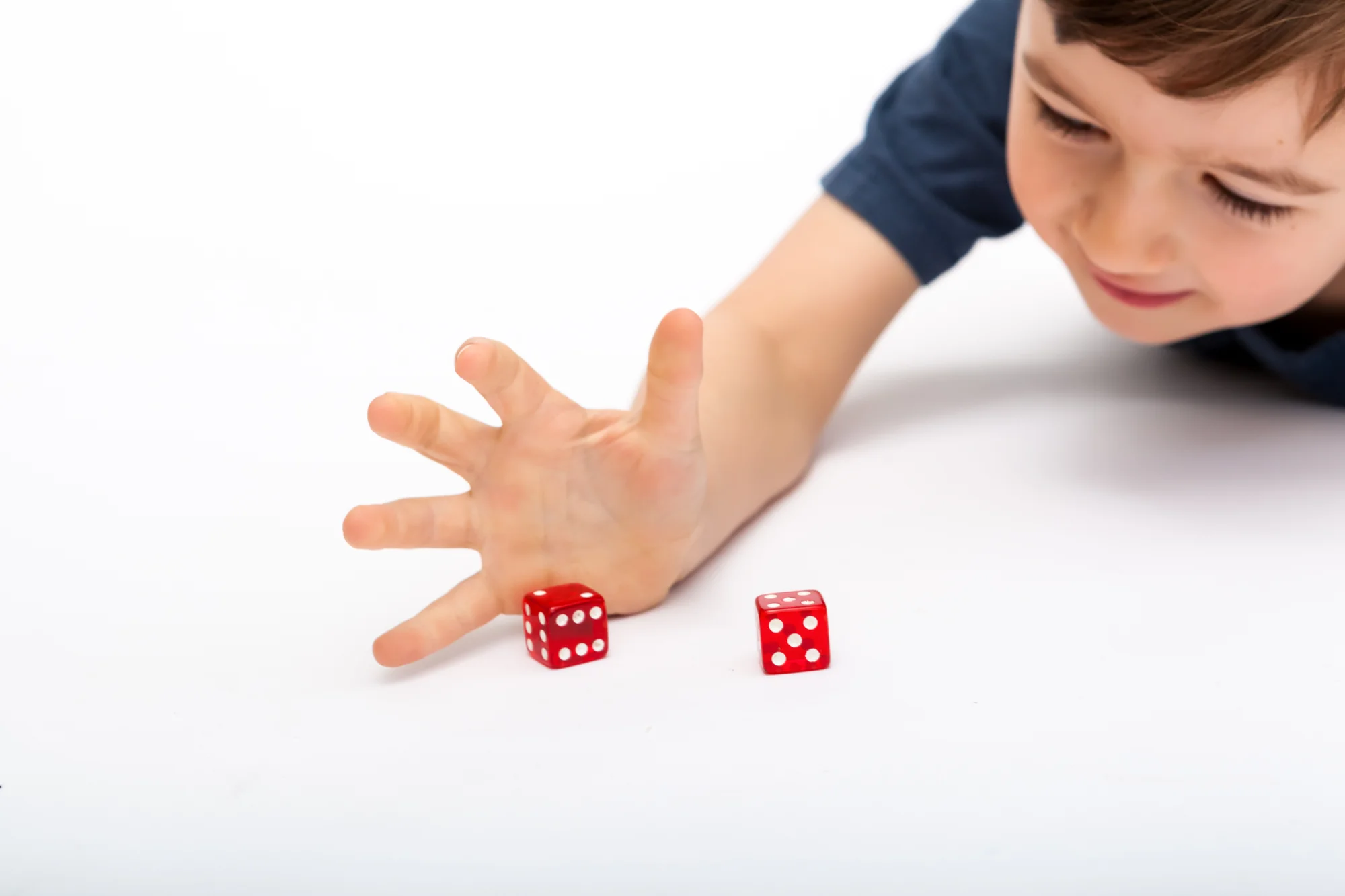
Place value is one of those concepts that can be hard to explain but surprisingly easy to teach through play.
When children are having fun, they absorb ideas faster and build understanding that actually sticks. They are practicing without even realizing it.
Mathnasium tutors have pulled together five of their favorite games to help your child develop exactly that, covering ones, tens, and hundreds with nothing more than materials you already have at home.
5 Fun Place Value Activities You Can Try Today
The five games below bring place value to life using nothing more than what you already have at home. Each one is short, repeatable, and easy to adjust as your child grows more comfortable with bigger numbers.
📕 You May Also Like: 10 Fun Math Games to Play at Home with Your Child
1. Coin Towers (Grades K–1)
For this game, you will need some pennies, dimes, and dollar coins.
Draw a three-column mat on any piece of paper and label the columns "ones," "tens," and "hundreds." Pennies represent ones, dimes represent tens, and dollar coins represent hundreds.
Here is what one round looks like:
-
The parent calls out a three-digit number, for example, 142.
-
The child places the correct coins in the correct columns: one dollar coin in the hundreds column, four dimes in the tens column, and two pennies in the ones column.
-
The parent checks the mat. If something is off, they point to the column that needs fixing rather than correcting it outright, encouraging the child to spot their own mistake.
You can then award them points based on how many attempts they needed. Alternatively, you can establish a time limit and see how many they can go through in that time.
As your child gets more comfortable, introduce numbers with a zero in one of the columns and ask them what that means for the coins. It is a small detail that tends to spark a big conversation.
We also suggest swapping the roles occasionally, so the child is calling out the number and you’re making the tower.
By checking your work, they are still practicing, but this time from a more relaxed angle.
2. Dice Race (Grades 2–3)
For this game, you will need three dice and something to write on.
Both players roll all three dice at the same time, then arrange the digits to build the largest three-digit number they can. Here is what one round looks like:
-
Both players roll all three dice.
-
Each player arranges their three digits however they choose and writes down the largest number they can make.
-
Both players reveal their numbers and compare. The higher number wins the round and scores a point.
-
The first player to ten points wins the game.
Players quickly discover that a six in the hundreds column is worth far more than a six in the ones column and that where you place a digit matters just as much as which digit you have.
After your child gets used to the basic game, there are plenty of ways to change it up:
-
Smallest wins: Players arrange their digits to build the smallest number possible instead. This is a surprisingly tricky reversal that can catch children off guard the first time.
-
Target number: The parent calls out a target number before the roll, and players try to build the number closest to it rather than the highest or lowest. Figuring out who was closer also lays the groundwork for subtraction later on.
-
Two dice only: Strip the game back to two dice and two-digit numbers for younger children who are still building confidence with tens and ones.
-
Four dice: Add a fourth die to bring thousands into the mix for children who are ready to go beyond hundreds.
📕 You May Also Like: How to Nurture Algebraic Thinking in Elementary School
3. Place Value Bingo (Grades 2–3)
For this game, you will need a piece of paper and a pen for each player, plus one person to act as the caller.
Each player fills their 3x3 grid with place value attributes, things like "three hundreds," "seven tens," or "five ones," making sure every square has a different attribute.
Here is what one round looks like:
-
The caller reads out a three-digit number, for example, 352.
-
Players scan their card for any attribute that matches a digit in that number. In this case, they are looking for "three hundreds," "five tens," and "two ones." A single number can unlock up to three squares at once, so the game moves quickly.
-
The first player to mark a complete row, column, or diagonal wins.
The beauty of this game is that rounds are quite quick.
However, you can always expand the grid or make the goal to cross out every square if you want them to last longer.
This format is particularly good at reinforcing the connection between place value language and written numbers, which is a skill that comes up constantly in early math.
📕 You May Also Like: 5 Fun, Educational Math Card Games You Can Play with a Standard Deck
4. Alien Math (Grades K–2)
For this game, you won’t need anything.
Before you start, assign a body action to each place value.
For example:
Here is what one round looks like:
-
The parent calls out a three-digit number, for example, 213.
-
The child performs the correct sequence of actions to represent it: two clicks for the hundreds, one shoulder tap for the tens, and three claps for the ones.
-
The parent checks the sequence and awards a point for a correct answer.
What makes this game great in our books is that it also gets your child to move around.
Therefore, you can even play it before homework so that they feel fresh and energized.
If the game ever starts getting dull, here are some ways to change it up:
-
Swap roles: Let your child call out the numbers and check your actions. Having to verify someone else's answer is often where understanding really solidifies.
-
Speed round: The parent calls numbers faster and faster, turning it into a fun race against the clock.
-
Add a digit: Introduce a fourth action for thousands, for example jumping, and start calling out four-digit numbers.
📕 You May Also Like: 7 Active Games to Build Math Skills at Home (Move and Learn)
5. The Number Detective (Grades 2–4)
For this game, you will need a piece of paper and a pen.
The parent picks a secret three-digit number and writes it down without showing the child.
The child's job is to crack the number in as few guesses as possible.
Here is what one round looks like:
-
The child guesses a three-digit number.
-
The parent gives feedback one column at a time, telling the child whether their hundreds digit is too high, too low, or correct, then does the same for the tens digit and the ones digit.
-
The child uses that information to make a smarter next guess, narrowing down each column until they figure out the number.
The challenge is to identify the secret number in as few guesses as possible, so children are pushed to think carefully about each column rather than guessing randomly.
As with the rest, there are also ways to change the game up:
-
Easier: Play with two-digit numbers so the child only has to track two columns at once.
-
Competitive: Both players pick a secret number simultaneously and take turns guessing each other's. The first to guess their opponent's number wins.
-
Harder: Set a maximum number of guesses. If the child cannot figure out the number in time, the parent wins the round.

Mathnasium tutors know how to keep math both fun and engaging.
How Mathnasium Makes Math Fun
Mathnasium is a math-only learning center, dedicated to helping students excel in any math skill or concept, including the foundational ones like place value that everything else in math depends on.
When students come to us, we do not just hand them drills and worksheets.
Our approach, the Mathnasium Method™, works differently. It is proprietary, personalized, and designed to build a deep understanding of math from the ground up.
To foster true mastery, our approach relies on:
-
Personalization on a granular level: Each student begins their enrollment with a diagnostic assessment. This allows us to pinpoint their strengths, knowledge gaps, and how they approach math. From there, we create a learning plan customized to their needs, whether they are just getting started or working to solidify more advanced concepts.
-
Teaching for understanding: We explain math using clear, everyday language and support each concept with a blend of visual, verbal, written, mental, and hands-on techniques. This layered instruction helps students truly make sense of what they are learning rather than simply following steps.
-
Caring instruction: Our instructors are trained not just in math but in how to connect with students. They know how to support a child who is feeling discouraged and how to challenge one who is ready to move further ahead.
-
Independent problem-solving and critical thinking: During instruction, we always set aside time for students to work through problems on their own. This gives them space to test their understanding and trust their own thinking. We guide them to see both the how and the why behind each concept, so they develop tools they can use in math and beyond.
-
Singular focus on math: Our curriculum spans thousands of pages and has been continuously refined over more than 20 years. This singular focus on math allows us to take a deep dive into how students best absorb, learn, and retain mathematical concepts at every level.
-
Empowering, fun learning environment: Our environment is designed to be both confidence-building and enjoyable. Much like the games we covered here, our materials are often game-based, turning concepts like place value into something children want to engage with rather than something they have to sit through. We also give students the chance to earn rewards to keep them motivated as they continue advancing to higher levels of achievement.
The results speak volumes:
-
94% of parents report an improvement in their child's math skills and understanding
-
93% of parents report an improved attitude towards math after attending Mathnasium
-
90% of students saw an improvement in their school grades
We operate over 1,100 learning centers, bringing top-rated math instruction close to your home.
Families based in the Cincinnati area choose Mathnasium of Hyde Park for a reason. We’re proud to be:
If your child needs help with place value or more advanced math concepts, our team of specially trained tutors is here to help, not just to rebuild skills but to transform how they think and feel about math.
Ready to get started?
📅 Schedule a Free Assessment at Mathnasium of Hyde Park
Not near Cincinnati?
📍 Find a Mathnasium Learning Center Near You


 (513) 832-8773
 (513) 832-8773