

La Costa
3451 Via Montebello
, #190
Carlsbad, CA 92009
Carlsbad, CA 92009

If you're looking into summer math programs for your child, whether to help them catch up or get ahead, choosing the right one isn't always straightforward.
Programs come in several familiar formats: tutoring centers, online platforms, private one-on-one instruction, and enrichment camps. Each format serves different learners and different needs, and knowing which one fits your child before committing makes all the difference.
Today, we will walk you through the most important criteria for evaluating a summer math program. We start with your child's specific needs and work outward from there so you can make a confident, informed decision before summer begins.
Summer math programs are not one-size-fits-all, and the right choice looks different for each child. Before weighing formats or comparing programs, it helps to get clear on where your child actually stands.
Gap-filling and catching up. Students falling behind or carrying unresolved foundational gaps need a program that begins with a diagnostic assessment and delivers targeted, personalized instruction. A tutoring center or structured program is most appropriate here.
Maintenance and engagement. Students on track but at risk of losing ground over summer need a program that keeps skills active without overwhelming them. A flexible, lighter-touch format, such as an enrichment program or a tutoring center with moderate session frequency, suits this profile well.
Enrichment and advancement. Students performing well in math and ready to push further can benefit from a program that goes beyond grade level and deepens mathematical thinking. Look for centers that offer enrichment programs or summer sessions designed to challenge students who are already ahead.
📕 You May Also Like: 7 Reasons to Invest in Math As an Extracurricular Activity
The teaching approach is the single most important quality indicator of any math program, more important than brand recognition, price, or convenience.
A program teaching understanding produces lasting results. A program built on drilling procedures produces temporary performance that fades quickly.
Three questions help evaluate any program's teaching approach before enrolling.
Does it start with a diagnostic assessment? A program that places every child at the same starting point, regardless of their current knowledge, cannot deliver targeted instruction. Look for programs that assess before they teach.
Does it teach for understanding or memorization? Ask how the program explains concepts. Strong programs use multiple representations, including visual, verbal, written, and hands-on methods, rather than relying primarily on repetition.
Is instruction personalized? A one-size-fits-all approach cannot address the specific knowledge gaps and goals of an individual child. Programs that build personalized learning plans from assessment insights are more likely to produce meaningful progress.
Each student at Mathnasium, for example, begins with a diagnostic assessment that identifies their current skills, knowledge gaps, and goals. From those insights, a personalized learning plan is built that targets exactly what each student needs to move forward.
📕 You May Also Like: How Summer Math Programs Help Keep Skills Sharp During Break
Knowing who will work with your child is as relevant as the program itself. Before enrolling, it is completely reasonable to ask about how instructors are selected, trained, and assigned. A few questions can tell you a lot.
How are instructors selected and trained? Programs that deliver results train their tutors in both the math content and how to explain it clearly to students at different levels. Consistent, structured training is what separates a program that delivers results from one that relies on good intentions alone.
What is the instructor-to-student ratio? One-on-one instruction offers the most personalized attention but comes at a higher cost. Small group settings, typically two to six students, can strike a nice balance between individual attention and the kind of peer dynamic that keeps students engaged and motivated.
Is there continuity of instruction? Students tend to open up and make progress with a tutor they know and trust. A program that rotates instructors between sessions makes it harder to build. Look for programs that keep the same tutors working with the same students consistently.
Mathnasium's specially trained tutors are prepared in both the content and the instructional approach, ensuring students receive consistent, high-quality guidance whether they attend in-center or online.
📕 You May Also Like: Math Enrichment: Everything You Need to Know
The program is only effective if your child can attend consistently. Format and scheduling flexibility are quality criteria, not just matters of convenience.
In-center versus online. Both can deliver high-quality, face-to-face instruction when online sessions are live and synchronous. Asynchronous formats, such as recorded videos or app-based practice, can supplement instruction but should not replace it for a child needing targeted support.
Session frequency and length. Shorter, more frequent sessions tend to produce better math retention than longer, less frequent ones. A program offering two to three sessions per week is more likely to build consistent progress than one meeting just once weekly.
Scheduling flexibility. Summer schedules are rarely predictable due to travel, camps, and other activities. Look for programs that offer a mix of in-center and online attendance so your child can stay consistent without the summer feeling over-scheduled.

Mathnasium offers live, face-to-face math instruction from wherever the summer takes you.
A summer math program should make progress visible and measurable. Parents should not have to wait until the school year starts to find out whether the program worked.
How does the program measure progress? Look for programs that use ongoing assessment rather than relying solely on the enrollment diagnostic. Regular check-ins, session observations, and periodic progress reviews give parents a clear picture of what is improving and what still needs work.
How does the program communicate with parents? Regular updates, whether through session summaries, progress reports, or direct communication with instructors, keep parents informed and allow them to reinforce learning at home.
A program that operates without parent communication between enrollment and the end of summer is not providing the partnership families need to support their child effectively.
The environment in which a child learns math has a direct impact on their engagement, confidence, and willingness to persist through difficulty. Three dimensions help evaluate whether a program's environment is the right fit.
Supportive and encouraging versus high-pressure. Math confidence is fragile, especially for students having struggled before. A program that leans on timed drills, competitive ranking, or pressure to perform can do more harm than good. Look for programs that treat mistakes as part of the process and celebrate progress at every level.
Fun and engaging. Summer is summer, and a program that feels like an extension of the school year will lose a child's motivation fast. The best summer programs find ways to make math feel like something worth showing up for, through games, hands-on activities, and varied formats that keep students genuinely engaged.
Small group dynamic. There is something quietly powerful about learning alongside a small group of peers. Students push each other, normalize the struggle, and often build more confidence than they would working alone. It is worth looking for programs that keep group sizes small enough for each student to feel seen.

Mathnasium's summer programs combine structured math learning with hands-on activities, keeping students engaged, motivated, and excited about math all summer long.
Mathnasium is a math-only learning center helping K-12 students of all skill levels catch up, keep up, and get ahead in math.
Whether your child is looking to catch up on missed skills, (re)build confidence, or get a head start on the new school year, our summer math programs are designed around what they specifically need.
What sets us apart isn't just the support; it's how we deliver it. Behind each Mathnasium program is our proprietary teaching approach, the Mathnasium Method™.
Rather than a one-size-fits-all format, it's a personalized approach designed to help each student truly understand math and build lasting confidence.
Our approach includes:
Comprehensive assessment. Every student begins with a diagnostic assessment that helps us identify their strengths, knowledge gaps, and goals, so summer sessions target exactly what each child needs.
Personalized learning plan. From those assessment insights, we create a personalized learning plan tailored to each student's needs, pace, and goals, building on what they already know and introducing new concepts gradually.
Interactive and fun learning. Students engage in structured, hands-on activities that make math exciting and keep motivation high throughout the summer.
Real results. Students return to school in September with stronger foundations, greater confidence, and a more positive attitude toward math.
With over 1,100 centers, Mathnasium brings top-rated math instruction to your community.
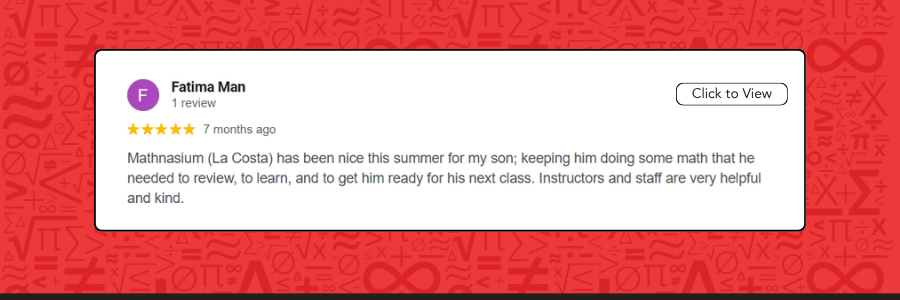
Families in and near Carlsbad, CA, trust Mathnasium of La Costa to help their children grow in math skills and confidence, season after season. They’ve awarded us with over 100 glowing reviews on Google.
Here’s what one parent had to share about their child’s experience at our center.
Whether your child needs to catch up, keep up, or get ahead this summer, our team is ready to assist.
📅 Schedule a Free Assessment at Mathnasium of La Costa
Not nearby?
Mathnasium of La Costa is a math-only learning center for K-12 students in Carlsbad, CA. Trusted by over a million parents, Mathnasium uses personalized learning plans and the proprietary Mathnasium Method™ to help students catch up, keep up, and get ahead on their math journey.
Our specially trained tutors deliver face-to-face instruction in a supportive and fun small-group environment, working with students both in center and online to develop a deep understanding of math, build confidence, and improve academic performance.
Schedule Free Assessment
 (760) 452-6150
 (760) 452-6150