If you're like most families, you're constantly balancing busy schedules with the desire to support your child's learning, particularly when it’s time to tackle math.
You know how important it is, and you want to help. But time is limited, and when you do carve out those precious minutes, you need them to actually work.
The reality? It doesn't always go as planned. What should be a quick practice session drags on longer than expected. Or maybe it never quite becomes a consistent part of your routine, no matter how many times you try.
Why does this happen? In most cases, it comes down to one thing: lack of structure.
That's exactly why our seasoned Mathnasium tutors are stepping in today. They're sharing a practical, efficient 30-minute math routine that families can actually stick to and showing you how it works across different scenarios.

Why 30 Minutes Is the Sweet Spot
A common misconception among parents is that more time equals more mastery. They envision hours of grueling practice as the path to an A+.
However, our experience and educational research suggest that for most learners, the clock starts working against you much sooner than you think.
So why does 30 minutes work so well?
A. It Matches Natural Attention Spans
Childhood development experts agree that the average attention span to expect of a child is two to three minutes per year of their age.
That means elementary and middle schoolers can sustain focused attention for roughly 16-35 minutes, depending on age.
The 30-minute framework allows for multiple mini-focus periods, like warm-up, core practice, and application, keeping engagement high throughout.

Thirty minutes: long enough to learn, short enough to stay focused.
B. It Prevents Cognitive Overload
John Sweller, creator of Cognitive Load Theory (CLT), identified math as a high-load subject because its rules and symbols must be processed simultaneously rather than in isolation.
This "element interactivity" quickly overwhelms children’s limited working memory.
To keep this from happening, we recommend structuring practice into 30-minute sessions with varied activities.
This gives your child's brain a chance to reset between tasks, so they stay engaged and confident rather than frustrated and ready to quit.
📕 You May Also Like: 6 Activities to Strengthen Your Child’s Math Problem-Solving Skills
C. Consistency Beats Cramming Every Time
A notable study in cognitive psychology showed that spaced practice, shorter, regular sessions, leads to better long-term retention than marathon study sessions.
What does that mean for you?
A child practicing 30 minutes four times a week will outperform one cramming for two or three hours once. Your brain needs time between sessions to consolidate learning.
Consistent practice builds lasting understanding; cramming creates temporary recall that fades fast.
📕 You May Also Like: 5 Ways Reflection Improves Math Retention & How to Encourage It at Home
D. It Builds Sustainable Habits
Thirty minutes is long enough to accomplish real work but short enough that it doesn't take over your evening or become the thing everyone dreads.
When practice feels doable, your family will actually stick with it, and showing up consistently is what helps your child go from "I don't get this" to "Wait, I can do this."
📕 You May Also Like: 5 Ways Math Practice Impacts Brain Development + Benefits
How to Build Your 30-Minute Math Routine
Thirty minutes alone won't magically fix everything. If it's just one long, unfocused stretch, it can still feel overwhelming for both your child and you.
What makes the difference is breaking that time into intentional chunks, so your child has a chance to warm up, dig into the real work, and finish feeling like they actually got somewhere.
Our tutors recommend this simple framework.
-
Minutes 1-5: Warm-Up: Start with mental math, a quick review of yesterday's concept, or a simple math game to ease into focus.
-
Minutes 6-20: Core Practice: This is the main work: homework, targeted practice on a specific skill, or learning a new concept.
-
Minutes 21-27: Application/Challenge: Put the math to work with a word problem, real-world connection, or brain teaser that shows why it matters.
-
Minutes 28-30: Wrap-Up & Win: Review what was accomplished, set a small goal for tomorrow, and end on a positive note.
To help this routine run smoothly, here are a few practical guidelines:
-
Choose a consistent time and distraction-free spot: Same time, same place helps build the habit naturally.
-
Use a visible timer: Kids love racing the clock, and it keeps everyone on track.
-
Keep your role as a guide rather than a lecturer: Ask questions that lead them to answers rather than explaining everything.
-
Prioritize routine and progress over perfection: Showing up consistently matters more than getting every problem right.

A steady 30-minute routine can bring calm back to math time.
30-Minute Routines in Action
With the time and structure in place, let’s look at how this routine plays out in everyday situations.
Scenario 1: Homework Support Night
Say your student comes home with a worksheet on multiplying fractions, something they learned in class but aren't quite comfortable with yet.
-
0-5 min: Warm-Up: Before diving into fractions, spend a few minutes reviewing what they already know. Ask them to multiply a few whole numbers (like 4 × 3 or 6 × 5) or do some quick mental math. This gets their brain into "math mode" without pressure.
-
6-20 min: Core Practice: Now tackle the worksheet together. Instead of explaining every step, ask guiding questions: "What do we multiply first, the tops or the bottoms?" or "Does this answer make sense? Is it bigger or smaller than what we started with?" Let them work through a problem, check it together, then move to the next one. If they're stuck on the same step repeatedly, pause and practice just that part a few times before continuing.
-
21-27 min: Application: Take one problem from the homework and make it real. If the problem is \(\Large\frac{1}{2}\) x \(\Large\frac{2}{3}\), grab some snacks from the kitchen. "If we have half a granola bar and you want two-thirds of that half, how much do you get?" Let them see and touch what's happening, not only write numbers.
-
28-30 min: Wrap-Up: Go back through the worksheet quickly. Did they get the concept? What felt hard? Acknowledge what they figured out tonight, pack up the homework, and let them know you'll check in again tomorrow if needed.
📕 You May Also Like: Creating a Math-Friendly Homework Environment at Home
Scenario 2: Test Prep Session
Your child has a math test on Friday covering adding and subtracting integers, those positive and negative numbers that always seem to confuse them. It's Tuesday night, and they're anxious because they keep mixing up when to add and when to subtract.
-
0-5 min: Warm-Up: Start by reviewing the number line. Have them plot a few integers (like -3, 5, -7, 2) to remind them which way is positive and which is negative. Then do a couple of quick questions: "What's farther from zero, -8 or 6?" This visual refresher sets them up for the problems ahead.
-
6-20 min: Core Practice: Pull out the study guide or old quizzes and tackle the problems that tripped them up before. Work through 4-5 together: -4 + 9, 3 - (-5), -6 - 2. When they're stuck, go back to the number line, physically draw it out or use one already on paper. "Start at -4, which way do we move when we add 9?" Let them see the jumps. Are they forgetting that subtracting a negative means adding? Do they struggle when both numbers are negative? Zero in on that pattern and practice it until it clicks.
-
21-27 min: Application: Create a mini practice test with 3-4 questions that look like what'll be on Friday. Set a timer and let them work independently while you're nearby: cleaning up the kitchen, answering emails, whatever. This simulates test conditions and builds their confidence working solo.
-
28-30 min: Wrap-Up: Grade the mini test together. Celebrate what they got right and what's improved since the last session. Talk through one mistake calmly: no pressure, just clarity. Remind them what to review tomorrow, and end with reassurance: "You're getting this."
📕 You May Also Like: How to Help Your Child Overcome Math Test Fear

How Mathnasium Supports Families with Busy Schedules
Despite the best intentions and real effort, practicing math at home can easily get derailed—by busy schedules, and just as often, by a concept that's moved a little beyond what you feel comfortable explaining yourself.
When that happens, Mathnasium is here.
A trusted math support partner for over a million families across the U.S., Mathnasium is a math-only learning center dedicated to helping K-12 students of all skill levels excel.
Whether your child needs to rebuild foundational skills, improve their grades, or tackle something more challenging than what school is covering, we're ready to step in.
What sets us apart isn't just the support, it's how we deliver it. Behind every Mathnasium program is our proprietary teaching approach, the Mathnasium Method™. Rather than a one-size-fits-all format, it's a personalized approach designed to help each student unlock their true math potential.
Our approach includes:
-
Personalization on a granular level: Each student begins their Mathnasium journey with a diagnostic assessment. This helps us pinpoint their strengths, potential knowledge gaps, and how they approach math in general. With these insights, we create a learning plan customized to each student’s needs.
-
Teaching for understanding: We use natural, student-friendly language to phrase math concepts. We also combine verbal, visual, mental, tactile, and written teaching techniques to help students truly make sense of what they’re learning.
-
Caring tutors: Our tutors are specially trained in math as well as the technical and emotional aspects of teaching. This means they know how to encourage a student who’s stuck and how to challenge one who’s ready to stretch their thinking.
-
Problem-solving and critical thinking skills: During sessions, we always allow time for productive struggle, then rejoin students to check and correct their processes. This helps them learn to rely on their own thinking. We guide them through both the how and the why behind each math problem, not only the final answer. This approach develops the problem-solving and critical thinking tools they’ll use in math and life.
-
Singular focus on math: Our proprietary curriculum includes over 1,000 pages dedicated to math and math only. This singular focus allows us to dive deeper into how students best learn, absorb, and retain math skills.
-
An empowering, fun learning environment: We often hear families say our sessions don’t feel like conventional lessons. That’s by design. We incorporate a lot of game-based activities and rewards to keep students motivated and engaged.
And the results? They speak for themselves:
-
94% of parents report an improvement in their child's math skills and understanding
-
93% of parents report an improved attitude towards math after attending Mathnasium
-
90% of students saw an improvement in their school grades
With over 1,100 centers across the U.S., Mathnasium brings our proven approach close to your home.
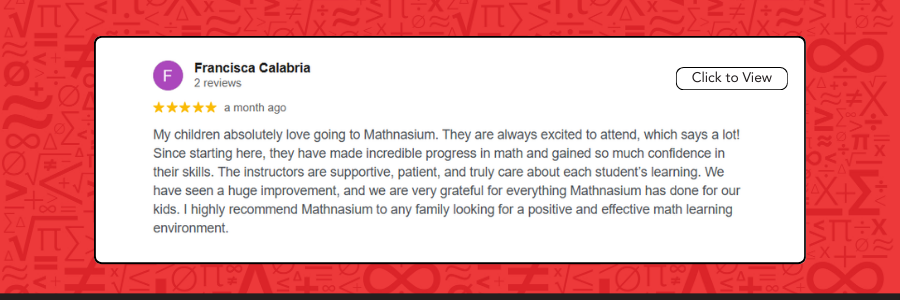
Families in and around Carlsbad, CA, turn to Mathnasium of La Costa for trusted, local math support, backed by more than 100 Google reviews from parents who’ve seen real progress.
Here’s what one parent had to share about their child’s Mathnasium experience.
Whether your child is looking to catch up, keep up, or get ahead in math, our team is delighted to help.
📅 Schedule a Free Assessment at Mathnasium of La Costa
Not near Carlsbad?
📍 Find a Mathnasium Learning Center Near You


 (760) 452-6150
 (760) 452-6150