Telling time is a core part of the Common Core State Standards for elementary mathematics.
In first grade, children are expected to read analog and digital clocks to the hour and half-hour. By second grade, that extends to the nearest five minutes, including a.m. and p.m.
Learning this skill is not always a smooth road, and that's completely normal. The clock face asks children to track two hands of different lengths, moving at different speeds, across two separate scales, all at once. That is a real cognitive load.
With that in mind, our tutors share the approach we use at Mathnasium centers, giving you a step-by-step guide to help your young learner master reading an analog clock with confidence.

Get the Basics Right First: Parts of the Clock and Pre-Skills
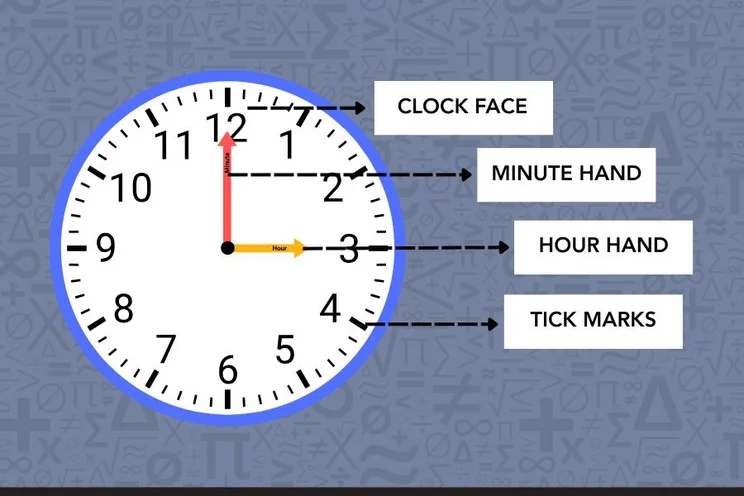
Before your child can read a clock, they need to know what they're looking at. Let’s start with the most important parts of an analog clock:
-
The clock face: the circular face marked with the numbers 1 through 12, representing the 12 hours of the day
-
The hour hand: the short, slow-moving hand that points to the current hour
-
The minute hand: the long, faster-moving hand that counts the minutes
-
The tick marks: the 60 small marks around the edge of the clock face, one for each minute
Take a moment to check that your child has these foundational skills in place before you introduce the clock.
-
Counting to 60 reliably
-
Skip counting by 5s to 60 — this is the direct mathematical foundation for reading the minute hand
-
Understanding the concepts of before, after, and halfway
-
Recognizing the numbers 1 through 12 on sight
If any of these feel shaky, spend a little time practicing them first. The more they’re comfortable with these skills, the less frustrating the whole clock reading gets.
📕 You May Also Like: 5 Easy Steps to Help Your Child Build Math Fact Fluency
Step 1: Start With the Hour Hand Only
When parents first sit down to teach clock reading, the most common instinct is to explain both hands at once. Our tutors would gently suggest holding off on that.
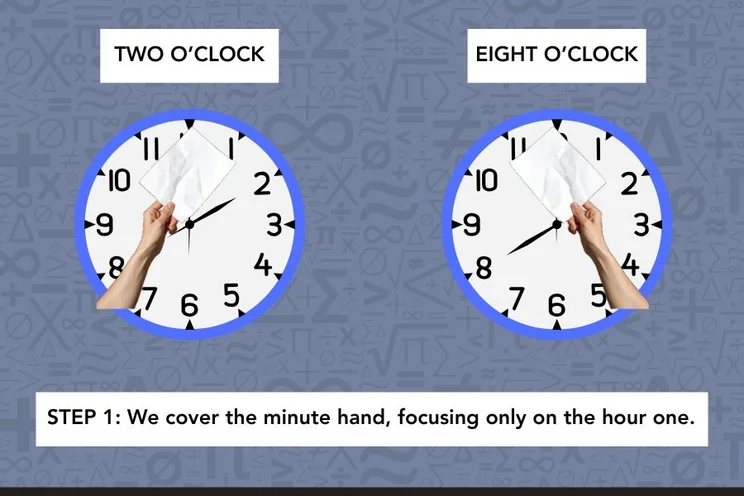
Start with the hour hand only, aka the short one. If it helps, cover the minute hand with a small piece of paper or tape to remove the distraction entirely. At this stage, it simply isn't needed.
Show your child that when the short hand points directly at a number, it tells us the hour. Point it at 3, that's 3 o'clock. Move it to 7, that's 7 o'clock. Work through several hours together, taking your time with each one.
Your goal should not be speed but familiarity. Once your young learner can look at any whole hour and name it confidently, they're ready for the next step.
📕 You May Also Like: 9 Ways Analog Clocks Teach Both Time and Fractions
Step 2: Introduce Half Hours and Half Past
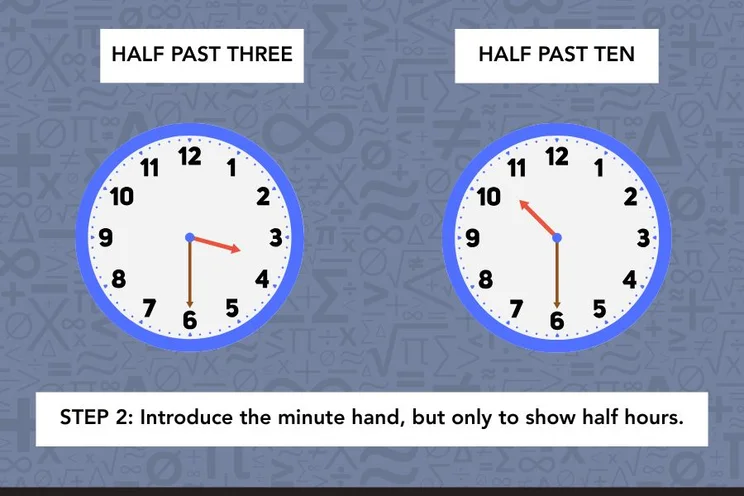
If whole hours feel solid, it's time to bring in the minute hand. Mindfully, though. We are not reading the full clock yet. We are starting with just one position: straight down, pointing at the 6.
When the minute hand points at the 6, exactly half an hour has passed. That is why we call it half past.
Half past three, half past seven. The minute hand is always in the same spot, which makes this a wonderfully easy concept for children to latch onto.
Here is what to show your child when the clock reads 3:30:
-
The minute hand points straight down at the 6
-
The hour hand sits halfway between 3 and 4, still traveling toward 4 but not there yet
-
The hour hand will never sit exactly on a number when it is half past
Don’t forget to remind them that there are two ways to say the same thing, and both are correct.
-
"Half past three"
-
"Three thirty"
Your child will encounter both in everyday life, so practice saying it both ways. Make a game of it. Half past bedtime, anyone?
📕 You May Also Like: Why Kids Need to Learn Math Vocabulary Early
Step 3: Count by 5s Around the Clock
Here is where that skip-counting pre-skill your child practiced earlier comes into its own.
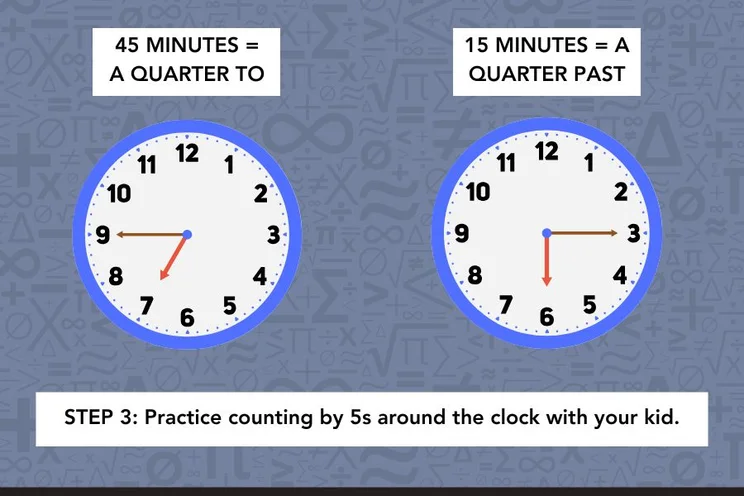
Each number on the clock face represents a five-minute interval. The minute hand takes exactly five minutes to travel from one number to the next. So a child who can skip count by 5s already has everything they need to read the minute hand.
Practice counting around the clock together, pointing to each number in turn:
5, 10, 15, 20, 25, 30, 35, 40, 45, 50, 55, 60
After that feels comfortable, try it the other way around. Point to a number on the clock face and ask your child to give the minute count:
-
Minute hand on the 3? That's 15 minutes, also called quarter past.
-
Minute hand on the 9? That's 45 minutes, also called quarter to.
-
Minute hand on the 7? That's 35 minutes.
Make this a game. Point to a number; your child calls out the minutes. Switch roles and let them point while you answer. A little friendly competition goes a long way at this stage.
Ultimately, if your child can confidently convert any number on the clock face to its minute value, they are ready for the final step.
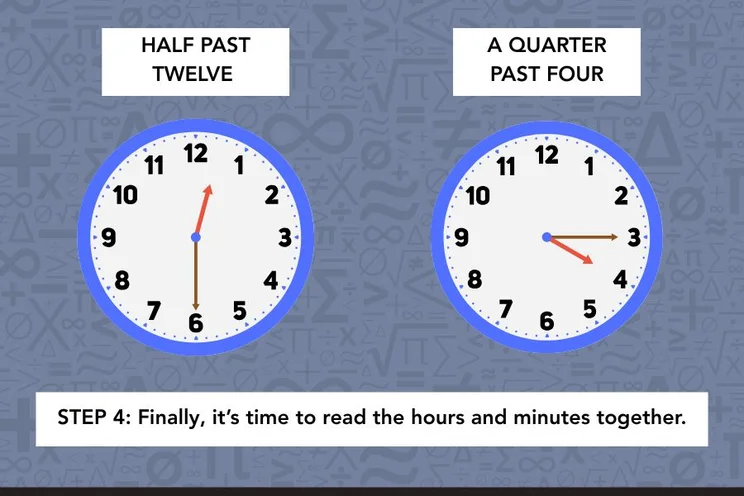
Step 4: Read the Full Time: Hour and Minutes Together
This is where everything comes together.
Reading the full time is a two-step process. Always start with the hour hand, then move to the minute hand, and combine the two.
A simple reminder helps children keep track of which hand is which:
-
Short hand: hours
-
Long hand: minutes
Walk your child through it together. Take a clock showing 9:15.
-
The short hand points toward 9; that gives us the hour.
-
The long hand points at the 3; that's 15 minutes, or quarter past. Put them together: nine fifteen, or quarter past nine.
When they nail this down, introduce times that fall between the five-minute marks, like 7:43. Here, the minute hand sits between the 8 and the 9. The nearest five-minute mark below it is 40 (the 8). Count on from there: 41, 42, 43. That gives us seven forty-three.
Lastly, they should keep this in mind:
-
Always read the hour hand first
-
The hour hand may sit slightly past a number; that is normal, it has been moving since the last hour
-
Reading to the minute takes practice across several sessions, so take your time
There is no rush here. Confidence at this stage is built through repetition, not speed.
📕 You May Also Like: Math for Life: Why Math Skills Matter Beyond School
Time to Practice: Can Your Child Read These Clocks?
Now that you have worked through all four steps, here is a chance to put the sequence into practice together.
The image below shows four clock faces. Ask your child to read each one aloud.
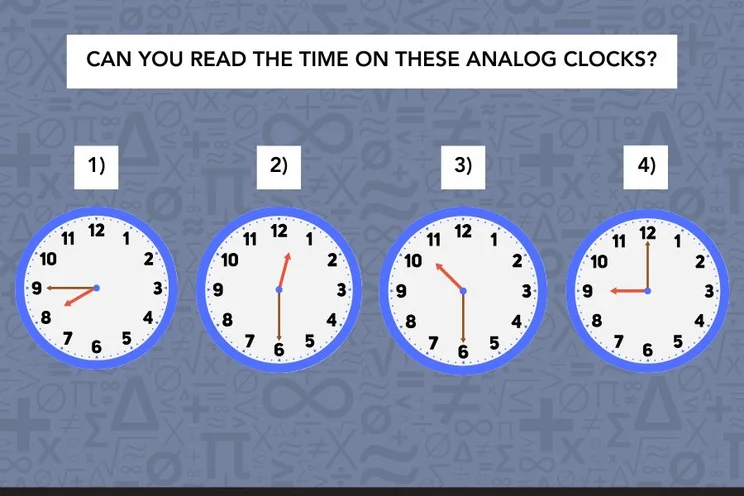
When they’re done, check the answers at the bottom of the guide.
How Mathnasium Helps Young Learners Build Lasting Math Foundations
Telling time on an analog clock is one of those skills that looks simple from the outside but involves real mathematical thinking: spatial reasoning, skip counting, and understanding that the same symbol can mean two different things depending on context.
At Mathnasium, we work with young learners at exactly this level every day.
Our approach, the Mathnasium Method™, is built around one core idea: that every child can understand math when it is taught in a way that makes sense to them.
Here is what that looks like in practice:
-
Personalized learning plans: Every student begins with a diagnostic assessment that identifies exactly where they are and what they need next. No assumptions, no one-size-fits-all programs.
-
Teaching for understanding: Our tutors use clear, everyday language and a mix of verbal, visual, and hands-on techniques to help concepts stick.
-
Specially trained, caring instructors: Our tutors know how to meet a child where they are, build their confidence, and challenge them when they are ready for more.
-
A fun, engaging environment: Sessions at Mathnasium don't feel like extra school. We keep learning purposeful and enjoyable in equal measure.
The results speak for themselves:
-
94% of parents report an improvement in their child's math skills and understanding
-
93% of parents report their child's improved attitude toward math after attending Mathnasium
-
90% of students saw an improvement in their school grades
We operate over 1,100 learning centers, bringing our top-rated math instruction close to your home.
For families in La Jolla, Mathnasium of La Jolla has built a strong local reputation helping students at every level build lasting math confidence.
Our community recognizes our impact with 100+ glowing Google reviews and a Reader's Choice Award from La Jolla Light.
Whether your child is just getting started with telling time or working through bigger math challenges, our team is ready to help.
📅 Schedule a Free Diagnostic Assessment at Mathnasium of La Jolla
Not near La Jolla?
📍 Find a Mathnasium Learning Center Near You
Pssst! Check Your Answers Here
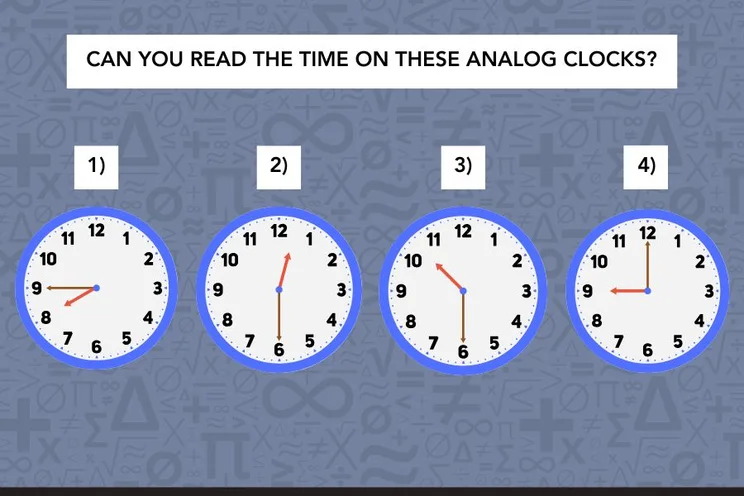
If your child tried our analog clock challenges, check their answers below.
-
Hour hand between 7 and 8, minute hand on 9: 7:45
-
Hour hand between 12 and 1, minute hand on 6: 12:30
-
Hour hand between 10 and 11, minute hand on 6: 10:30
-
Hour hand on 9, minute hand on 12: 9:00


 (858) 291-8186
 (858) 291-8186