What Is Symmetry in Math? A Complete, Kid-Friendly Guide with Examples
Dec 10, 2025
| Lakewood CO
Have you ever folded a piece of paper to make a butterfly and smiled when both wings matched perfectly?
That satisfying moment—that’s symmetry at work! Symmetry is one of the first math ideas that truly feels magical.
You see it in the wings of a bird, paper snowflakes, heart-shaped crafts, and even in some of the numbers you write every day.
Most of the time, you notice symmetry long before you ever learn the word for it, and once you understand it, symmetry becomes a powerful way to understand shapes, patterns, and spatial reasoning.
At Mathnasium, we see how symmetry helps students make sense of geometry in a hands-on, intuitive way. This is why today we’ll explore symmetry in a simple, kid-friendly way, using examples you’ll recognize and ideas you can try at home or school.
What is Symmetry in Math?
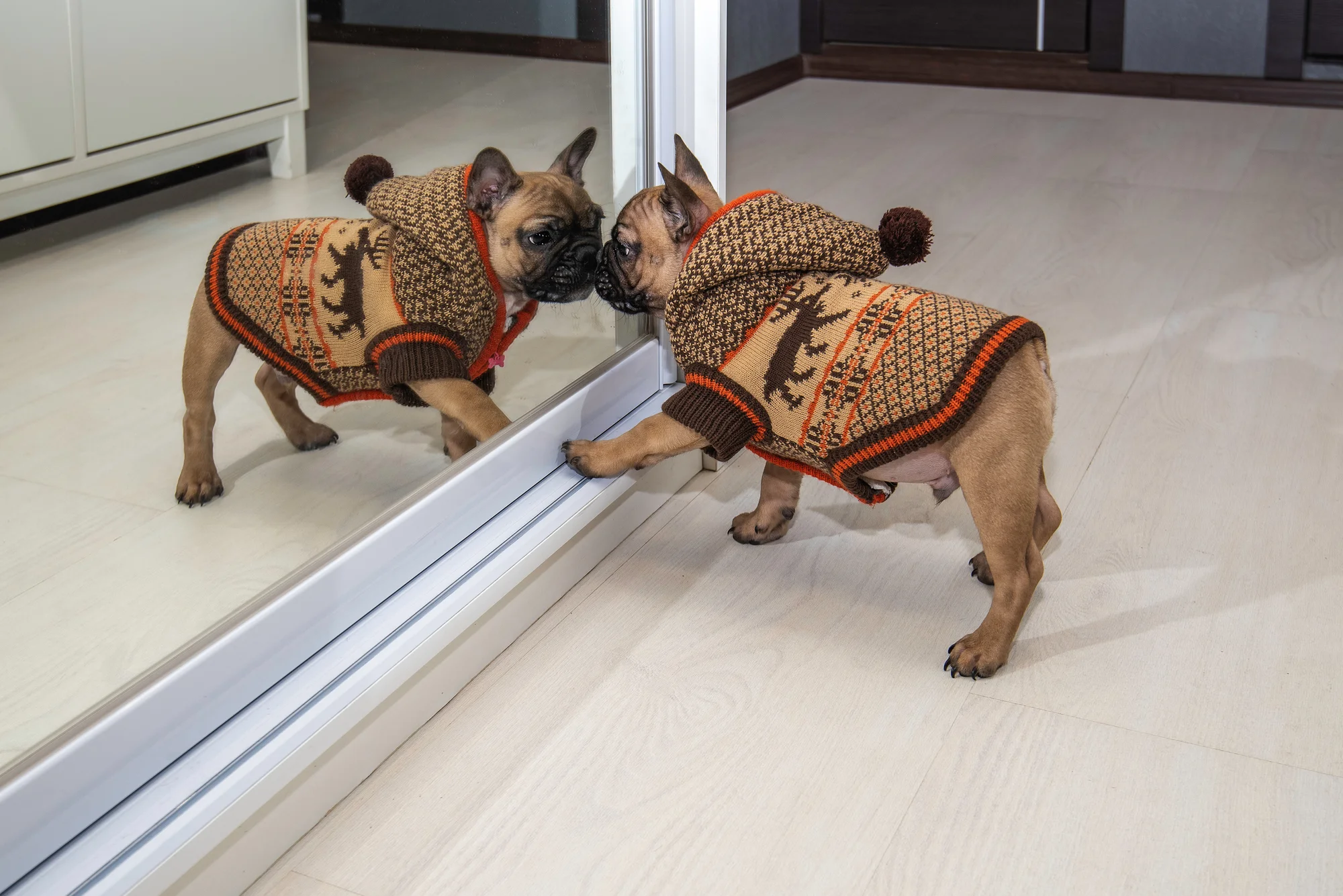
Symmetry means that one side of an object matches the other in some way. When something is symmetrical, you could flip it, fold it, or rotate it, and it would still look the same.
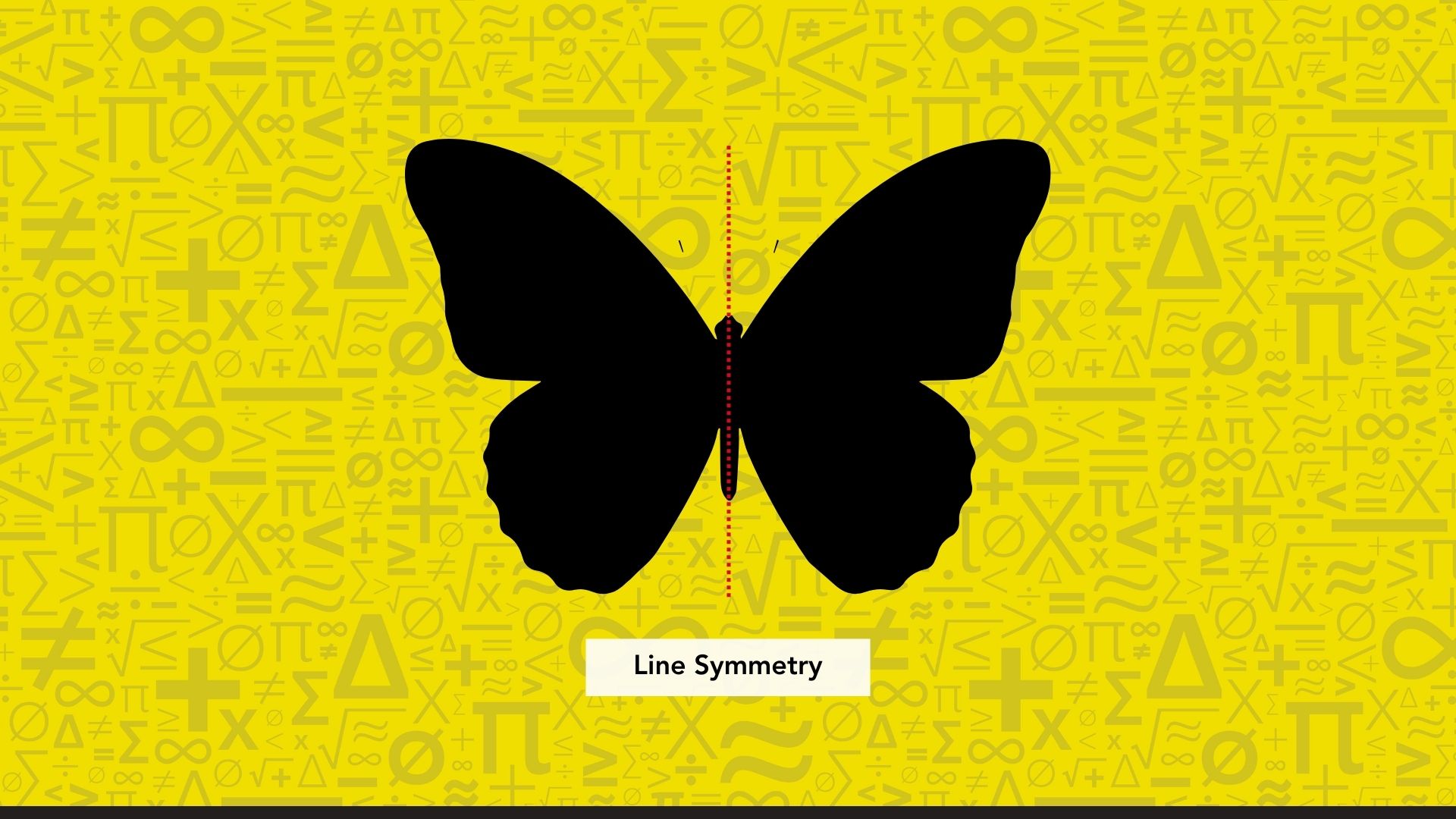
Think of symmetry like a perfect mirror trick: if you could draw a line down the middle, both halves would look the same, like so:
It also helps you understand shapes better. It trains your brain to notice details, compare sides, look for patterns, and imagine how shapes move or change. These skills show up later in geometry, graphing, designing things, and solving more difficult problems.
One easy way to check for symmetry is to imagine folding a shape along a line.
Ask yourself, “If I fold it here, will the two sides line up?”
If the answer is yes, congratulations, you found symmetry!
You can see symmetry through everyday objects, such as:
A heart folded down the center
The left and right sides of a face
A snowflake with repeating arms
A square that still looks like a square when turned
There are four main kinds of symmetry you’ll learn about in school. Don’t worry—they’re easier than they sound, and you’ve probably seen all of them before.
1. Line Symmetry: The Most Familiar Kind
Line symmetry happens when you can draw a line through a shape, and both halves match perfectly. That line is called the line of symmetry. It’s like folding the shape makes both sides match or slicing a picture into two pieces and discovering they’re twins.
You've probably seen line symmetry in:
A paper heart folded down the middle: When you fold a heart in half, both sides line up perfectly, the classic example of line symmetry.
The left and right sides of your face: If you drew a line down the center of your face, each side would look similar. Faces are one of the easiest real-life examples of symmetry.
Letters like A, M, T, U, V, W, and Y: Some capital letters look the same on both sides when you split them down a vertical or horizontal line.
Squares, circles, and sometriangles: Shapes like squares, circles, and certain triangles have lines of symmetry that make them easy to fold or divide into matching halves.
Footballs, leaves, masks, and more: Many everyday objects, from sports equipment to leaves and even costume masks, have matching sides that show line symmetry.
Line symmetry helps you notice balance and matching sides. Once you start looking for it, you’ll see it in art, nature, buildings, school projects, and even in designs on clothes and backpacks.
And discovering which shapes don’t have line symmetry is just as fun. Some letters and shapes will definitely surprise you!
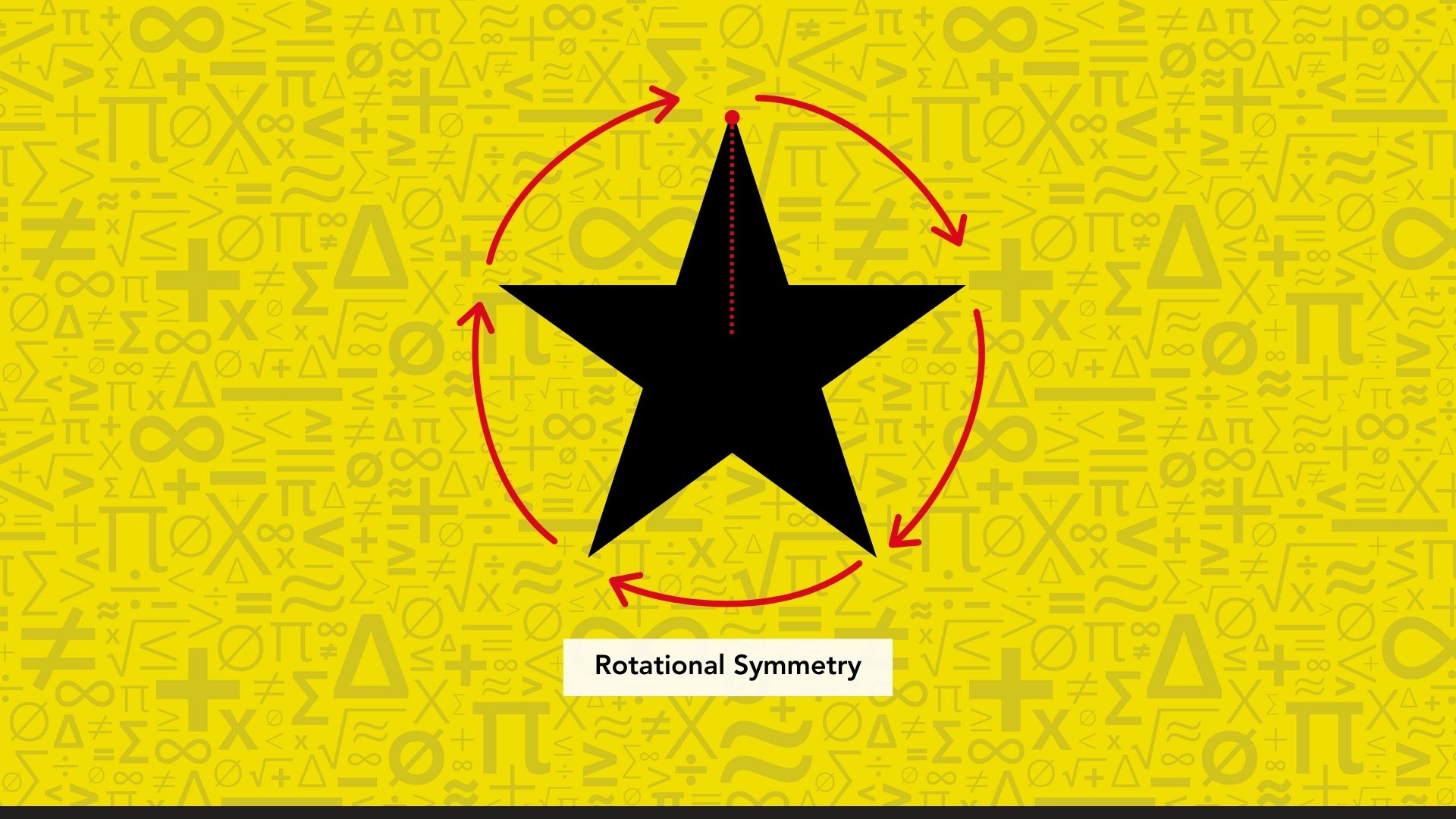
Rotational symmetry happens when a shape still looks the same after you turn it. Imagine placing a shape on a spinner. If you spin it a little and it looks exactly the same as before, it has rotational symmetry.
Some shapes look the same at several different angles, which makes rotational symmetry pretty cool.
You’ve definitely seen examples, like:
Stars: Many stars look the same every time you turn them. A 5-pointed star matches itself five times as it spins around the center.
Snowflakes: Snowflakes have repeating arms that look identical when you rotate them. No matter how you turn one, the pattern keeps lining up.
Pinwheels: When you spin a pinwheel, the blades repeat their shape over and over, so it looks the same at different angles.
Ferris wheels: The seats and spokes are arranged evenly around the middle. As the wheel turns, the pattern stays perfectly balanced.
Squares at 90°, 180°, or 270°: A square is one of the clearest examples. If you turn it a quarter-turn, half-turn, or three-quarter turn, it looks exactly the same each time.
Rotational symmetry helps you practice imagining shapes moving, a skill that becomes super useful in geometry and problem solving later on. This makes drawing, building, puzzles, and geometry a lot easier. It’s also great for art and designing patterns, since you start noticing how shapes repeat when they turn.
3. Translational Symmetry
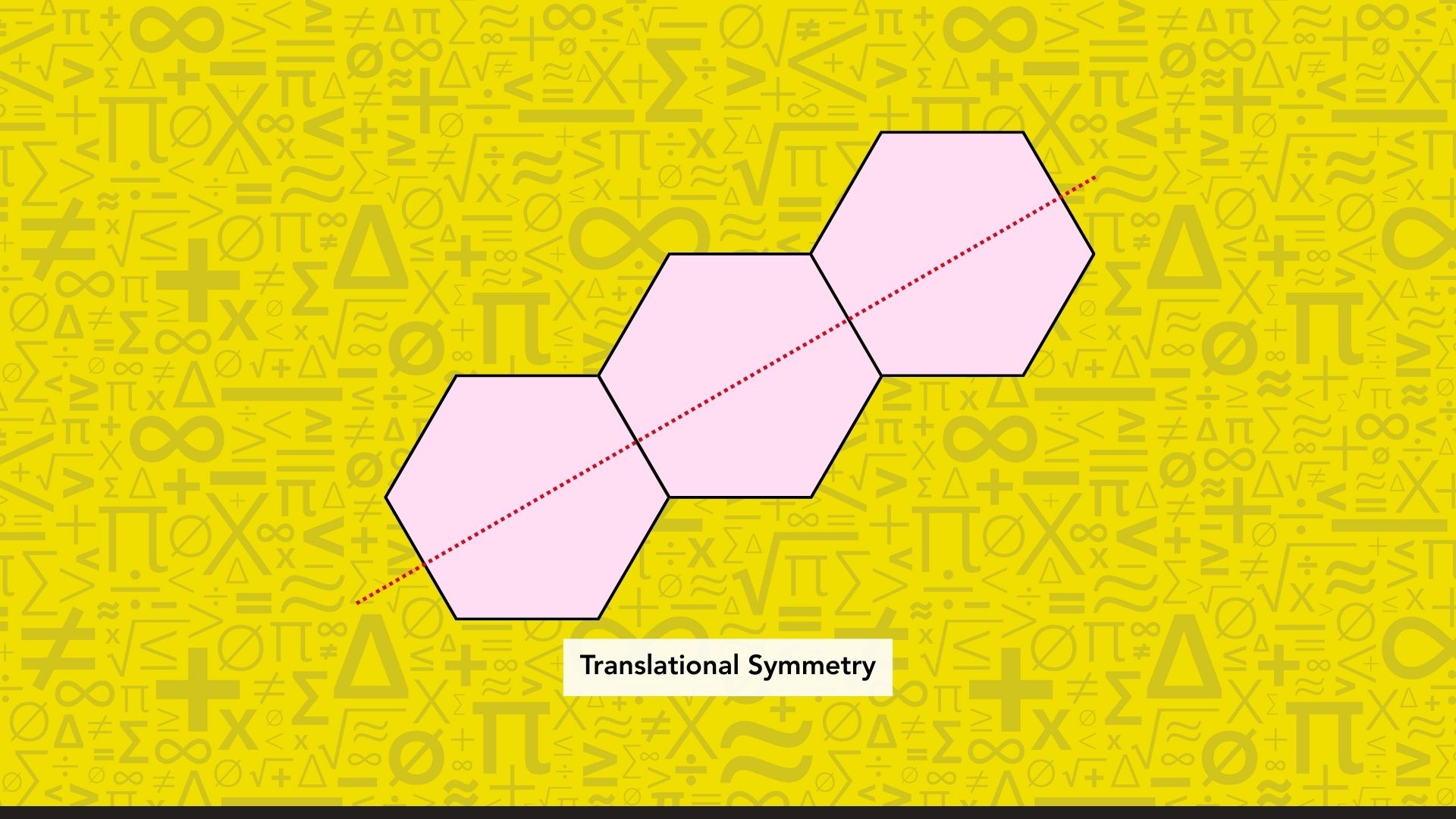
Translational symmetry shows up when a pattern repeats as it slides in a straight line. Nothing flips or turns; it just moves forward.
You see this everywhere:
Floor tiles: Look down at a tiled floor and you’ll notice the same shapes repeating in straight rows. Each tile slides over to make the next one, creating a pattern that keeps going.
Brick walls: Bricks are stacked in long, even lines. Each brick is the same size and shape, and the pattern continues as the bricks slide across the wall row by row.
Wrapping paper: Most wrapping paper has cute designs of snowmen, stars, and shapes that repeat over and over. If you slid the design to the right, it would match the next copy exactly.
Wallpaper borders: Borders usually have pictures or shapes that repeat in one long line around a room. The design doesn’t rotate or flip, it just slides along the wall.
Patterns in your notebook or clothes: Lots of notebooks, shirts, leggings, and backpacks use repeating icons like hearts, stars, dinosaurs, or stripes. Those shapes slide across the fabric in straight lines to make the design.
Translational symmetry teaches you how designs repeat, which is a big part of understanding patterns. When you see a pattern slide forward over and over, it becomes easier to understand how repeating patterns work.
This is the same idea behind arrays and multiplication, which are groups that repeat in equal steps. It’s also something you probably notice in art, computer games, video games, and crafts without even trying.
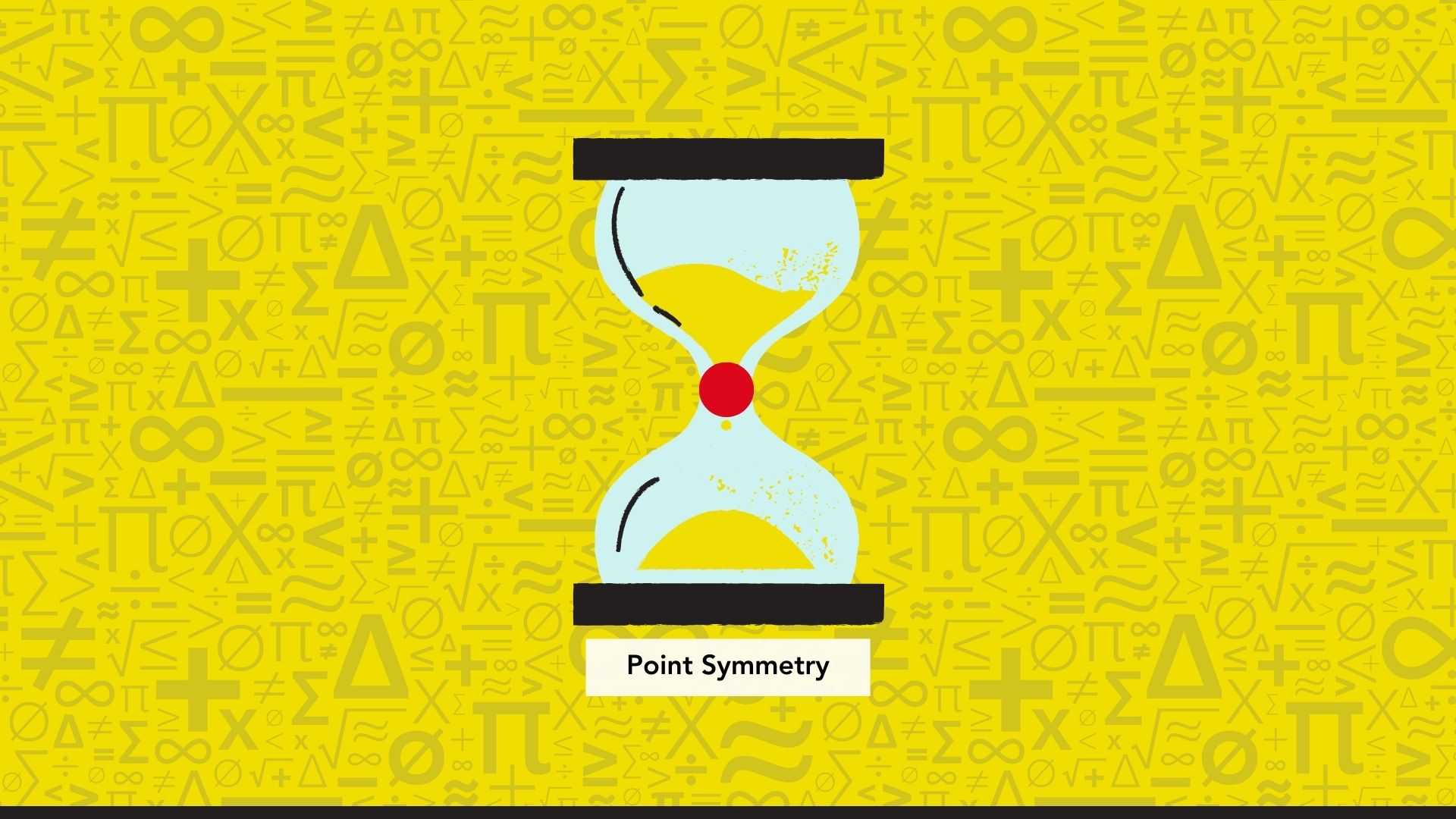
Point symmetry happens when every part of a shape has a matching part on the opposite side of a central point. If you take the whole shape and rotate it 180° (half a turn), it ends up looking exactly the same as before.
It’s almost like the design flips over an invisible center dot and lands perfectly back on itself.
Once you notice point symmetry for the first time, it feels like discovering a secret math trick.
You suddenly realize, “Oh! The other side is the same… just upside down!”
You’ll see point symmetry in all kinds of places, like:
Playing cards (especially the ones with numbers or suit symbols printed at both ends)
X-shaped figures such as the letter X or a cross-shaped pattern
Logos for brands, sports teams, or video games
Geometric designs that repeat around a center point
Point symmetry might seem a little more advanced than line or rotational symmetry, but once you understand how it works, you’ll start spotting it everywhere.
It helps you see how shapes connect, how designs repeat, and how rotations work in real life.
Understanding point symmetry also makes topics like transformations, coordinates, and geometry challenges feel much easier later on because you know how to visualize a shape turning in space.
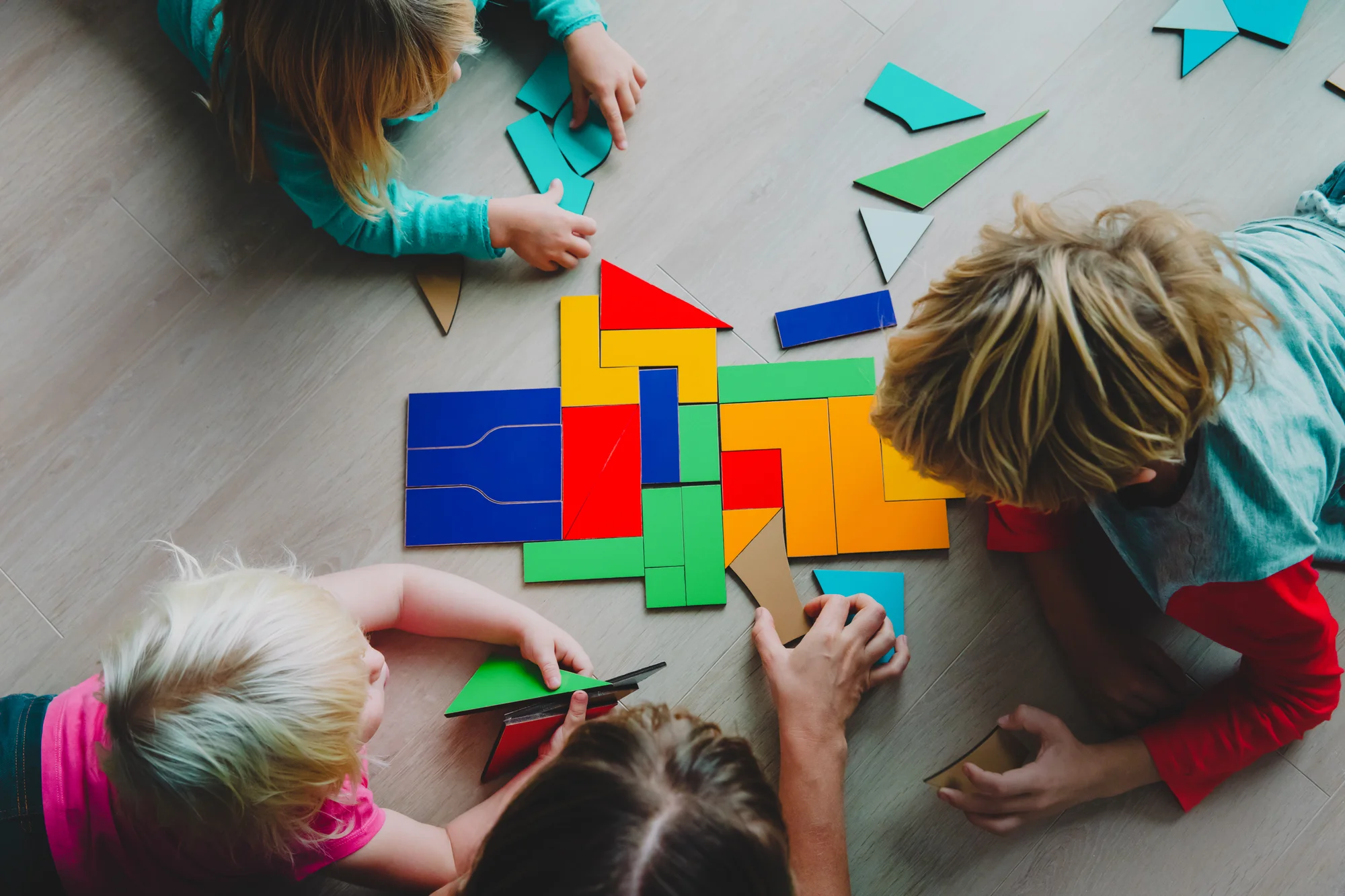
Bright geometric tiles arranged in repeating and rotational patterns, illustrating different types of mathematical symmetry.
Real-Life Examples of Symmetry
Once you understand symmetry, you’ll start noticing it everywhere: in nature, in design, and even in the everyday objects around you.
Though we’ve already touched on a few examples, it’s worth taking another moment to reflect on just how often symmetry shows up in the world around us.
In Nature
Nature is full of symmetrical wonders.
A butterfly’s wings are almost identical on both sides.
Many leaves have a central line with matching halves.
Snowflakes have repeating patterns that radiate out from the center.
Flowers often grow petals evenly spaced in circular symmetry.
You’ll even see symmetry in faces, from cats and dogs to people.
Some natural patterns, like the spirals in pinecones or sunflowers, follow mathematical rules that create beautiful, repeating symmetry.
In Art and Design
Symmetry helps artists and designers create balance and beauty.
Mandalas and mosaics repeat shapes evenly around a central point.
Quilt patterns and tile designs often mirror shapes to form harmony.
Buildings, windows, and arches often feature left-right symmetry.
Even video games and animated characters use symmetry to make designs more appealing and easy to recognize.
In Everyday Objects
You probably use symmetrical items every day without even thinking about it.
Playing cards have mirrored images, so they look the same upside down.
Logos, sports equipment, and tools like scissors are often symmetrical to feel balanced and easy to use.
Things like sneakers, notebooks, and backpacks are designed to be functional — and symmetry plays a big part in that.
Try a Symmetry Hunt!
Take a walk around your house, school, or neighborhood and look for symmetry in the things you see.
Whether it’s the pattern on a rug or the shape of a basketball court, you might be surprised by how often symmetry appears once you start looking.
How Mathnasium Helps Students See Math More Clearly
At Mathnasium, we teach math in a way that makes sense, and that starts by helping kids see how math connects to the world around them. Whether they’re exploring geometry through symmetry or solving everyday problems, our goal is to strengthen understanding, not just performance.
That’s why every student begins with a diagnostic assessment. We look beyond grades to understand how each child thinks, what concepts they’ve mastered, and where they need support. From there, we create a personalized learning plan tailored to their skill level and learning style.
But what really sets Mathnasium apart is how we teach. Using the Mathnasium Method™, our instructors work face-to-face with students in a fun, focused environment. Through hands-on activities, visual models, and thoughtful questions, we help kids discover the why behind the math.
We don’t rush students or rely on worksheets. Instead, we guide them through problems at a pace that builds both skills and confidence. And because every win is celebrated, students stay motivated, engaged, and proud of their progress.
This approach works. Nationally:
94% of parents report improved math skills and understanding,
90% of students see better grades in school,
93% of parents say their child has a more positive attitude toward math.
More importantly, students stop saying “I’m not a math person” and start saying, “I get it now.”
If your child is ready to explore math with confidence, curiosity, and clarity—symmetry included!—book a free assessment today and see how Mathnasium can help.
Visit Us at Mathnasium of Lakewood CO
Mathnasium of Lakewood CO is a math-only learning center for K-12 students in Lakewood,
CO. Trusted by over a million parents, Mathnasium uses personalized learning plans
and the proprietary Mathnasium Method™ to help students catch up, keep up, and get ahead on their math journey.
Our specially trained tutors deliver face-to-face instruction in a supportive and fun small-group environment,
working with students both in center and online to develop a deep understanding of math, build confidence,
and improve academic performance.
Math confidence shapes how students approach every new concept. Learn the common reasons it breaks down and how personalized tutoring helps students rebuild it.


 (303) 975-6159
 (303) 975-6159