One week, your child is breezing through times tables. Next, they’re struggling to recall basic facts they seemed to know cold.
You start wondering if math is just leaking out of their head. In a way, it is.
Kids forget fast, particularly when it comes to math. That’s because the brain is constantly deciding what to keep and what to toss.
To help parents understand why math slips away so easily, our tutors break down how memory works, why math is uniquely vulnerable to forgetting, and the simple, proven strategies that help students retain what they’ve learned.

How Our Brains Are Built to Remember…and Forget
Imagine this: Your child sits down to do their math homework and seems to understand everything. They breeze through the problems, check their answers, and even feel confident.
But a few days later, during the quiz or test, they stare at the page as if they’ve never seen the material before.
This experience is surprisingly common. But there is a scientific reason behind it.
The Ebbinghaus Forgetting Curve: The Brain’s Filter
Over a century ago, psychologist Hermann Ebbinghaus studied how people retain information over time.
He discovered what we now call the Forgetting Curve. According to his findings, students can forget up to 50% of new material within 24 hours if they don’t review it. After one week, most of the information fades from memory unless it has been actively reinforced.
So when a child forgets how to solve a type of problem they learned just a few days ago, it often reflects a natural pattern of memory loss and not necessarily a lack of effort or ability.
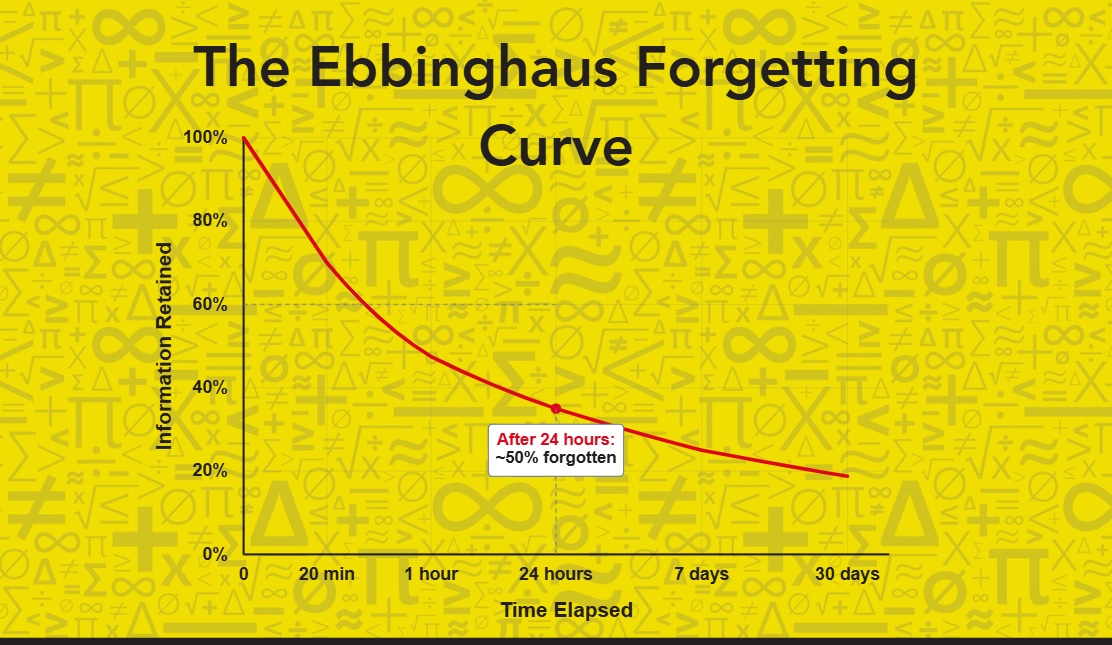
The Ebbinghaus Forgetting Curve shows why routine reviews are so important for math retention.
Why Math Fades Away So Easily
Math can’t just be memorized. It relies on layered procedures, a high mental load, and emotional context, all of which make it especially vulnerable to forgetting.
Reasons math may fade faster than other types of subjects include:
-
High cognitive load: Math requires students to juggle steps, rules, and symbols in their working memory. Without consistent review, these connections weaken quickly.
-
Procedural decay: Unlike facts in history, math procedures must be recalled flexibly and applied across contexts.
-
Interference from new learning: Similar problem types with slight differences (like multiplying vs. dividing fractions) can blur together, making old material harder to retrieve.
-
Emotional blocking: Math anxiety can trigger avoidance or even subconscious forgetting, particularly after long breaks when confidence dips.
-
Disconnected instruction: If math is taught as a series of isolated tricks or steps, students memorize without understanding, and those fragile memories are the first to go.
-
Overloaded pacing: A fast-moving curriculum often stacks new topics on shaky foundations, leading the brain to discard what it can’t organize or use.
What Parents Are Seeing at Every Age
One may assume that forgetting only becomes a problem in middle or high school. But challenges with math retention show up at every age.
That being said, there are slight differences depending on the stage of development. Here's what you might be noticing right now:
Ages 3–6: The Quick Forgetters
In early childhood, the brain is incredibly open to learning. However, it’s still forming the structures needed for long-term memory. This means young children often seem to “forget” things almost as quickly as they learn them.
Common signs at this age:
-
A child can count to 20 one day, but skips numbers the next.
-
They know what "3" means during one activity, but can't recognize it later on in the book.
-
They struggle to connect the number of objects in front of them with the number they’re saying aloud (this is called one-to-one correspondence).
At this age, children often memorize counting sequences like songs, without fully understanding what the numbers represent. Without daily, hands-on reinforcement, these abstract ideas can fade quickly.
Short attention spans, frequent changes (like moving between caregivers, classrooms, or routines), and limited exposure to consistent math language also make it harder for early learners to retain these skills.
Ages 6–11: The Cumulative Gap Years
This is a critical time for developing core math skills. From addition and subtraction to multiplication, division, and fractions, everything is built step by step. But if a child forgets a key skill, the next step can feel confusing or impossible.
Common challenges at this age:
-
A student forgets multiplication facts they knew last month and now struggles with division.
-
They forget how to find the least common denominator, which makes it hard to add or subtract fractions.
-
They lose track of place value understanding, which leads to confusion when regrouping during multi-digit subtraction or performing long multiplication.
School programs may move quickly from one topic to the next, and students don’t always get enough time to master a concept before moving on.
Other factors also begin to appear:
-
Summer break often leads to a major loss of progress, known as the summer slide.
-
Math anxiety becomes more common, especially if a child has experienced repeated confusion or mistakes.
-
Children may not speak up when they’re lost, which allows small misunderstandings to grow into larger knowledge gaps over time.
It’s also during these years that differences in classroom instruction styles, peer comparison, and lack of personalized review start to have a noticeable impact on retention.
📕 You May Also Like: How to Spot and Overcome Early Gaps in Algebra
Ages 11–14: Too Much to Juggle
In middle school, math starts to get more complex. Students are expected to keep track of more steps, understand abstract ideas, and solve longer problems. This puts a strain on something called working memory, or the mental space used to hold and work with information at the same time.
Working memory is limited. When a student is trying to remember rules, steps, numbers, and the meaning of the question all at once, their brain can get overloaded.
It is at this point that things start to slip. They might forget a step halfway through a problem or confuse two different math rules, even if they’ve learned them before.
Common challenges at this age:
-
A student forgets a step while solving an equation because they are thinking about too many things at the same time.
-
They struggle with multi-step word problems that involve reading, planning, and doing math all in one question.
-
They mix up rules for different concepts, like when to use a formula or how to solve with variables.
So, how can students successfully juggle all of this information?
It comes down to understanding. Namely, when students truly grasp what they are doing, they rely less on short-term memory and more on real reasoning. That makes it easier to hold onto ideas, even when the pressure is on.
So, What Actually Helps Kids Remember Math?
If forgetting is a natural part of learning, what can we do to help kids hold on to what they’ve learned? The most effective strategies combine insights from cognitive science with simple, everyday habits.
1. Active Learning Over Passive Reviewing
Retention improves when children interact with math, rather than just look at examples or re-read notes.
Try these methods at home:
-
Retrieval practice: Ask your child to solve a problem without looking back at their materials. This challenges the brain to recall information, which strengthens memory.
-
Teach-back method: Let your child explain a concept to you, step by step. Teaching someone else is one of the most powerful ways to reinforce understanding.
-
Use real-life math: Build math into daily routines. Ask your child to estimate the total while grocery shopping, double a recipe, or track time during a game.
These small moments of application help the brain recognize math as useful and worth remembering.
📕 You May Also Like: 7 Active Games to Build Math Skills at Home
2. Spaced Practice and Spiral Review
Many students review math just before a test, only to forget it soon after. This is because cramming boosts short-term recall, not long-term memory.
We recommend a different approach with spaced and spiral review.
What do we mean by those?
Spaced practice means reviewing smaller amounts over time. Studies find that revisiting a topic for 5 minutes each day for a week is far more effective than a single 35-minute session.
Spiral review involves mixing in old concepts with new ones. This keeps earlier skills active and prevents them from fading.
To implement these, you can:
-
Keep a small review notebook of problems your child has already mastered, and revisit one or two each day.
-
Use flashcards that include both current and past topics.
-
Start homework time with a quick “review round” of older problems.
3. Make It Stick With Games and Activities
Repetition helps memory, but worksheets aren’t the only way to reinforce skills.
Here are fun options that still provide meaningful practice:
-
Math bingo using multiplication or fractions (or any other math concepts)
-
Scavenger hunts where answers to math problems lead to clues
-
Dice games to practice addition, subtraction, or probability
-
Card games like “Make 10” or “Target Number” that require strategy and mental math
These activities provide the repetition students need in a way that feels engaging rather than overwhelming. When math becomes part of how they play, students are more likely to remember what they learn and feel good about using it.
📕 You May Also Like: 10 Fun Math Games to Play at Home with Your Child

At Mathnasium, students strengthen math memory through hands-on games and activities that make learning feel like play.
How Mathnasium Helps Kids Remember What They Learn
At Mathnasium, we understand how frustrating it is when your child seems to forget math concepts they just learned. We’ve worked with thousands of students facing this exact challenge.
To address it, we go far beyond rote memorization. Instead, we use our proprietary teaching approach, the Mathnasium Method™, designed around how children actually absorb, retain, and develop lasting math skills.
To help students build a deep understanding of math, our approach relies on:
-
Personalized learning plans: Each student begins with a diagnostic assessment. This helps us pinpoint their strengths, learning gaps, and how they approach math in general. With these insights, we create a learning plan customized to their needs.
-
Teaching for understanding: Our tutors deliver face-to-face math instruction using natural language to explain concepts, along with a mix of verbal, visual, mental, tactile, and written techniques to match different learning styles.
-
Caring tutors: In addition to being specially trained in math, our tutors are skilled in both the technical and emotional aspects of teaching. They know how to support students when they’re stuck and how to challenge them when they’re ready.
-
Independent problem solving and critical thinking: During each session, we give students time to work through tasks on their own before rejoining them to review and strengthen their process. Our goal is to develop independent math thinkers. When we guide, we focus on both the how and the why behind each answer, helping students build critical thinking skills they can apply in math and beyond.
-
Singular focus on math: We specialize in math—and only math. Our curriculum includes thousands of carefully developed pages, continuously refined to align with how students learn, absorb, and retain math skills most effectively.
-
Fun, confidence-building environment: Parents often tell us that Mathnasium sessions don’t feel like traditional lessons. Many of our activities are game-based, and we build in frequent rewards to celebrate progress. This keeps students engaged, having fun, and proud of what they’re achieving.
The results speak for themselves:
-
94% of parents report improved math skills and understanding
-
90% of students see higher grades at school
-
93% of parents say their child’s attitude toward math improves after enrolling at Mathnasium
Mathnasium operates over 1,100 learning centers across the country, bringing our proven approach close to your home.
If you're located near Lakewood, CO, you're in good hands. Mathnasium of Lakewood is a trusted local resource, recognized by Business Rate as the Best Tutoring Services in Lakewood.
Whether your child is looking to catch up, keep up, or get ahead in math, our team is happy to help!
Ready to get started?
📅 Schedule a Free Diagnostic Assessment at Mathnasium of Lakewood
Not near Lakewood, CO?
📍Find a Mathnasium Learning Center Near You


 (303) 975-6159
 (303) 975-6159