The score at the start of every game. The temperature at which water freezes. The number that sits at the very center of the number line.
They're all zero.
Most students would agree that zero is one of the most important numbers in mathematics. Far fewer would agree on whether it's even or odd. Adults don't always have a confident answer either.
In Texas classrooms, even and odd numbers are introduced as early as first and second grade, and zero tends to slip through without a clear answer attached to it.
Today, our tutors walk you through the full picture: what even and odd really mean, where zero fits, and why the answer is more surprising than most people expect.

What Even and Odd Numbers Mean
Before we can answer the big question, we need to make sure there is no confusion about the definitions of even and odd.
When people hear even numbers they think of "the ones ending in 2, 4, 6, 8, or 0" and odd numbers as "the ones ending in 1, 3, 5, 7, or 9."
In daily calculations, this explanation is more than enough. Students, however, need to learn one important rule.
The rule is quite simple:
Every whole number falls into exactly one of these two categories.
-
Take 8: divide by 2, you get 4 with nothing left over. Even.
-
Take 9: divide by 2, you get 4 with 1 left over. Odd.
Now that we know the definition, let's put zero to the test.
📕 You May Also Like: Difference Between Odd & Even Numbers: A Kid-Friendly Guide
So, Is Zero Even or Odd?
Zero is even.
How do we prove that?
We circle back to the rule about even and odd numbers.
To check if zero is even, divide it by 2. The result is 0, and there is no remainder. That's the only test that matters, and zero passes it cleanly. By the definition of even numbers, zero is even.
So where does the whole confusion about it come from?
The most common thing you hear is "But zero means nothing. How can nothing be even?"
It's a fair question to ask, but it confuses what zero represents with what zero is mathematically. Zero is a number. It has a place on the number line, it follows arithmetic rules, and if we divide it by 2, we get a whole number result with nothing left over.
The second question that often comes up: could zero be odd instead? Short answer is no. An odd number always leaves a remainder of 1 when divided by 2. Zero divided by 2 leaves a remainder of 0, not 1. So zero being odd can never work.
And just to tie any possible loose ends: could zero be both even and odd, or neither?
Neither option is possible. Every whole number is one or the other. That's how the number system works. Zero is no exception.
So the answer is clear. Zero is even, zero is not odd.
📕 You May Also Like: What Is Number Sense & Why It Matters in Early Math Education
The number that confuses the most people turns out to have the clearest answer.
Why Zero Feels Like a Special Case
Zero gets treated differently because of how unusual it is as a number.
Zero is neither positive nor negative. It doesn't count for anything. It is in a category of its own. That unusual position makes students feel like math rules should not apply to zero.
There's also a language problem. When we say "even," we instinctively imagine pairs. Two socks, four chairs, six eggs. That mental image requires something to be paired. Zero gives you nothing to pair, so the word "even" just doesn't feel like it applies.
But what matters is that the feeling of a number and its mathematical classification are two different things. Zero being neutral is a real and important property. It just has nothing to do with parity. Those are separate questions entirely.
Think of it this way.
A number can be even and negative at the same time. Can it be even and a fraction? No, but that's a different rule.
The point is that "even" answers one specific question about one specific property. Zero's answer to that question is unambiguous.
So, although the confusion is normal, it isn't mathematical.
📕 You May Also Like: Why Zeros Are Challenging for Young Learners (And How You Can Help)
Zero in the Even/Odd Pattern — See It for Yourself
The definition settles the question. But there's an even simpler way to see why zero is even. Just look at where it sits on the number line.
Even and odd numbers alternate perfectly, without exception. Every even number is surrounded by two odd numbers, and every odd number is surrounded by two even numbers. That pattern never breaks.
Look at the numbers around zero: −1 is odd, 1 is odd. Zero sits between them. For the pattern to hold zero has to be even. There's no other option that keeps the sequence intact.
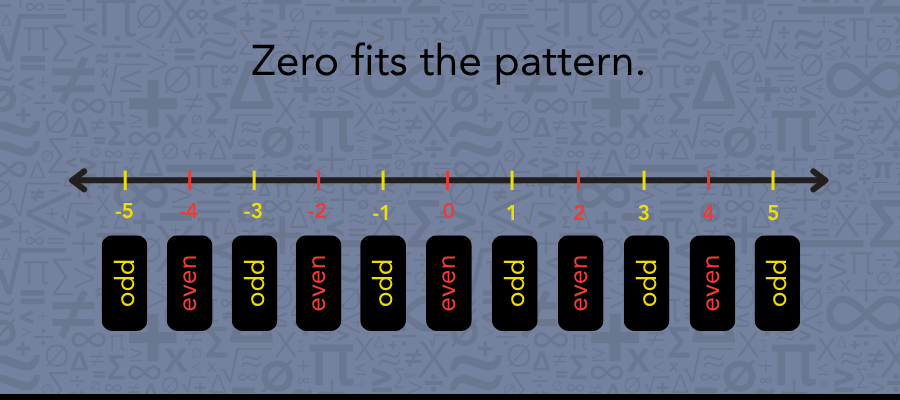
The pattern is consistent in both directions: negative numbers, positive numbers, and zero included. Odd, even, odd, even, without interruption. Zero completes the sequence
FAQs: Other Surprising Questions About Zero
Of all the numbers that raise questions, zero fills up more than its fair share. Here are the ones we hear most often at Mathnasium centers, with straight answers to each.
1. Is zero a whole number?
Yes. Whole numbers are the set of non-negative integers: 0, 1, 2, 3, and so on. Zero is included by definition.
2. Is zero a natural number?
This one depends on the context. In some definitions, the natural numbers start at 1. In others, particularly in formal mathematics and computer science, they start at 0. Both conventions exist, and neither is wrong.
3. Is zero divisible by every number?
Almost. Zero divided by any non-zero number equals zero, so yes, zero is divisible by every number except zero itself. Dividing by zero is undefined, which is a separate and important rule in mathematics.

Over 1,000,000 parents across the U.S. trust Mathnasium to build their children's math skills and confidence.
How Mathnasium Helps Students Build Solid Math Foundations
Mathnasium is a math-only learning center helping K-12 students of all skill levels learn and master math.
Our proprietary teaching approach, the Mathnasium Method™, starts with a diagnostic assessment that identifies exactly what a student knows and where the gaps are. From there, we build a personalized learning plan targeting what they need.
With the plan in place, our specially trained tutors work with students face-to-face, using natural everyday language rather than intimidating math jargon.
When something isn't landing, we break it down into smaller steps and explain both the how and the why, because a student who understands why a rule works will never have to re-learn it. Over time, that builds the kind of independent thinking that travels with them into every test and every new concept they encounter.
The results speak for themselves:
-
94% of parents report an improvement in their child's math skills and understanding
-
93% of parents report their child's improved attitude toward math after attending Mathnasium
-
90% of students saw an improvement in their school grades
We operate over 1,100 learning centers across North America, bringing our proven approach close to your community.
If you're located in or near Plano, TX, Mathnasium of Legacy West is the local center trusted by families from Legacy West, The Colony, West Plano, Lewisville ISD, and other nearby communities.
With over 100 five-star Google reviews, our community recognizes our dedication to building confident math thinkers.
Here’s what one parent had to share about our center.
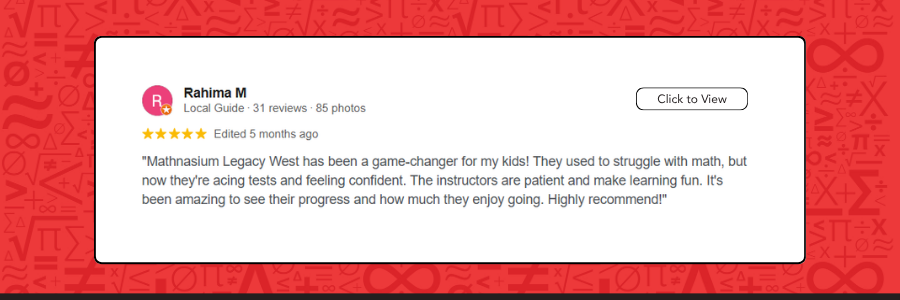
Whether your child is looking to catch up, keep up, or get ahead, our team is ready to help.
📅 Schedule a Free Diagnostic Assessment at Mathnasium of Legacy West
Not near Plano?
📍 Find Mathnasium Learning Centers Near You


 (214) 618-0558
 (214) 618-0558