Picture a straight road cutting across two parallel train tracks. The road crosses both tracks at an angle, creating a set of corners at each intersection.
In the world of geometry, this road would be called a transversal line, and the eight corners, or angles, it creates all follow predictable rules, making them perfect for geometry problems.
Without further ado, let’s explore some of these rules, starting with what a transversal line is, the four different angle relationships it creates, and ending with a short practice of what we learned today.

What Is a Transversal Line?
As we’ve mentioned, a transversal is a line that crosses two or more other lines at distinct points. From the previous example, that would be the road crossing the tracks.
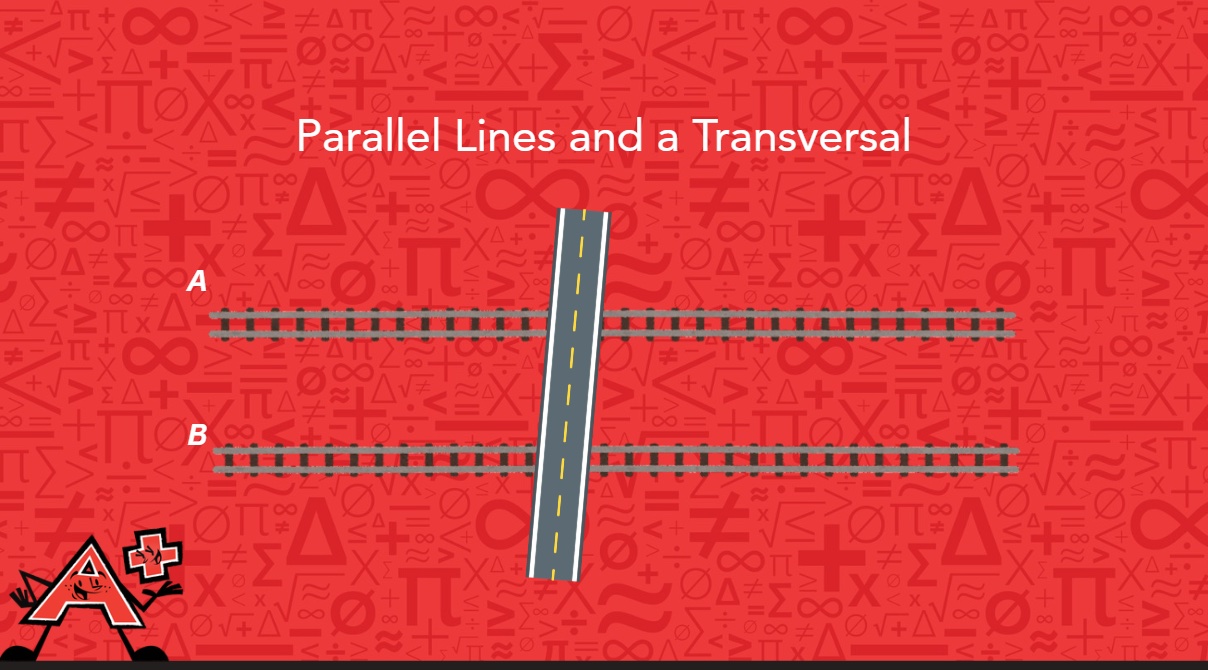
The lines it crosses do not have to be parallel. A transversal can cut across any two (or more) lines at any angle.
However, in most cases, geometry problems will have the transversal line go through two or more parallel lines, as this makes it possible to calculate the different angles the line creates.
This is why we will only be using parallel lines today.
Here’s what a simple diagram using a transversal line will usually look like.
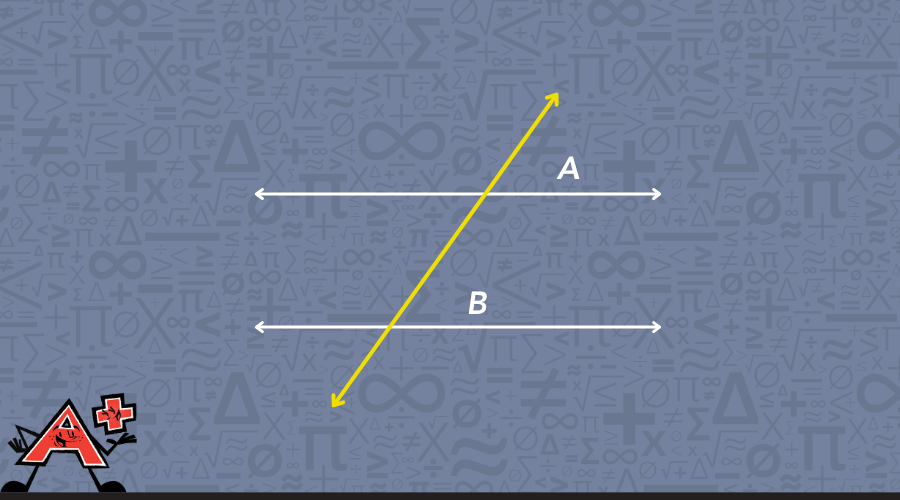
As we can see, the transversal line creates eight angles in total: four at the upper intersection and four at the lower intersection.
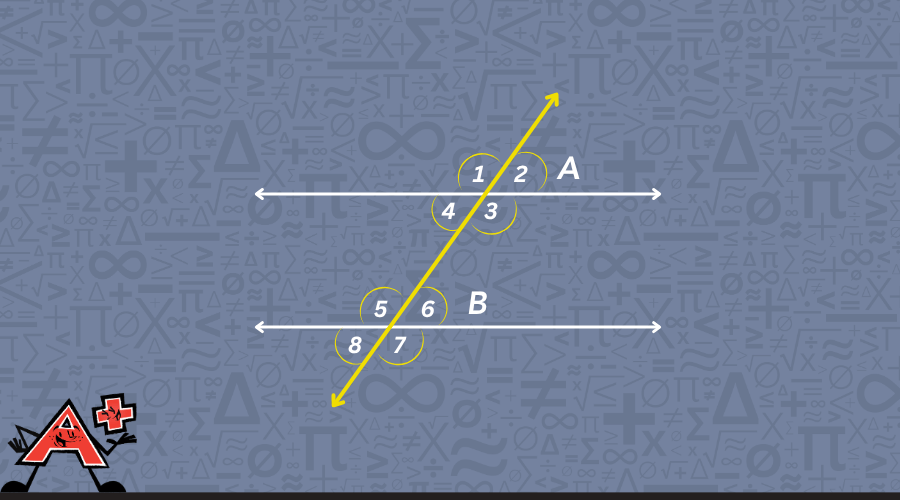
These angles have a consistent relationship with each other. This means we can calculate one unknown angle from the lower line with one from the upper line.
But first, we have to establish the type of relationship these angles have.
📕 You May Also Like: Types of Lines in Math – The Ultimate Kid-Friendly Guide
The 4 Angle Pairs a Transversal Creates
When a transversal crosses two parallel lines, the eight angles it creates fall into four groups based on where they sit and how they relate to each other.
We will go through each one with a concrete example so you can see exactly how they work.
📕 You May Also Like: Complementary and Supplementary Angles - A Complete Guide
1. Corresponding Angles
Corresponding angles are angles that sit in the same corner at each intersection.
So, if we look at the previous diagram and focus on just the upper line, we can see that angle 2 is in the upper right part. If we then look at just the lower line, we can see that angle 6 is also in the upper right part.
Those two are corresponding angles, and they are always equal when the lines are parallel.
Since each line has four sections, we have four pairs of corresponding angles. They are:
-
Angles 1 and 5
-
Angles 2 and 6
-
Angles 3 and 7
-
Angles 4 and 8
So, if angle 1 at the upper intersection measures 115°, what is angle 5 at the lower intersection?
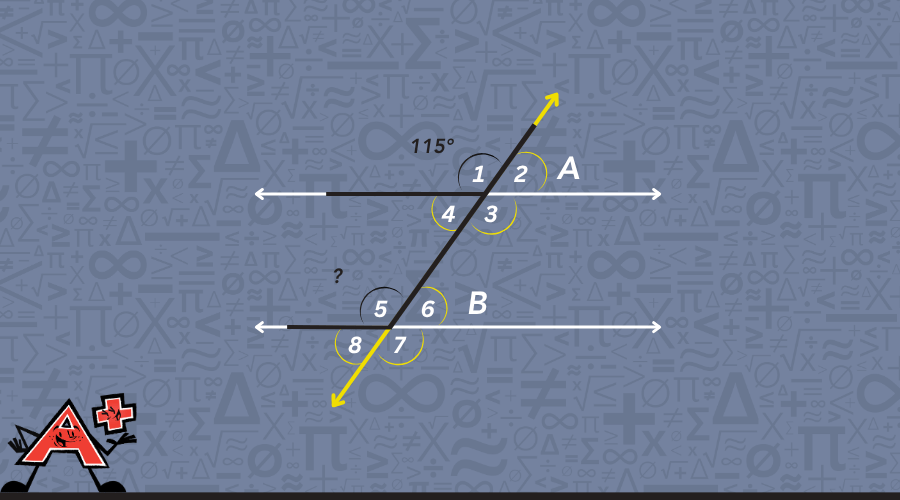
Because angle 5 sits in exactly the same corner as angle 1, they are corresponding angles. That means that angle 5 = 115° as well.
2. Alternate Interior Angles
Alternate interior angles are the angles that sit between the two parallel lines, on opposite sides of the transversal.
This means that we’re only looking at the lower two angles from line A and the upper two angles from line B.
A useful trick for spotting them is to trace the two angles and the part of the transversal between them. If they form a Z-shape or a reverse Z-shape, you know they are alternate interior angles.
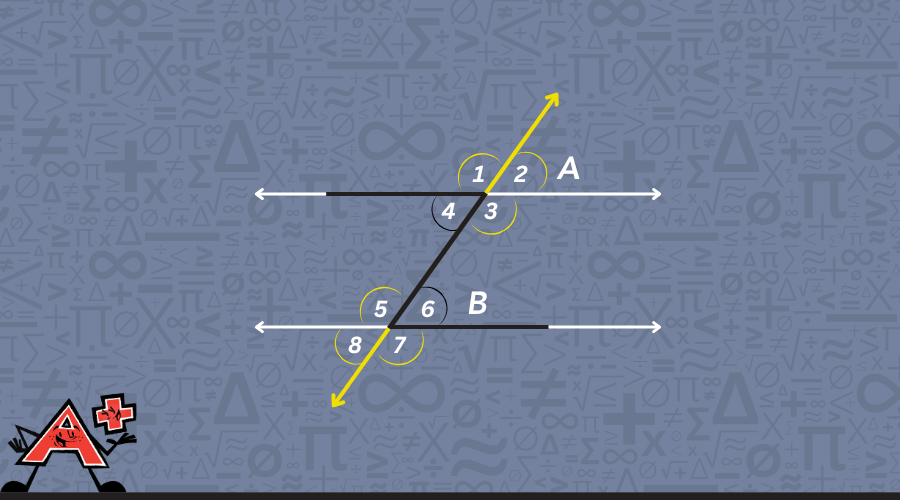
Alternate interior angles are always equal when the lines are parallel.
Like in the previous example, this means that if angle 4 measures 65°, angle 6 = 65° as well.
Since we’re only looking at half the angles, there are two pairs of alternate interior angles in our diagram:
-
Angles 3 and 5
-
Angles 4 and 6
📕 You May Also Like: Types of Angles: How to Identify Straight, Right, Acute, and Obtuse Angles?
3. Alternate Exterior Angles
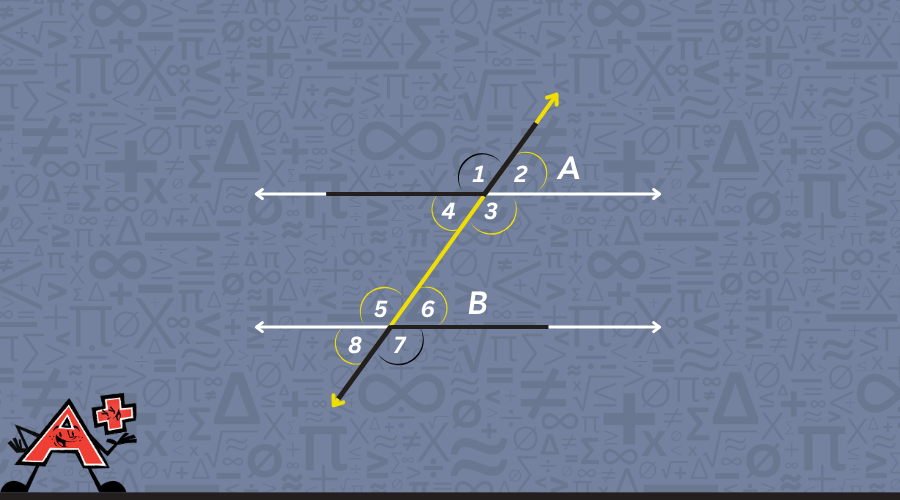
Alternate exterior angles are like alternate interior angles, but they sit outside the two parallel lines rather than between them.
This means we’re looking at the upper two angles on the A line and the lower two angles on the B line. From there, we just want to find angles that are on opposite sides of the transversal line.
Like last time, since we’re looking at only half the angles, there are only two alternate exterior pairs in our diagram:
This is the third group where the angle pairs are equal.
4. Co-Interior Angles
Co-interior angles sit between the two parallel lines, just like alternate interior angles. The key difference is that co-interior angles are on the same side of the transversal, not opposite sides.
Here too, we have a way of easily recognizing them, as If you trace them, they form a C-shape or U-shape.
This is the one relationship that catches people off because co-interior angles are supplementary, meaning they add up to 180°, rather than being equal.
The co-interior pairs in our diagram are:
-
Angles 3 and 6
-
Angles 4 and 5
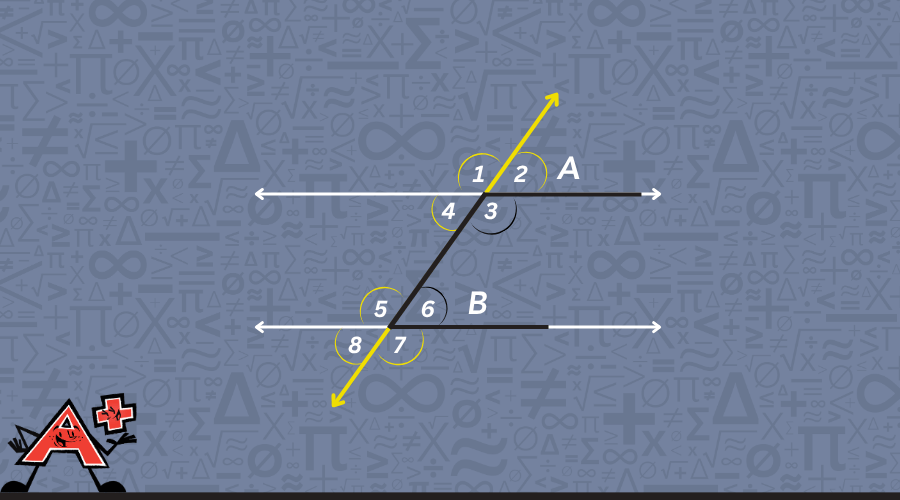
On geometry problems, calculating co-interior angles goes as follows:
-
If angle 3 measures 115°, what is angle 6?
-
Both angles sit between the parallel lines on the right side of the transversal, so they are co-interior angles.
-
That means they add up to 180°, so angle 6 = 180° - 115° = 65°.
If you’re uncertain whether two angles are co-interior angles, there is a simple check you can do.
Namely, co-interior angles will always be one acute and one obtuse angle. If both angles look the same size, you are probably thinking of alternate interior angles instead.
📕 You May Also Like: 10 Geometry Concepts Students Should Master Before 10th Grade
Practice Time: Try These Transversal Problems
Time to put it all together. Each problem below has its own diagram, so the angle values are different each time. For each one, find the missing angle and name the relationship you used.
1. Lines p and q are parallel. Angle 1 = 72°. What is angle 7?
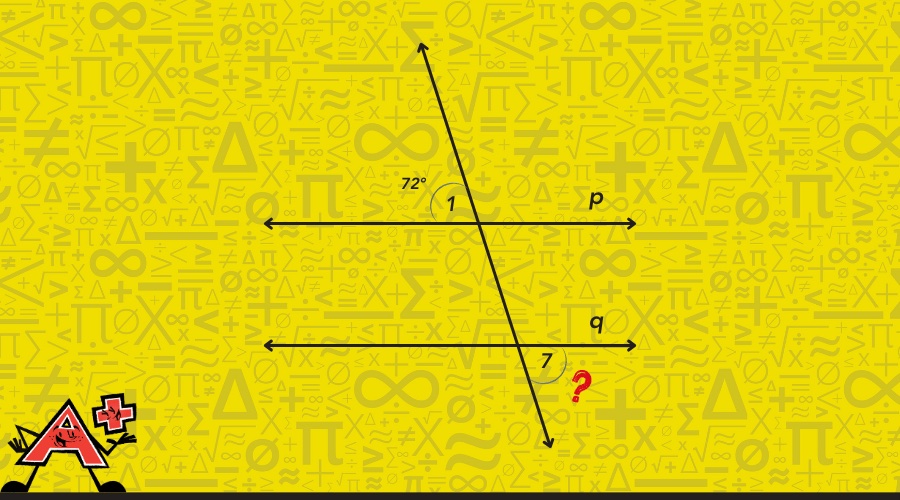
2. Lines p and q are parallel. Angle 4 = 108°. What is angle 5?
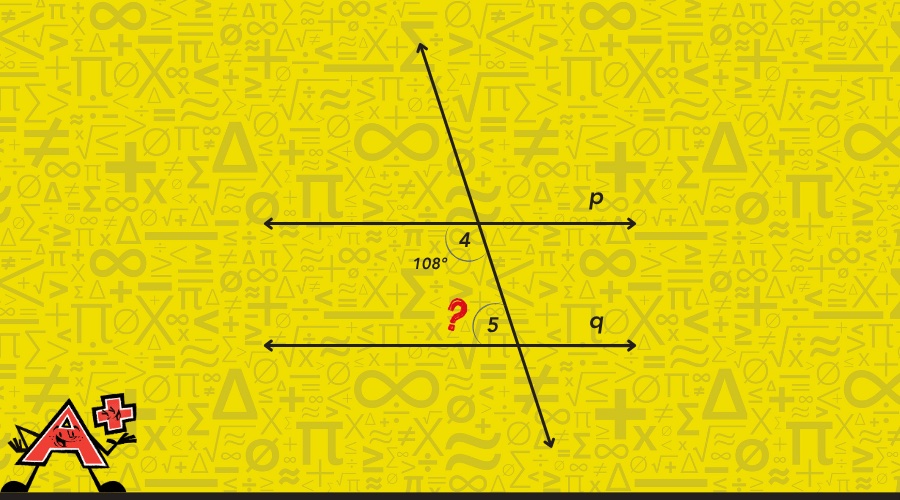
3. Lines p and q are parallel. Angle 3 = 97°. What is angle 5?
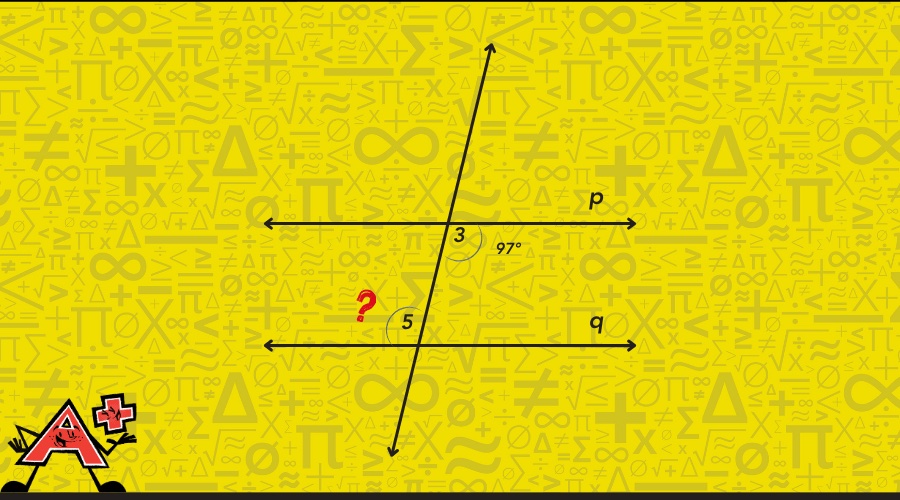
4. Lines p and q are parallel. Angle 3 = 119°. What is Angle 7?
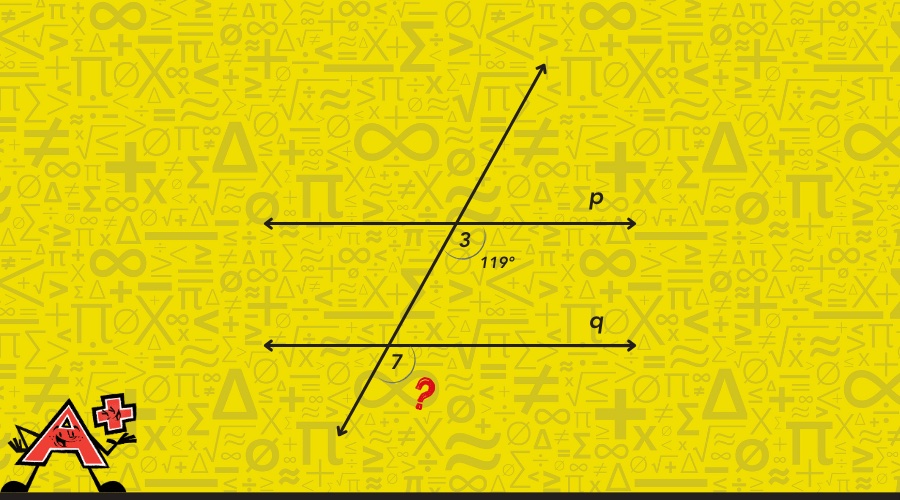
Check your answers at the bottom of the page!
FAQs About Transversal Lines
Here are the most common questions we hear from students working through this topic for the first time.
1. Does a transversal have to cross parallel lines?
No. A transversal is any line that crosses two or more other lines at distinct points, regardless of whether those lines are parallel.
Problems will typically rely on parallel lines because they create consistent, predictable angle relationships. When the two lines are not parallel, the angles at the two intersections will not follow the equal or supplementary rules we’ve described.
2. What is the difference between alternate interior and co-interior angles?
Both types sit between the two parallel lines, which is why they are easy to mix up. The difference is which side of the transversal they are on.
-
Alternate interior angles are on opposite sides of the transversal, they form a Z-shape, and they are equal.
-
Co-interior angles are on the same side of the transversal, they form a C-shape or U-shape, and they add up to 180°.
If you can identify the Z-shape, you are looking at alternate interior angles. If you see a C-shape, those are co-interior.
3. How do I decide which angle relationship to use when solving a problem?
Start by identifying where each angle sits relative to the parallel lines and the transversal, then ask two questions:
-
Are both angles between the parallel lines, or are both outside them?
-
Are they on the same side of the transversal, or on opposite sides?
Once you answer both these questions, you can quickly find out which relationship is at play:
-
Between the lines, opposite sides: alternate interior angles (equal).
-
Between the lines, same side: co-interior angles (supplementary).
-
Outside the lines, opposite sides: alternate exterior angles (equal).
-
Same position at each intersection: corresponding angles (equal).

Mathnasium tutors utilize real-world examples, images, and manipulatives to make geometry easier to understand.
Master Geometry With Mathnasium
Mathnasium is a math-only learning center dedicated to helping K-12 students learn and master math at every level, from the foundational concepts introduced in elementary school through the geometry and algebra of high school.
When students come to us working through topics like transversals and angle relationships, we provide personalized, hands-on guidance, building upon what they already know, addressing knowledge gaps, and moving their pace until they build a deep understanding of these concepts.
Our proprietary approach, the Mathnasium Method™, is built to help students truly understand why the math works, not just how to apply it on a test.
To foster lasting mastery, our approach relies on six core principles:
-
Personalization on a granular level: Each student begins with a diagnostic assessment that identifies their strengths, knowledge gaps, and how they think through problems. Tutors then follow personalized learning plans that build steady, structured progress toward the concepts each student actually needs.
-
Teaching for understanding: We use clear, everyday language to explain math and back every concept with visual, verbal, written, mental, and hands-on techniques so students develop genuine understanding rather than surface familiarity.
-
Caring instruction: Our tutors provide patient, caring guidance in a fun group environment where students feel comfortable asking questions and working through material that challenges them.
-
Independent problem solving and critical thinking: Each session includes dedicated time for students to work through problems on their own. Tutors help them understand both how and why a concept works, which is what allows students to apply it confidently across different topics and formats.
-
Singular focus on math: Our program spans thousands of pages and has been continuously refined over more than 20 years. That singular focus means everything we do is built around how students best absorb, retain, and apply mathematical thinking.
-
Empowering, fun learning environment: Our sessions are designed to be engaging and rewarding. We use game-based materials and give students the opportunity to earn recognition as they advance, keeping motivation high throughout the learning process.
And the results speak for themselves:
-
94% of parents report an improvement in their child's math skills and understanding
-
93% of parents report an improved attitude toward math after attending Mathnasium
-
90% of students saw an improvement in their school grades
With over 1,100 centers, we bring the Mathnasium Method™ close to your community.
If you're in the Littleton, CO, area, you're in great hands. With 100+ glowing Google reviews, Mathnasium of Littleton has earned the trust of families throughout the community, serving as your local partner to rebuild math confidence.
Here’s what one parent had to share about our center:

Whether your student is looking to catch up, keep up, or get ahead in math, we’re here to help!
Ready to get started?
📅 Schedule a Free Diagnostic Assessment at Mathnasium of Littleton
Not near Littleton?
📍 Find Mathnasium Learning Centers Near You
Pssst! Check Your Answers Here
-
Angle 7 = 72°. Angles 1 and 7 are alternate exterior angles (equal).
-
Angle 5 = 72°. Angles 4 and 5 are co-interior angles (supplementary).
-
Angle 5 = 97°. Angles 3 and 5 are alternate interior angles (equal).
-
Angle 7= 119°. Angles 3 and 7 are corresponding angles (equal).


 (303) 979-9077
 (303) 979-9077