Triangles are everywhere, from the slice of pizza on your plate to the roof above your head, but figuring out how much space they cover can leave kids scratching their heads.
If your child has started learning about the area of triangles, you might have noticed some confusion setting in. Maybe they're mixing up which numbers to use or forgetting why they need to divide by 2. Sometimes, they just get stuck when the triangle doesn't look like the examples in their textbook.
That's completely normal. Triangle area is one of those topics that seems simple on the surface but requires a deeper understanding of where the formula comes from and how to apply it to different shapes.
So, today our tutors are going to break it down in a way that makes sense, using visual examples, real-world connections, and step-by-step practice problems.

First, Let’s Make Sense of Area
When you hear the word "area," what comes to mind?
Maybe you think about the size of your backyard, or how much wrapping paper you need to cover a gift box.
In math, area is simply the amount of space inside a flat or two-dimensional (2D) shape. It tells us how much surface that shape covers.
Think of it like this: if you wanted to put wallpaper on a wall, the area would tell you how much wallpaper you’d need to cover it from corner to corner.
We measure this area in squared units: square inches, square feet, square centimeters, and so on.
Why "square" units? Because we're essentially counting how many little 1x1 squares would fit inside the shape.
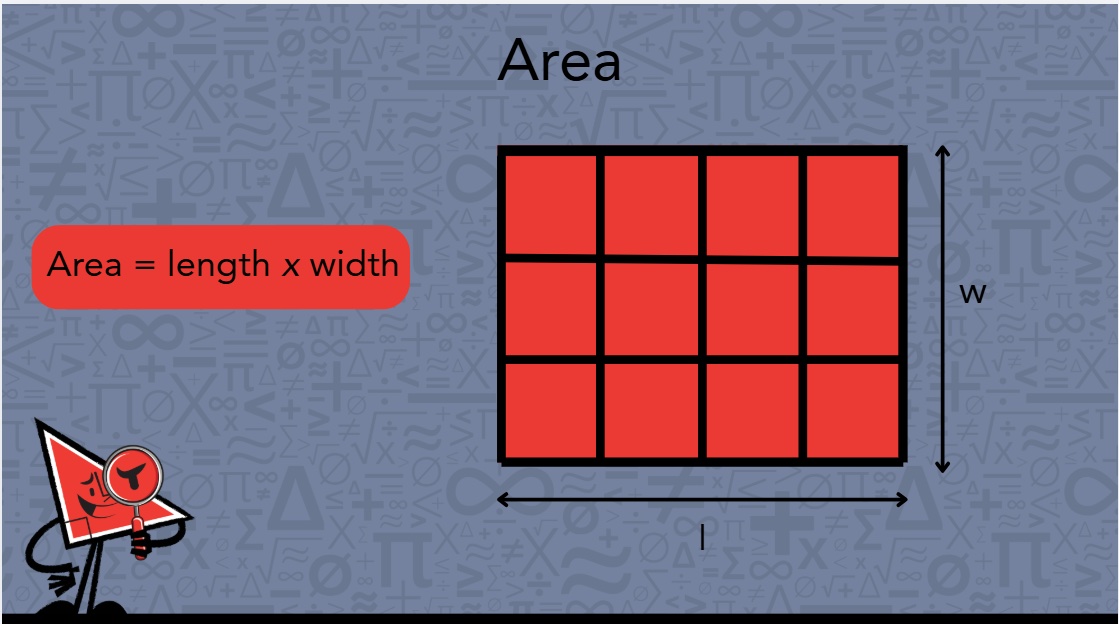
Picture a rectangle that's 4 units wide and 3 units tall. If you drew a grid inside it, you could actually count the little squares: one row has 4 squares, and there are 3 rows total. That gives you 4 × 3 = 12 square units.
This is why we multiply length times width for rectangles. We're really just counting those little boxes in a smart way instead of counting them one by one.
But what about triangles?
They have those slanted sides and pointed corners. You can't fill a triangle with neat rows of squares the same way. Some squares along the edges would stick out, and others wouldn't quite fit. So how do we count the space inside?
Here's where it gets interesting: triangles are actually closely connected to rectangles and squares.
In fact, understanding that connection is the secret to making a triangle area simple.
Let's explore that relationship, starting with the easiest type of triangle to understand.
📕 You May Also Like: Guide to Understanding the Surface Area of a Rectangular Prism
Start With Right Triangles—The Easiest Way to Learn Area
To understand how to find the area of a triangle, we’re going to start with right triangles, as they’re the easiest to work with.
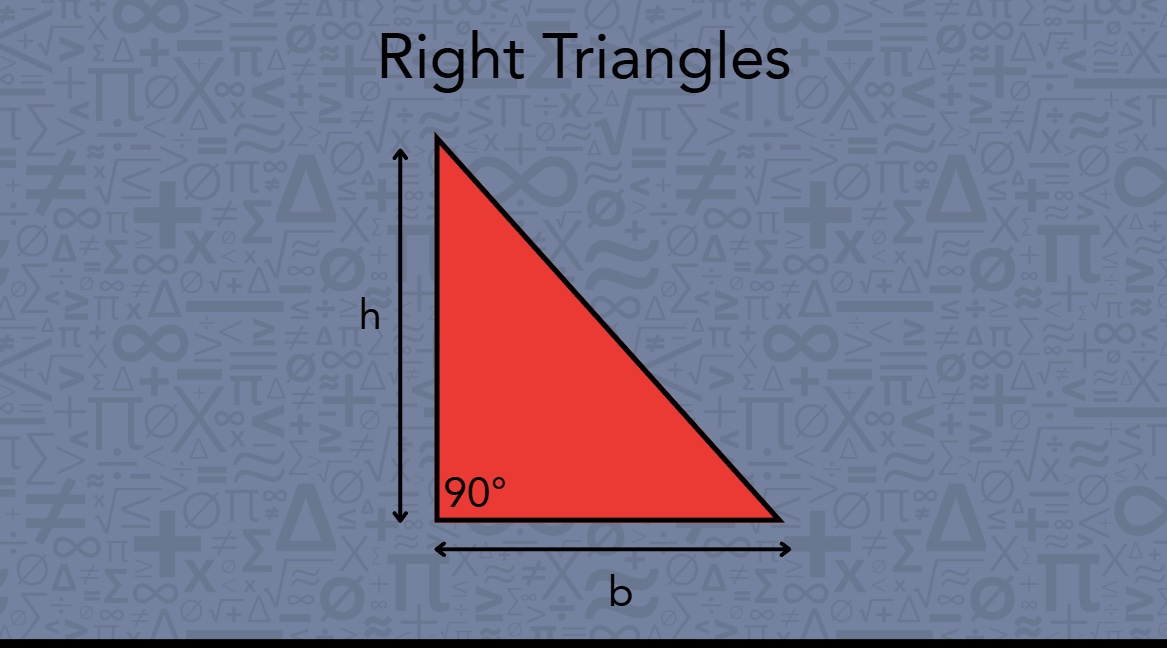
As a reminder, a right triangle is a triangle with one square corner, just like the corner of a book or a picture frame. It has a flat bottom and a straight vertical side that meet at the right angle.
The third side, the slanted one, connects them.
We need to give these sides names so we can talk about them clearly:
-
The base (b) is the bottom side of the triangle.
-
The height (h) is the vertical side that goes straight up from the base.
-
The slanted side is called the hypotenuse, but we won’t need it for this formula because the area of a triangle is based on height and base, not side lengths or angles.
Once we know the base and the height, we can calculate the area. To better visualize this process, we’re going to use the following method.
The Double Triangle Trick
Here’s a clever way to understand why the formula for a triangle’s area is what it is.
Start with a right triangle. Now imagine making an identical copy and flipping it over. Place the second triangle next to the first one so that their slanted sides (the hypotenuses) are touching.
What shape do you end up with?
A rectangle!
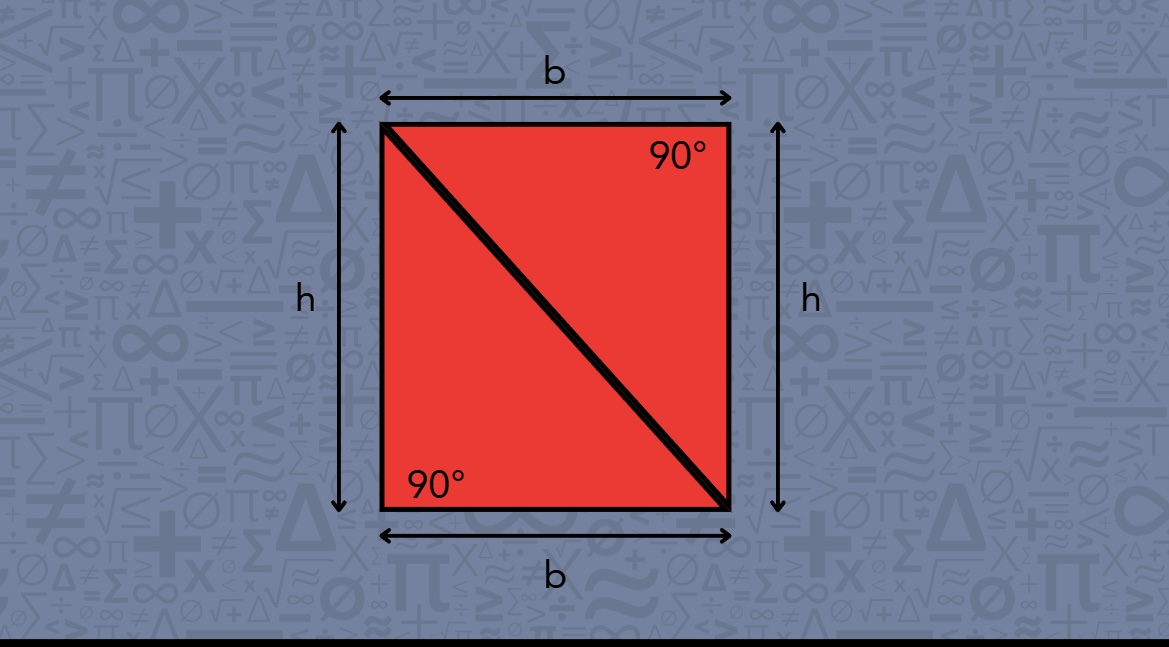
The original triangle’s base becomes the rectangle’s width. Its height stays the same. And because the two triangles fit together perfectly to fill the rectangle, that rectangle has twice the area of one triangle.
Since the area of a rectangle is:
Area = base (width) × height
And your triangle is exactly half of that rectangle, the triangle’s area is:
Area = \(\Large\frac{1}{2}\) × base × height
Let’s try it with numbers. Say your triangle has a base of 6 units and a height of 9 units. Put two of those triangles together, and you get a 6-by-9 rectangle.
Area of rectangle = 6 × 9 = 54
Area of triangle = \(\Large\frac{1}{2}\) × 6 × 9 = \(\Large\frac{54}{2}\) = 27
Makes sense, right?
📕 You May Also Like: Perimeter vs. Area: Why Kids Mix Them Up
What If the Triangle Isn't a Right Triangle?
The method we just used to figure out the triangle area works for every triangle, not just right triangles!
Whether your triangle is tall and skinny, short and wide, or even if it leans to one side, you can always use:
Area = 12 × b × h
The method stays exactly the same. The only thing that changes is how we find and measure the height.
What do we mean by this?
With a right triangle, finding the height was easy because one side of the triangle already stood straight up from the base.
But what about triangles that don't have that convenient right angle?
In these cases, we will have to identify the height ourselves.
The key is understanding this: the height must always be measured as the perpendicular distance from the base to the opposite point.
In simpler terms, the height is always a straight line that forms a right angle with the base.
📕 You May Also Like: How to Identify Straight, Right, Acute, and Obtuse Angles?
Triangle Area Examples for Different Angles
Let's work through two examples with triangles that aren't right triangles. This will show you how the same method for finding area applies no matter what the triangle looks like.
Example 1: An Acute Triangle
An acute triangle is one where all the angles are less than 90 degrees (also called acute angles).
Because none of the angles are right angles, none of the sides stand perfectly vertical. This means that we have to figure out the height ourselves.
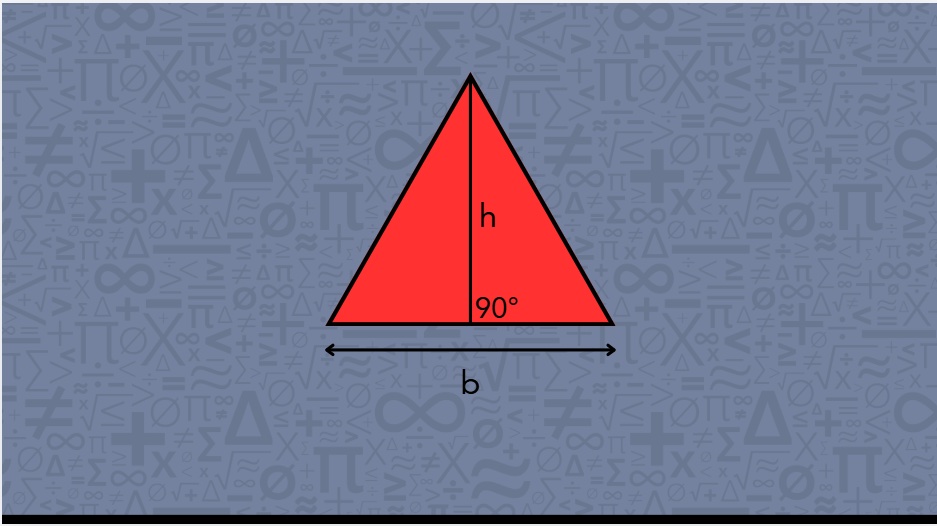
Let’s look at the picture below. See the line coming straight down from the top point to the base?
That's the height! Notice how it makes a perfect 90-degree corner with the base. The height line also splits the triangle into two pieces.
Now, to work back to the area.
In the picture below, notice the yellow dashed lines. They form a rectangle using the triangle’s height and base. That rectangle is twice as large as the red triangle, because the triangle takes up exactly half the space.
Why? Because the height is the same, the triangle fits neatly into one half of the rectangle.
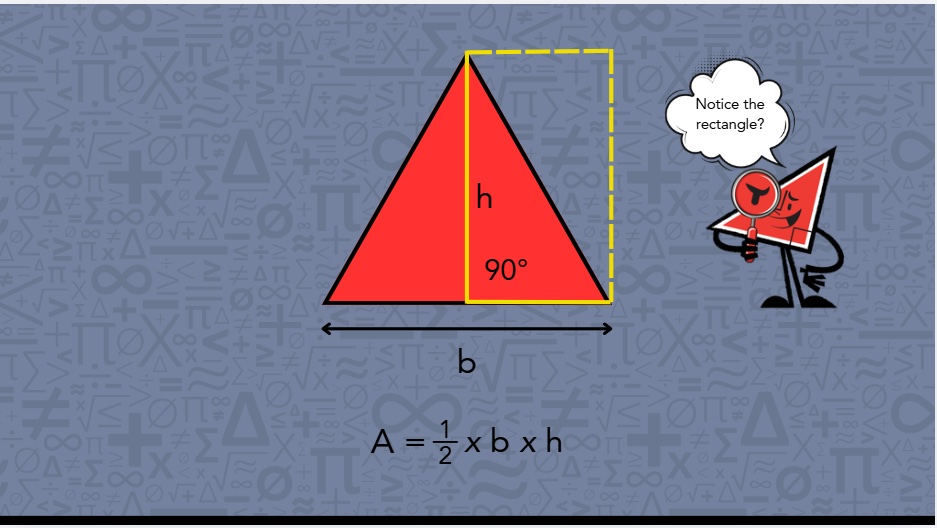
So, we’ve come right back to A = \(\Large\frac{1}{2}\) × b × h
Since we know why the same method works for acute triangles, let's find the area of one with a base of 12 inches and a height of 8 inches.
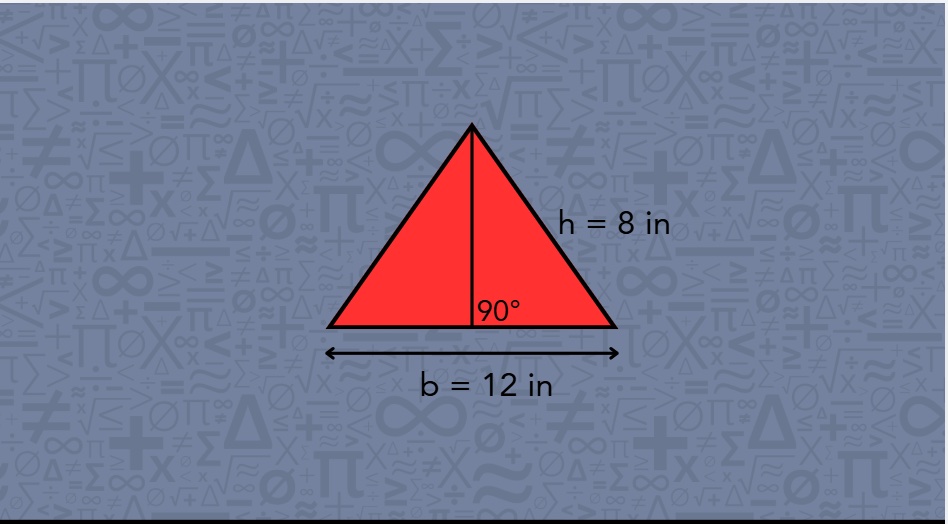
Even though this isn't a right triangle, the process is identical to what we did before.
If we know A = \(\Large\frac{1}{2}\) × b × h, we can just supply values:
A = \(\Large\frac{1}{2}\) × 12 × 8
Now do the math:
See? Exactly the same steps, even though the triangle has a different shape.
Example 2: An Obtuse Triangle
An obtuse triangle is one that has one angle greater than 90 degrees.
These triangles can look like they’re leaning to one side.
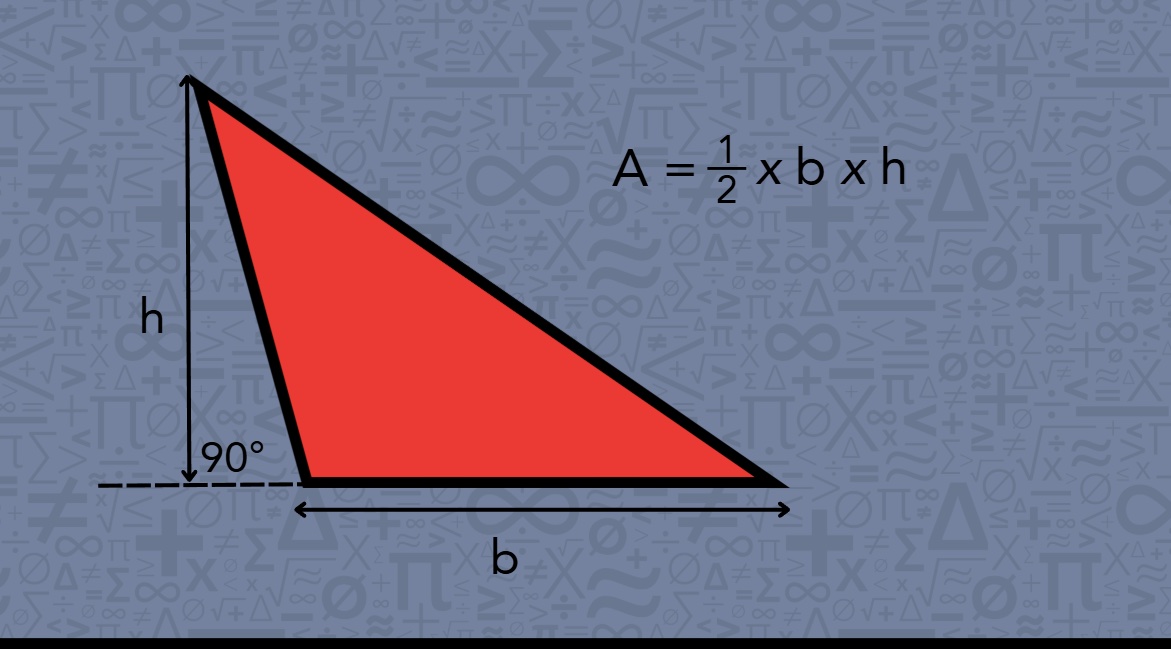
Here’s what to watch for: when you draw the height from the top vertex (the point opposite the base), it might land outside the triangle. That’s normal for obtuse triangles.
To measure it correctly, extend the base into a straight line. Then, draw a line from the top vertex straight down to that extended base, forming a right angle. That’s your height.
Even though the triangle looks different, the method for finding the area is still the same.
Say we want to find the area of an obtuse triangle with a base of 15 inches and a height of 6 inches.
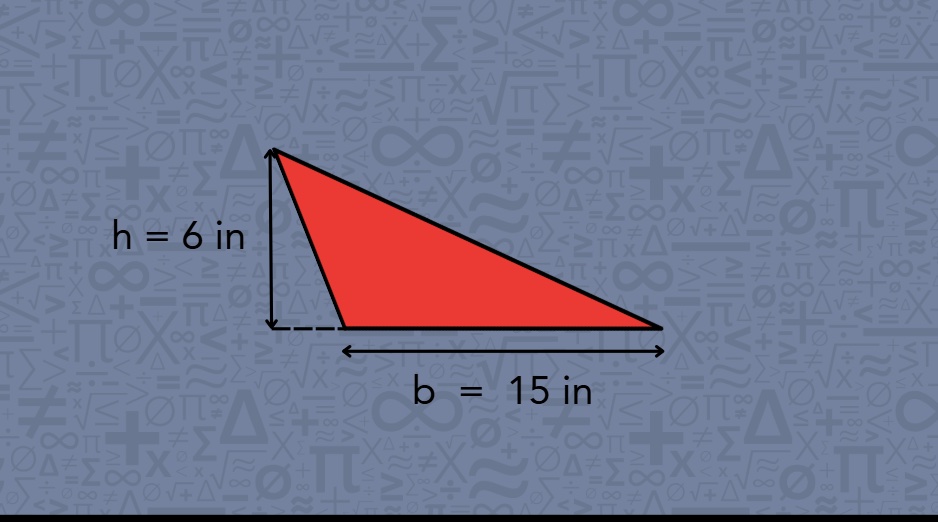
Using our reliable formula A = \(\Large\frac{1}{2}\) × b × h, we calculate:
-
A = \(\Large\frac{1}{2}\) × 15 × 6
-
A = \(\Large\frac{1}{2}\) × 80
-
A = \(\Large\frac{80}{2}\)
-
A = 40 in2
The shape of the triangle might look different, and the height might be in a different spot, but the math stays the same.
Triangle Area Quiz: Let's See What You Know
Now that you've learned about triangle area, let's test your understanding!
When you finish, check your answers at the bottom of the guide!
Question 1: What does "area" mean in mathematics?
a) The distance around the outside of a shape
b) The amount of space inside a flat, two-dimensional shape
c) The length of the longest side of a shape
d) The number of corners a shape has
Question 2: Why is area measured in "square" units (like square inches or square centimeters)?
a) Because all shapes with area must be squares
b) Because the area is always an even number
c) Because we're counting how many 1x1 squares would fit inside the shape
d) Because the formula always includes the number 2
Question 3: Do we need to know the hypotenuse to calculate the area of a right triangle?
a) Yes, the hypotenuse is always required for any triangle area calculation
b) No, we only need the base and height
c) Yes, but only if the triangle is also obtuse
d) Yes, but only if the height of the triangle is greater than the base
Question 4: How are the areas of rectangles and triangles related?
a) A triangle's area is always twice the area of a rectangle with the same base and height
b) A triangle's area is exactly half the area of a rectangle with the same base and height
c) There is no relationship between the rectangle and the triangle areas
d) A triangle's area equals a rectangle's area when they have the same perimeter
Question 5: What happens to the area formula when you're working with an obtuse triangle instead of a right triangle?
a) You no longer divide the result by two: A = b × h
b) You need to add the hypotenuse to the calculation: A = \(\Large\frac{1}{2}\) × b × h + c
c) The formula stays exactly the same: A = \(\Large\frac{1}{2}\) × b × h
d) You must divide by 4 instead of 2: A = \(\Large\frac{1}{4}\) × b × h
Question 6: A triangle has a base of 8 inches and a height of 5 inches. What is its area?
a) 40 square inches
b) 13 square inches
c) 20 square inches
d) 80 square inches
Frequently Asked Questions About Triangle Area
Parents and students often have similar questions when learning about triangle areas. Here are answers to some of the most common ones.
1. When do students typically learn how to find the area of a triangle?
Most students learn how to find the area of a triangle in fifth or sixth grade, usually around ages 10 to 12. The exact timing can vary depending on the curriculum and the school district.
Before tackling the triangle area, students typically need to be comfortable with a few foundational skills. They should understand multiplication and division well, since the triangle area formula requires both operations.
2. Can you find the area if you only know the three sides of a triangle?
Yes, you can! There's a special formula called Heron's Formula that lets you calculate the area of a triangle when you know the lengths of all three sides but don't know the height.
However, Heron's Formula is more advanced and involves several steps. It's not usually taught until high school geometry, often in ninth or tenth grade. For this reason, we will have a separate guide for it.
3. What if the triangle is upside down or rotated? Does the formula change?
The formula never changes, no matter which way the triangle is pointing or how it's rotated on the page.
The only thing you need to pay attention to is making sure you correctly identify which measurement is the base and which is the height. Remember, the height must always be perpendicular (at a right angle) to the base. As long as you keep that relationship clear, you can choose any side to be your base.
4. Do you always need to draw the height inside the triangle?
No, and this is an important point that sometimes confuses students.
For some triangles, especially obtuse triangles (ones with an angle larger than 90 degrees), the height actually falls outside the triangle. When this happens, you need to imagine extending the base as a longer line, then drawing the height from the opposite point straight down to meet that extended line at a right angle.
This might seem strange at first. How can the height be outside the triangle? But remember, the height is a measurement, not necessarily a physical part of the triangle itself. It's the perpendicular distance from the base (or the base extended) to the opposite point.

Our expert tutors are always happy to answer any additional questions about geometry.
How Mathnasium Helps Students Master Any Math Concept
Mathnasium is a math-only learning center dedicated to helping K–12 students of all levels excel in math.
In our centers, we've worked with many elementary and middle school students who struggle with geometry concepts like area and perimeter. Our programs are designed to build a strong foundation in these topics, making sure students don't just memorize formulas but truly understand where they come from and how to apply them.
Behind each of our programs is not a one-size-fits-all curriculum, but a proprietary teaching approach called the Mathnasium Method™. Unlike rote drills or shortcuts, our method is built to help students truly make sense of what they're learning.
We support math mastery through:
-
Personalized learning: Each student begins with a diagnostic assessment that helps us identify their current skills, knowledge gaps, and how they naturally think through math. We use those insights to build a custom learning plan tailored to their needs.
-
Teaching for understanding: We explain math in clear, everyday language, using a mix of verbal, visual, mental, tactile, and written techniques. This allows students to approach each concept in the way that makes the most sense to them. When teaching triangle areas, for example, we might use physical shapes, drawings, or real-world examples to help the concept click.
-
Caring, responsive tutors: Our tutors are specially trained in both the technical and emotional aspects of teaching. They know when to guide, when to challenge, and how to help students regain trust in their thinking.
-
Independent problem-solving and critical thinking: We give students space to work through challenges on their own, then rejoin them to check their reasoning. Instead of just giving the answer, we help them understand the how and why. This helps them develop problem-solving skills and critical thinking tools they can use in math and in life.
-
A singular focus on math: We specialize in math and math only. Our robust, individually-tailored programs span thousands of custom materials built around how students actually learn and retain math skills.
-
A supportive, fun environment: Many of our activities are hands-on or game-based. We use reward systems and consistent encouragement to keep students engaged. And we celebrate progress because confidence grows with every win.
The result? Real, measurable progress.
-
94% of parents report improvement in their child's math skills and understanding
-
93% of parents notice a more positive attitude toward math
-
90% of students see higher grades in school
Mathnasium operates over 1,100 learning centers across the U.S., bringing our proven approach close to your community.
For families in or near Mason, Ohio, Mathnasium of Mason is a trusted local center with years of experience transforming how students think and feel about math.
The center has been recognized with impressive accolades, including:
If your child is ready to build confidence and truly understand math concepts like triangle area, our team is happy to assist.
📅 Schedule a Free Diagnostic Assessment at Mathnasium of Mason
Not located near Mason?
📍 Find a Mathnasium Learning Center Near You
Pssst! Check Your Answers Here
If you’ve given a quiz a try, check your answers below:
-
b) The amount of space inside a flat, two-dimensional shape
-
c) Because we're counting how many 1x1 squares would fit inside the shape
-
b) No, we only need the base and height; the hypotenuse isn't used in the area formula
-
b) A triangle's area is exactly half the area of a rectangle with the same base and height
-
c) The formula stays exactly the same: A=\(\Large\frac{1}{2}\) × b × h
-
c) 20 square inches


 (513) 683-9800
 (513) 683-9800