8th grade is the final year of middle school and, in math, one of the most consequential.
Students are working through linear functions, algebraic reasoning, the Pythagorean theorem, and statistical thinking. All of these form the direct foundation of high school math.
For parents, this year brings a common challenge: wanting to help but feeling less confident with content that has moved well beyond what they remember from their own school days.
We see you, and we’ve got you covered! We put together a list of thoughtful, content-specific strategies for supporting your 8th grader through this critical year.

What the Common Core Expects From 8th Graders in Math
Before we discuss strategies, it helps to understand what 8th-grade math actually covers. Common Core organizes 8th-grade math into five domains, each building meaningfully on 7th grade and pointing directly toward high school algebra and geometry.
-
The Number System: Extending understanding of rational numbers to include irrational numbers like √2 and π, and working with their decimal approximations
-
Expressions and Equations: Solving linear equations with one variable, understanding and applying the properties of integer exponents, and working with scientific notation
-
Functions: Understanding what a function is, comparing linear and non-linear functions, and interpreting the rate of change and initial value of linear functions in real-world contexts
-
Geometry: Applying the Pythagorean theorem to find distances in two and three dimensions, understanding congruence and similarity through transformations
-
Statistics and Probability: Constructing and interpreting scatter plots, understanding patterns of association, and using linear models to solve problems involving bivariate data
📕 You May Also Like: What Parents Need to Know About Common Core Math Standards
Strategies for Supporting Your 8th Grader in Math
Supporting an 8th grader in math starts with understanding where the conceptual friction points are and knowing how to help them work through them.
The strategies our tutors suggest are specific to the content and challenges of 8th-grade math, and each one is grounded in how students at this level build understanding.
1. Build Fluency With Integer and Rational Number Operations
8th-grade algebra assumes automatic comfort with negative numbers, fractions, and decimals. Gaps in these areas from earlier grades are common and can slow down every algebraic manipulation a student attempts this year.
To support your student’s fluency in these skills, you can:
-
Use a number line for integer operations. Have your child plot additions and subtractions like -5 + 8 or -6 - (-3) and explain which direction they are moving and why. This builds the intuition behind why subtracting a negative adds, a concept that trips up many students in linear equations.
-
Practice fraction and decimal conversions with visuals. Shade fraction bars or circles to represent something like \(\Large\frac{2}{5}\), then convert to a decimal by dividing. Reversing the process and comparing equivalents like \(\Large\frac{3}{4}\) = 0.75 = 75% helps students spot patterns without reaching for a calculator.
-
Run quick diagnostics on multiplication and division rules. Ask your child to solve -6 × (-5) or \(\Large\frac{2}{3}\) ÷ \(\Large\frac{1}{6}\) and explain the reasoning behind their answer in plain language. Five to ten of these daily, using real contexts like temperature changes or ingredient amounts, builds both automaticity and understanding.
-
Apply operations to real-world problems. Calculating a 20% discount on a $35 item, or halving \(\Large\frac{2}{3}\) cup in a recipe, connects fluency to situations students actually encounter. It reduces hesitation when the same operations appear inside an equation.
📕 You May Also Like: How to Convert Fractions to Decimals (& Vice Versa)
2. Address Scientific Notation and Irrational Numbers Through Real-World Scale
Scientific notation and irrational numbers are two concepts that could feel disconnected and arbitrary to 8th graders. This is largely because they are introduced as procedures without context. Grounding them on a real-world scale changes that.
To make these concepts tangible, we recommend:
-
For scientific notation, start with a number your child finds surprising; the distance from Earth to the Sun is approximately 1.5 × 10⁸ kilometers, or the diameter of a red blood cell is about 8 × 10⁻⁶ meters. Ask your child to write these out in full and discuss why scientific notation exists. The format stops feeling arbitrary once the scale problem it solves becomes visible.
-
For π, measure the circumference and diameter of a round object at home, a plate, a cup, a coin, and divide one by the other. The result will always be close to 3.14. That hands-on discovery makes π feel like an observed truth rather than a memorized symbol.
-
For √2, draw a square with sides of 1 unit and ask your child to find the length of the diagonal using the Pythagorean theorem. The answer, √2, appears naturally from a shape they can see and touch.
📕 You May Also Like: Is Pi a Rational or Irrational Number? A Kid-Friendly Guide
3. Reinforce the Pythagorean Theorem Through Application
The Pythagorean theorem is among the most commonly memorized concepts in 8th-grade math.
Our tutors frequently see students who can recite a² + b² = c² but stumble when asked to find the distance between two points on a coordinate grid or explain why that side relationship actually works.
The formula is there, but the understanding behind it is not.
To help your student move beyond the formula, you can try these tips:
-
Ask your child to explain the theorem in plain language, without using variables. If they cannot describe what the relationship between the three sides actually means, the formula has been memorized without the geometry behind it being grasped.
-
Draw it out. Have your child sketch a right triangle, label the sides, and show where a², b², and c² appear as actual squares. Seeing the areas makes the relationship between the sides feel concrete, not abstract.
-
Try a real-world problem together. Measure the length and width of a room at home and calculate the diagonal. Or plot two points on a piece of graph paper and challenge your child to find the distance between them. Either exercise will quickly reveal whether the theorem has been understood or simply stored.
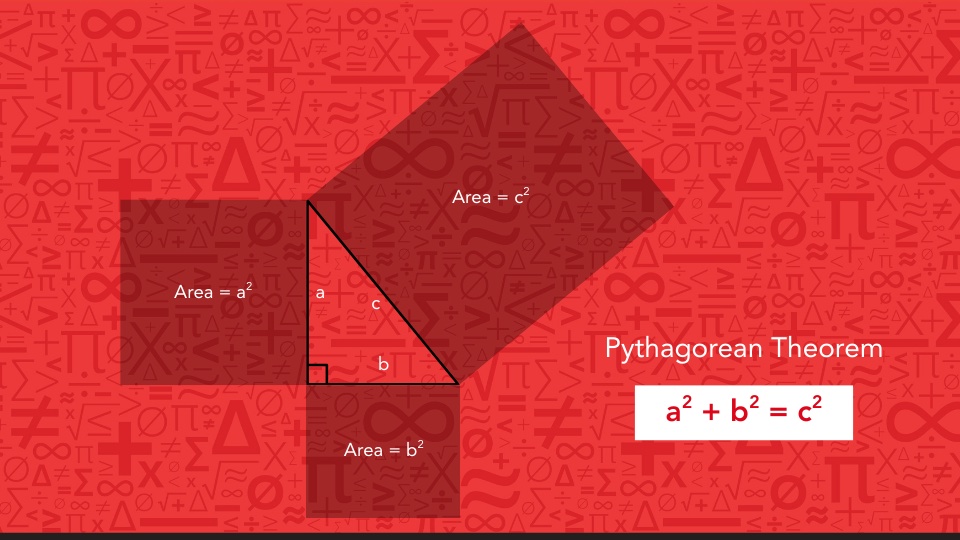
Seeing the three squares built on each side of a right triangle makes the relationship between a², b², and c² far easier to grasp than the formula alone.
4. Help Your Child Visualize Linear Functions
Linear functions are the conceptual heart of 8th-grade math and the foundation of high school algebra.
Speaking from experience, the jump from arithmetic to functions is one of the hardest abstract leaps students make at this level.
So what helps?
The same principle that worked for scientific notation and the Pythagorean theorem applies here, too: start with something your child can picture.
-
Use speed and distance. Ask, "If we drive at 55 miles per hour, how far will we be in 2 hours? And in 4?" Then plot those points on a graph together. The straight line that emerges is a linear function, and the steepness of that line represents how fast the distance is changing.
-
Try the cost per item. If one notebook costs $3, how much do five cost? Ten? Plotting those values produces the same straight line, and the slope becomes the price per item. The graph stops being abstract and starts being a picture of something real.
-
Connect the graph to the equation. After your student can see the pattern in the graph, introduce y = mx + b and ask them to identify what m and b represent in their real-world example. That connection between the visual and the algebraic is where function understanding takes hold.

Through personalized instruction and interactive teaching techniques, Mathnasium helps 8th graders of all skill levels reach their goals in math.
How Mathnasium Helps 8th Graders Excel in Math
Mathnasium is a math-only learning center empowering students of all skill levels to excel in math.
Across our centers, we have worked with thousands of 8th graders to support them through this critical part of their math journey. We offer a dedicated middle school program that covers the challenging concepts 8th graders face, from linear functions and the Pythagorean theorem to scientific notation, irrational numbers, and statistical reasoning.
Behind that program is not a one-size-fits-all system but a proprietary teaching approach we call the Mathnasium Method™.
To build the solid math foundations 8th graders need to carry into high school, our approach relies on:
-
Customization on a granular level: Each student begins with a diagnostic assessment, helping us pinpoint what they already know and where they need support. With these insights, we develop a learning plan customized to their needs.
-
Teaching for understanding: We explain math using everyday language and support each concept with a mix of visual, verbal, mental, tactile, and written techniques. This helps students truly make sense of what they’re learning.
-
Caring tutors: Our tutors are trained not just in math but in how to connect with students. They know how to support a child who’s feeling frustrated by math and how to challenge one who’s ready for more.
-
Problem-solving and critical thinking: We always allow time for productive struggle, helping students trust their own thinking. We guide them to see both the how and the why behind each concept. The goal is for them to develop critical thinking skills they can use in math and beyond.
-
Singular focus on math: Our method spans thousands of pages dedicated to math only. This singular focus on math allows us to have a deeper insight into how students best absorb, learn, and retain skills.
-
Empowering learning environment: Our learning environment is confidence-building and fun. Our materials are often game-based, and we give students a chance to earn rewards to keep them motivated as they continue advancing to higher levels of achievement.
And the results?
-
94% of parents report an improvement in their child's math skills and understanding
-
93% of parents report an improved attitude towards math after attending Mathnasium
-
90% of students saw an improvement in their school grades
With a network of over 1,100 centers, Mathnasium brings top-rated instruction close to your community.
If you’re near Phoenix, AZ, Mathnasium of Paradise Valley is a local center families trust to help kids thrive in math and enjoy it along the way.
Whether your 8th grader is looking to catch up, keep up, or get ahead on their math journey, we’re more than happy to assist.
📅 Schedule a Free Diagnostic Assessment at Mathnasium of Paradise Valley
Not near Phoenix?
📍 Find Mathnasium Learning Centers Near You


 (602) 494-2076