What’s 6 × 7? Most students would quickly shoot back with 42.
Still, what’s behind that answer? Is it a memorized fact, something learned by reciting times tables like lyrics to a poem? Maybe.
Now imagine hearing a student say, “I know 5 × 7 is 35, so one more group of 7 makes 42.”
Does that mean they’re unsure or using some cheat tactic? Not at all. It’s what flexible thinking looks like in action. That’s exactly the kind of reasoning we aim to build at Mathnasium.
Through related fact strategies, we help students move past memorization and toward meaningful problem-solving.
Today, we’ll start with a quick refresher on related facts and how they work. Then we’ll walk through four tutor-approved approaches you can use at home to help build your child’s math flexibility.

What Are Related Facts in Math?
Most often, related facts are introduced as fact families or equations that use the same set of numbers (typically three) and are connected through inverse operations, like addition and subtraction or multiplication and division.
Let’s break it down with a few simple examples:
-
3 + 5 = 8
-
5 + 3 = 8
-
8 − 5 = 3
-
8 − 3 = 5
Here’s the same idea with multiplication and division:
-
6 × 4 = 24
-
4 × 6 = 24
-
24 ÷ 6 = 4
-
24 ÷ 4 = 6
So all these facts are one family.
And why do they matter? Well, a student who understands how these facts connect solves problems more efficiently, without falling back on memorization alone.
What Are Related Fact Strategies?
Once students understand fact families, they’re ready for the next step: using known facts as building blocks for unfamiliar ones. These are called related fact strategies or mental shortcuts that help students solve problems by leaning on logic and structure.
Unlike traditional related facts, these strategies don’t always use the same three numbers. Instead, they rely on strong number sense and pattern recognition. Students take a fact they know and adjust it to fit the problem in front of them.
You’ll see this kind of reasoning in examples like:
-
Using 5 × 6 = 30 to figure out 6 × 6 by adding one more group of 6
-
Solving 6 + 7 by doubling 6 and adding 1
-
Breaking apart 9 + 4 as 9 + 1 + 3 to make 10 first, then add the rest
-
Using a known division fact like 28 ÷ 7 = 4 to solve 35 ÷ 7 by thinking in groups of
The more strategies a student has, the more aces they hold when a math problem won’t budge.
Of course, students don’t usually come to Mathnasium with these tools fully formed.
They take time to develop and the right kind of instruction to bring them out. But more on that in the next chapter.
📕 You May Also Like: 5 Ways to Help Your Child Build Flexible Thinking in Math
Related Fact Strategies That Build Math Flexibility
Not every student needs more facts. What they need are better ways to work with the ones they already know. The strategies we’re about to share help students think flexibly, stay calm when facts don’t come quickly, and solve with confidence.
1. Make-a-Ten: A Mental Math Power Tool
In early math, ten is the sweet spot. Students who know which numbers “team up” to make ten can solve trickier problems without blinking. These number pairs, 1 and 9, 2 and 8, 3 and 7, and so on, are often called Friends of Ten in our centers.
That’s where the Make-a-Ten strategy comes in. When a student sees something like 8 + 5, we teach them to split the 5:
“8 needs 2 to get to 10. That leaves 3. So 10 + 3 = 13.”
This approach, sometimes called “bridging to ten”, gives students a way to reorganize the numbers so the math is easier to follow and finish mentally.
It even shows up in subtraction:
Take 13 − 6. A student might think, “6 needs 4 to reach 10, and 3 more gets me to 13. So the answer is 7.”
It’s the same logic, just in reverse.
An action research study found that using the Make-a-Ten strategy significantly improved students’ fact fluency and flexibility with addition.
If you’re looking for ways to reinforce this at home, we recommend:
-
Quick-fill flashcards: Show one number (like 6) and ask, “What makes ten?” Flip through them casually at the table, in the car, wherever.
-
Dot sticker match-ups: Write numbers 1–9 on sticky notes or cards. Have your child match pairs that make ten using colored dot stickers or by drawing lines.
-
Snack math: “You’ve got 3 grapes, how many more to make 10?” This works great with small items they can count and rearrange.
-
Ten-frame games: Use a simple 10-frame grid and fill in different combinations with coins, cereal, or building blocks. Ask how many are missing or how many to fill the frame.
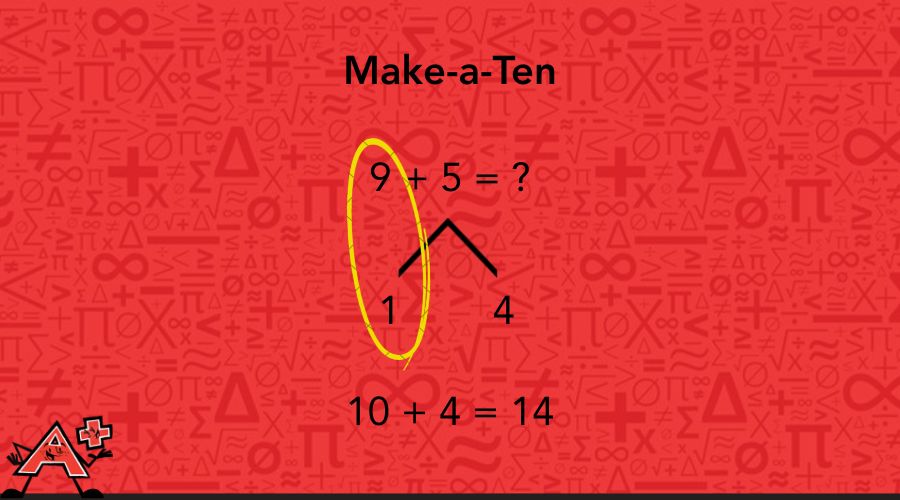
Ten is the bridge to easier mental math.
2. Near Doubles: A Shortcut That Teaches Number Flexibility
Let’s start with a classic: 6 + 6 = 12.
That’s what we call a double fact, when a number is added to itself. It’s a math anchor most students memorize early on.
But here’s where it gets interesting:
What about 6 + 7? If you know 6 + 6, you’re just one step away. “Double 6 is 12, and one more makes 13.”
That’s the near doubles strategy, or using a known double to solve a nearby fact. Instead of treating every problem as new, they learn to adjust a familiar fact and carry on.
Same idea with subtraction:
17 − 9? Think of double 9: that’s 18. So you’re just one short. The answer is 8.
Why does this work so well? It builds part–whole awareness, a math way of saying students get better at seeing how numbers fit together and how just a small change affects the outcome.
Now, a few Mathnasium-style moves you can use at home:
-
Double + one card game: Flip a double (like 6 + 6), then draw a nearby number and solve the near double. Great with playing cards or number tiles.
-
Domino match-ups: Pull a double domino (like 5 | 5), then ask, “What if one side were just one higher?”
-
Quick verbal prompts: Say a double fact out loud, then challenge your child to adjust it up or down. “Double 8 is 16, so what’s 8 + 9?”
📕 You May Also Like: 5 Ways Mental Math Supports Long-Term Math Success
3. 5× Facts: A Gateway to Multiplication Fluency
Of all the multiplication facts, the fives are often the first to click. And that’s no accident.
Students see them everywhere: on clocks, in money, in five-minute warnings and ten-finger countdowns. The rhythm is familiar, the skip-counting is easy, and the results are predictable.
That’s why we use 5× facts as a launchpad to build flexibility with other multiplication problems.
Take this: 7 × 6
If a student already knows 5 × 6 = 30, they can split 7 into 5 and 2, then add: 30 + 12 = 42
Same with division:
40 ÷ 5? Students who are fluent in their fives immediately think, “What times 5 equals 40?”
It’s a backward glance at the table they already know.
To support this kind of routine at home, you can try:
-
Make a 5× ladder: Start with 5 × 1 and work your way up aloud. Bonus: Clap, step, or tap for each count.
-
Nickel counting challenge: Line up nickels and have your child count by 5s to hit a target total.
-
Clock races: Ask how many minutes in 3 hours, how many 5-minute intervals in 45 minutes, or what 5 × 7 means on a clock.
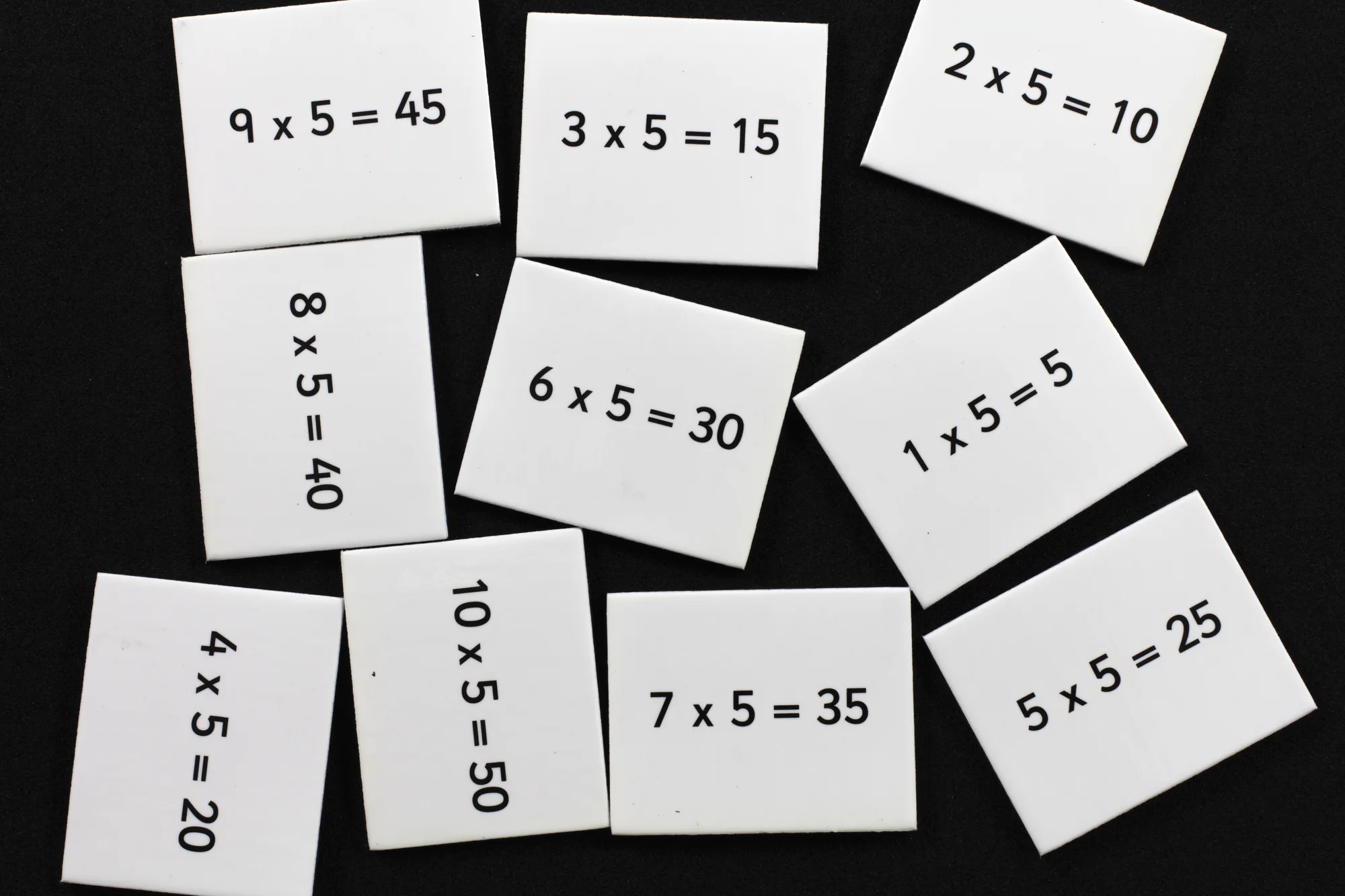
5× facts come quickly and open the door to bigger, more flexible multiplication strategies.
4. Use What You Know: Building Unknown Facts from Known Ones
Here’s something we love to point out to students: If you already know one fact, you’re not starting from zero. You actually have a head start.
That’s the whole idea behind this strategy. When students use what they know to build what they don’t, they’re thinking strategically. And they’re training themselves to approach unfamiliar problems with confidence instead of hesitation.
Take multiplication:
6 × 4 = 24 is familiar. So when they see 7 × 4, they can reason: “One more group of 4 makes 28.”
It works just as well in reverse:
28 ÷ 7? A student might say, “I know 21 ÷ 7 is 3, and 28 is one more group of 7, so the answer is 4.”
To help that kind of reasoning stick:
-
Start with a known fact: Write down a multiplication or addition fact your child is confident with (like 6 × 4 = 24), then ask, “What would 7 × 4 be?” Have them build from what they know.
-
Play “one more group” or “one less group”: Give a fact and have your child mentally add or subtract one group to solve a nearby fact.
-
Use fact triangles: Cover one number in a fact triangle and ask them to figure it out using the other two. This works especially well for subtraction and division.
-
Create number chains: Start with a known fact, then gradually shift one part:
“6 × 4 = 24 → 6 × 5 = ? → 7 × 5 = ?” and so on. It keeps the reasoning fluid.
📕 You May Also Like: 5 Easy Steps to Help Your Child Build Math Fact Fluency

At Mathnasium, we help students grow into flexible, confident math thinkers.
How We Foster Flexible Thinking at Mathnasium
To truly excel, students need to learn how to think flexibly about math. That’s one of our most important goals.
We use our proprietary teaching approach, the Mathnasium Method™, to support that growth.
Designed to build a deep understanding of math, our approach relies on:
-
Customization on a granular level: Each student begins their Mathnasium enrollment with a diagnostic assessment. This allows us to pinpoint what they already know, where they need support, and how they approach math. With these insights, we develop a learning plan customized to their needs.
-
Teaching for understanding: We explain math using natural, everyday language and support each concept with a combination of visual, verbal, mental, tactile, and written techniques. This multi-sensory instruction helps students truly make sense of what they’re learning.
-
Caring instruction: Our tutors are trained not just in math but in how to connect with students. They know how to support a child who’s feeling overwhelmed by math and how to challenge one who’s ready for more.
-
Independent problem-solving and critical thinking: During sessions, we always set aside time for students to work through problems on their own. This gives them space to test their understanding and rely on their own thinking. We guide them to see both the how and the why behind each concept. By understanding both, they develop critical thinking tools they can use in math and beyond.
-
Singular focus on math: Our curriculum includes thousands of pages and has been continuously refined over the past 20 years. This singular focus on math allows us to have a deeper focus on how students best absorb, learn, and retain mathematical concepts.
-
Empowering, fun learning environment: Our learning environment is designed to be both confidence-building and fun. Our materials are often game-based, and we give students a chance to earn rewards to keep them motivated as they continue advancing to higher levels of achievement.
Our method brings measurable results:
-
94% of parents report an improvement in their child's math skills and understanding
-
93% of parents report an improved attitude towards math after attending Mathnasium
-
90% of students saw an improvement in their school grades
With a network of over 1,100 centers across the U.S., Mathnasium brings top-rated instruction close to your neighborhood.
If you’re near Phoenix, AZ, Mathnasium of Paradise Valley is a local center families trust to help kids thrive in math and enjoy it along the way.
Whether your child is looking to catch up, keep up, or get ahead on their math journey, we’re more than happy to help.
📅 Schedule a Free Diagnostic Assessment at Mathnasium of Paradise Valley
Not near Phoenix?
📍 Find Mathnasium Learning Centers Near You


 (602) 494-2076