Mathnasium tutors have worked with Colorado students across every CMAS grade level. Something we’ve noticed is that often families know the test is coming, but usually don’t know what it actually assesses at their child's specific grade.
What the score report means once it arrives is just as likely to raise questions.
Both gaps are worth closing before test day. So, we’ve prepared a grade-by-grade breakdown of the math content CMAS covers from Grade 3 through Grade 8, a plain-language explanation of all five performance levels, and specific guidance on how to act on the results.

What CMAS Tests at Each Grade Level
CMAS math is built on the Colorado Academic Standards, closely aligned with the Common Core State Standards for Mathematics. The content assessed at each grade reflects what students are expected to have mastered by that point in the school year.
CMAS serves as a cumulative snapshot.
Gaps from prior years tend to show up alongside current-grade content, which is why grade-level preparation alone does not always tell the full picture.
Here’s a breakdown of what is expected at each grade.
📕 You May Also Like: Parents’ Guide to Tracking Math Progress (Grades K-12)
Grade 3: Multiplication, Division, and Early Fractions
At Grade 3, multiplication and division are the primary focus. CMAS assesses whether students understand these operations conceptually and can apply them to word problems.
Fluency with multiplication facts matters here more than any other single skill. It is a prerequisite for nearly everything else the test covers. Students who have not yet internalized those facts will spend cognitive energy on recall that the test assumes they can devote to reasoning.
Grade 3 CMAS also covers:
-
Early fraction concepts, including understanding fractions as numbers on a number line
-
Foundational measurement and data tasks
📕 You May Also Like: Is My 3rd Grader Really Ready for Multiplication? The Foundation Check
Grade 4: Fractions, Multi-Digit Arithmetic, and Place Value
Grade 4 places the greatest emphasis on fractions and multi-digit arithmetic. Students are expected to compare fractions, generate equivalent fractions, and add and subtract fractions with like denominators.
Multi-digit multiplication is also central.
Place value understanding extends into the hundred thousands, and students are assessed on rounding, comparing, and working with larger numbers in standard, word, and expanded form.
Additional tested content at Grade 4 includes:
📕 You May Also Like: Types of Fractions—Your Comprehensive, Beginner-Friendly Guide
Grade 5: Fraction Operations, Decimal Arithmetic, Volume, and Algebraic Thinking
Grade 5 is the year the demands compound. The major areas CMAS assesses at this level are:
-
Fraction multiplication and division
-
Decimal operations through the thousandths place
-
Volume of rectangular prisms
-
Writing and interpreting numerical expressions
-
Analyzing patterns and understanding ordered pairs on a coordinate plane
This is the grade where gaps from prior years tend to surface most visibly.
The test requires students to apply multiple skills in combination. An incomplete understanding of fractions from earlier grades will show up in the decimal and ratio work that the test also covers.
📕 You May Also Like: How to Make Sure Your Child Is Ready for Algebra
Grade 6: Ratios, Proportional Reasoning, Expressions, and Statistics
Grade 6 is the first year that algebraic reasoning becomes a primary focus rather than a supporting topic. CMAS at this grade assesses:
Students who have been successful with arithmetic may find Grade 6 questions unfamiliar, even when the underlying concepts are ones they have studied. The cognitive demand is less about computation and more about reasoning through an unfamiliar situation.
📕 You May Also Like: How to Solve Basic Equations — A Parent and Student Guide
Grade 7: Proportional Relationships, Rational Numbers, and Geometry
At Grade 7, proportional relationships take center stage. CMAS assessed content includes:
Students are expected to explain and justify their reasoning alongside producing the correct answers. Grade 7 CMAS is more demanding in its written response expectations than many classroom assessments at this level.
📕 You May Also Like: Is Your Student Ready for Their Geometry Class? [+Quiz]
Grade 8: Linear Equations, Functions, and Geometric Reasoning
Grade 8 is where the assessment connects most directly to high school readiness. CMAS at this level covers:
By Grade 8, the test is measuring conceptual groundwork for algebra. Whether a student understands what a function is, how to interpret slope and intercepts, and why a linear relationship behaves the way it does matters as much as computational accuracy.
📕 You May Also Like: Geometric Transformations – Definitions, Types, Examples, and Quiz
The Five CMAS Performance Levels Explained
CMAS scores arrive with a performance level label attached. For many families, that label is the part that is hardest to interpret. Here is what each level actually means, in plain language.
1. Did Not Yet Meet Expectations
This result indicates the student has not demonstrated the foundational skills expected at their grade level. It typically points to knowledge gaps that predate the current grade.
A score at this level is not a reflection of a child's ability, but a signal that specific gaps exist and that addressing them at the root, rather than at the surface, is the most productive path forward.
2. Partially Met Expectations
The student demonstrates some grade-level skills but has an inconsistent understanding across the tested domains.
This is the level where the gap between classroom performance and CMAS scores is most common. A student can earn passing grades while still lacking the depth CMAS requires, because classroom assessments and CMAS measure understanding differently.
3. Approached Expectations
The student is close to grade-level proficiency but has not fully demonstrated it across all domains.
This result often indicates a student who understands core concepts but struggles with multi-step application or question formats that look different from standard classroom work. The gap here is usually narrower and more specific than the overall label suggests.
4. Met Expectations
The student has demonstrated solid grade-level proficiency. This is the target benchmark and indicates the student is prepared for the next grade's math demands.
A score at this level should be acknowledged. It means the work students have put in is reflected in the results.
5. Exceeded Expectations
The student has demonstrated understanding beyond grade-level expectations. This result does not mean there is nothing left to work on. It means the tested material is not the ceiling of what the student is ready for.
For students at this level, the question should be where to build from next.
How to Prepare for CMAS
Whether you are preparing before the test or working through results afterward, the same information guides both. Here are some of our quick tips for getting ready.
-
Know the grade-level targets before the test. The grade-by-grade breakdowns above are a starting point. A conversation with your child's teacher about where understanding is thin adds a layer of specificity that no general guide can provide. The Colorado Department of Education also publishes released CMAS practice items, which give families a concrete sense of question formats and cognitive demand without requiring a formal test prep program.
-
Read the domain subscores, not just the overall level. When the score report arrives, go straight to the domain breakdown. Subscores show whether gaps are concentrated in one area or spread across the test. A student who partially met expectations with low scores in fractions but solid scores elsewhere has a specific, addressable gap that the overall performance label alone does not reveal.
-
Turn the score into a specific next step. For students who did not yet meet or partially met expectations, addressing gaps usually means working below grade level to fill foundational knowledge gaps before returning to grade-level content. For students who met or exceeded expectations, the question is where to build from next, whether that means reinforcing areas close to the domain boundary or extending into material beyond what the test covers.
For families who want structured, consistent support in acting on that next step, working with a specially trained math tutor is one of the most direct ways to turn a CMAS score into real progress.

Mathnasium tutors help students work on fundamental gaps and meet expectations for their grade level.
How Mathnasium Helps Colorado Students Prepare for CMAS
Mathnasium is a math-only learning center dedicated to helping K-12 students learn and master math at every level, from foundational arithmetic through high school algebra and beyond.
When students come to us for support, we do not rely on drills or isolated practice. Our approach, the Mathnasium Method™, is proprietary, personalized, and designed to help students truly understand how math works.
To foster lasting mastery, our approach relies on six core principles:
-
Personalization on a granular level: Each student begins with a diagnostic assessment that identifies their strengths, knowledge gaps, and how they approach math. Tutors then follow personalized learning plans that guide steady, structured progress toward the specific skills CMAS assesses at each grade level.
-
Teaching for understanding: We explain math using clear, everyday language and support each concept with visual, verbal, written, mental, and hands-on techniques so students develop a deep understanding of math rather than surface familiarity with procedures.
-
Caring instruction: Our tutors provide caring guidance in a fun group environment where students feel supported as they work through challenging material.
-
Independent problem solving and critical thinking: Each session includes time for students to work through problems on their own. Tutors guide them to understand both how and why a concept works, which supports concept reapplication across topics and question formats.
-
Singular focus on math: Our program spans thousands of pages and has been continuously refined over the past 20 years. This singular focus allows us to take a deep dive into how students best absorb, learn, and retain mathematical concepts across every grade level.
-
Empowering, fun learning environment: Our environment is designed to be both engaging and fun. Our materials are game-based, and students have the opportunity to earn rewards to keep them motivated as they advance to higher levels of achievement.
And the results speak for themselves:
-
94% of parents report an improvement in their child's math skills and understanding
-
93% of parents report an improved attitude toward math after attending Mathnasium
-
90% of students saw an improvement in their school grades
With over 1,100 centers, we bring the Mathnasium Method™ close to your community.
For families based in or near Parker, CO, Mathnasium of Parker is the go-to local center, with years of experience helping students of all skill levels excel in math.
Read what one parent had to say about their child’s Mathnasium journey.
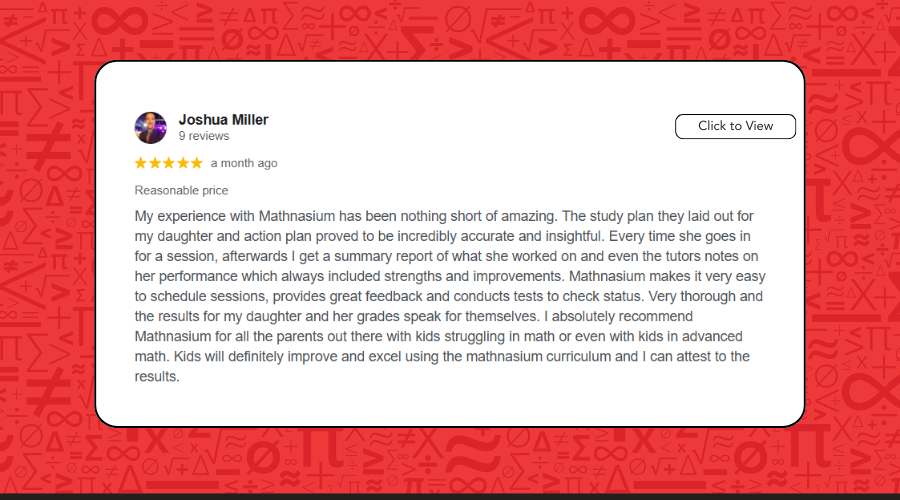
If your child is looking to catch up, keep up, or get ahead in math, our team is ready to help!
📅 Schedule a Free Diagnostic Assessment at Mathnasium of Parker!
Not near Mathnasium of Parker?
📍 Find Mathnasium Learning Centers Near You


 (303) 840-1184
 (303) 840-1184