One minute, your child is playing outside or watching TV. The next minute, you're asking them to sit down and solve math problems. That's a big mental leap, and most kids can't make the switch that quickly.
Just like athletes warm up before a game, kids benefit from warming up their brains before homework. A quick five-minute mental math session can make a real difference in focus and performance.
Mathnasium tutors have prepared a few simple, age-appropriate mental math activities that take just a couple of minutes and can get your child in the right headspace to tackle any homework assignment.

Why a Short Mental Math Warm-Up Helps Before Homework
Research in learning science shows that the brain performs better when it has a brief warm-up before tackling a new task.
Just like stretching helps prevent pulling a muscle, students benefit from warming up their thinking.
A few minutes of mental math delivers three key benefits that can make homework time smoother for everyone.
-
It activates mathematical thinking. When children answer a few mental math questions, they begin recalling number facts, operations, and patterns they already know. This mental activation primes the brain to work with numbers rather than “jump-start” the process.
-
It reduces resistance. Parents frequently notice that this short lead-in helps their child settle into homework with less pushback. The homework instructions become easier to process, and the problems feel more familiar once they start writing.
-
It eases math anxiety. By starting with quick, approachable questions your child can answer successfully, you're creating a round of easy wins before the "real work" begins. This small boost can make the difference between a child who sits down thinking "I can't do this" and one who approaches their homework feeling capable and ready.
📕 You May Also Like: Understanding Math Anxiety and How to Overcome It
5-Minute Warm-Up Activities for Every Grade Level
The beauty of mental math warm-ups is that they can be tailored to meet your child exactly where they are. What works for a first-grader building basic number sense won’t work for a middle schooler preparing for algebra.
It’s important to choose mental math activities that feel just challenging enough to engage your child's brain without causing frustration.
We’ve prepared a few age-appropriate warm-up exercises that take just five minutes to do but can make a real difference in your child's homework routine.
Elementary School (Grades 1-3)
For younger students, mental math warm-ups should focus on building a strong foundation of number sense and basic fact fluency. These early years are all about making numbers feel friendly and familiar.
-
Number sense builders are perfect for this age group. Have your child count by 2s starting from any even number ("2, 4, 6, 8..."), then try it backward ("20, 18, 16, 14..."). Once they're comfortable, move to 5s and 10s. This activity strengthens their understanding of number patterns and helps them see relationships between numbers, which is crucial for later math success.
-
Quick addition and subtraction facts can be practiced anytime and anywhere. While your child gets their pencils ready, rapid-fire simple questions: "What's 6 + 3?" or "What's 10 - 4?" Allow them to use their fingers to visualize the problem if needed, but mental math is the end goal.
-
The "More or Less" game helps develop comparison skills. Ask questions like "Which is more: 15 or 12?" or "What's the higher result: 11 + 3 or 24-20?" These simple comparison questions build the mental flexibility kids need for problem-solving.
-
Grouping by Equal Sets introduces early multiplication/division thinking without formal language. Try a prompt like: “If we have 12 apples and we put them into groups of 3, how many groups will we have?” Then switch it: “If we make 4 equal groups from 20 stickers, how many stickers go in each group?” Encourage your child to solve it mentally by counting in groups rather than dividing one by one.
📕 You May Also Like: What Is Number Sense & Why It Matters in Early Math Education
Upper Elementary (Grades 4-5)
Fourth and fifth graders are ready for mental math practice that bridges basic facts and more complex operations. These activities should challenge their growing mathematical thinking while building confidence.
-
Skip-counting challenges take the pattern work from earlier grades to the next level. Ask your child to count by 3s ("3, 6, 9, 12...") or by 4s, 6s, or 7s. Start from different numbers to keep it interesting: "Count by 4s starting at 8." This strengthens multiplication readiness and helps kids see how numbers relate to each other in more sophisticated ways.
-
Mental multiplication becomes essential at this stage, and the best practice connects to real-world scenarios. Instead of drilling "What's 7 × 8?", try "If you have 7 packs of trading cards with 8 cards in each pack, how many cards do you have in total?" This approach makes abstract math facts concrete and prepares children for word problems.
-
Number pattern recognition develops algebraic thinking. Present sequences like "2, 4, 8, 16... what comes next?" or "3, 7, 11, 15... what's the pattern?" These exercises train the brain to look for rules and relationships, which is exactly what they'll need for homework problems.
-
Fraction quick shots introduce this challenging concept in bite-sized pieces. Ask comparison questions: "Which is bigger: \(\Large\frac{1}{2}\) or \(\Large\frac{1}{4}\)?" or simple addition: "What's \(\Large\frac{1}{4}\) + \(\Large\frac{1}{4}\)?" Here too, you can frame it as a word problem. For instance, while organizing homework materials, you might ask, "If we have 3 pizzas and each has 8 slices, how many slices are there in total?" When your child answers "24," they've just activated their multiplication skills and are primed for whatever math practice lies ahead.
📕 You May Also Like: How to Nurture Algebraic Thinking in Elementary School
Middle School (Grades 6-8)
Middle schoolers benefit from mental math activities that mirror the complexity of their coursework while building computational fluency that will serve them through high school and beyond.
-
Percent estimation is both practical and powerful for this age group. Practice quick mental calculations: "What's 10% of 80?" "What's 25% of 40?" "What's 50% of 76?" These percentages come up constantly in real life, and being able to calculate them mentally builds both confidence and number sense. The trick is to start with friendly numbers and gradually increase the difficulty.
-
Integer operations prepare students for algebra. Practice adding and subtracting positive and negative numbers: "What's -5 + 8?" or "What's 3 - 7?" Use a number line visualization if they need help: "If it's 3 degrees and the temperature drops 7 degrees, what's the new temperature?" This connects abstract concepts to tangible scenarios.
-
Order of operations quickies keep PEMDAS fresh without the pressure of a test. Give simple problems like "What's 2 + 3 × 4?" or "What's 15 - 6 ÷ 2?" These bite-sized problems remind students to follow the correct sequence without overwhelming them.
-
Mental multiplication strategies are invaluable for working with larger numbers. Teach your child how to break down problems: "What's 15 × 12? Well, that's (10 × 12) + (5 × 12) = 120 + 60 = 180." Getting your child used to thinking about numbers in this way will make working with larger numbers in high school a lot more manageable.

Mathnasium tutors help students begin math homework ready to think by building the mental habits and reasoning skills that make it easier to get started and stay focused.
How Mathnasium Helps Students Build Mental Math Skills
Mathnasium is a math-only learning center dedicated to helping K–12 students build a deep understanding of math. That means students don’t just master individual concepts. They develop flexible thinking skills that they can apply to homework, tests, and real-life problem-solving.
At the core of our instruction is the Mathnasium Method™, a proprietary approach designed to help students truly understand math.
To foster true mastery and enjoyment of math, our approach relies on:
-
Personalization on a granular level: Each student begins with a diagnostic assessment that allows us to pinpoint strengths, knowledge gaps, and how they approach math problems. From there, we create personalized learning plans that guide students through concepts in a way that supports readiness and reduces hesitation when homework begins.
-
Teaching for understanding: Tutors explain math using clear, everyday language and support each concept with a blend of mental, visual, verbal, written, and hands-on techniques. This helps students recognize structure and relationships, which makes homework directions easier to follow.
-
Caring guidance: Specially trained tutors provide caring guidance that supports steady thinking and an appropriate challenge. Students learn to engage with problems thoughtfully rather than rushing or avoiding them.
-
Independent problem-solving and reasoning: Every session includes time for students to work through problems independently. This mirrors homework time and helps students practice getting started, staying focused, and reasoning through challenges on their own.
-
Singular focus on math: Mathnasium’s programs focus exclusively on math and have been refined for more than 20 years. This allows us to address both skill development and the thinking habits students need before beginning math tasks.
-
Empowering, fun learning environment: Instruction takes place in a caring and fun group environment where students are encouraged to explain their thinking, stay engaged, and continue progressing through levels of achievement.
The results speak for themselves:
-
94% of parents report improved math skills and understanding
-
90% of students see higher grades at school
-
93% of parents say their child’s attitude toward math improves after enrolling at Mathnasium
With over 1,100 learning centers across the U.S., Mathnasium brings top-rated instruction to communities nationwide.
For families based in or near Parker, CO, Mathnasium of Parker is the go-to local center, with years of experience helping students of all skill levels excel in math.
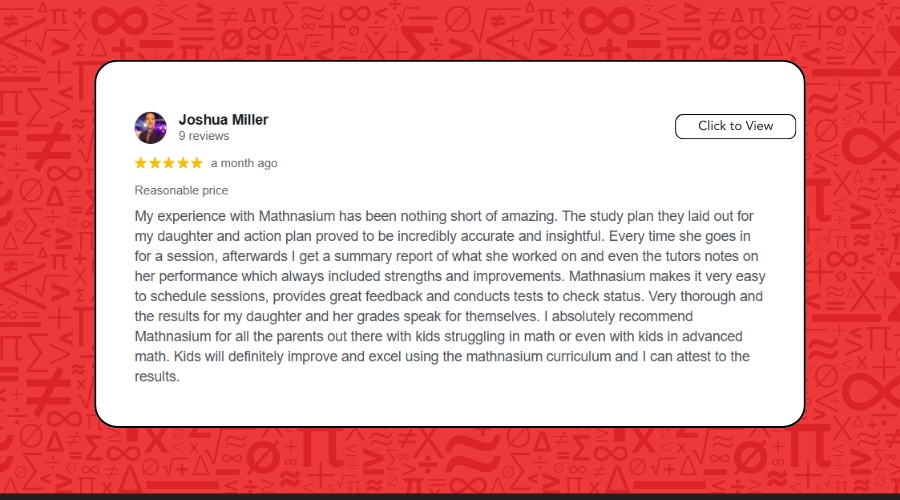
Read what one parent had to say about their child’s Mathnasium journey.
If your child is looking to catch up, keep up, or get ahead in math, our team is ready to help!
📅 Schedule a Free Diagnostic Assessment at Mathnasium of Parker!
Mathnasium of Parker is not your nearest center?
📍 Find Mathnasium Learning Centers Near You


 (303) 840-1184
 (303) 840-1184