It is a question that trips up a lot of students, and for good reason.
Today, we are going to walk you through exactly why 1 sits in a category all its own and what that tells us about how math works.

What Are Prime Numbers?
A prime number is a whole number greater than 1 that has exactly two factors: 1 and itself.
That "exactly two" part is doing a lot of work in that definition. Let's slow down and look at what it means.
A factor is any whole number that divides evenly into another number. So when we ask, "How many factors does a number have?" we are really asking, ‘’How many whole numbers divide into it without leaving a remainder?’’
Let’s take 7. What divides evenly into 7?
That's it. No other whole number divides into 7 without a remainder. So 7 has exactly two factors: 1 and 7. That makes it prime.
Now try 5. What divides evenly into 5?
Again, exactly two factors: 1 and 5. Prime.
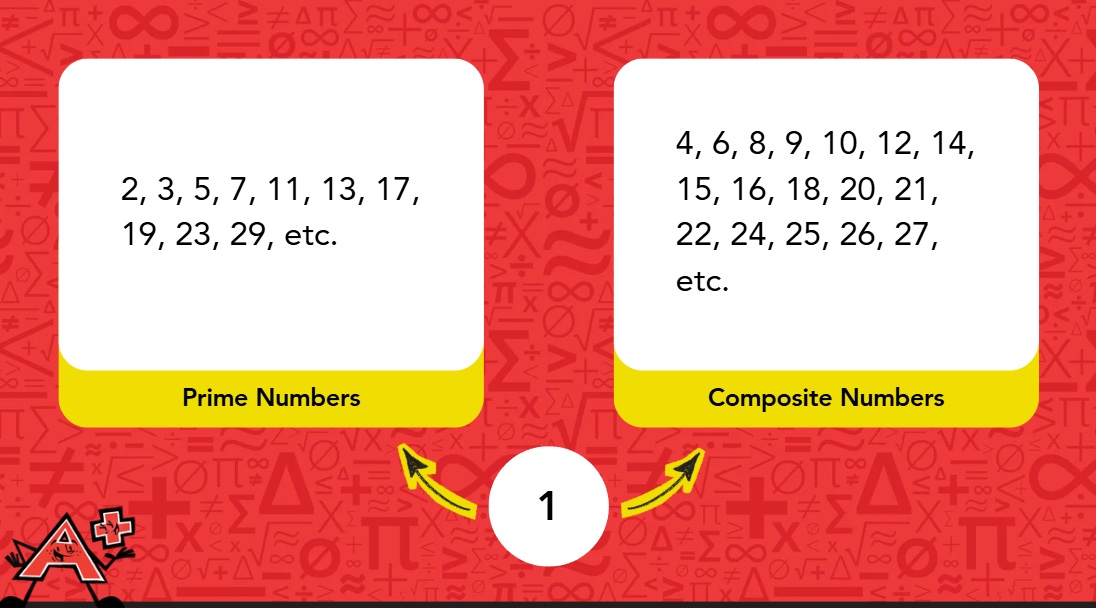
A few more examples of prime numbers: 2, 3, 5, 7, 11, 13, 17, 19.
Notice that 2 is the only even prime number. Every other even number is divisible by 2, which gives it at least three factors and bumps it out of the prime category.
📕 You May Also Like: What Is Prime Factorization? Explain It to a 10-Year-Old
Why Is 1 Not Prime?
Here is where things get interesting.
Ask yourself the same question we asked about 7 and 5: What divides evenly into 1?
Only 1 itself.
That gives 1 exactly one factor, not two. And since the definition of a prime number requires exactly two distinct factors, 1 does not qualify.
It is not a technicality or an arbitrary rule. The definition was carefully written this way, and there is a very good reason for it. We will get to that shortly.
In the meantime, here’s a fun fact! Number one has not always been the consensus. Historically, some mathematicians, including Euler, did classify 1 as a prime number.
Over time, the mathematical community settled on the modern definition that excludes 1, because keeping 1 out makes important theorems work cleanly and consistently.
📕 You May Also Like: What Is Euler's Number? A Beginner-Friendly Overview
What Are Composite Numbers?
A composite number is a whole number greater than 1 that has more than two factors.
In other words, something other than 1 and itself divides evenly into it.
Let’s try with 9. What divides evenly into 9?
-
9 ÷ 1 = 9
-
9 ÷ 3 = 3
-
9 ÷ 9 = 1
It has three factors, so number 9 is composite.
Now, take 12. What divides evenly into 12?
-
12 ÷ 1 = 12
-
12 ÷ 2 = 6
-
12 ÷ 3 = 4
-
12 ÷ 4 = 3
-
12 ÷ 6 = 2
-
12 ÷ 12 = 1
Those are six factors, well above two, which make 12 composite.
A few more examples of composite numbers: 4, 6, 8, 9, 10, 12, 14, 15.
You can think of composite numbers as numbers that can be "broken down" into smaller whole-number pieces. They are built from other numbers multiplied together.
Why Is 1 Not Composite?
Apply the same factor check to 1.
Composite numbers need more than two factors. But 1 has only one factor: itself.
It does not clear the bar for composite either.
So 1 is not prime (needs exactly two factors, has one) and not composite (needs more than two factors, has one). Mathematicians call 1 a unit. It is in a class by itself.
Practice Time! Can You Work Out These Numbers?
Now it is your turn. For each number below list all the factors by asking: What divides evenly into this number?
Then decide: is it prime, composite, or neither?
1. Is 11 prime or composite?
Hint: Try dividing 11 by every whole number from 1 to 11.
2. Is 15 prime or composite?
Hint: Does anything other than 1 and 15 divide evenly into 15?
3. Is 1 prime or composite?
Hint: how many factors does 1 have?
4. Is 4 prime or composite?
Hint: Try dividing 4 by 1, 2, 3, and 4.
5. Is 17 prime or composite?
Hint: Try dividing 17 by every whole number from 1 to 17.
Check your answers at the bottom of the page!
📕 You May Also Like: 5 Common Division Problems Kids Face and How to Solve Them
FAQs About Prime and Composite Numbers
Here are some of the most common follow-up questions we hear from students and parents.
1. Can a number be both prime and composite?
No. Every whole number greater than 1 is either prime or composite, but never both. If it has exactly two factors, it is prime. If it has more than two, it is composite.
2. Why is 2 the only even prime number?
Every even number is divisible by 2, which gives it at least three factors: 1, 2, and itself. That makes it composite. 2 is the exception because its only factors are 1 and 2, so it meets the definition of prime exactly.
3. What are the largest known prime and composite numbers?
There is no largest prime or composite number. Both go on forever. The largest prime numbers discovered so far have millions of digits and were found using computers. As for composites, since every even number greater than 2 is composite, they are simply endless.
4. Do I have to memorize all prime and composite numbers?
No. For K--12 math, the primes worth knowing well are the ones up to about 30: 2, 3, 5, 7, 11, 13, 17, 19, 23, and 29.
Common composites in that same range include 4, 6, 8, 9, 10, 12, 14, 15, 16, 18, 20, 21, 24, 25, 26, 27, 28, and 30.
Their respective charts are helpful references, and with practice, the most common primes and composites become familiar quickly.
5. How do prime and composite numbers show up in real life?
Primes and composites appear in more places than most people expect. Primes are the foundation of encryption, the technology that keeps passwords and online information secure.
Composites show up whenever students simplify fractions, find common denominators, or break numbers into their prime factorizations, since composite numbers are the ones being broken down.

At Mathnasium, no question is too small. Our specially trained tutors take the time to explain the "why" behind every math rule, building understanding that lasts.
Master Prime and Composite Numbers with Mathnasium
Mathnasium is a math-only learning center dedicated to helping K-12 students learn and master math at every level, from foundational arithmetic through high school algebra and beyond.
When students come to us asking why 1 is neither prime nor composite, they are curious, a little confused, and ready to understand the "why" behind the rule. That is where our proprietary teaching approach, the Mathnasium Method™, comes in.
Designed to build true understanding, our method relies on:
-
Personalization: Every student begins with a diagnostic assessment that reveals their strengths and knowledge gaps. From there, we build a personalized learning plan tailored to exactly where they are.
-
Teaching for understanding: We use verbal, visual, mental, tactile, and written techniques to make concepts truly clear, not just memorizable.
-
Caring instruction: Our specially trained tutors meet students where they are, guide them at their own pace, and create a space where questions are always welcome.
-
Independent problem-solving and critical thinking: We give students the tools to work through challenges on their own and understand the how and why behind every answer.
-
Singular focus on math: Math is all we do. Our entire program, materials, and team are built around one subject, so students get focused, expert support every session.
-
Empowering, fun learning environment: Sessions are engaging and encouraging, with plenty of room to explore, make mistakes, and celebrate progress.
The results speak for themselves:
-
94% of parents report an improvement in their child's math skills and understanding
-
93% of parents report their child's improved attitude toward math after attending Mathnasium
-
90% of students saw an improvement in their school grades
With over 1,100 centers, Mathnasium brings top-rated instruction close to your home.
For families in Westminster, Mathnasium of South Westminster is a trusted center with years of experience transforming how children think and feel about math.
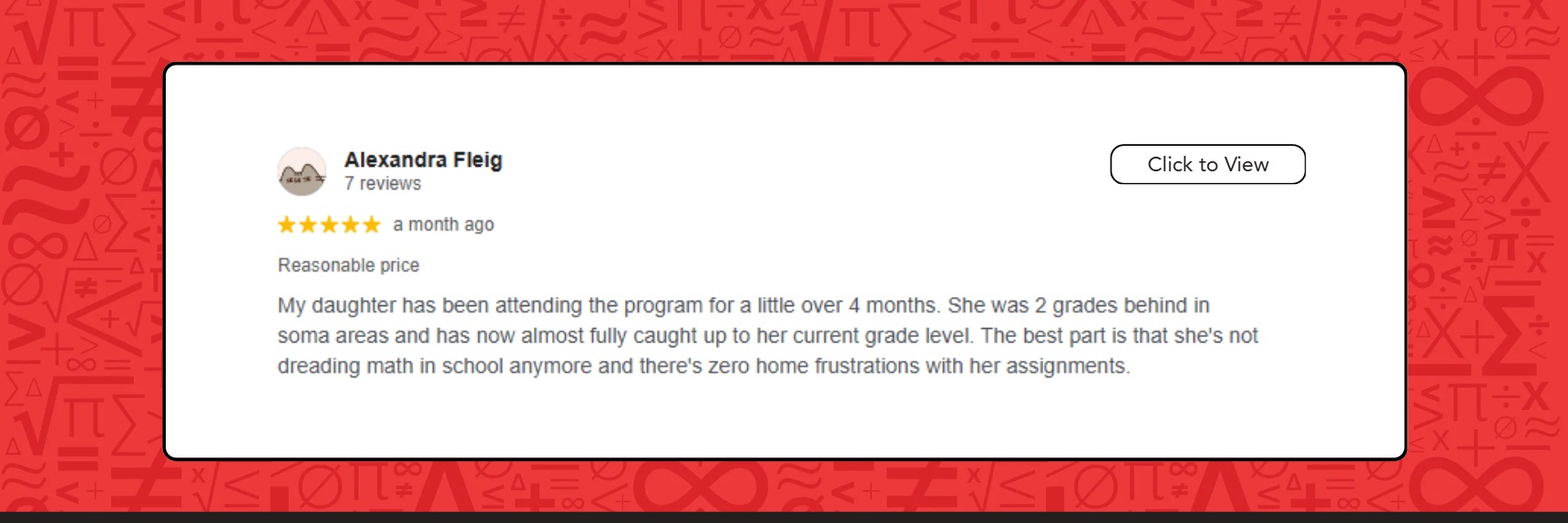
Here is what one parent had to say about their child's experience at Mathnasium:
Whether your child needs help catching up, wants to stay on track, or is ready to move ahead, Mathnasium can support their journey.
Ready to get started?
📅 Schedule a Free Diagnostic Assessment at Mathnasium of South Westminster
Not near South Westminster?
📍 Find Mathnasium Learning Centers Near You
Pssst! Find Your Answers Here
1. Is 11 prime or composite?
No other whole number divides evenly into 11. That gives it exactly two factors, making it prime.
2. Is 15 prime or composite?
-
15 ÷ 1 = 15
-
15 ÷ 3 = 5
-
15 ÷ 5 = 3
-
15 ÷ 15 = 1
15 has four factors, which is more than two, making it composite.
3. Is 1 prime or composite?
1 has only one factor: itself. It does not meet the definition of prime (exactly two factors) or composite (more than two factors). 1 is neither; it is a unit in its own category.
4. Is 4 prime or composite?
-
4 ÷ 1 = 4
-
4 ÷ 2 = 2
-
4 ÷ 4 = 1
4 has three factors, which is more than two, making it composite.
5. Is 17 prime or composite?
No other whole number divides evenly into 17. That gives it exactly two factors, making it prime.
How did you do?


 (720) 524-4533
 (720) 524-4533