Equations appear in pre-algebra and early middle school when students begin solving for unknown values. Functions enter the picture formally in Algebra 1, yet the two concepts can seem interchangeable at first because they use the same variables, algebraic expressions, and graphs.
The difference is specific. An equation states that two expressions are equal, while a function describes a relationship in which each input produces exactly one output. Algebra 2 builds directly on that distinction through graph transformations and more advanced function analysis.
Our tutors at Mathnasium put together this simple guide to explain both concepts with worked examples and make the distinction concrete.
What Is an Equation?
An equation is a mathematical statement that two expressions are equal. The equal sign is the defining feature, confirming that both expressions on the left and right share the same value.
Equations first appear in elementary arithmetic as number sentences like 3 + 4 = 7, and reappear in pre-algebra when your child starts solving for unknown values in expressions like 2x + 5 = 13.
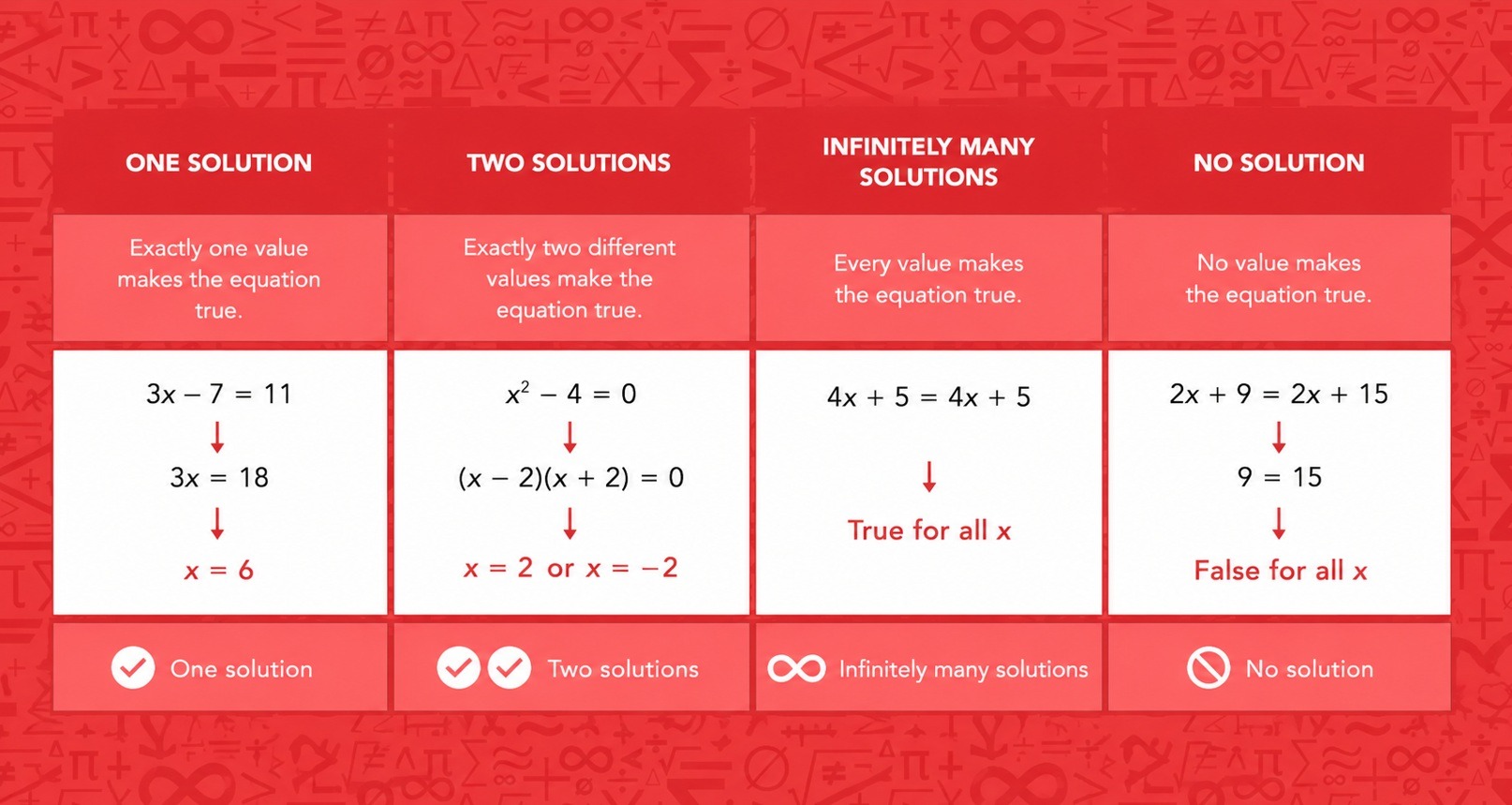
Equations do not always produce a single answer. An equation can have one solution, two solutions, infinitely many solutions, or no solution at all, depending on the relationship it describes:
-
2x + 5 = 13 → 2x = 8, x = 4 → one solution
-
x² = 9 → x = 3 or x = −3 → two solutions
-
2(x + 1) = 2x + 2 → true for every value of x → infinitely many solutions
-
x + 3 = x + 7 → no value of x makes this true → no solution
Equations describe relationships between quantities and ask students to find the values that make the statement true.
Functions take that relationship one step further by showing how one quantity depends on another in a predictable, repeatable way.
📕 You May Also Like: How to Solve Basic Equations — A Parent and Student Guide
What Is a Function?
A function is a rule that connects inputs to outputs so that every input produces exactly one output.
We can picture this as a vending machine. When you press the same button, the same item comes out every time.
One thing to keep in mind is that two different buttons can sometimes lead to the same snack.
For example, a vending machine might have two different slots for the same type of chips. In math, this is like how both 22 and (−2)2 result in 4. As long as one button doesn't give you two different snacks at once, it is still a function.
Function notation uses the form f(x), and reads as "f of x." Even though it looks like multiplication, it does not mean f times x. It means the output of the function named f when the input is x.
For example, f(3) means substitute 3 for x and calculate the result.
For the function f(x) = 2x + 3, the outputs for different inputs are:
-
Input 1 → 2(1) + 3 = 5
-
Input 4 → 2(4) + 3 = 11
The input-output idea first appears in tables and patterns around grade 7, and function notation is introduced formally in Algebra 1.
📕 You May Also Like: How to Prepare Your Student for Algebra: From Graphs to Variables
So, What Is the Difference Between a Function and an Equation?
Students usually notice the difference once they begin graphing, interpreting inputs and outputs, and working with function notation in Algebra 1 and Algebra 2.
-
Equations focus on finding values that make a statement true.
-
Functions focus on how one quantity changes in response to another.
-
Equations may produce multiple valid answers.
-
Functions must follow a consistent input-output rule.
That overlap is exactly why the two concepts begin to feel interchangeable in later algebra courses.
📕 You May Also Like: Combination vs. Permutation: What's the Difference?
Why Functions and Equations May Confuse Students
Functions and equations can confuse students because the same algebraic expression can sometimes be interpreted in two different ways, depending on what the problem asks them to do.
The distinction becomes much clearer once the same expression is examined from both perspectives:
-
y = 2x + 1 is an equation because it states that two expressions are equal. It is also a function because every value of x produces exactly one value of y.
-
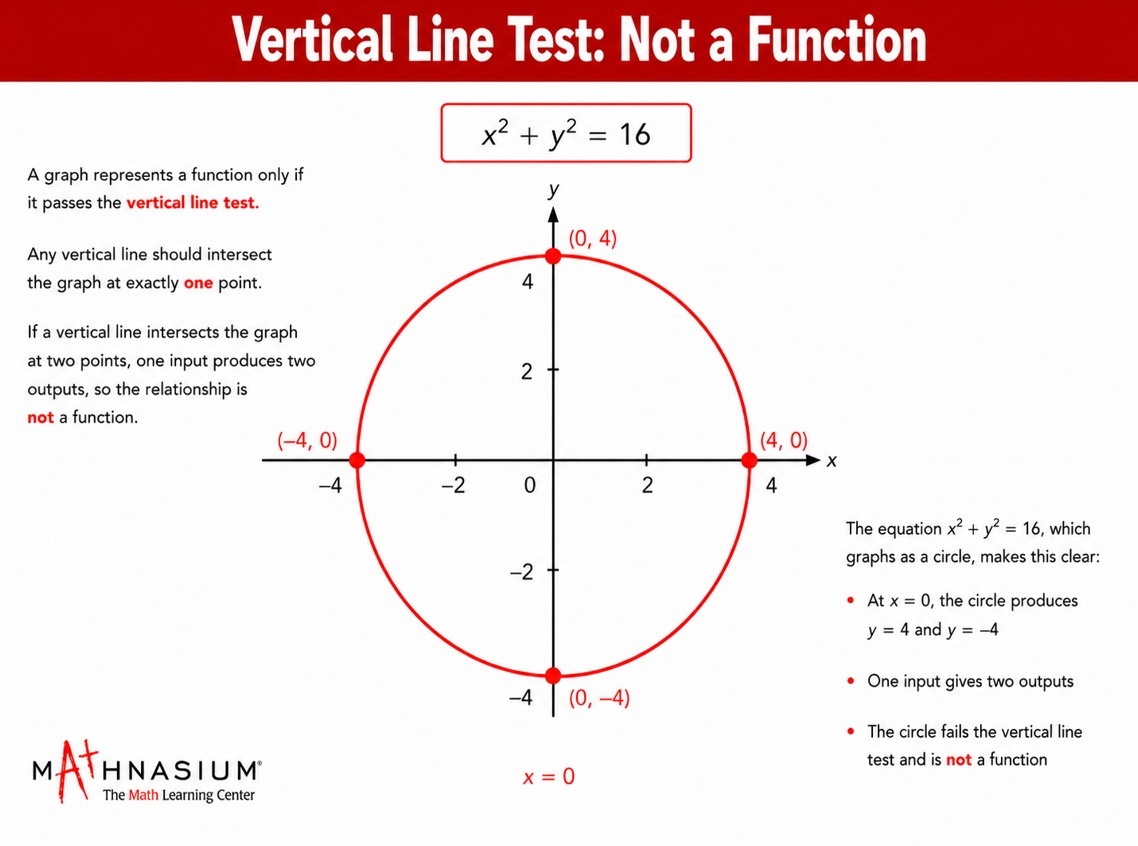
x² + y² = 16 is an equation. It is not a function because some values of x produce two values of y, which fails the vertical line test, as we demonstrated in the example above.
The clearest mental model to keep is that an equation asks whether two things are equal, and a function describes how an output depends on an input. That distinction changes how the expression is read, solved, and graphed.
📕 You May Also Like: Common Math Misconceptions & How to Fix Them (for K-8 Students)
Why Students Need to Understand the Difference Before Algebra 2
Algebra 2 introduces quadratic functions, exponential functions, piecewise functions, inverse functions, domain and range, and transformations.
The big shift here is that students move from solving an equation for a single missing number to analyzing how a function behaves as a whole.
The same expression treated as a simple equation in Algebra 1 becomes a function to analyze, transform, and interpret in Algebra 2.
This is why concepts like "domain" (the allowed inputs) and "range" (the possible outputs) become so important. The same line y = 2x + 1 looks different depending on the course:
In Algebra 1:
In Algebra 2:
-
Identify the slope and what it means about the rate of change
-
Describe the behavior of the function as x increases
-
State the domain and range
-
Transform the function by shifting or reflecting the graph
The Algebra 1 version asks students to find a number.
The Algebra 2 version asks them to analyze how the function behaves across many inputs at once, including how quickly it changes, where it increases or decreases, and how the graph transforms.
Gaps in the equation and function distinction usually become visible once Algebra 2 shifts from solving equations toward interpreting and analyzing functions, which is why targeted algebra support becomes much more useful before confusion compounds in higher-level math.
📕 You May Also Like: How to Make Sure Your Child Is Ready for Algebra

At Mathnasium, we use personalized learning plans and interactive teaching techniques to make concepts like functions and equations make sense.
How Mathnasium Helps Students Master Any Math Concept
Mathnasium is a math-only learning center helping K-12 students of all skill levels learn and master math.
We make concepts like functions, equations, and algebraic reasoning make sense, not through rote memorization, but through a proprietary teaching approach called the Mathnasium Method™, designed around each student's individual needs and learning style.
To build a deep understanding of math, our approach includes:
-
Personalized learning: Every student starts with a diagnostic assessment that helps us identify their current skills and knowledge gaps. Those insights guide a customized learning plan built around each student’s goals, with session frequency adjusted to support steady and consistent progress.
-
Teaching for understanding: We phrase math in plain, everyday language rather than heavy jargon, and draw on a mix of verbal, visual, mental, tactile, and written techniques so each concept truly lands.
-
Caring tutors: Our tutors are skilled in both math and the emotional side of teaching. They know how to support a student who feels overwhelmed and how to challenge one who is ready to move ahead.
-
Problem-solving and critical thinking: We allow time for productive struggle, then rejoin students to check their reasoning. Our goal is to help students gradually trust their own thinking and become independent problem-solvers. We teach both the how and the why behind the math, so students build critical-thinking skills they can carry into future math courses and everyday problem-solving.
-
A supportive, fun environment: We often hear that our sessions do not look like lectures, and that is by design. Games, earned rewards, and consistent celebration of progress keep learning enjoyable and help students grow in confidence with every session.
The results speak for themselves:
-
94% of parents report improvement in their child's math skills and understanding
-
93% of parents report an improved attitude toward math after attending Mathnasium
-
90% of students saw improvement in their school grades
With over 1,100 learning centers across North America, there is likely a Mathnasium close to you.
Families across The Woodlands, Spring, Conroe, Carlton Woods, Creekside, Sterling Ridge, and Indian Springs trust Mathnasium of The Woodlands to help their children build solid foundations for math mastery
When needed, our tutors can align instruction with Texas Essential Knowledge and Skills standards and help students prepare for STAAR and SAT assessments alongside regular coursework.
If your child is working through functions and equations or any other math challenge and needs more targeted support, our team is ready to help.
📅 Schedule a Free Assessment at Mathnasium of The Woodlands
Not near The Woodlands?
📍 Find a Mathnasium Learning Center Near You


 (281) 465-4990