Before equations enter the picture, students spend years calculating answers directly. They see 5 + 3 and write 8. They solve 12 × 4 and arrive at 48. The process is straightforward: numbers go in, answers come out.
Then equations arrive, usually in late elementary or early middle school. Suddenly, there's an X where a number should be.
The task changes from calculating to figuring out what value makes the statement true. This requires a different kind of thinking. Students must work backward, test possibilities, or hold an unknown in mind while manipulating everything around it.
That leap from direct calculation to working with unknowns can feel disorienting without the right support. To help parents and students navigate this transition, today our tutors explain what equations really mean, how to approach them step by step, and how to build lasting confidence through guided examples and hands-on exercises.

First, What Are Basic Equations?
At Mathnasium, we like to say that an equation is like a balanced scale. Whatever you do to one side, you have to do to the other to keep things even.
So, what is a basic equation?
A basic equation is a math sentence that shows two sides are equal. It usually includes a variable (like x) that stands for a number we don’t know yet. The goal is to figure out what number makes both sides the same.
Let’s look at a simple example:
x+3=7
This equation tells us that when we add 3 to something, we get 7. So, we ask: What number plus 3 equals 7?
If you said 4, you're right! That means x = 4.
How to Solve Basic Equations (Step-by-Step Example)
Let’s walk through solving a basic one-variable equation, the kind students often see when they’re just starting algebra.
We’ll use this example:
x − 5 = 9
This equation is asking: what number minus 5 equals 9?
Let’s solve it together.
Step 1: Understand the equation
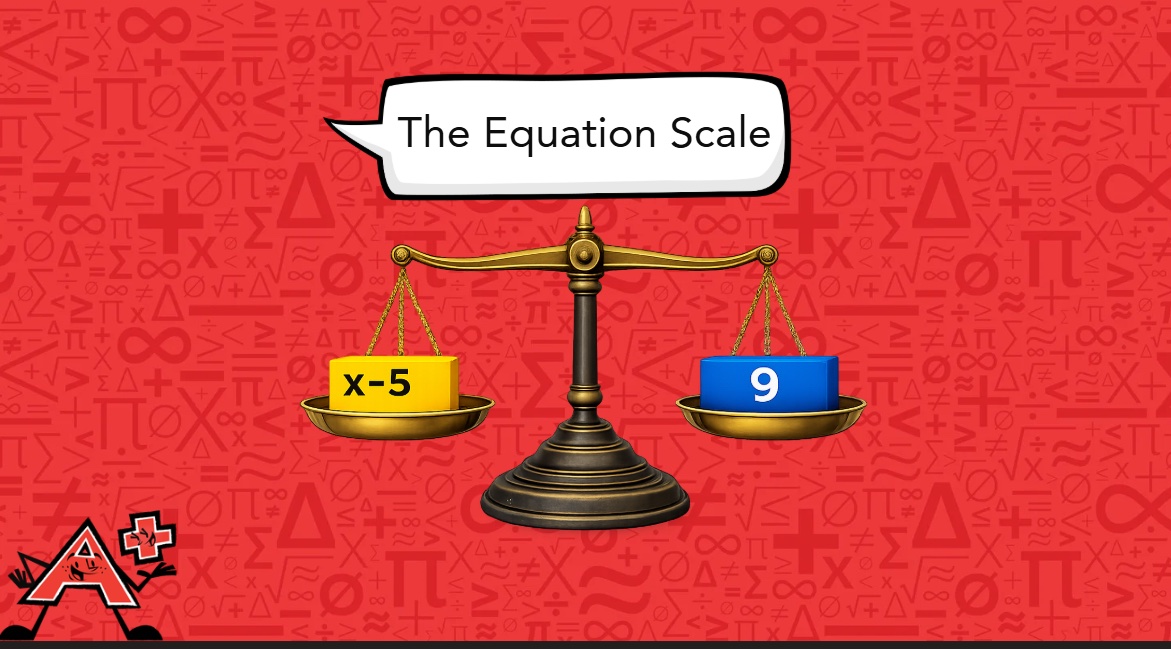
We’re trying to figure out what number, when you subtract 5 from it, gives you 9. That number is x. Our goal is to get x by itself on one side of the equation.
You can always visualize it as an actual scale to make it easier.
Step 2: Use opposite operations
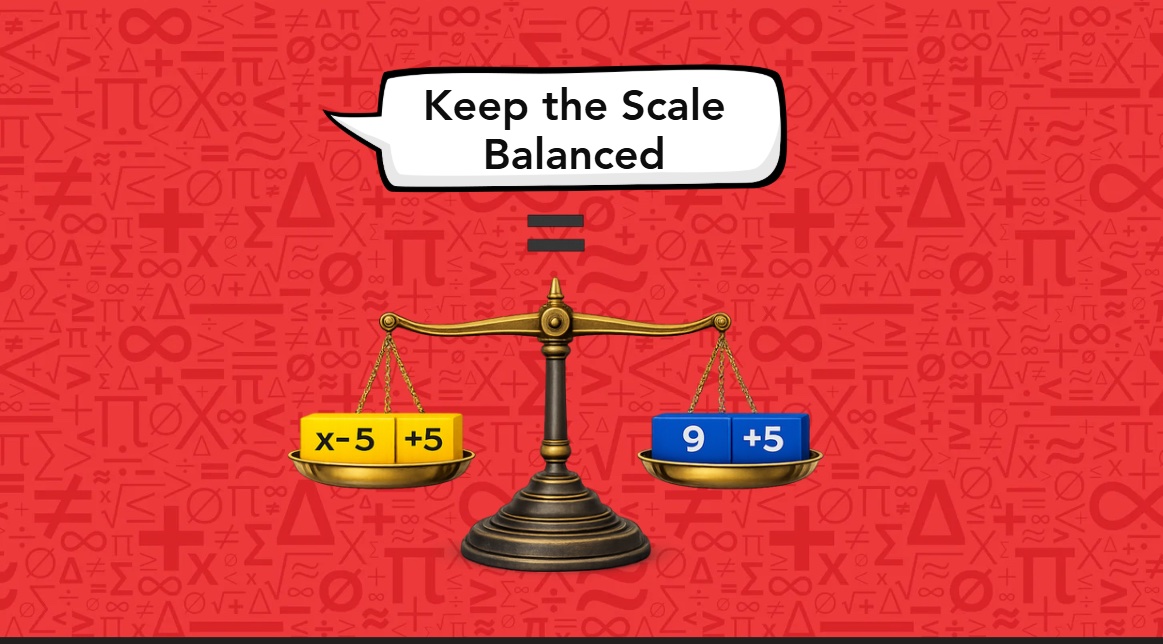
Since we see a - 5, we’ll do the opposite of subtracting 5. We’ll add 5.
But remember: this is a scale!
So, whatever you do to one side of the equation, you must do to the other to keep things balanced. In this case, this means adding a +5 block to both sides.
x − 5 + 5 = 9 + 5
Step 3: Simplify both sides
On the left side, we can see that we’re supposed to subtract 5 and then add 5. Sounds a bit pointless, doesn’t it?
So, we will just cross that out. That leaves us with:
x = 9 + 5
On the right side, we have a simple addition problem, which we can solve. We then have:
x = 14
So the answer is x = 14.
Let’s double-check it. If x = 14, then:
14 − 5 = 9
It works!
Let’s try one more:
3x = 21
This time, the variable is being multiplied. We use the opposite operation again (in this case, division).
3x÷3=21÷3
Once again, there’s no point in dividing a number by 3 and then multiplying it by 3. So, we get rid of that.
That leaves us with:
x = 21 ÷ 3
Doing this simple division problem, we end up with:
x = 7
Check it:
3 × 7 = 21
Correct again!
Solving equations is all about keeping both sides balanced. Once students understand how to “undo” operations by doing the opposite on both sides, they’re on their way to mastering algebra.
Let’s Do a Two-Step Equation As Well
If one-step equations are too easy for you, try out two-step equations! As the name implies, this means that you have to resolve two operations instead of one.
2x + 3 = 11
This equation has two things happening to x: it’s being multiplied by 2, and then 3 is added.
So, we want to deal with this equation one step at a time.
Step 1: Undo the addition
Start by removing the “+3”.
What’s the opposite of adding 3? That’s right: it’s -3. Let’s subtract 3 from both sides:
2x + 3 − 3 = 11 − 3
Like before, we can cross out the +3 and -3 from the left side and then handle 11 - 3 on the right side. Now we have a simpler equation to work with.
2x = 8
Step 2: Undo the multiplication
Now that the addition is gone, we’re back at a one-step equation.
To get x by itself, we divide both sides by 2:
2x ÷ 2 = 8 ÷ 2
This leaves us with x = 8 ÷ 2, which equates to x = 4!
Step 3: Check it
Let’s plug 4 back into the original equation:
2(4) + 3 = 11 => 8 + 3 = 11
It works!
📕 You May Also Like: What Is the Substitution Method in Algebra?
Exercises for Solving Basic Equations
Try these problems on your own or with a parent, tutor, or teacher. As you go through each one, ask yourself:
-
What is the equation telling me?
-
What operation is being used?
-
What can I do to get the variable by itself?
Let’s get started.
One-Step Equations
-
x + 7 = 12
Read: What number plus 7 equals 12?
-
x − 9 = 4
Read: If we’re subtracting 9, what do we need to do to find x?
-
5x = 20
Read: What number times 5 gives us 20?
-
X ÷ 6 = 3
Read: If x divided by 6 is 3, how can we reverse the division?
Two-Step Equations
-
2x + 3 = 11
What should we do first, subtract or divide?
-
x − 4 = 2x + 5
What do you notice about both sides of this equation? Can we move all the x terms to one side?
-
x ÷ 3 − 2 = 6
Can we undo subtraction first, then deal with the division?
Frequently Asked Questions About Basic Equations
Whether you're a student just getting started with algebra or a parent helping with homework, it's normal to have questions about how equations work. Here are a few questions our tutors get quite frequently.
When do students start learning to solve equations?
Students are usually introduced to simple equations with a variable in late elementary school, usually around 5th grade.
In 6th to 8th grade, they begin solving more complex equations, including two-step equations and those with variables on both sides. This is a key step in preparing for full algebra courses.
What is the difference between simple equations and linear equations?
Simple equations usually involve just one step (like adding or dividing) or two steps (a combination of operations) to solve for a single variable.
For example:
x + 4 = 10
Linear equations can be more advanced. They often include variables on both sides and may require several steps to solve.
Here’s an example:
2x − 3 = x + 5
They also form a straight line when graphed.
Both are part of algebra, but simple equations are often taught first to build confidence and understanding.
What does it mean to “isolate the variable”?
To isolate the variable means to get it alone on one side of the equation. When the variable is by itself, you know what it equals. For example:
x + 5 = 12
Subtracting 5 from both sides gives you x = 7.
Isolating the variable is the goal of solving most equations.

Mathnasium instructors guide students through each step of solving equations with clarity and encouragement.
What Mathnasium Tutoring Looks Like: Mastering Equations with Confidence
Solving equations can be a turning point in a student's math journey. Whether it’s understanding what a variable represents or learning how to apply inverse operations, these concepts lay the foundation for algebra and beyond. At Mathnasium, we help students make sense of equations and build lasting confidence in their problem-solving skills.
Mathnasium is a math-only learning center that has helped thousands of students across the country truly understand and enjoy math. When students come to us, we don’t use a one-size-fits-all approach. We use the Mathnasium Method™, our proprietary strategy based on personalized learning plans and proven instructional techniques.
Here’s how we help students succeed with solving equations and other core concepts.
-
Personalization on a granular level: Each student begins with a diagnostic assessment that helps us pinpoint what they already know, where they need support, and how they approach math. Based on these insights, we create a customized learning plan that targets the exact skills they need to strengthen, such as understanding operations, balancing equations, and solving for variables.
-
Teaching for understanding: We explain math using everyday language and a combination of strategies that make concepts stick. These include verbal explanations, visual models, hands-on tools, and written practice. When students understand why solving equations works the way it does, they become more confident and better prepared for advanced math.
-
Caring, trained instructors: Our instructors are specially trained in both math content and teaching techniques. They know how to connect with students, ask the right questions, and adjust their approach based on each child’s learning style. Instruction is delivered face-to-face in a supportive group environment that encourages curiosity and growth.
-
Problem-solving and critical thinking: Students are encouraged to think through problems independently before reviewing their approach with an instructor. We focus on both the how and the why of solving equations so that students develop real problem-solving skills, not just short-term strategies.
-
A singular focus on math: Math is all we do. With decades of refinement, our program is built to help students absorb, retain, and apply key concepts. We don’t rush through topics. We take the time to ensure students truly understand them.
-
A confidence-building, motivating environment: Mathnasium sessions are structured but never feel like ordinary classroom lessons. Students stay engaged through goal-setting, rewards, and interactive activities that make learning math feel rewarding and fun.
And the results speak for themselves.
-
94% of parents report an improvement in their child’s math skills and understanding
-
93% of parents say their child’s attitude toward math improved
-
90% of students saw better grades in school
With over 1,100 learning centers across the U.S., Mathnasium offers convenient access to top-rated math instruction in your community.
And families in our West Chester community are noticing the results. Mathnasium of West Chester has earned:
🏆100+ glowing Google Reviews
🏆Cincy Magazine’s 2025 Family’s Choice Award for “Tutoring/Learning Center”
🏆City Beat’s 2025 Best of Cincinnati award for “Best Tutoring Center”
We’re honored to be a trusted part of so many local learning journeys.
Schedule a free assessment and unlock your child’s math potential today with Mathnasium of West Chester!
Or, find a center in your neighborhood!
Find Mathnasium Locations Near You
Cheat sheet
A: x = 5
B: x = 13
C: x = 4
D: x = 18
E: x = 4
F: x = -9
G: x = 24


 (513) 296-2000
 (513) 296-2000