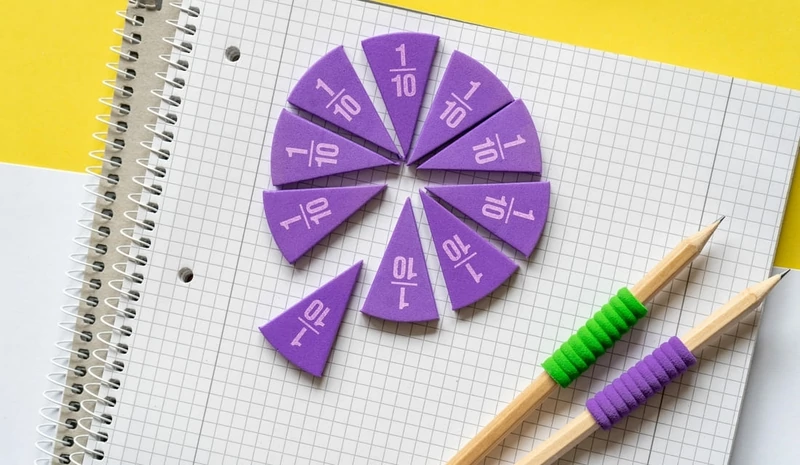
At Mathnasium, we often hear from parents that their students start to lose their way in math when fractions enter the picture. This is understandable.
In most cases, the challenge isn't fractions themselves, but earlier foundations that were never fully secure, such as understanding what a whole is or recognizing how parts relate to the whole.
When that happens, we take a few steps back, identify the missing pieces, and rebuild understanding gradually and deliberately.
This guide does the same. It's designed for parents who want to support their child’s learning at home by breaking down big ideas into smaller, manageable steps.
Read on for a step-by-step guide from our seasoned tutors to help your child make sense of wholes and fractions and move forward with greater confidence in math.

1. Wholes and Parts – The Starting Point
Before children can understand fractions, they need to understand something much simpler: what a whole is, and how that whole can be made up of parts.
This might seem obvious to adults, but it’s a surprisingly important (and often overlooked) step in early math understanding. Without it, the concept of fractions won’t make much sense.
In math, a whole can be one single object (like one apple), a complete set (like a box of 12 crayons), or a total amount (like the number 10). No matter the context, it’s the idea of something complete—nothing missing, nothing broken down.
Parts are just the smaller pieces or groups that make up a whole. We can think of them as:
In math language, we’d express this idea as:
Whole = Part + Part + … + Part
The whole is equal to the total of all the little things that make it up. It’s a simple idea, but one that runs through nearly every area of math.

This whole–part relationship also shows up in many early math problems your child may already be familiar with.
Sometimes, they’re asked to add parts to find the whole:
“There are 3 red apples and 5 green apples in the basket. How many apples in total?”
3 + 5 = 8
Other times, they’ll be given the whole and one part, and need to find what’s missing:
“A box has 12 pencils. 7 are sharpened. How many are unsharpened?”
12 – 7 = 5
Understanding how known and unknown parts relate to the whole lays the groundwork for making sense of fractions. It teaches students to look at what is given, what is missing, and how the pieces fit together.
📕 You May Also Like: What Is Number Sense & Why It Matters in Early Math Education
2. Fractions As Equal Parts of a Whole
Once your child understands that a whole is made up of parts, the next step is learning that fractions are not just any parts, but are equal parts of a whole.
In math, a piece can only be considered a fraction if the whole has been divided into parts that are the same size. If the pieces are uneven, they might still belong to the whole, but they don’t count as fractions.
Children often see something broken into pieces and assume it was divided fairly, even when the sizes don’t match. But in math, fair means equal. Fractions are used only when each part is the same share of the whole.
You can help your child understand that fractions must be equal parts by using examples like these:
-
Compare two versions of the same object: Cut one sandwich or paper into random pieces, then another into equal parts. Ask which looks fair.
-
Use pre-divided items to highlight equal parts: A chocolate bar or graham cracker often comes in clearly marked sections that are the same size.
-
Create your own model: Fold a sheet of paper into equal sections, then unfold it and label each part. Talk about how these parts make up one whole.
-
Discuss objects that don’t divide easily: Try to split an odd number of items, like 7 grapes, between 2 people. Let your child see why unequal parts aren’t counted as fractions.

3. The First Fraction – One Half
Once your child understands that fractions are equal parts of a whole, you can introduce their first named fraction: one-half (\(\Large\frac{1}{2}\) ).
This is often where fraction learning begins.
Why?
Because halves are simple to see, easy to work with, and they appear often in everyday situations, from sharing food to folding paper.
But before your child can understand what a half is, it helps to show what it is not. Children often call any two pieces "halves," even when one is clearly larger than the other. In math, two pieces can only be called halves when they are equal parts of a whole.
To instill this way of thinking, you can use simple, everyday demonstrations:
-
Cut an apple or orange into two clearly unequal pieces and ask, “Are these halves?” Then cut another one into two equal parts and compare.
-
Use a chocolate bar: break off one small square and ask if that counts as half, then show what half actually looks like.
-
Draw circles or rectangles on paper and divide them unequally, then equally. Ask which one shows a proper half.

Once your child understands what halving looks like, you can move on to halving simple numbers in familiar situations:
-
“What’s half of 10 grapes?”
-
“If two kids share 8 crackers equally, how many does each get?”
-
“How many pieces do we need to cut something into to give each person one half?”
To take it a step further, bring in odd numbers to stretch their thinking:
With a solid grasp of halves and halving, you’re ready to carry that same logic into situations where the whole is split into more than two equal parts.
📕 You May Also Like: How to Teach Math to Visual Learners with Pictures & Manipulatives
5. What Happens When We Split the Whole Into More Equal Parts
If a whole can be divided into two equal parts, it can also be divided into three. Or four. The idea doesn’t change, only the number of parts does.
It’s important to point out that as we divide a whole into more equal parts, each part becomes smaller.
You might think of it like this:
Splitting a whole into halves gives us the largest equal pieces. When you cut a pizza in two, each person gets a huge share. But if the same pizza is split three ways, the pieces are smaller, yet still equal.
When a whole is split into three equal parts, each part is called a third. One part is one-third (\(\Large\frac{1}{3}\) ), two parts are two-thirds (\(\Large\frac{2}{3}\) ), and all three together make up the whole or three-thirds (\(\Large\frac{3}{3}\) ).
In each of these, the bottom number (denominator) tells you how many equal parts the whole has been divided into. The top number (numerator) tells you how many of those parts we’re working with.
The same logic applies to fourths. A whole split into four equal parts gives us fourths (also called quarters). One part is one-fourth (\(\Large\frac{1}{4}\) ), two parts are two-fourths (\(\Large\frac{2}{4}\) ), and four parts together complete the whole as four-fourths (\(\Large\frac{4}{4}\) ).

As the number of equal parts increases, the size of each part becomes smaller, but the logic stays the same: each part still fits neatly into the whole.
This is also the point where many students begin to feel confused. Up to now, they’ve learned that larger numbers usually mean larger amounts, like 8 is more than 3 (8 > 3).
But in fractions, that logic works differently. Splitting something into 8 equal parts gives you smaller pieces than splitting it into 3 (\(\Large\frac{1}{3}\) >\(\Large\frac{1}{8}\) ).
The number on the bottom of the fraction (denominator) goes up, but the size of each part goes down.
5. Comparing Simple Fractions
Once your child understands how a whole can be split into equal parts and that more parts mean smaller pieces, you can gently introduce them to the idea of comparing fractions.
A good place to start is when the fractions have the same denominator. That means the whole has been divided into the same number of equal parts, and we’re just comparing how many of those parts are being used.
For example:
-
\(\Large\frac{3}{5}\) is more than \(\Large\frac{1}{5}\) , because three parts is more than one part when the parts are the same size. It’s like saying one child eats 1 out of 5 cookie pieces, and another eats 3 out of 5. It’s clear who ate more.
-
\(\Large\frac{2}{4}\) is more than \(\Large\frac{1}{4}\) , because two of the same-sized pieces are more than one. Think of a pie sliced into four equal pieces: someone who takes two slices clearly has more than someone who takes one.

After these clicks, you can move to fractions that have the same numerator. This means the number of parts being counted stays the same, but the size of those parts changes depending on how the whole was divided.
Try this:
-
\(\Large\frac{1}{3}\) is more than \(\Large\frac{1}{5}\) . Imagine a loaf of bread cut into three slices versus five thinner ones. One of the larger slices will clearly give you more.
-
\(\Large\frac{2}{4}\) is more than \(\Large\frac{2}{6}\) . Picture two chocolate bars of the same size: one broken into four pieces, the other into six. If you take two from each, the bar with fewer pieces gives you the bigger share.

This is where children begin to move from simply counting parts to thinking more deeply about what those parts represent. They start to see how each fraction connects to the whole it came from. That kind of understanding sets the stage for more advanced fraction work later on.
How Mathnasium Helps Students Master Any Math Concept
Mathnasium is a math-only learning center with over 20 years of experience helping K–12 students unlock their true math potential.
At the heart of how we work with students is the Mathnasium Method™, our proprietary teaching approach designed to help children learn math in a way that makes sense to them.
Each student's journey begins with a diagnostic assessment. This allows us to pinpoint their strengths, identify learning gaps, and understand how they think, whether they need to build stronger number sense, reinforce wholes and parts, or deepen their understanding of fractions. The assessment also helps us identify their learning style, whether they respond best to visual, verbal, tactile, or written instruction.
With those insights, we create a personalized learning plan tailored to their exact needs. Our tutors follow this plan closely, guiding students through each concept with face-to-face instruction in a supportive and fun small-group environment.
When teaching a concept like fractions, we focus on language that children can naturally understand. Rather than relying on overly technical terms, we use real-world context and clear, consistent language. Our approach blends direct teaching, Socratic questioning, and a range of mental, visual, tactile, and written techniques to meet each student where they are.
We don’t focus on memorization. Instead, we help students understand the why and how behind each solution. For example, when introducing \(\Large\frac{2}{4}\) and \(\Large\frac{2}{6}\) , we don’t just tell students which is greater, we explore why fourths are larger than sixths and what that tells us about fraction size. Through this kind of thinking, students gain tools to solve problems independently and with confidence.
Each session includes time for students to practice independently. Then, they regroup with their instructor to review, adjust, and reinforce their process. Our goal is always the same: to build strong, independent mathematical thinkers.
And the results?
-
94% of parents report an improvement in their child’s math skills and understanding
-
93% of parents report a more positive attitude toward math
-
90% of students saw improvement in their school grades
For families curious about how we work, Mathnasium operates over 1,100 learning centers across the U.S., bringing top-rated instructors and a proven method to communities everywhere.
If you're located in or near West Chester, Mathnasium of West Chester is a trusted, award-winning local center. In 2025, we were honored as:
If you’re looking to help your child master fractions and go far beyond, we’re here to help. Take the first step by scheduling a free diagnostic assessment, and we’ll carve out a clear, customized path to math success.
📅 Schedule a Free Diagnostic Assessment at Mathnasium of West Chester
Not near West Chester?
📍 Find a Mathnasium Learning Center Near You


 (513) 296-2000
 (513) 296-2000