












What are Equivalent Fractions?
Fractions that represent the same value, even though they have different numerators and denominators.
Equivalent fractions are fractions that may look different but represent the same part of a whole. We create equivalent fractions by multiplying or dividing both the numerator and denominator by the same number.
For example, \(\Large\frac{1}{2}\) is equivalent to \(\Large\frac{2}{4}\), and \(\Large\frac{4}{8}\). Even though the numbers look different, these fractions cover the same portion of a whole.
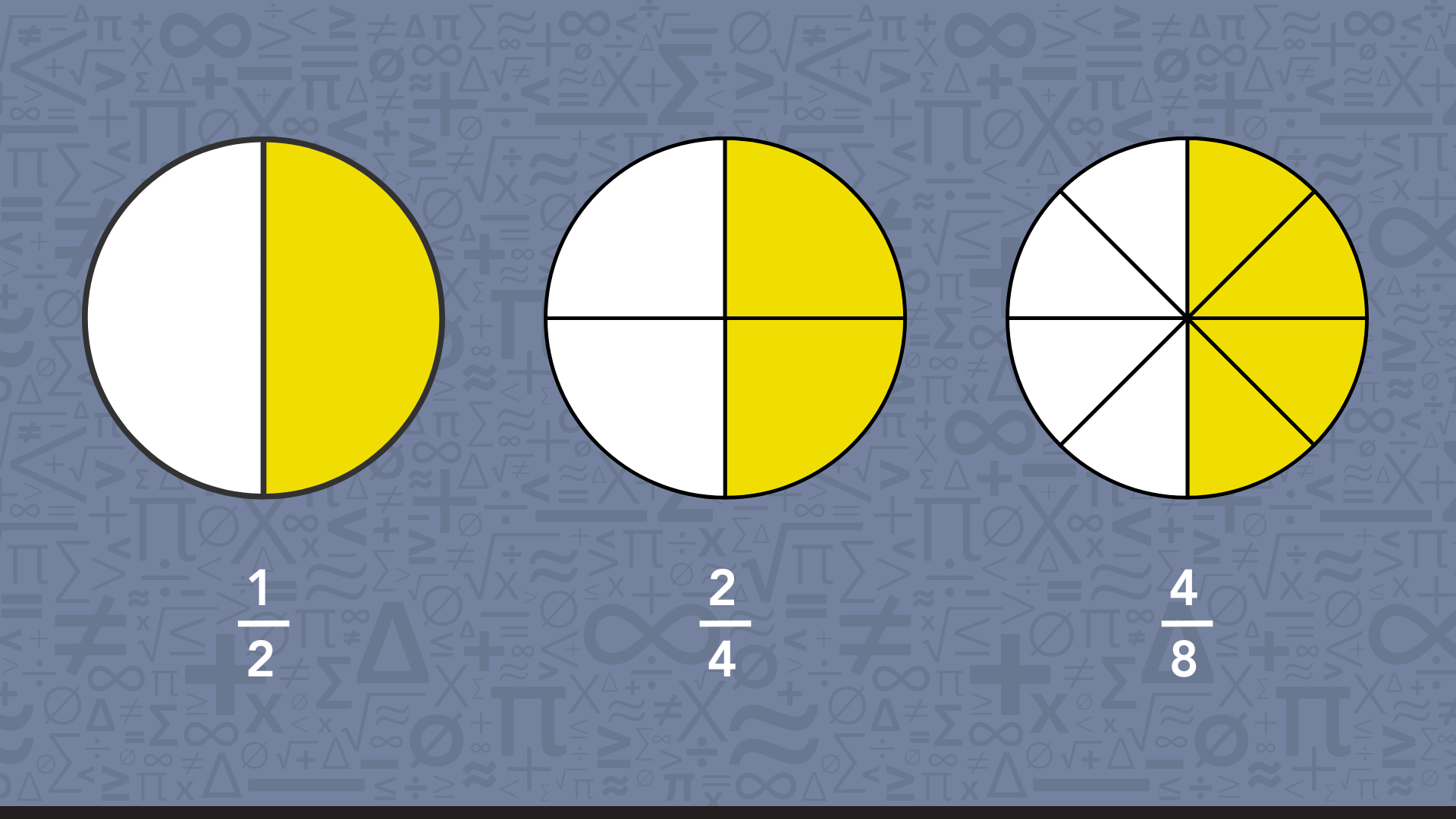
We can make equivalent fractions by multiplying or dividing both the numerator and the denominator by the same number.
-
\(\Large\frac{1}{2}\) × \(\Large\frac{2}{2}\) = \(\Large\frac{2}{4}\)
-
\(\Large\frac{2}{4}\) × \(\Large\frac{2}{2}\) = \(\Large\frac{4}{8}\)
When we multiply or divide the numerator and the denominator by the same number, for example \(\Large\frac{2}{2}\), \(\Large\frac{3}{3}\), or \(\Large\frac{11}{11}\), we are essentially multiplying it by 1.
How so?
Fractions represent division. What happens when we divide 2 by 2, or 3 by 3, or 11 by 11?
We get 1! And multiplying or dividing a number with 1 doesn’t change its value.
Understanding equivalent fractions helps students:
-
Compare fractions
-
Add and subtract fractions with different denominators
-
Simplify fractions
When Do Students Learn About Equivalent Fractions?
Students are introduced to equivalent fractions when they begin learning about parts of a whole and how fractions relate to each other.
Grades 3–5 – Understanding Equivalent Fractions
Students use visuals like fraction bars, fraction circles, and number lines to explore equivalent fractions. They practice making equivalent factions and simplifying fractions to solve problems.