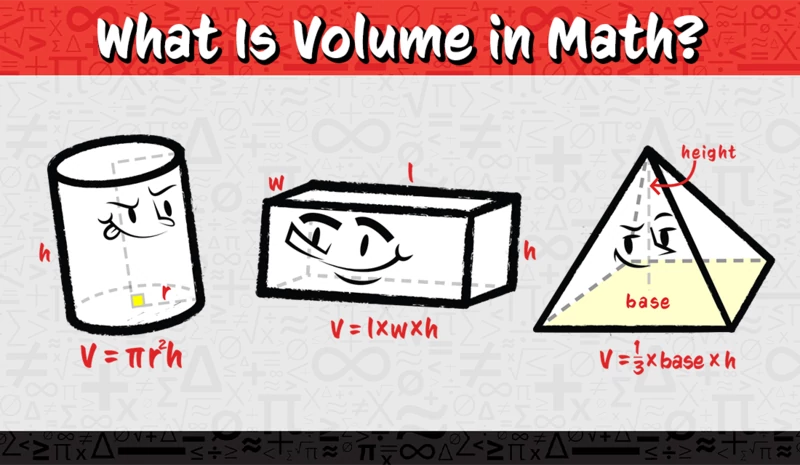












What is Volume?
The amount of space inside a three-dimensional (3-D), measured in cubic units
In math, volume measures the amount of space within a 3-D object like a box, a ball, or a cylinder.
We usually measure the volume of space using cubic units, such as:
- Cubic centimeters (cm³)
- Cubic inches (in³)
- Cubic meters (m³)
To measure the volume of liquids, we use different units that are designed for fluids, including:
- Gallons, fluid ounces, and cups (in the U.S. customary system)
- Liters and milliliters (in the metric system)
For example:
- A small box with dimensions 2 cm × 3 cm × 4 cm has a volume of 24 cm³.
- There is 1 liter of water in a water bottle, which is a measure of liquid volume.
Volume formulas vary depending on the shape. For a rectangular prism (box), the formula is:
Volume = length × width × height

Understanding volume helps in real-life tasks like:
- Figuring out how much a container can hold
- Packing boxes
- Measuring ingredients in cooking or science
When Do Students Learn About Volume?
Students start learning about volume as they work with three-dimensional shapes and explore how to measure the space they occupy.
Grades 3–5 – Introduction to Volume
Students begin exploring volume by counting unit cubes and using simple formulas for rectangular prisms.
Grades 6+ – Working with Volume in Geometry
Students apply volume formulas to a variety of 3-D shapes like cylinders, cones, pyramids, and spheres, and solve real-world problems involving capacity and measurement.