Everything is bigger in Texas, or so they say. But how much bigger is it really?
Our tutors are always looking for ways to make math more engaging for our young learners and we find that they learn best when they do what kids like to do most: play and explore the world around them!
So, today, we’ll apply math concepts like measurement, comparison, and scale to describe the size of the Lone Star State.
Let's dive into some fascinating facts that show just how massive Texas really is and discuss the underlying math concepts at play!

How Big Is Texas? Putting the Numbers in Perspective
Texas covers 261,267 square miles, making it the second-largest U.S. state after Alaska. But what does that actually mean?
When we talk about “square miles,” we’re working with area, a measurement that tells us how much two-dimensional space something covers. Think of it like counting how many one-mile-by-one-mile squares you could fit inside Texas.
So, when we say that Texas is bigger, even by just one square mile, the difference is still about the size of New York’s Central Park!
Now let’s see how Texas stacks up against other states and countries.
📕 You May Also Like: What Is Area in Math? A Complete & Kid-Friendly Guide
Texas vs. the World
If Texas were an independent country, it would rank as the 39th or 40th largest nation in the world by land area, sitting between Zambia and Myanmar.
And aside from Russia, no other European country can step into the ring with Texas!
Texas is about 1.2 times larger than France (213,011 square miles). You could fit all of France inside Texas with room left over. You can double-check this fact by using division!
Just divide Texas’s area (261,267) by France’s area (213,011) to get approximately 1.22.
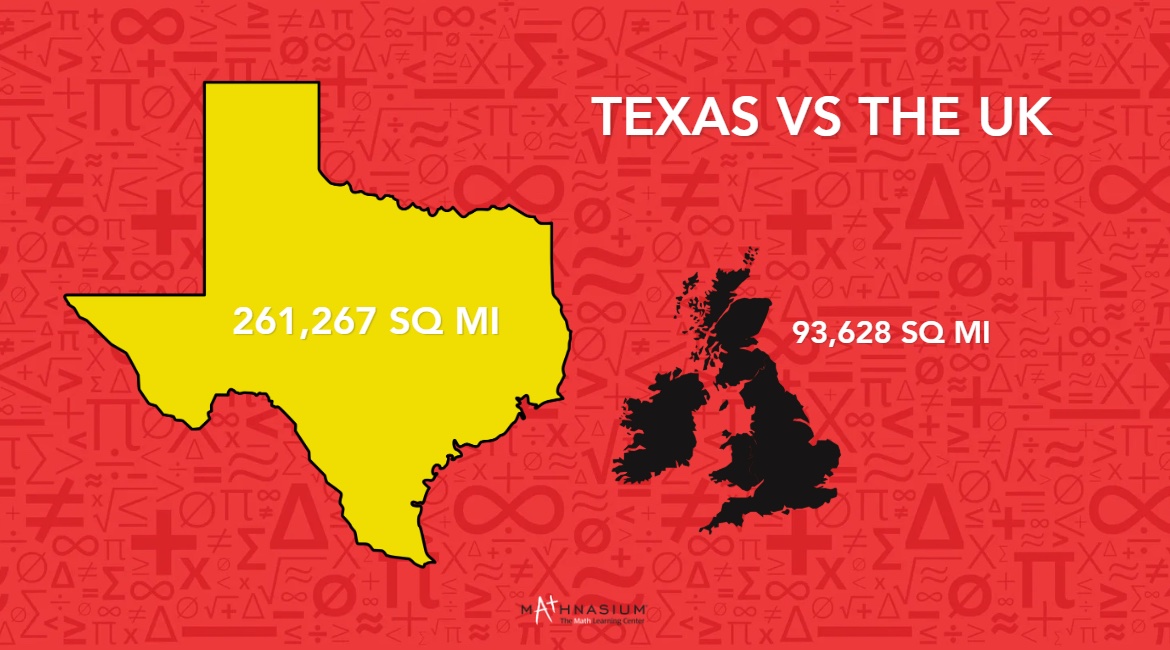
Texas is also nearly three times larger than the United Kingdom (93,628 square miles) and almost twice the size of Germany (137,847 square miles). In fact, you could fit Poland (120,733 square miles) and Germany together inside Texas, and you’d still have a bit of wiggle room!
This time, let’s use multiplication and addition to double-check these comparisons:
-
United Kingdom: 93,628 square miles x 3 = 280, 884 square miles (which is still surprisingly close to Texas’ 261,000).
-
Germany: 137,847 square miles x 2 = 275,694 square miles
-
Germany and Poland: 137,847 square miles + 120,733 square miles = 258,580 (this means we have room for about 2 Central Parks)
Texas vs. Other States
While Alaska dwarfs Texas at 665,384 square miles (about 2.5 times larger), Texas towers over most other states:
-
Texas is roughly 1.7 times larger than California (155,779 square miles)
-
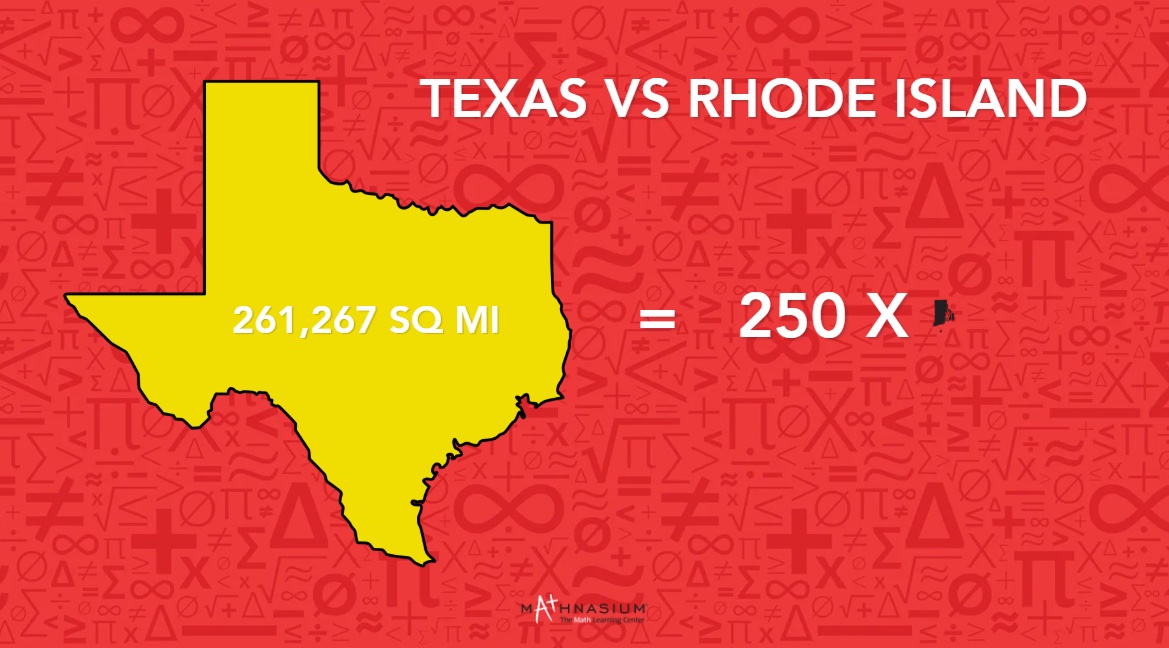
About 250 Rhode Islands could fit inside Texas (Rhode Island is just 1,045 square miles)
How do we know 250 Rhode Islands fit in Texas? We divide!
261,267 (Texas) ÷ 1,045 (Rhode Island) = approximately 250.
This division problem shows us the scale difference between states. It’s a great example of how division helps us understand “how many times” one number fits into another.
And here’s a fun thought experiment: if Texas had the same population density as New York City (about 27,000 people per square mile), it could almost hold the world's entire population.
How do we know this?
We calculate it by using population density times area.
Population density describes the number of people per square mile of an area. NYC has about 27,000 people per square mile. So, if Texas had the same density, we’d multiply:
261,267 square miles × 27,000 people per square mile = approximately 7,054,209,000 people.
That’s over 7 billion! This calculation shows how multiplication of a rate (people per square mile) by area (square miles) gives us the total population.
Of course, that's not practical given Texas's varied terrain, but it shows just how much space the state has!
Use Math to Plan a Texas Road Trip
Crossing Texas takes time. A lot of it!
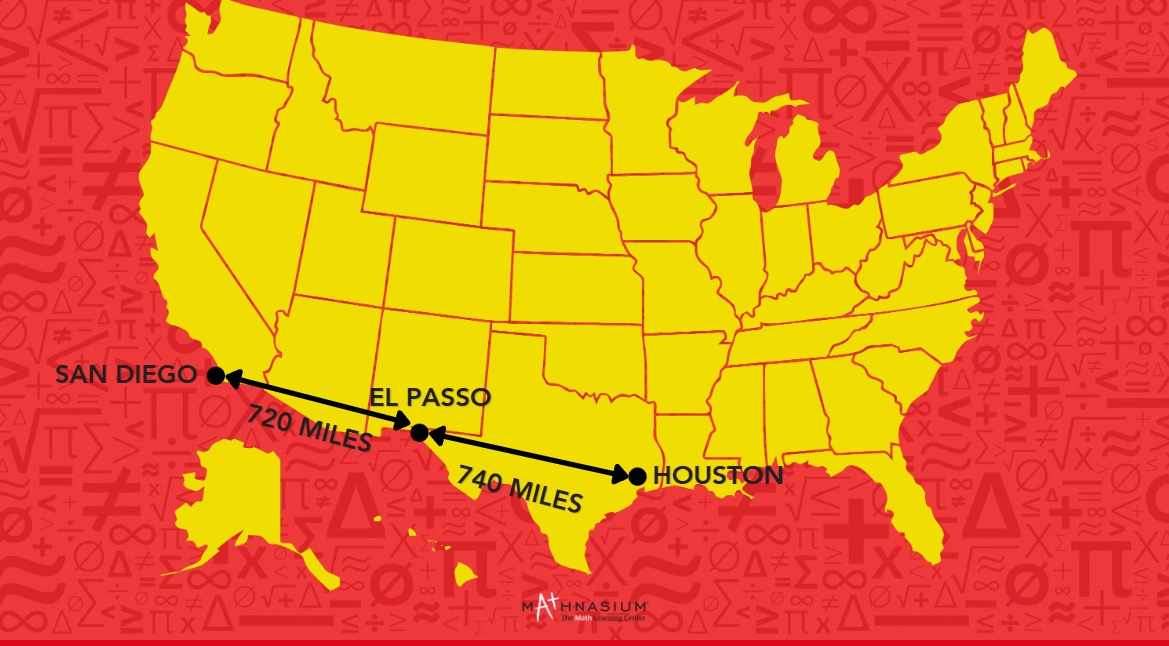
Here's something that surprises many people: El Paso, located in western Texas, is closer to San Diego, California (about 720 miles away) than it is to Houston, Texas (about 740 miles away).
That's right, a California city is geographically closer than a fellow Texas city!
The Texas highway system also spans over 313,000 lane miles, more than any other state. If you laid all those lanes end to end, they would stretch more than 12 times around the Earth's equator.
Lastly, did you know that driving from El Paso to Orange (across the entire state) is about 870 miles, which is roughly the same distance as driving from Chicago to New York City? At an average speed of 60 miles per hour, that's about 14.5 hours of straight driving!
This is a perfect example of the distance-rate-time formula: Distance = Rate × Time.
If we know the distance (870 miles) and the rate (60 mph), we can find time by dividing:
Time = Distance ÷ Rate = 870 ÷ 60 = 14.5 hours.
This fundamental formula appears everywhere in real life, from planning road trips to calculating shipping times.
Use Math to Describe Texas Landmarks
Texas doesn't just stretch far. It also soars high and builds big!
-
The Texas State Capitol: Standing at 302 feet tall, the Texas State Capitol in Austin is 14 feet taller than the U.S. Capitol in Washington, D.C. (which reaches 288 feet). That extra 14 feet gives Texas bragging rights for the tallest state capitol building in the United States.
-
AT&T Stadium: This Arlington stadium can hold over 100,000 people, which is more than the entire population of many U.S. cities. To give you an idea, cities like Berkeley, California, and Cambridge, Massachusetts, each have populations under 125,000. The stadium could fit nearly everyone from those cities!
-
San Jacinto Monument: At 567 feet tall, this Houston-area monument is the tallest war memorial in the United States. It's even 12 feet taller than the Washington Monument (555 feet).
These landmarks offer great opportunities to explore concepts like measurement and scale while learning about Texas history!
Use Math to Explore Ranches and Natural Wonders
Texas ranches and natural landmarks break records left and right!
-
The King Ranch: This South Texas ranch spans 825,000 acres (about 1,289 square miles), which is larger than the entire state of Rhode Island. Yes, a single ranch in Texas is bigger than an entire U.S. state!
-
Water, Water Everywhere: Texas has over 7,000 lakes and 191,000 miles of rivers and streams. If you laid out all those river and stream miles end to end, you could circle the Earth more than seven times (Earth's circumference is about 24,901 miles).
-
Big Bend National Park: This park alone covers over 800,000 acres (about 1,250 square miles of protected wilderness). Like the King Ranch, it's also larger than some small states.
-
Palo Duro Canyon: Known as the "Grand Canyon of Texas," this massive feature in Palo Duro Canyon State Park stretches 120 miles long, reaches up to 20 miles wide, and plunges as deep as 800 feet. This makes it the second-largest canyon in the United States, surpassed only by Arizona's Grand Canyon itself. Yes, Texas boasts a canyon that rivals one of the world's most iconic natural wonders!
How do we convert acres to square miles? There are 640 acres in one square mile. So we divide:
825,000 acres ÷ 640 acres per square mile = approximately 1,289 square miles.
Unit conversion is essential in math and science, helping us express measurements in different ways for easier comparison.
📕 You May Also Like: Measurement Conversions: A Kid-Friendly Guide
Use Math to Understand Texas Cities: Big Populations, Bigger Footprints
Last up, the three major cities in Texas are just as super-sized as everything else so far.
-
Houston: Covering over 640 square miles, Houston is larger than the entire country of Singapore (which spans about 278 square miles). That means Houston is more than twice as large.
-
San Antonio: Sprawling over 500 square miles, San Antonio is one of the largest cities by land area in the entire United States. For perspective, that's bigger than the combined area of San Francisco, Boston, and Miami.
-
Dallas: At around 385 square miles of land area, Dallas is smaller than Houston and San Antonio but is still about 9 times larger than Paris (with the city proper being around 40 square miles).
Hopefully, all of these examples have put into perspective just how vast Texas is, from top to bottom. Comparing these large numbers to other states, countries, or cities makes for an easy, natural segway into learning how to work with large numbers in a fun way.

Mathnasium tutors make math come alive through games, visuals, and comparisons that ground math concepts.
How Mathnasium Makes Learning Big Numbers Fun
If your child has ever asked, "How big is a million?" or struggled to picture the difference between 100,000 and 1,000,000, you've seen firsthand how abstract large numbers can feel.
That's why examples like these Texas comparisons are so powerful; they turn overwhelming numbers into something kids can actually visualize.
At Mathnasium, we specialize in making math both understandable and enjoyable, especially when it comes to concepts that feel too big to grasp.
Behind every program we offer is our proprietary teaching approach called the Mathnasium Method™. We don't just rely on rote drills but rather aim to help students truly understand what they're learning.
We support math mastery through:
-
Personalized learning: Each student begins with a diagnostic assessment that helps us identify their current skills, knowledge gaps, and how they naturally think through math. We use those insights to build a custom learning plan tailored to their needs.
-
Teaching for understanding: We explain math in clear, everyday language, using a mix of verbal, visual, mental, tactile, and written techniques. This allows students to approach each concept in the way that makes the most sense to them.
-
Caring, responsive tutors: Our tutors are specially trained in both the technical and emotional aspects of teaching. They know when to guide, when to challenge, and how to help students regain trust in their thinking.
-
Independent problem-solving and critical thinking: We give students space to work through challenges on their own, then rejoin them to check their reasoning. Instead of just giving them the answer, we help them understand the how and why. This helps them develop problem-solving skills and critical thinking tools they can use in math and life.
-
A singular focus on math: We specialize in math and math only. Our robust, continually refined program spans thousands of custom materials built around how students actually learn and retain math skills.
-
A supportive, fun environment: Many of our activities are hands-on or game-based. We use reward systems and consistent encouragement to keep students engaged. And we celebrate progress because confidence grows with every win.
The result? Real, measurable progress.
-
94% of parents report improvement in their child's math skills and understanding
-
93% of parents notice a more positive attitude toward math
-
90% of students see higher grades in school
Mathnasium operates over 1,100 learning centers across the U.S., bringing our proven approach close to your community.
For families in or near Richardson, TX, Mathnasium of Richardson West is a trusted local center with years of experience transforming how students think and feel about math.

With over 100 five-star Google reviews and multiple Reader's Choice Awards from Living Magazine, it's been recognized for:
If your child is ready to catch up, keep up, or get ahead in math, our team is happy to assist.
📅 Schedule a Free Diagnostic Assessment at Mathnasium of Richardson West
Not located near Richardson?
📍 Find a Mathnasium Learning Center Near You


 (972) 231-6284
 (972) 231-6284