The associative and distributive properties allow us to make calculations simpler and faster. We can think of them as reliable shortcuts and use them to rearrange numbers, break problems into smaller pieces, and get to the answer more efficiently.
Today, Mathnasium tutors break down both properties step by step, starting with what each one means, how to use it, and how the distributive property connects multiplication and addition in a way that makes big problems much more manageable.
Each property works differently, and by the end of this guide, you'll know exactly when to use each one.
What Is the Associative Property?
The associative property allows us to change the grouping of numbers in a multiplication or addition problem, and the answer stays the same. The parentheses move, while the operation and the result do not.
1. The Associative Property With Multiplication
The associative property of multiplication tells us that while we multiply numbers, we can change how we group them without changing the result.
In math, the equation is:
(a × b) × c = a × (b × c)
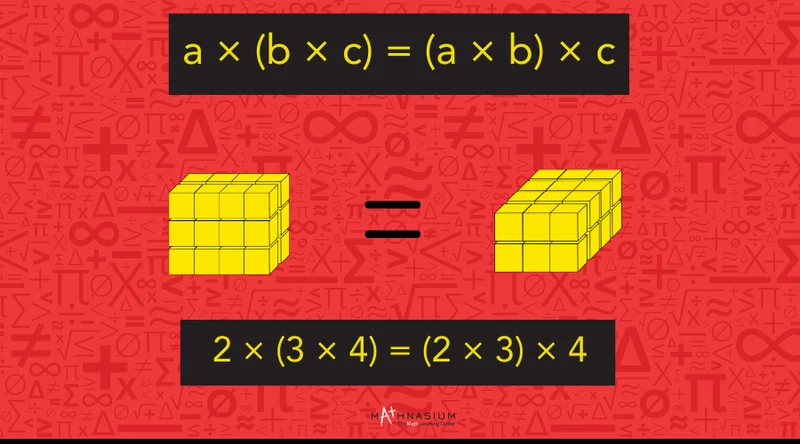
Let's say Peter and his dad need to arrange 24 boxes. Peter’s idea is to arrange them as 2 × (3 × 4) while his dad prefers (2 × 3) × 4.
Whatever they decide, they will still be working with the same number of boxes: 24.
2 × (3 × 4) = (2 × 3) × 4
That is the associative property in action.
📕 You May Also Like: What Is the Associative Property of Multiplication?
2. The Associative Property With Addition
The associative property of addition allows us to change how we group numbers in addition without changing the result.
In math, it looks like this:
(a + b) + c = a + (b + c)
Let’s illustrate this with a familiar real-life example.
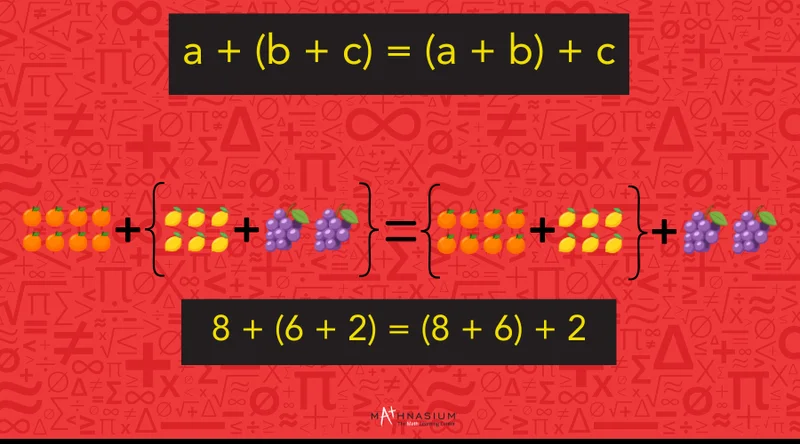
Kelly and her mom just finished grocery shopping and need to pack the fruits they bought: 8 oranges, 6 lemons, and 2 bunches of grapes.
Kelly suggests grouping the oranges and lemons together, while her mom prefers grouping the lemons and grapes. No matter how they pack them, they will get home with the same 16 pieces of fruit.
8 + (6 + 2) = (8 + 6) + 2
In this scenario, we see how the associative property with addition works.
What Is the Distributive Property?
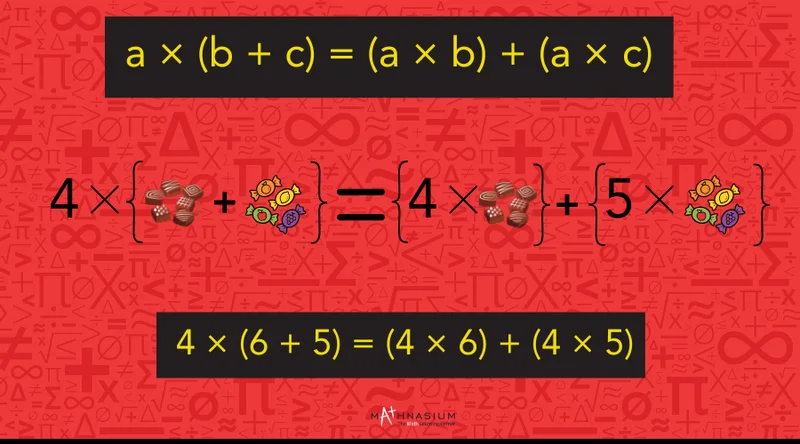
The distributive property tells us that we can break a multiplication problem into smaller parts, solve each part separately, and then add the results together. This is how multiplication and addition work together. In math, we write:
a × (b + c) = (a × b) + (a × c)
To visualize this, let’s go through one familiar situation.
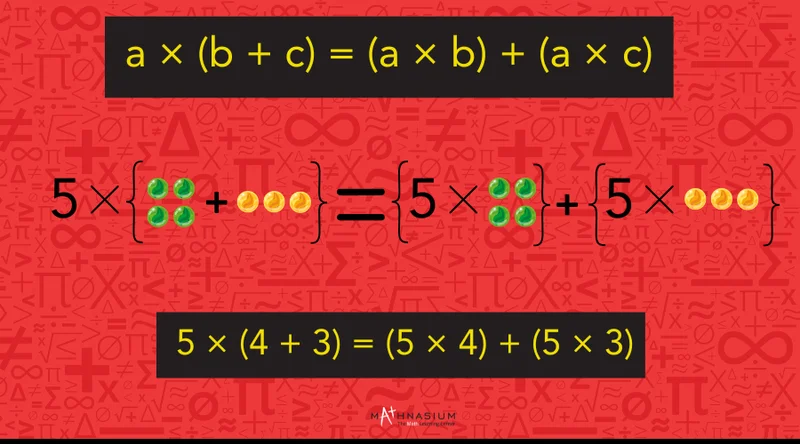
Mike wants to buy 5 sacks of marbles. Each sack contains 4 green and 3 yellow marbles, and that is 7 in total. Instead of multiplying 5 × 7 straight away, we can break it into two simpler steps:
5 × 7 → 5 × (4 + 3) = (5 × 4) + (5 × 3) = 20 + 15 = 35
Mike will get 35 marbles in different colors.
Let’s try one more example.
Tanya asked her mom to buy her 4 bags of candies. Each bag contains 6 chocolate candies and 5 fruit candies (11 per bag). Let’s break it into two smaller problems before adding the results.
4 × 11 → 4 × (6 + 5) = (4 × 6) + (4 × 5) = 24 + 20 = 44
Associative vs. Distributive: How to Know Which to Use
Although the associative and distributive properties are easy to mix up, they do different jobs.
The associative property works within a single operation, either addition or multiplication. For example:
(2 × 3) × 4 = 2 × (3 × 4) = 24
It allows us to regroup numbers without changing the result. The operation doesn’t change throughout the process.
The name itself is a useful clue. ‘’Associative’’ comes from "associate," which means to group together, so the property is all about changing the grouping.
The distributive property bridges two operations. It lets us break a multiplication problem into smaller addition (or subtraction) problems, then add the results together. Let’s see it in action:
2 × (3 + 4) = (2 × 3) + (2 × 4) = 6 + 8 = 14
The name works the same way here. ‘’Distributive’’ comes from "distribute," which means to hand out, so think of it as spreading the multiplication across each number inside the parentheses.
📕 You May Also Like: How to Break Down Any Math Problem Into Steps
Quiz: Check Your Knowledge of Associative and Distributive Properties
Ready to practice what we’ve covered? Give these challenges a try on your own and check your answers at the bottom of the guide.
Question 1
Which equation shows the associative property of multiplication?
-
3 + 4 = 4 + 3
-
(2 × 3) × 4 = 2 × (3 × 4)
-
2 × (3 + 4) = (2 × 3) + (2 × 4)
-
5 × 1 = 5
Question 2
Which equation shows the distributive property?
-
(4 + 5) + 6 = 4 + (5 + 6)
-
3 × (4 + 5) = (3 × 4) + (3 × 5)
-
6 × 7 = 7 × 6
-
(2 × 3) × 4 = 2 × (3 × 4)
Question 3
Use the distributive property to simplify: 4 × (6 + 3). Which expression is correct?
-
(4 × 6) + 3
-
4 + (6 × 3)
-
(4 × 6) + (4 × 3)
-
(4 + 6) × (4 + 3)
Question 4
What is the value of 4 × (6 + 3) using the distributive property?
-
24
-
27
-
36
-
42
📕 You May Also Like: What Is an Expression in Math? A Beginner-Friendly Guide
FAQs About Associative and Distributive Properties
Here are some of the questions our tutors hear from our students while learning about associative and distributive properties in math, along with their answers.
1. Does the associative property work for subtraction or division?
No, the associative property only works for addition and multiplication. If we attempt applying associative property with subtraction and division and change the grouping, the result will change.
For example, (8 - 3) - 2 = 3, but 8 - (3 - 2) = 7. The grouping matters, so the associative property does not apply.
2. Can I use the distributive property with subtraction inside the parentheses?
Yes. The distributive property works with subtraction inside the parentheses, too.
For example: 4 × (5 - 2) = (4 × 5) - (4 × 2) = 20 - 8 = 12
We distribute the multiplication across both numbers, just as we do with addition.
3. Does the distributive property work when there are three numbers inside the parentheses?
Yes. In this case, we simply distribute the multiplication across all three numbers. For example:
2 × (3 + 4 + 5) = (2 × 3) + (2 × 4) + (2 × 5)
6 + 8 + 10 = 24
The same rule applies no matter how many numbers are inside the parentheses.

Mathnasium's specially trained tutors help students work through math properties step by step, building confidence and understanding along the way.
Master Associative and Distributive Math Properties (and Any Math Concept) With Mathnasium
Mathnasium is a math-only learning center dedicated to helping K-12 students learn and master math at every level.
Each student starts their Mathnasium enrollment with a diagnostic assessment that helps us identify their current skills, knowledge gaps, and learning goals. From there, we build a personalized learning plan tailored to their needs and pace.
Our specially trained tutors use the Mathnasium Method™, a proprietary teaching approach that combines verbal, visual, mental, tactile, and written techniques to help students understand the math they are working with.
With concepts like the associative and distributive properties, our tutors go beyond the rule and help students see the logic behind it, so they can apply it confidently across different problems.
Gradually, students learn to do the same independently and walk out of our centers with the problem-solving skills and critical thinking tools they can use in math and beyond.
Every session includes hands-on and game-based activities that keep students engaged, and we celebrate every bit of progress along the way.
The results speak for themselves:
-
94% of parents report an improvement in their child's math skills and understanding.
-
93% of parents report their child's improved attitude toward math after attending Mathnasium.
-
90% of students saw an improvement in their school grades.
Mathnasium operates over 1,100 learning centers, bringing our top-rated math instruction close to your community.
For families based in or near Allen, TX, Mathnasium of Allen is a trusted local center with years of experience building confident math thinkers.
Our community recognizes our commitment to student success and has rewarded us with:
-
Over 100 five-star Google reviews reflect our parents' trust in proven results
-
Multiple Reader's Choice Awards from Living Magazine: Best Tutoring (2021–2024) and Best Early Education (2023)
-
Community Votes 2025 Best Tutor in Allen
-
Business Rate Best of 2025 Tutoring Service for Allen
Whether your child needs to catch up, keep up, or get ahead, our local team is ready to help.
📅 Schedule a Free Diagnostic Assessment at Mathnasium of Allen
Not near Allen?
📍 Find a Mathnasium Learning Center Near You
Pssst! Check Your Answers Here
If you worked through the quiz, here are the answers:
-
Question 1 - Answer: 2) (2 × 3) × 4 = 2 × (3 × 4)
-
Question 2 - Answer: 2) 3 × (4 + 5) = (3 × 4) + (3 × 5)
-
Question 3 - Answer: 3) (4 × 6) + (4 × 3)
-
Question 4 - Answer: 3) 36
How did you do?


 (469) 361-2277
 (469) 361-2277