(469) 361-2277
 (469) 361-2277











Mathnasium of Allen Awarded in Reader's Choice Contest for Best Tutoring and Best Early Education
Aug 11, 2026 | Allen


Your child can rattle off "24 ÷ 4 = 6" without missing a beat, but ask them why that's true, or to explain it a different way, and suddenly things get quiet.
This is something Mathnasium tutors see more often than you'd think. Students frequently learn division as a set of steps to follow rather than an idea to truly understand. And when the steps are all you have, the first time a problem looks a little different, the whole thing falls apart.
Understanding can be built, though, and it doesn't require a whiteboard full of rules. Sometimes, all it takes is showing division from a fresh angle: through stories, objects, patterns, or questions that make a child stop and genuinely think.
Those moments of real connection don't have to stay in the classroom. So, today we're sharing 7 Mathnasium-approved creative techniques to help your child truly learn division.
Before your child ever sees a division symbol, give them the question that makes the whole concept make sense: how many times does this number fit inside that one?
That's it. That's division.
At Mathnasium, this is exactly how we define it: not as a procedure to follow, but as a counting question to answer.
How many 4s fit inside 24?
Count them up, and you have your answer. The sooner your child internalizes this framing, the less division feels like an abstract operation, and the more it becomes a question they can actually picture and answer.
Try it at home without any written math at all. Ask your child questions like:
"How many 5s do you think fit inside 20?"
"How many 4s fit inside 24?"
"How many 3s can you count inside 15?"
Let them reason it out, guess, or count if they need to. Don't worry if it takes a moment. That pause is them probably thinking it through, which is exactly the point.
📕 You May Also Like: What Is Division in Math? A Simple & Complete Overview
Manipulatives can be anything you find around the house: coins, snacks, small toys, or building blocks. The setup is simple: give your child a pile and ask them to share it out equally.
A few ways to try it:
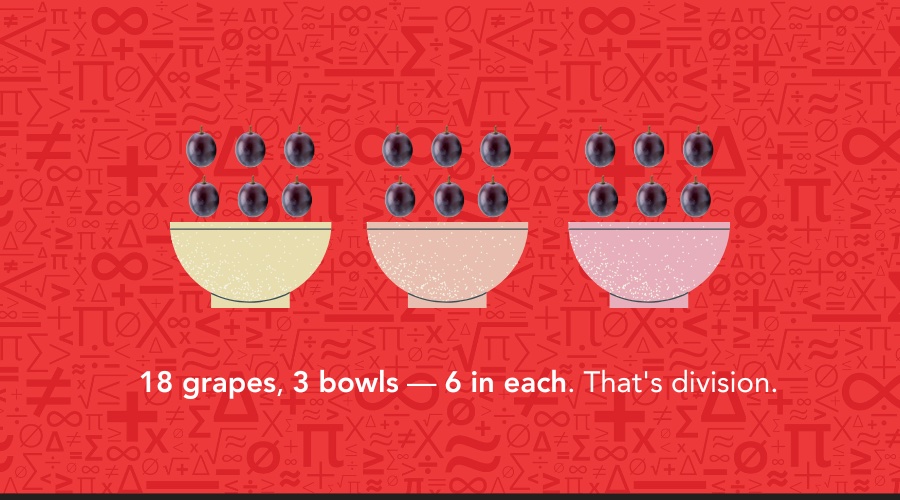
"Here are 18 grapes. Can you split them equally between 3 bowls?"
"You have 20 coins. How would you share them fairly between 4 friends?"
"There are 15 blocks. Can you build equal towers?"
That hands-on, fair-sharing model is usually the first way kids naturally grasp what division actually does.
📕 You May Also Like: How to Teach Math to Visual Learners with Pictures & Manipulatives
If your child already has subtraction down, they're closer to understanding division than you might think.
Repeated subtraction is just division in disguise; instead of dividing in one step, you simply keep subtracting the same number and count how many times you do it before reaching zero.
Try it with 20 ÷ 4:
20 - 4 = 16
16 - 4 = 12
12 - 4 = 8
8 - 4 = 4
4 - 4 = 0
Count how many times you subtracted 4; that's 5 times. So 20 ÷ 4 = 5. Same answer, no new operation, just a skill they already have, used in a new way
📕 You May Also Like: 5 Ways Mental Math Supports Long-Term Math Success
For kids who think visually, this one lands fast.
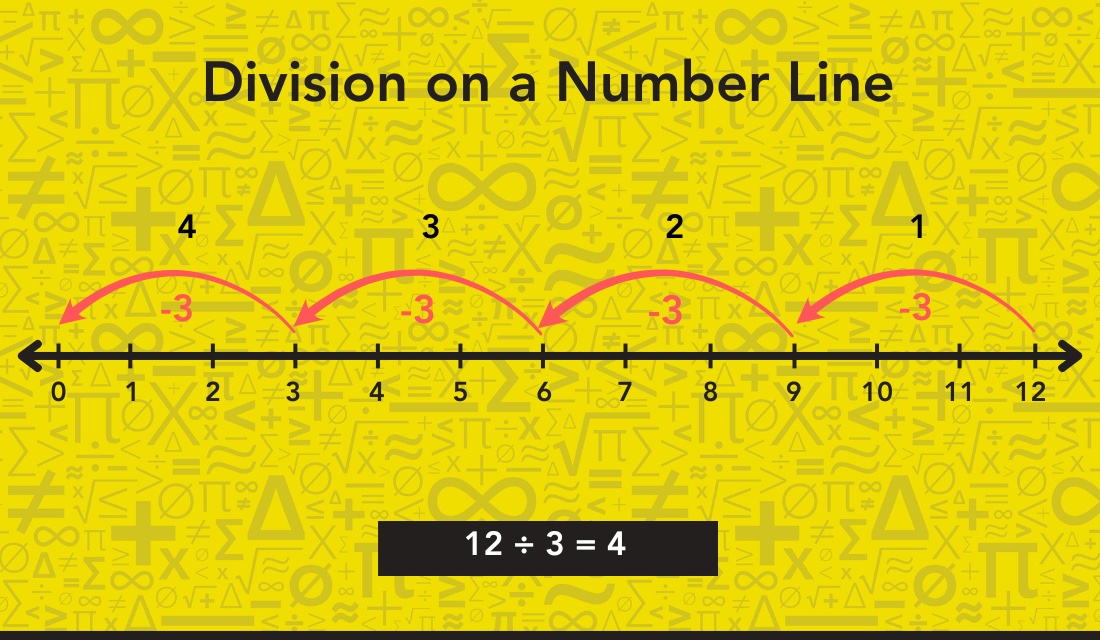
Draw a number line, and instead of subtracting on paper, they physically hop backwards in equal steps, then count the hops.
You can start with something simple like 12 ÷ 3:
Start at 12
Hop back 3 → land on 9 (hop 1)
Hop back 3 → land on 6 (hop 2)
Hop back 3 → land on 3 (hop 3)
Hop back 3 → land on 0 (hop 4)
4 hops. 12 ÷ 3 = 4.
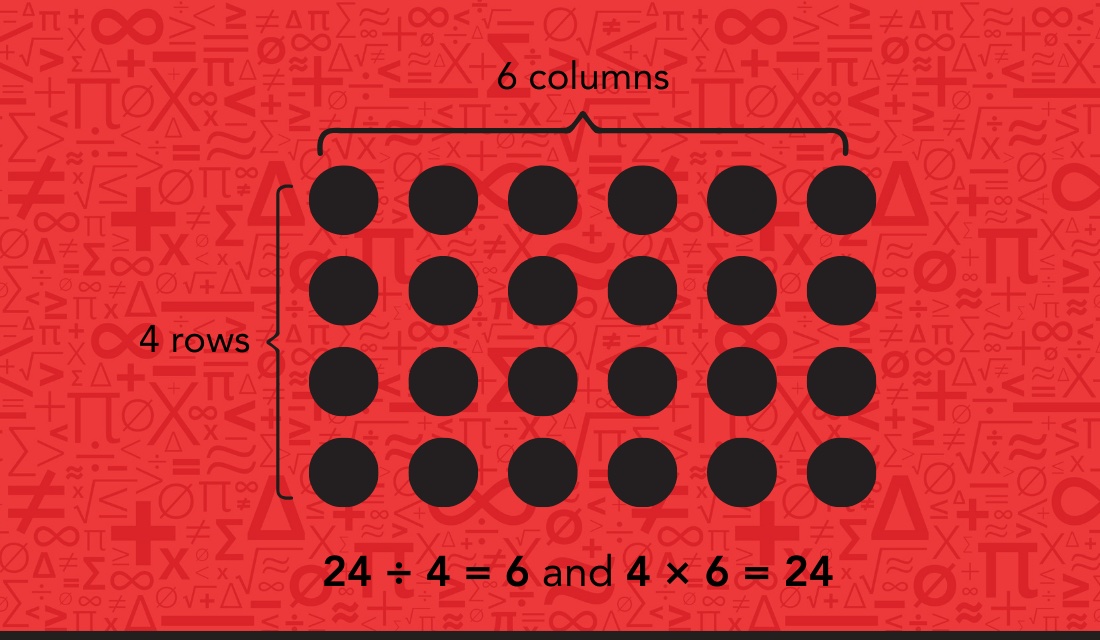
An array is just a grid of dots or objects arranged in rows and columns, and it's one of the clearest ways to show a child that division and multiplication are two sides of the same coin.
Take 24 ÷ 4:
Draw 24 dots arranged in 4 equal rows
Count the columns → 6
So 24 ÷ 4 = 6, but also, 4 × 6 = 24
That single picture is doing the work of two operations at once. That's a connection worth pausing on.
The array in the previous section hinted at something worth exploring further: division and multiplication are inverse operations or, put simply, two sides of the same equation.
If your child knows their multiplication tables, they already have division facts hiding in plain sight.
Every multiplication equation comes with two division equations built in: that trio is called a fact family:
4 × 6 = 24
24 ÷ 6 = 4
24 ÷ 4 = 6
Same three numbers, three different truths.
📕 You May Also Like: 5 Division Challenges Students Commonly Face and How to Fix Them
Math that lives only on paper has a short shelf life. Give your child division problems that are actually about something, like their world, their stuff, their interests.
A few ideas to get started:
"There are 30 minutes until dinner. If we split that time equally between 5 games, how long is each turn?"
"You have 18 stickers. You want to give an equal amount to 3 friends. How many does each friend get?"
"We're ordering 3 pizzas, each cut into 8 slices. There are 6 of us, how many slices each?"
The numbers matter less than the context. If a child is invested in the answer, division stops being a school task and starts being a useful thing to know.
These seven techniques all work toward the same goal: giving your child enough ways into division that one of them opens the door, and once they're in, the concept tends to take hold on its own.

Mathnasium uses personalized learning plans and interactive techniques to help students build true mastery of any math skill.
Mathnasium is a math-only learning center dedicated to empowering students of all skill levels to learn and master math.
Our tutors employ the Mathnasium Method™, a proprietary teaching approach designed to help each student unlock their true math potential.
To build a deep understanding of each math concept, our approach relies on:
Personalized learning plans: Each student begins their Mathnasium enrollment with a diagnostic assessment. This helps us identify their strengths, potential knowledge gaps, and how they approach math overall. Using these insights, we design a learning plan customized to each student’s needs.
Teaching for understanding: We use natural, everyday language to phrase math concepts. We also use a combination of verbal, visual, mental, tactile, and written teaching techniques to help students truly make sense of what they’re learning.
Caring, supportive tutors: Our tutors are specially trained in math as well as the technical and emotional aspects of teaching. This means they know how to encourage a student who’s stuck and how to challenge one who’s ready to stretch their thinking.
Problem-solving and critical thinking skills: During sessions, we always allow time for productive struggle, then rejoin students to check and correct their processes. This helps them learn to rely on their own thinking. We guide them through both the how and the why behind each math problem, not only the final answer. This approach develops the problem-solving and critical thinking tools they’ll use in math and life.
A confidence-building, fun learning environment: We often hear students say our sessions don’t feel like lessons at all. That’s because we incorporate game-based activities and plenty of rewards to keep students motivated and engaged.
Families see measurable results:
94% of parents report an improvement in their child's math skills and understanding
93% of parents report an improved attitude towards math after attending Mathnasium
90% of students saw an improvement in their school grades
Mathnasium operates over 1,100 learning centers, bringing top-rated math tutors and our proven method close to your home.
For families in or near Allen, TX, Mathnasium of Allen has spent years changing the way students think and feel about math. With over 100 five-star Google reviews and multiple Reader's Choice Awards from Living Magazine, the results speak for themselves:
Best Tutoring (2021–2024)
Best Early Education (2023)
Community Votes 2025 Best Tutor in Allen
If your child is looking to catch up, keep up, or get ahead in math, our team is delighted to help!
📅 Schedule a Free Diagnostic Assessment at Mathnasium of Allen
Not near Allen?
Mathnasium of Allen is a math-only learning center for K-12 students in Allen, TX. Trusted by over a million parents, Mathnasium uses personalized learning plans and the proprietary Mathnasium Method™ to help students catch up, keep up, and get ahead on their math journey.
Our specially trained tutors deliver face-to-face instruction in a supportive and fun small-group environment, working with students both in center and online to develop a deep understanding of math, build confidence, and improve academic performance.
Schedule Free Assessment