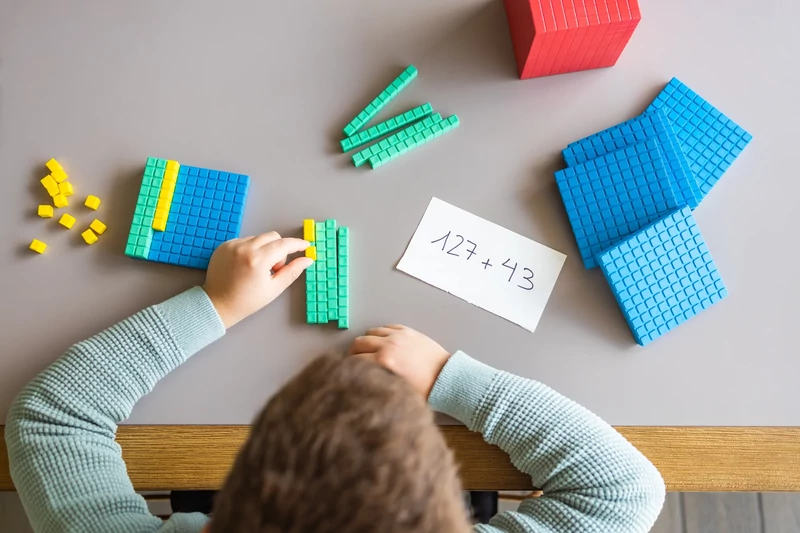
At ages 7 and 8, children are moving beyond counting and starting to work with larger numbers, but understanding how numbers are built is still a developing skill.
Place value is the key to making sense of multi-digit numbers, yet it remains one of the most common sticking points in early math. That’s because place value is an abstract concept. Just knowing that 73 is “seventy-three” doesn’t mean a child understands it’s made of 7 tens and 3 ones.
Base-10 blocks give children something to hold, trade, and build. They take the mystery out of place value by letting kids experience how our number system works, physically and visually.
Today, our seasoned math tutors are sharing a list of practical strategies, examples, and games you can use at home to make place value concrete, meaningful, and fun—no worksheets required!
1. Start with the Physical Connection
Before introducing place value vocabulary or written problems, start with something much more powerful for 7– and 8-year-olds: their hands.
At this age, children are still developing abstract thinking skills. Ideas like “place value” or “regrouping” can feel vague or confusing when they only exist on paper. But when kids can touch, move, and trade objects, those same ideas suddenly make sense.
This is why base-10 blocks work so well. They turn an abstract system into something concrete.
Let them explore first
Begin by putting the blocks in front of your child and letting them play.
-
Ones cubes
-
Tens rods
-
Hundreds flats
Resist the urge to explain right away. Instead, invite curiosity:
This open exploration matters. Kids in this age group learn best when new ideas are grounded in physical experiences. As they manipulate objects, they’re playing and building mental models that support deeper understanding later.
Make trading the main event
Once your child is comfortable handling the blocks, introduce trading:
That moment when your child realizes that 10 ones equal 1 ten is foundational. It helps them move from memorization to experience.
Repeat the process with tens and a hundred flat:
Each trade reinforces how our number system works.
📕 You May Also Like: How to Use Math Manipulatives Effectively at Home
2. Build Numbers They Care About
Once your child has physically explored the blocks and understands how trading works, you can start to make place value personal.
Connecting math to their life turns it into something they see, count, or talk about every day. As a result, math becomes more than just a tedious lesson. It becomes useful.
Use numbers from their world
Start by asking:
Whatever the number, help them build it with blocks:
They’ll begin to see how numbers break apart into tens and ones in a way that makes sense to them.
Add variation as they grow
As your child becomes more confident, you can expand to larger numbers they recognize:
Each example becomes an opportunity to build, break apart, and rebuild using place value blocks.
Make it a conversation
As you build, ask open-ended questions:
-
“What happens if we add one more?”
-
“Can we still use the same blocks?”
-
“What would 15 look like?”
These kinds of questions encourage your child to think in terms of tens and ones, reinforcing place value without needing worksheets.
📕 You May Also Like: 9 Math Skills Kids Use Every Day Without Realizing It
3. The Trading Game: Play to Learn
One of the simplest—and most effective—ways to reinforce place value and regrouping is by playing a game called “Race to 100.”
This activity transforms trading from a math rule into an exciting part of play.
To play the game, you’ll need:
Here’s how it works:
-
Take turns rolling the die.
-
After each roll, collect that number of ones cubes.
-
Any time a player reaches 10 ones, they must trade them in for 1 ten rod.
-
Once a player has 10 tens rods, they trade for 1 hundred flat.
-
First to reach 100 wins!
What this teaches
Without any formal instruction, your child is practicing:
They’ll start to anticipate the trades, plan ahead, and even self-correct:
📕 You May Also Like: 9 Creative Ways to Keep Math Skills Sharp
4. Use “Illegal Numbers” to Spark Critical Thinking
As your child understands how to build and trade blocks correctly, they begin to think in patterns. To test their understanding, you want to occasionally break those patterns by building a number incorrectly.
Some of our tutors like to playfully call these “illegal numbers.” In the classroom, this may be referred to as “equivalent grouping.”
The goal isn’t to confuse your child but to help them spot what’s wrong and figure out how to fix it. That process of identifying and correcting builds mental flexibility and a deeper understanding of place value.
How to introduce illegal numbers
Pick a number your child knows how to build, like 47. But this time, instead of building it as 4 tens and 7 ones, you say:
“Hmm... I made 47, but I used 3 tens and 17 ones. What do you think?”
Now you’ve given them a puzzle. Let them:
-
Look at the blocks
-
Think about what feels off
-
Decide if a trade needs to happen
-
Physically fix the grouping
Why this works
This simple strategy helps your child learn how to regroup in both directions (breaking and building tens) and develop math reasoning by exploring questions like: “Is this number represented correctly?”
You can create variations too:
-
Build 63 using 5 tens and 13 ones.
-
Show 28 as 1 ten and 18 ones.
-
Ask them to “make it legal.”
As your child practices catching and fixing these errors, they begin to internalize the logic behind place value. And that’s the goal: not just to get the right answer, but to know why it’s right.

Playing with “illegal numbers” and real-life examples makes concepts like place value fun.
5. Connect to Real-Life Contexts (Beyond the Blocks)
The fastest way to make place value click? Connect it to what your child already cares about.
Here are some simple ways to adapt base-10 block activities to match your child’s interests:
-
For the artist: Set up an art supply challenge. “We need 50 paint bottles for the school art show. We have 32; how many more do we need?” Your child builds 32 with blocks, then figures out how many more are needed. It’s a hands-on way to practice regrouping and problem-solving.
-
For the dino lover: Turn place value into a fossil dig. “We found 37 bones today... and 8 more in another spot!” Have them build the totals and decide whether to trade up. Or, try comparing dino lengths: “Velociraptor is 6 feet long. T-Rex is 40. How many tens would we need for each?”
-
For the builder or collector: Whether it’s toy cars or block towers, turn collections into counting games. “You’ve built a tower with 27 blocks. Can we reach 63 by adding tens?” (hint: we’re dealing with “illegal numbers” here). Or: “You have 28 cars. How many more to get to 50?”
-
For the snack planner: Use snack prep to make numbers tasty. “We’re packing 100 pretzels. If we use bags of 10, how many bags do we need?” or “We have 62 pretzels. How many more to make it 100?”
-
For the sports fan: Use points to bring math into the game. “You scored 14 points this week and 26 last week. What’s your total?” Build it with blocks, regroup if needed, and celebrate the win.
The idea here is to weave place value into what they already love. That’s how you get math to stick, without forcing it.
📕 You May Also Like: How to Understand & Support Your Child’s Math Learning Style
Additional Tips to Make Learning Fun & Effective
The most effective learning for 7- and 8-year-olds happens in short, focused bursts, especially when it feels playful and low-pressure.
Here are a few strategies, grounded in educational psychology, that can help you get the most out of your time together.
a. Keep it short
Aim for math play sessions of about 15–20 minutes, especially for early elementary kids.
Pediatricians and educators have an effective rule of thumb parents can borrow: young children can focus for roughly 2–3 minutes per year of age, which puts many K–3 learners in that 10–20 minute sweet spot for sustained attention.
Short, hands‑on bursts reduce off‑task behavior and help children stay engaged instead of frustrated.
If your child is still interested after 20 minutes, wonderful! Keep going as long as the energy stays positive. If you notice focus fading, it is better to stop, take a break, and come back another day than to push through a tiring session.
b. Let them teach you
Studies on “learning by teaching” and peer tutoring in math show that students who teach or explain to others often develop deeper understanding, higher achievement, and more confidence.
Even very young children solve problems more successfully when they are asked to “teach” a listener or puppet how to think through a task.
Invite your child to be the teacher and you be the learner. Try questions like:
-
“Can you show me how to build 43 with the blocks?”
-
“What would I trade if I had 10 ones?”
-
“Oops, I think I made a mistake! Can you help me fix it?”
Letting them lead shifts the power dynamic, encourages mathematical talk, and gives them ownership over their ideas, which is linked to better attitudes and persistence in math.
c. Notice the process, not just the result
Growth mindset research by Carol Dweck, along with other notable studies, shows that “process praise”—praising effort, strategies, and persistence—builds resilience, motivation, and a belief that abilities can grow with practice.
Children who are praised this way are more likely to seek challenges, stick with difficult tasks, and ultimately perform better academically than children who are praised mainly for being “smart.”
When you talk to your child, focus on how they are thinking:
-
“You kept going even when it got tricky.”
-
“I noticed how carefully you counted those tens.”
-
“You figured out a new way to solve that!”
d. Celebrate discoveries (even tiny ones)
You might have noticed your child’s attitude change after hearing a simple, everyday praise like “good job” or “nice work!” They become more determined and even enthusiastic.
Noticing and celebrating small wins keeps learners engaged and builds a sense of momentum toward bigger goals.
So, make a big deal out of “aha!” moments, no matter how small:
-
If they realize on their own that 10 ones can be traded for 1 ten, celebrate it with a high‑five or a big smile.
-
If they catch an “illegal number” you built, let them enjoy the role of “error detective.”
These small celebrations boost confidence, reinforce productive behaviors, and make math time feel like a place where success is possible and noticed.
e. Embrace mistakes as part of learning
Mistakes are an integral part of learning math. Work on growth mindset and error‑focused instruction shows that when students see errors as information, not as a verdict on their ability, they learn more and are more willing to tackle challenging problems.
Newer studies even find that intentionally making and then correcting errors can deepen understanding and improve students’ ability to transfer their learning to new problems.
Instead of rushing to correct, treat errors as thinking opportunities:
This kind of response helps your child slow down, reflect, and adjust their strategy, which strengthens both understanding and resilience.
At Mathnasium, we focus on helping students truly understand and even enjoy math.
How Mathnasium Helps Kids Master Place Value and Beyond
If you’re looking for extra support as your child builds their understanding of place value, or any math concept, Mathnasium is here to help.
Mathnasium is a math-only learning center for K-12 students of all skill levels. Our specially trained tutors work face-to-face with students in a caring and fun group environment, using personalized learning plans that meet them exactly where they are.
We focus on teaching math in a way that makes sense, starting with what your child already knows, then building new knowledge step by step. Whether it’s regrouping with base-10 blocks or mastering multi-digit multiplication, we use a range of techniques to help kids understand, apply, and truly enjoy math.
-
94% of parents report an improvement in their child’s math skills and understanding
-
90% of students see better grades in school
-
93% of parents notice a more positive attitude toward math
With more than 1,100 centers across North America, we’re proud to support students both in person and through live, online sessions.
If you're in the Allen, TX, area, you're in great hands. Mathnasium of Allen has earned the trust of families throughout the community, and the results speak for themselves:
-
100+ 5-star Google reviews
-
Reader’s Choice Award Winner in Living Magazine’s Best of Allen and McKinney
-
Voted Best Tutoring from 2021 to 2024
-
Recognized as Best Early Education in 2023
-
Community Votes 2025 winner for Best Tutor in Allen
-
BusinessRate’s 2025 Best Tutoring Service
From foundational math to algebra, from homework help to test prep, we are here to empower your child to thrive, not just in school, but in how they think and feel about math.
Ready to see how we can help?
📅 Schedule a free assessment at Mathnasium of Allen!
Not near Allen?
📍 Find Mathnasium Learning Centers near you


 (469) 361-2277
 (469) 361-2277