Who Was Euclid? The Ancient Mind Behind Modern Geometry
May 5, 2026
| Blue Ash
At Mathnasium, we love connecting math to the stories and ideas that gave it shape because once students see where a concept comes from, it stops feeling arbitrary and starts making sense.
One of those stories belongs to Euclid, an ancient Greek mathematician who took everything known about geometry and created a logical system that could be taught, learned, and built upon.
That system, organized in a collection of 13 books called Elements, still underlies the geometry lessons students encounter in class today.
Our tutors are here to walk you through his life, his work, and the mark he left on modern mathematics.
Meet Euclid, the Father of Geometry
It’s around 300 BCE in Alexandria, Egypt, one of the greatest cities in the ancient world. Scholars from across the globe have gathered here to study, debate, and discover.
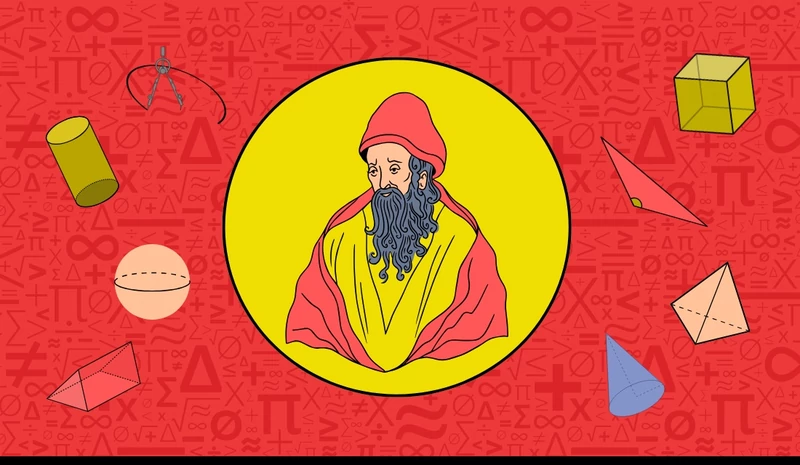
Among those scholars was a mathematician named Euclid. He took everything known about geometry and organized it into a single logical system, one that anyone could follow and build upon.
That's the reason why we call him the “Father of Geometry," the man who gave geometry a home, a structure, and a set of rules that anyone could follow.
His impact echoes straight into your math class today:
The geometric relationships he described still appear in modern school curricula
The logical structure he introduced underlies how proofs are taught in middle and high school
His approach to reasoning, starting from clear rules and building step by step, is exactly the thinking standardized tests reward
When you study lines, angles, and triangles in class, you’re working inside the system Euclid organized over 2,000 years ago. Amazing, right?
Euclid's Masterpiece: Elements
Imagine you wanted to teach everything you knew about geometry, and you wanted it so well‑organized that the ideas could be clearly passed down, step by step, from one generation to the next.
That’s essentially what Euclid achieved.
His magnum opus, a collection of 13 books called Elements, became one of the most influential texts in the entire history of mathematics. It was used in classrooms for over two millennia. Longer than almost any other textbook in existence.
But here's what made Elements brilliant: the how mattered just as much as the what.
It started with a small set of definitions and basic rules that everyone could agree on
Every conclusion that followed was built logically from those foundations
Nothing was assumed, and nothing was left to guesswork
Sound familiar? It should. When your geometry teacher asks you to justify each step in a proof, that requirement traces straight back to how Euclid organized Elements. You're actually carrying on a tradition that’s over 2,000 years old.
Behind every geometry topic is a clear logical foundation.
Every game needs rules. Chess has its pieces and their moves. Basketball has its court boundaries and shot clock. Geometry has postulates and theorems, and Euclid invented that system.
Think about the difference like this:
Postulates are the starting rules, basic truths accepted without proof, like the ground rules everyone agrees to before the game begins.
Theorems are what you can prove by following a logical chain of steps from those postulates. You start from the agreed-upon rules and build your argument, one step at a time.
You encounter this distinction directly in geometry class. When a teacher asks you to prove that two triangles are congruent, they’re asking you to do exactly what Euclid did: start from agreed-upon rules and build a logical argument step by step.
One of the most famous theorems to come out of this tradition? The Pythagorean Theorem. You know it as a² + b² = c², and what makes it truly powerful is that it can be proven, every single time, from first principles. No exceptions. No guesswork.
If geometry has ever felt confusing or random to you, understanding this structure might be the turning point you need. The subject is a logical system where every piece connects to the next. Once you see that, everything starts to make a lot more sense.
Euclid's Legacy: Why It Still Matters in the Classroom
The next time a geometry proof feels tedious, you can blame, or thank, Euclid. Because that demand for rigorous, step-by-step reasoning traces back to a mathematician who lived over 2,000 years ago and decided math should make sense all the way down.
His influence shows up everywhere in your academic life today:
The concept of proof as the standard for mathematical truth
The structure of your geometry course, from definitions to theorems to applications
The logical reasoning skills for the SAT® and ACT®
It goes even beyond geometry. Euclid’s real legacy is a way of thinking:
Start from clear principles,
Reason carefully
Don’t skip steps.
That’s a skill that helps you in every subject, and honestly, in life.
Geometry demands a level of disciplined reasoning that most other subjects simply do not. The payoff, however, is equally real. Students who work through it build a kind of logical confidence that carries well beyond the classroom.
Frequently Asked Questions About Euclid and Geometry
Euclid’s work raises questions all the time. Here are some of the most common ones.
1. What is Euclidean geometry? Is this the same as regular school geometry?
Yes, almost always. Euclidean geometry is the “flat-plane” geometry you study in school: lines, angles, triangles, circles, and shapes on a flat page.
When you study topics like “lines and angles” or “properties of triangles,” you’re working inside the system Euclid organized centuries ago, just with modern language and diagrams.
2. How early does Euclidean geometry show up in math class?
Earlier than you might think. The foundations of Euclidean geometry appear as early as elementary school, when you start working with shapes, symmetry, and basic angles.
By middle school, you encounter more formal geometric reasoning, and by high school, Euclid’s influence is fully present in proof-based coursework. The earlier you understand his framework, the more of a head start you have.
3. Do I need to memorize Euclid’s axioms and postulates?
No, not by heart. You don’t need to recite them like a poem, but understanding the ideas behind them matters a lot.
Think of them as the starting rules everyone agrees on. Everything else is built from there, and that’s precisely the mindset that examiners reward in proof-based questions.
At Mathnasium, our tutors help students see geometry the way Euclid intended: as a logical system where every step connects to the next.
Mathnasium tutors help students see geometry the way Euclid intended: as a logical system where every step connects to the next.
How Mathnasium Helps Students Understand and Enjoy Geometry
Mathnasium is a math-only learning center dedicated to helping K-12 students of all skill levels excel in math.
Geometry often feels difficult when it is taught as a list of rules with no story behind them. Without understanding where ideas come from or why they work, students can lose interest quickly.
At Mathnasium, we approach geometry the same way Euclid did: as a logical system built from clear foundations. By helping students see the connections between concepts, geometry becomes structured, meaningful, and even enjoyable.
Our proprietary teaching approach, the Mathnasium Method™, builds understanding from the ground up and helps students experience math logically, step by step.
To foster true mastery and enjoyment of math, our approach relies on:
Personalization on a granular level: Every student begins with a diagnostic assessment that identifies their strengths, knowledge gaps, and goals. From those insights, we create a personalized learning plan that meets each student exactly where they are and builds skills in a clear, logical sequence.
Teaching for understanding: We explain math using clear, everyday language and support each concept with a blend of verbal, visual, mental, tactile, and written techniques. Students learn not just what to do, but why it works.
Caring guidance: Our specially trained tutors know how to encourage a student who feels stuck and how to challenge one who is ready for more, keeping each child motivated and engaged.
Independent problem-solving and critical thinking: During sessions, we set aside time for students to work through problems on their own, helping them test their understanding and develop confidence in their reasoning.
Singular focus on math: Mathnasium is math-only, and our program spans thousands of pages, refined over more than 20 years. This focused approach allows us to take a deep dive into how students best learn, retain, and enjoy math at every level.
Empowering, fun learning environment: Our centers are designed to make math engaging. Sessions often include interactive and game-based materials, because when learning feels fun, students are more curious, confident, and willing to keep going.
The results speak for themselves:
94% of parents report an improvement in their child's math skills and understanding
93% of parents report an improved attitude toward math after attending Mathnasium
90% of students saw an improvement in their school grades
With more than 1,100 learning centers, Mathnasium brings top-rated math instruction close to home.
For families in and around Cincinnati, OH, Mathnasium of Hyde Park is a trusted local center with experience helping students transform how they think and feel about math.
Our center has been recognized for the quality of instruction we bring to the community:
Winner of Cincy Magazine's 2025 Family's Choice Awards in the "Tutoring/Learning Center" category
Winner of City Beat's Best of Cincinnati 2025 in the "Best Tutoring Center" category
Whether a student is catching up, keeping up, or getting ahead, our team is committed to helping them discover that geometry and math as a whole can make sense and be enjoyable.
Mathnasium of Blue Ash is a math-only learning center for K-12 students in Blue Ash,
OH. Trusted by over a million parents, Mathnasium uses personalized learning plans
and the proprietary Mathnasium Method™ to help students catch up, keep up, and get ahead on their math journey.
Our specially trained tutors deliver face-to-face instruction in a supportive and fun small-group environment,
working with students both in center and online to develop a deep understanding of math, build confidence,
and improve academic performance.
Learn what back-to-school math readiness looks like in Ohio and six practical, research-backed ways to help your child prepare for the new school year.


 (513) 984-1212
 (513) 984-1212