In September 2024, the Colorado State Board of Education updated graduation requirements for the classes of 2025 and 2026. This affects how students prove "College and Career Readiness" before receiving their diploma.
Beyond credit hours, students must now meet a competency threshold using at least one state-approved measure. That means different testing strategies, course selection decisions, and choosing between traditional tests, concurrent enrollment, or capstone projects.
Here's what you need to know about these new changes in order to meet Colorado’s state standards.

Why Colorado's High School Math Graduation Requirements Are Changing
Colorado uses a two-part system for graduation. The school district sets the coursework requirements (like how many years of math classes a student takes), while the state verifies competency (whether they can actually demonstrate those math skills).
This dual approach gives districts the flexibility to meet local needs while maintaining statewide standards.
Importantly, Colorado recently switched to the digital SAT format, which created some challenges. The state board adjusted requirements to ensure fairness as students and educators adapt to the new digital SAT format.
These tweaks specifically affect students graduating in 2026 (and those who graduated in 2025), giving everyone time to adapt to the new testing landscape.
📕 You May Also Like: Helpful Tips for Digital SAT Prep
1. Lowered SAT Math Cut Scores
One of the biggest changes is that Colorado temporarily lowered the SAT math score students need for graduation competency.
If your high schooler is a senior banking on their SAT score, this adjustment gives them breathing room. Without it, they might have faced a tight deadline to find an alternative way to demonstrate competency before May. And while a 20-point reduction may not sound too impactful, it can make a real difference for students right on the edge.
However, it’s important to remember that this is a temporary change for the classes of 2025 and 2026, and the needed score may go back to 500 in 2027.
2. A "Menu of Options" for Demonstrating Math Competency
In order to demonstrate math competency, students can choose from a flexible menu of approved assessments.
The approved assessments and the respective scores students will need are as follows:
-
SAT: 480 (temporary for 2025 and 2026)
-
ACT: 19
-
AP Math Exam: 2*
-
IB Exam: 4
-
ASVAB: 31
-
ACCUPLACER: 230 (Quantitative Reasoning, Algebra, and Statistics) or 255 (Arithmetic)
-
ACT WorkKeys: Bronze (score of 3 or higher)
-
Concurrent Enrollment: Passing grade in a college-level math course
-
Industry Certificate: Requirements set by your local district
-
Capstone Project: Must be approved by your local district
*Note that many local districts and universities require a 3 or higher AP math exam score for college credit and career readiness benchmarks.
This flexibility can be very beneficial to some. If standardized tests like the SAT or ACT present challenges for your high schooler, they might shine in a hands-on capstone project or a concurrent enrollment course.
Students interested in career pathways might pursue an industry certificate, while college-bound students might tackle an AP exam.
Chat with your high schooler about what feels most comfortable, and work with their school counselor to pick the path that sets them up for success.
📕 You May Also Like: SAT® vs. ACT® – Everything You Need to Know
3. Credit Requirements: How Many Years of Math?
While the state sets the competency bar, the local school district decides how many years of math coursework students need. These requirements vary across Colorado.
For example:
-
Douglas County: 3 credits of math, including Algebra I and Geometry (or equivalent integrated courses) to meet district graduation standards for the Class of 2026
-
Boulder Valley: 2 years (20 credits) for the class of 2026, increasing to 3 years for the class of 2029
Your high schooler’s requirements depend on their district. Some require 2 years, while others need 3 or 4. It’s best to check with your district or school counselor for the exact requirements.
It’s also worth keeping in mind that some colleges expect more than the district minimum. For example, if a student took 8th-grade geometry (which is common for accelerated students), that typically counts toward high school credit in many districts, potentially giving them a slight head start.
📕 You May Also Like: Is Your Student Ready for Their Geometry Class? [+Quiz]
4. The Role of Specific Courses Like Algebra I and Beyond
Most Colorado districts require at least Algebra I for graduation, with additional credits from Geometry, Algebra II, or Pre-Calculus.
Algebra I is usually the baseline. But if your high schooler is college-bound, it’s a good idea to continue beyond that point. A lot of universities expect at least Algebra II, and competitive schools might even look for Precalculus or Calculus.
So, even if your district's minimum is 2 years, taking 3 or 4 years will strengthen their college applications and build the foundation needed for college-level work.
📕 You May Also Like: Is Your Student Ready for Their Algebra Class? [+Quiz]
5. Financial Literacy and Math: Where Do They Overlap?
Some Colorado districts now require 0.5 credits in Personal Financial Literacy before graduation. Depending on your district, this credit might count toward either math or social studies.
If a student finds traditional math courses challenging, a financial literacy course could count towards a math credit while also teaching them practical skills like budgeting and understanding credit.
Check with your school to see if financial literacy credits count toward math in your district.
📕 You May Also Like: Financial Literacy for Kids: Teaching Money Management Through Math
6. Districts May Set Higher Requirements Than the State
Colorado's Home Rule status gives local districts freedom to set their own standards. Your district can (and frequently does) require more than state minimums.
Here's how this might play out:
-
A district might require 4 years of math, even if a student meets the state's competency requirement through their SAT score
-
Some districts may not accept alternative assessments (like capstone projects) without extra approval
Meeting the state's minimum may fall short of graduation clearance. Your district gets the final say, and their requirements might exceed the state baseline.
This is why it’s best to check with your school counselor or look up your district's official requirements. This simple step prevents last-minute surprises.
How Parents Can Help Their High Schoolers Stay on Track
As graduation requirements evolve, parents play a crucial role in keeping their student on track. Being proactive now prevents last-minute stress.
Some steps you can take include:
-
Review your district's specific math credit and competency requirements
-
Confirm your high schooler's current assessment scores (SAT, ACT, or other approved tests)
-
Talk to your school counselor about alternative pathways if traditional assessments present challenges
-
Ask whether financial literacy courses count toward math in your district
-
Map out your high schooler's 4-year course schedule, keeping college expectations in mind
Taking these steps early gives you breathing room to adjust plans, get support if needed, and explore every option. Remember, you can navigate this with help from your school counselor and resources like Mathnasium.
Looking Ahead: What Happens After 2026?
The temporary SAT score reduction (480 instead of 500) applies only to the classes of 2025 and 2026. After that, requirements could revert back or change based on the updated digital SAT performance data.
Colorado's Department of Education monitors assessment results and may make adjustments. Staying informed helps you guide your student effectively. The bottom line? While requirements may evolve, students still need both coursework credits and demonstrated competency to graduate.

Mathnasium is a math-only learning center that helps students fully prepare for graduation, standardized tests, and college math.
How Mathnasium Helps Students Meet Their Graduation Requirements
Mathnasium is a math-only learning center dedicated to helping K-12 students of all levels excel in math.
We've worked with countless high schoolers who need to build up their skills for standardized tests, fill in gaps from previous years, or push ahead into advanced coursework. Our approach aims to remove the anxiety and replace it with understanding.
Behind each of our programs is a proprietary teaching approach called the Mathnasium Method™. Beyond just rote drills or shortcuts, our method is built to help students truly make sense of what they're learning. We support math mastery through:
-
Personalized learning: Each student begins with a diagnostic assessment that helps us identify their current skills, knowledge gaps, and how they naturally think through math. We use those insights to build a custom learning plan tailored to their needs.
-
Teaching for understanding: We explain math in clear, everyday language, using a mix of verbal, visual, mental, tactile, and written techniques. This allows students to approach each concept in the way that makes the most sense to them.
-
Caring, responsive tutors: Our tutors are specially trained in both the technical and emotional aspects of teaching. They know when to guide, when to challenge, and how to help students regain trust in their thinking.
-
Independent problem-solving and critical thinking: We give students space to work through challenges on their own, then rejoin them to check their reasoning. Instead of just giving them the answer, we help them understand the how and why. This helps them develop problem-solving skills and critical thinking tools they can use in math and life.
-
A singular focus on math: We specialize in math and math only. Our robust, continually refined program spans thousands of custom materials built around how students actually learn and retain math skills.
-
A supportive, fun environment: Many of our activities are hands-on or game-based. We use reward systems and consistent encouragement to keep students engaged. And we celebrate progress because every win builds competency and enjoyment.
The result? Real, measurable progress.
-
94% of parents report improvement in their child's math skills and understanding
-
93% of parents notice a more positive attitude toward math
-
90% of students see higher grades in school
Mathnasium operates over 1,100 learning centers across the U.S., bringing our proven approach close to your community.
For families in or near Denver, Mathnasium of Cherry Creek is a trusted local center with years of experience transforming how students think and feel about math.
Read how one parent described their child’s experience at Mathnasium of Cherry Creek:
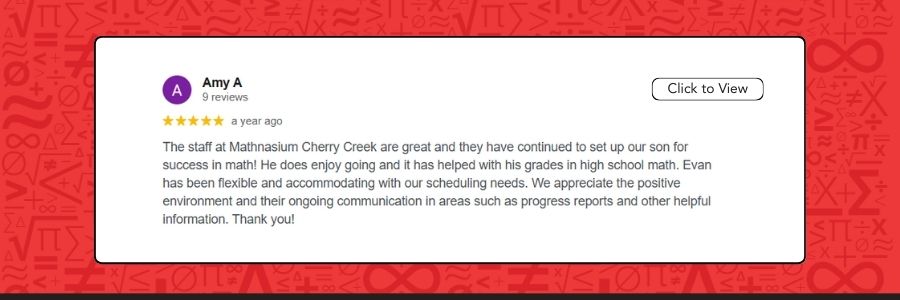
If your high schooler needs support preparing for the SAT, exploring alternative assessments, or strengthening their foundation for college math, our team is ready to help.
📅 Schedule a Free Diagnostic Assessment at Mathnasium of Cherry Creek
Not located near Cherry Creek?
📍 Find a Mathnasium Learning Center Near You


 (303) 333-6284
 (303) 333-6284