Speaking from experience, our tutors would say that a fair share of fraction troubles start with never fully understanding what each part of a fraction, the numerator and the denominator, truly means.
If you're looking to clear that up or just refresh your knowledge, you're in the right place.
Today, we'll explain what each numerator and denominator represent in a fraction, how they work together, and where students most commonly go wrong, so you can tackle any fraction task confidently.

Let’s Remind Ourselves: What Is a Fraction?
A fraction is a way of showing a part of a whole. When something is split into equal parts, a fraction tells us how many of those parts we have.
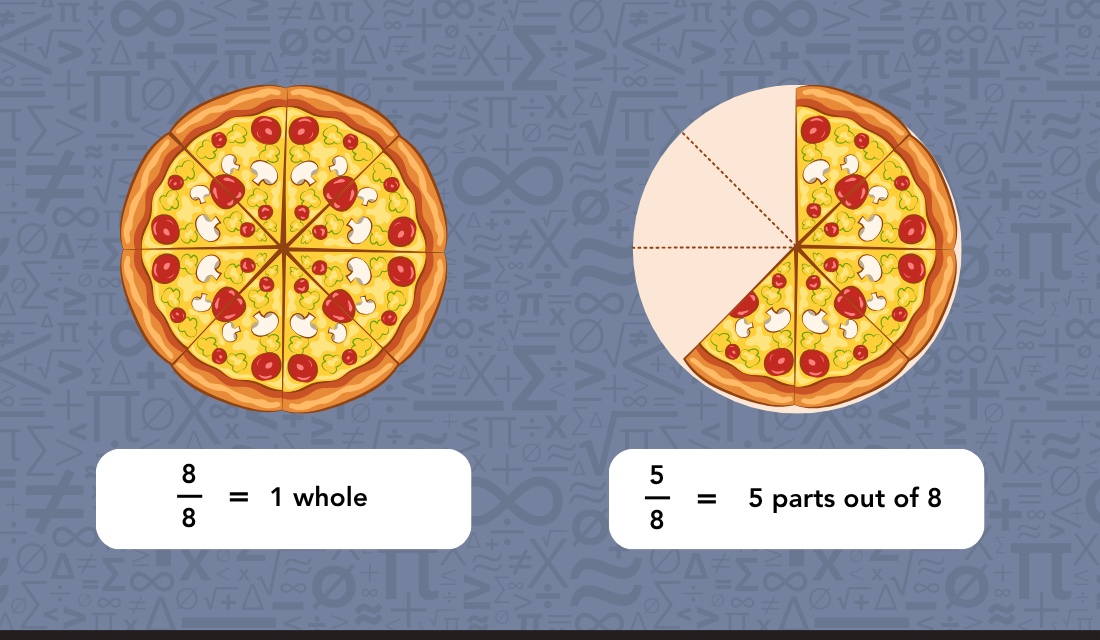
Say a pizza is cut into 8 equal slices and we eat 3 of them. How do we describe what's left? We're left with 5 out of 8 slices, and in math, we write that as \(\Large\frac{5}{8}\). That's a fraction.
The two numbers tell us the full story:
That's all a fraction is.
📕 You May Also Like: What Are Equivalent Fractions? A Kid-Friendly Guide
What Is the Denominator?
The denominator is the bottom number in a fraction. At Mathnasium, we like to call it the "name" of the fraction because it tells us what kind of parts we're working with, like halves, thirds, fourths, and so on.
Why do we start with this one? Because before we can count anything, we need to know what we're counting. The denominator sets up the whole picture first.
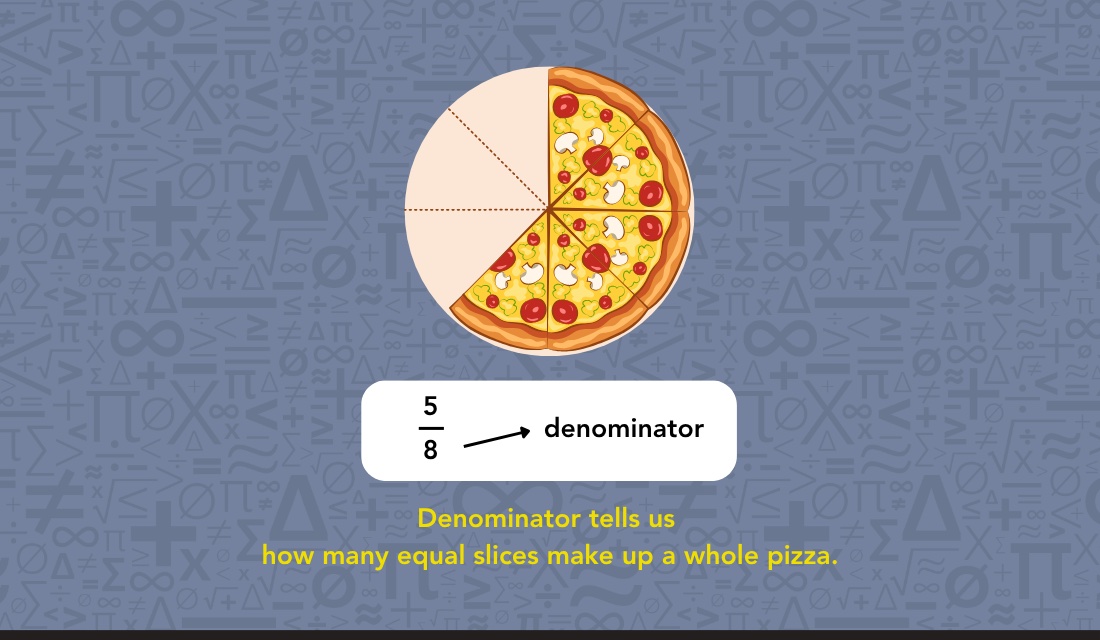
Now, let’s go back to our pizza example. Remember that it was cut into 8 equal slices? That 8 is the denominator. It tells us the pizza was divided into 8 parts, and that each slice is one eighth of the whole.
Makes sense? Great!
We always remind students to keep these things in mind about denominators:
-
It must always be a whole number and never zero. Dividing something into zero parts has no mathematical meaning, so a fraction with a denominator of zero is undefined.
-
A larger denominator means smaller parts. \(\Large\frac{1}{8}\) is actually smaller than \(\Large\frac{1}{4}\) because the more pieces you cut the pizza into, the smaller each slice gets.
-
The denominator stays the same as long as we're talking about the same whole. It only changes when we rewrite the fraction in a different form, like when finding equivalent fractions.
📕 You May Also Like: Adding and Subtracting Fractions with Unlike Denominators - A Kid-Friendly Guide
What Is the Numerator?
The numerator is the top number in a fraction. It tells us how many parts of the whole we're working with or considering.
So why does the numerator come second in our story?
Because it only makes sense once we know what we're counting. The denominator sets the scene; the numerator steps in and counts.
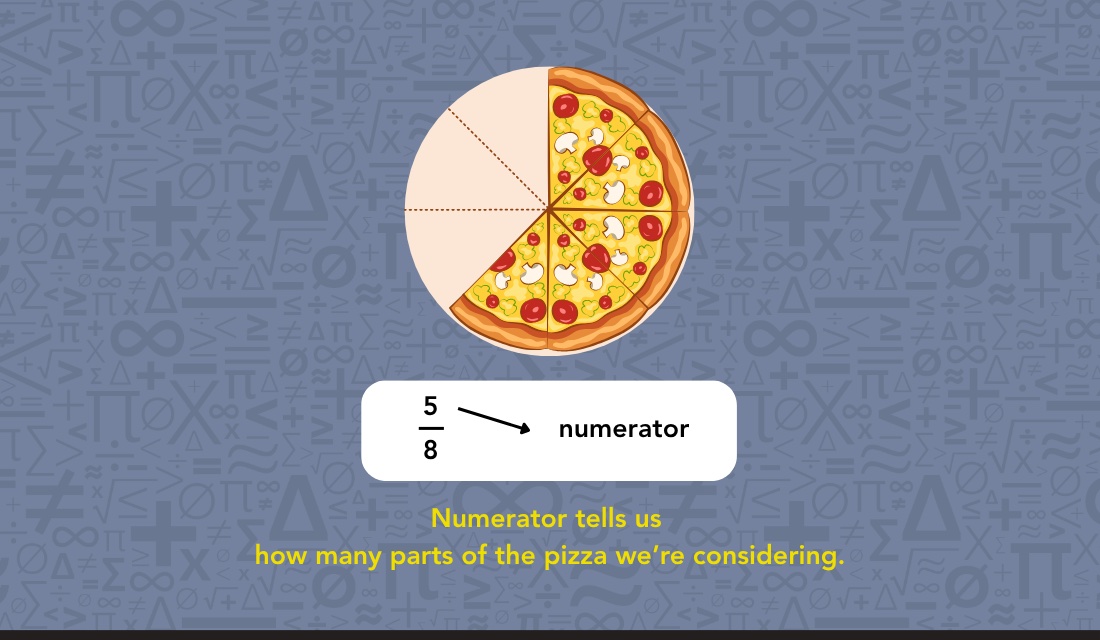
And once more, we go back to that pizza example one more time (What can you do? We really love pizza). Remember, we had 8 slices and ate 3, leaving us with \(\Large\frac{5}{8}\). That 5 is the numerator. It tells us exactly how many slices we're left with.
Now, just like denominators have their quirks, numerators have a few of their own we need to know:
-
It can be any whole number, including zero. A numerator of 0 means none of the parts are being counted. In other words, the fraction equals zero no matter what the denominator says.
-
It can be larger than the denominator. When that happens, the fraction is greater than 1, and we call it an improper fraction. \(\Large\frac{9}{8}\), for example, means we have more than one whole pizza's worth of slices.
-
It tells us how many, not how big. Two fractions can share the same numerator and represent completely different amounts depending on what the denominator says.
📕 You May Also Like: Adding and Subtracting Fractions with Like Denominators
Let's Complete the Picture: How the Numerator and Denominator Work Together
A fraction only makes sense when both numbers are read together. The denominator sets up the whole; it tells us how many equal parts we're working with. The numerator steps in and counts; it tells us how many of those parts we have.
Take \(\Large\frac{3}{8}\). The denominator tells us the whole is divided into 8 equal parts. The numerator tells us we have 3 of them. Change either number, and the fraction changes with it.
Let's look at what happens when we keep one number fixed and change the other.
-
Same denominator, different numerator: Say a chocolate bar is divided into 12 equal pieces. If we've eaten 2, the fraction is \(\Large\frac{2}{12}\). If we've eaten 5, it becomes \(\Large\frac{5}{12}\). The bar hasn't changed, but the numerator tells a different story each time. As the numerator goes up, the fraction gets larger.
-
Same numerator, different denominator: Now, say we keep the number of pieces fixed at 3, but change how the bar is divided. \(\Large\frac{3}{4}\) means the bar was split into only 4 pieces, and we have 3 of them, most of it. \(\Large\frac{3}{12}\) means the bar was cut into 12 much smaller pieces, and we only have 3. Not much at all. The numerator is the same in both cases, but the fractions represent very different amounts because the size of each piece has changed.
📕 You May Also Like: What Is the Least Common Denominator? A Kid-Friendly Guide
Avoid These Common Denominator/Numerator Mistakes
Working with students on fractions every day, our tutors see the same mix-ups around numerators and denominators come up again and again. Make sure these don't catch you out:
1. Thinking a bigger denominator means a bigger fraction
In most math, bigger numbers mean bigger values. With fractions, the denominator works differently; the larger it is, the smaller each part becomes.
\(\Large\frac{1}{10}\) is actually smaller than \(\Large\frac{1}{2}\), even though 10 is larger than 2. The whole has simply been cut into more pieces, making each one smaller.
Picture it this way: would you rather have 1 slice of a pizza cut into 4, or 1 slice of the same pizza cut into 12?
2. Swapping the numerator and denominator
\(\Large\frac{2}{5}\) and \(\Large\frac{5}{2}\) look like they contain the same numbers, but they describe completely different situations. \(\Large\frac{2}{5}\) means 2 parts out of 5 and that’s less than one whole. \(\Large\frac{5}{2}\) means 5 parts where only 2 make a whole. That’s more than two wholes. Flipping the two numbers changes everything.
3. Losing track of what the whole actually is
The denominator only makes sense in relation to a specific whole. \(\Large\frac{3}{4}\) of a large birthday cake and \(\Large\frac{3}{4}\) of a cupcake are the same fraction, but a very different amount of cake.
When a problem describes two different wholes, focus on the numbers alone and it's easy to miss the shift.
4. Assuming the numerator is always smaller than the denominator
Students used to proper fractions sometimes freeze when they see an improper fraction like \(\Large\frac{7}{3}\), assuming it must be wrong because the top number is bigger.
📕 You May Also Like: How to Convert Fractions to Decimals (& Vice Versa)

Understanding fractions starts with knowing what each number represents.
How Mathnasium Helps Students Master Any Math Concept
Mathnasium is a math-only learning center dedicated to empowering K–12 students of all skill levels to excel in math.
Fractions are a foundational math skill and one of the most common reasons students come to us for support. When that happens, we build solid, lasting foundations that carry students through their entire math journey.
To do that, we use the Mathnasium Method™, our proprietary teaching approach designed around how each student learns best.
It begins with a diagnostic assessment that helps us pinpoint each student's strengths, knowledge gaps, and how they think about math. This is often where we uncover exactly what's standing in the way of fraction fluency.
With those insights, we design a personalized learning plan tailored to their specific needs.
From there, our specially trained tutors follow the plan closely, delivering face-to-face instruction both in the center or online, depending on what works for your family.
We teach for understanding, using natural, everyday language and a mix of verbal, visual, mental, tactile, and written techniques to make every concept genuinely click.
When students get stuck, we break concepts down into manageable parts and explain both the how and the why. Over time, students learn to trust their own thinking and develop the critical thinking skills to use in math and beyond.
Fun is a major part of how we work. Our activities are often game-based, students earn rewards along the way, and we celebrate every step of progress, keeping them motivated and growing in confidence with every session.
The results are measurable:
-
94% of parents report an improvement in their child's math skills and understanding
-
93% of parents report their child's improved attitude toward math after attending Mathnasium
-
90% of students saw an improvement in their school grades
For families in and around Denver, Mathnasium of Cherry Creek is a trusted local center with years of experience helping students build real confidence in math, one concept at a time.
Here’s what one parent had to say about their child’s experience at Mathnasium of Cherry Creek:

Whether your child is looking to catch up, keep up, or get ahead, our team is ready to help.
📅 Schedule a Free Diagnostic Assessment at Mathnasium of Cherry Creek
Not near Cherry Creek?
📍 Find a Mathnasium Learning Center Near You


 (303) 333-6284
 (303) 333-6284