A big reason why we don’t rely on just rote drills when teaching math is that it undercuts a very important skill: reading comprehension.
Word problems are very common, particularly in standardized tests, and flawless arithmetic will still result in zero points if the student misunderstood what the problem was asking them to do.
So, let’s go over why reading comprehension is so important for math and explore a three-step framework we teach students that helps them get through word problems consistently.

Why Word Problems Are Harder Than They Look
Word problems place two distinct demands on a reader at the same time: reading comprehension and mathematical reasoning. Struggling with either one will make word problems difficult, even when the underlying math is relatively simple.
In practice, working through a word problem requires:
-
Identifying which information is relevant to the calculation.
-
Recognizing what the question is actually asking.
-
Translating verbal descriptions into mathematical relationships.
-
Calculating the desired end result.
As you can see, three out of the four steps require language skills. So, even with flawless arithmetic, a student can trip on three separate hurdles before crunching the numbers.
Research by Abedi and Lord documented the measurable effect of linguistic complexity on math test performance.
Their findings showed that children whose reading comprehension lagged behind their computation ability were disproportionately affected by the way word problems are written, particularly on standardized tests where the language used is deliberately precise.
This is why drill exercises alone can’t move the needle.
The next logical question is then, “How do you teach reading comprehension for math?”
In our experience, what works best is practicing the underline-identify-solve framework. Once it becomes second nature, students can quickly dissect word problems and focus on the math itself.
📕 You May Also Like: Understanding New Math Methods: How Schools Teach Today
The Underline-Identify-Solve Framework
This is a three-step process that students can reliably use to figure out what they need to know from a word problem. In essence, it just points their focus in the right direction, one step at a time, so that they are less likely to overlook or misunderstand a given problem.
At home, we suggest solving word problems with your student and calling out each individual step. This is to ensure that they internalize the process and can do it automatically once the test day comes.
Here is how you can explain the framework to them.
Step 1: Underline
Before writing a single number or equation, read the problem once without doing any math. Then read it a second time and underline every piece of numerical information and every word that signals a mathematical operation or relationship.
Words worth underlining include:
-
Total, combined, in all
-
Remaining, left over, spent
-
Times as many, per, each
-
Shared equally, split, divided among
-
How many more, less than, difference
The purpose of this phase is to separate the mathematical content from the narrative packaging before attempting to work with either.
Here is what that looks like in practice. Take this Grade 4 problem:
"Maya had 24 stickers. She gave 7 to her friend and then bought 15 more at the store. How many stickers does Maya have now?"
After two reads, the underlined content is: had 24, gave 7, bought 15 more, how many now.
Everything else is just filler and doesn’t need to be considered. For example, whether Maya went to the store or ordered the stickers online is unrelated to the problem.
As another example, let’s take this Grade 7 problem:
"A jacket originally costs $80. It is on sale for 35% off. How much does the customer pay?"
After two reads, the underlined content is: $80, 35% off, how much does the customer pay.
While there isn’t any filler information here, the underlying still has a purpose. In this case, it’s to highlight that it’s 35% off and not “down to 35%,” for example, and that the question is how much the customer pays at the end.
📕 You May Also Like: Critical Thinking vs. Memorizing: What Really Builds Math Skills?
Step 2: Identify
With the relevant information underlined, we now need to answer two specific questions:
-
What is the problem asking me to find?
-
What operation or relationship connects the underlined information to that answer?
Going back to the sticker problem, this is how we would break it down:
-
The unknown is the final number of stickers Maya has.
-
Maya started off with 24 stickers.
-
Recognize that the first operation is subtraction (giving away). Write down -7.
-
Recognize that the second operation is addition (buying more). Write down +15.
Here, we want to pay special attention to the order and which number relates to which operation. Although this example is straightforward, multi-step word problems can have more difficult wording. For example, if the problem stated: “before buying 15 more, Maya gave away half her stickers”.
We will break down the jacket problem in the same way.
-
The unknown is the final price paid, not the discount amount.
-
The relationship requires finding 35% of $80 first to see the sale amount.
-
We solve the problem by subtracting the sale amount from $80.
Without breaking it down like this, it is easy to calculate 35% of $80, get $28, and hand that in as the answer. This is why students who tend to rush through word problems often lose points despite understanding the material.
📕 You May Also Like: How to Nurture Algebraic Thinking in Elementary School
Step 3: Solve
Only after completing the first two steps does the calculation begin.
By this point, the setup is clear: the relevant numbers are underlined, the unknown is named, and the operation is confirmed. The arithmetic that follows should feel straightforward.
-
For the sticker problem: 24 minus 7 equals 17, then 17 plus 15 equals 32. Maya has 32 stickers.
-
For the jacket problem: $80 multiplied by 0.35 equals $28, then $80 minus $28 equals $52. The customer pays $52.
However, we will mention one additional step: a plausibility check.
Ask whether the answer makes sense given the context of the problem:
-
Does the number fit the real-world situation? An answer of 4,000 apples or a negative number of students signals that something went wrong in the setup.
-
Is the answer in the right units? A problem asking for a price should produce a dollar amount, not a percentage.
-
Is it in the right range? A jacket that ends up costing more than the original price after a discount is worth a second look.
The plausibility check takes ten seconds and catches errors that would otherwise go unnoticed under test conditions.
📕 You May Also Like: 5 Ways to Help Your Child Build Estimation Skills
Why This Framework Matters Most on Tests
Standardized tests tend to be where our students get the most value out of the underline-identify-solve framework. This is because word problems on standardized tests tend to be:
-
Multi-step, requiring more than one operation to reach the answer.
-
Deliberately embedded with irrelevant information to test whether students are paying attention.
-
Written in precise language that differs from the more casual phrasing of classroom homework.
That is to say that most standardized tests specifically target students’ reading comprehension.
The time limit is also worth considering.
Knowing exactly what to do first means no time is lost due to disorientation at the start of a problem.
The first read, the second read with underlining, the identification of the unknown: these steps take under a minute and replace the unproductive re-reading that tends to happen when students get confused.
And applying it consistently will get students to a point where it happens automatically. This frees up students’ mental capacity to focus on the math.
📕 You May Also Like: Is My Child 'Bad at Math' or Just Missing Foundational Skills?

Mathnasium tutors primarily focus on math understanding, making word problems easier to parse and solve.
How Mathnasium Helps Students Master Word Problems
Mathnasium is a math-only learning center dedicated to helping K-12 students learn and master math at every level, from foundational arithmetic through high school algebra and beyond.
Word problem performance is one of the clearest windows into whether a child has genuine conceptual understanding or surface-level procedural knowledge. The gap between being able to compute and being able to solve is the connective layer between math skills and math reasoning.
When students come to us, we do not focus on drilling procedures in isolation. Our approach, the Mathnasium Method™, is proprietary, personalized, and designed to help students truly understand how math works, including how to approach problems they have never seen before.
To foster lasting mastery, our approach relies on six core principles:
-
Personalization on a granular level: Each student begins with a diagnostic assessment that identifies their strengths, knowledge gaps, and how they approach problems. Tutors then follow personalized learning plans that build not just computation skills but the reasoning skills that word problems require.
-
Teaching for understanding: We explain math using clear, everyday language and support each concept with visual, verbal, written, mental, and hands-on techniques so students develop a deep understanding of math rather than surface familiarity with procedures.
-
Caring instruction: Our tutors provide caring guidance in a fun group environment where students feel supported as they work through challenging material.
-
Independent problem solving and critical thinking: Each session includes time for students to work through problems on their own. Tutors guide them to understand both how and why a concept works, building the flexible thinking that word problems and state assessments are designed to measure.
-
Singular focus on math: Our program spans thousands of pages and has been continuously refined over the past 20 years. This singular focus allows us to take a deep dive into how students best absorb, learn, and retain mathematical concepts across every grade level.
-
Empowering, fun learning environment: Our environment is designed to be both engaging and fun. Our materials are game-based, and students have the opportunity to earn rewards to keep them motivated as they advance to higher levels of achievement.
And the results speak for themselves:
-
94% of parents report an improvement in their child's math skills and understanding
-
93% of parents report an improved attitude toward math after attending Mathnasium
-
90% of students saw an improvement in their school grades
With over 1,100 centers, we bring the Mathnasium Method™ close to your community.
For families in or near Denver, Mathnasium of Cherry Creek is a trusted local center with years of experience transforming how students think and feel about math.
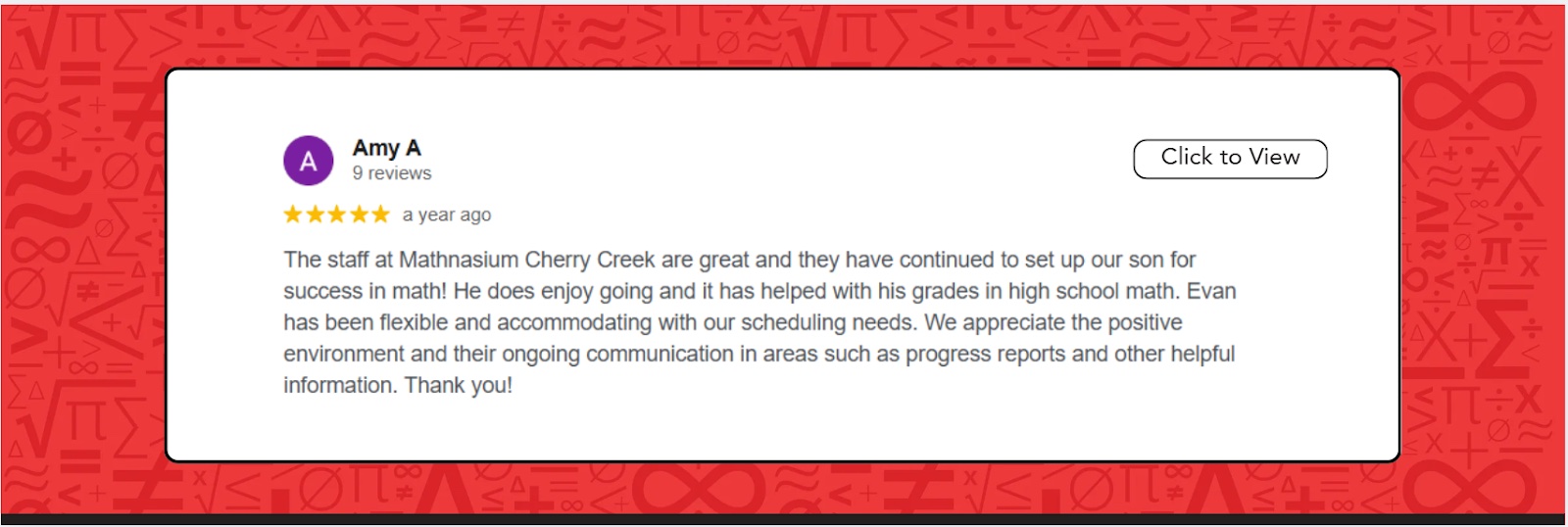
Read how one parent described their child’s experience at Mathnasium of Cherry Creek:
Whether your child is looking to catch up, keep up, or get ahead, our team is ready to assist!
📅 Schedule a Free Diagnostic Assessment at Mathnasium of Cherry Creek
Not located near Cherry Creek?
📍 Find a Mathnasium Learning Center Near You


 (303) 333-6284
 (303) 333-6284