“How can nothing be a number?”
We hear that question a lot at Mathnasium, and there’s a good chance you’ve heard it at home, too. That curiosity is completely normal.
Zero holds a special place in math. It represents nothing, yet it changes the value of the numbers around it. That’s what makes it both foundational and confusing for young learners.
The earlier this puzzle clicks for young learners, the more confidently they can move forward in their math journey. And you’re in the right place to help make that happen.
Today, seasoned Mathnasium tutors explain why zero can feel so confusing for young learners and share practical ways you can help your child master this tricky concept.

Why Zero Is So Difficult for Young Learners
Zero presents unique cognitive hurdles that other numbers simply don't.
Identifying these challenges is the first step in helping your child build a solid foundation in understanding zero and math learning overall.
1. It Defies Natural Counting Instincts
Your child learned to count by interacting with physical objects. They touched blocks, pointed to crayons, and grouped toys.
Every number from one onward represented something they could see, hold, or move around. Zero breaks this pattern completely.
Think about asking your child to count the cookies on an empty plate. The plate is there, but there's nothing to count. Their brain wants to find objects to point to, but there aren't any. This creates confusion because zero represents the absence of what they've been trained to look for.
Research in cognitive development shows that children build their number sense through concrete experiences, and zero simply doesn't fit into that tangible world the same way other numbers do.
📕 You May Also Like: What Is Number Sense & Why It Matters in Early Math Education
2. It Requires Abstract Thinking
Understanding zero demands abstract reasoning skills that develop gradually as children grow.
According to developmental psychology, most children don't fully develop abstract thinking abilities until they’re around twelve. Before then, they're firmly in what's called the concrete operational stage, where they learn best through physical, hands-on experiences.
Think about other abstract concepts that challenge young children.
Ideas like "tomorrow," "fairness," or "patience" are hard to grasp because they can't be touched or seen.
A child might understand "wait five minutes" if they can watch a timer, but "be patient" feels vague and confusing.
Zero falls into this same category of abstract ideas.
Unlike "three" or "seven," which can be demonstrated with objects, zero represents a state rather than a collection. You can point to an empty pencil case, but that's showing the container, not the zero itself. This distinction matters tremendously to young learners.
📕 You May Also Like: 5 Ways to Help Your Child Build Flexible Thinking in Math
3. Zero Plays Multiple Roles in Mathematics
Just as your child starts to grasp what zero means, they discover it behaves completely differently depending on the situation. This creates layers of confusion that other numbers don't have.
Zero serves as:
-
A number representing quantity: "I have 0 apples in my basket."
-
A placeholder in larger numbers: The 0 in 10, 100, or 1,000 doesn't mean "nothing," it shows position.
-
A boundary marker: Zero is the boundary between positive and negative numbers.
Each role requires its own understanding.
Your child might grasp that zero apples means no apples, but then feel completely lost about why the zero in "10" doesn't make the 1 disappear. After all, if zero means nothing, shouldn't 10 just be 1?
Consider these examples from your child's perspective. They understand that 7 always means seven of something. Seven blocks, seven days, seven anything.
But zero?
-
In "I have zero pencils," it means none.
-
In "I scored 10 points," the zero is just helping the 1 mean something bigger.
-
In "The temperature is zero degrees," it marks a specific point rather than representing nothing at all.
These roles contradict each other, and young learners haven't yet developed the flexibility to see zero as context-dependent.
📕 You May Also Like: How Number Lines Improve Math Understanding in Grades 1 Through 5
4. The Language We Use Creates Confusion
The words we use to talk about zero add another layer of complexity. We say "nothing," "none," "empty," and "zero," sometimes interchangeably. But are they really the same?
Different languages and cultures also express zero in varied ways, which can affect how naturally children grasp the concept.
Some languages have multiple words for different types of nothingness, while others use the same word for zero and nothing. Your child is navigating not just a mathematical concept but a linguistic puzzle.
The imprecision in how we talk about zero makes it harder for children to build a clear mental model. They hear these words used loosely in conversation, which blurs the boundaries of what zero actually means mathematically.
5. Zero Breaks the Rules Children Expect
By the time children encounter zero in operations, they've already formed expectations about how numbers behave. Zero violates nearly all of them.
Addition makes numbers bigger, right? Your child learns that 3 plus 2 equals 5, which is larger than either starting number. But then they discover 5 plus 0 equals 5. The number stayed the same. Nothing happened. This seems like an exception to the rule they just learned.
The same principle applies to subtraction.
Multiplication creates even more confusion. If 3 times 2 means "three groups of two," that makes sense. But what does 3 times 0 mean? Three groups of nothing? And why does everything times zero equal zero? Your child just learned that multiplication makes numbers bigger (usually), and now suddenly zero makes everything disappear.
Then there's division. You can divide 10 cookies among 2 friends, giving each person 5. You can even divide 0 cookies among 2 friends (they each get 0). But try to divide 10 cookies among 0 friends, and suddenly the math breaks. Division by zero is impossible, not because it equals zero, but because it doesn't equal anything.
These counterintuitive rules make zero feel like the exception to everything they've learned. And in many ways, it is.
How Parents Can Help Their Children Understand Zero
Now that you understand the challenges, here are practical strategies you can use at home to help your child develop a solid grasp of zero.
-
Use consistent, precise language. Choose one or two terms and stick with them, especially during learning time. "Zero" and "none" work well together. Avoid switching between "nothing," "empty," "all gone," "zilch," and other casual terms during math practice, as this can create unnecessary confusion.
-
Introduce one meaning at a time. Don't try to teach zero as a quantity, a placeholder, and a factor in operations simultaneously. Start with zero as a number representing no items. Master that thoroughly before moving to how zero functions in larger numbers like 10 or 100.
-
Connect zero to the number line. Help your child see zero as a number that lives between negative one and positive one. This reinforces that zero is a mathematical position, not just "nothing." Drawing number lines together and placing zero in its proper spot helps establish it as a legitimate number.
-
Practice with games that involve scoring and counting down. Play games where players can reach zero points or count down to zero. Board games where pieces get removed, cooking activities where ingredients run out, or countdown timers all help normalize zero as part of mathematical thinking.
-
Be patient with the developmental timeline. Remember that a full understanding of zero, especially its more abstract applications, may not click until your child is seven or older. If they struggle now, it doesn't mean they're behind. It means their brain is still developing the necessary cognitive tools.
These strategies work best over time and with repetition.
Your child won't master zero after one conversation, but with consistent, patient practice using these approaches, the concept will gradually become clear.

Mathnasium tutors know how to turn abstract ideas into something concrete and understandable.
How Mathnasium Helps Children Master Zero
At Mathnasium, we prevent these struggles from taking root by addressing understanding zero as a foundational concept that deserves careful, individualized attention.
We're a math-only learning center, dedicated to helping students excel in any math skill or concept, including understanding zero and building the cognitive skills necessary for math learning.
When students come to us needing help with math, we don't just drill operations or hand them worksheets. Our approach, the Mathnasium Method™, works differently. It's proprietary, personalized, and designed to build a deep understanding of math from the ground up.
To foster true mastery, our approach relies on:
-
Personalization on a granular level: Each student begins their enrollment with a diagnostic assessment. This allows us to pinpoint exactly where they are in their understanding of zero and number sense overall. From there, we create a learning plan customized to their specific needs and developmental stage.
-
Teaching for understanding: We explain zero using clear, everyday language and support the concept with a blend of visual, verbal, written, mental, and hands-on techniques. This layered instruction helps students truly make sense of what zero means in each of its different roles.
-
Caring instruction: Our tutors are trained not just in math but in how to connect with students. They know how to support a child who's feeling frustrated by abstract concepts and how to pace instruction to match each student's development.
-
Independent problem-solving and critical thinking: During instruction, we always set aside time for students to work through problems on their own. This gives them space to test their understanding and build the abstract thinking skills that math requires.
-
Singular focus on math: Our program spans thousands of pages and has been continuously refined over the past 20 years. This singular focus on math allows us to take a deep dive into how students best absorb, learn, and retain mathematical concepts.
-
Empowering, fun learning environment: Our environment is designed to be both confidence-building and fun. Our materials are often game-based, and we give students a chance to earn rewards to keep them motivated as they continue advancing to higher levels of achievement.
The result? Real, measurable progress.
-
94% of parents report improvement in their child's math skills and understanding
-
93% of parents notice a more positive attitude toward math
-
90% of students see higher grades in school
Mathnasium operates over 1,100 learning centers across the U.S., bringing our proven approach close to your community.
For families in or near Denver, Mathnasium of Cherry Creek is a trusted local center with years of experience transforming how students think and feel about math.
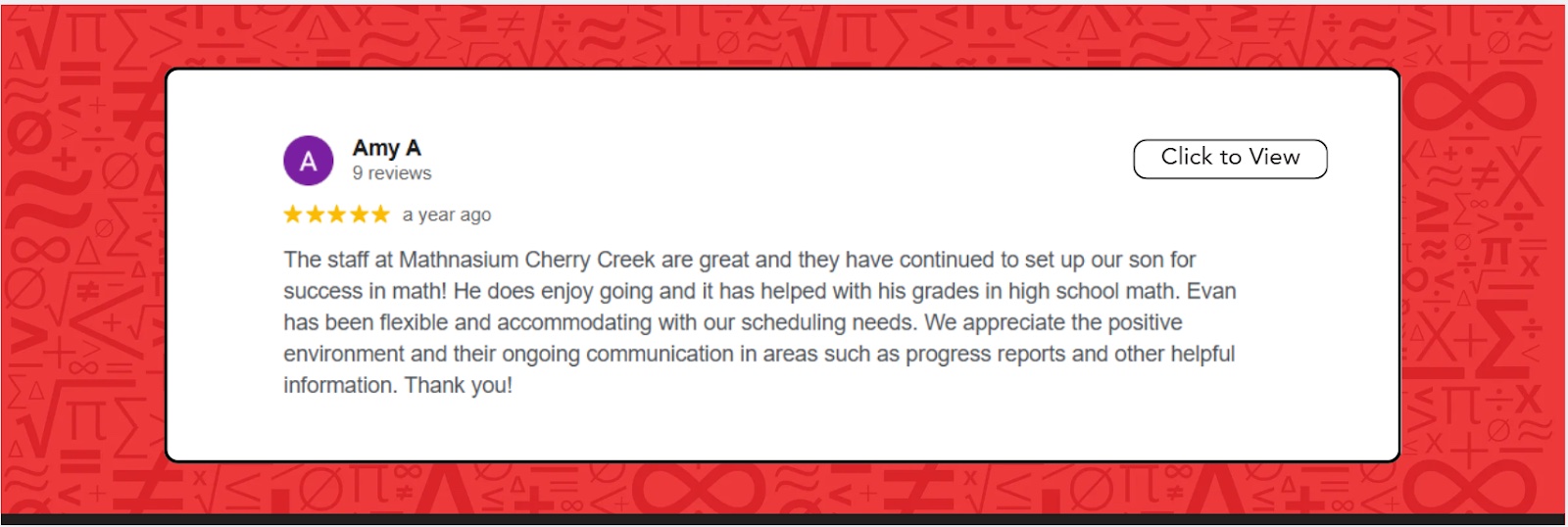
Read how one parent described their child’s experience at Mathnasium of Cherry Creek:
Whether your child is just beginning to encounter zero or struggling with how it works in operations, our team is happy to assist.
📅 Schedule a Free Diagnostic Assessment at Mathnasium of Cherry Creek
Not located near Cherry Creek?
📍 Find a Mathnasium Learning Center Near You


 (303) 333-6284
 (303) 333-6284