It’s easy to feel overwhelmed by the sheer volume of math your child is expected to master, especially as they approach middle school and transition towards a more abstract way of thinking.
At this point, it is important to recognize that not every topic deserves equal time. In fact, a few key skills do most of the heavy lifting.
This is where we can apply the Pareto Principle, commonly known as the 80/20 rule. In math, this principle can help us focus on the math concepts that carry the most weight—what we call high-impact skills—so you can help your child build a solid foundation in less time.
Let’s look at the four skills that matter most and how to make them part of your at-home practice.
What Is the 80/20 Rule in Math and Why It Matters
The 80/20 rule is the idea that 80% of outcomes come from just 20% of the effort, if that effort is focused in the right place.
In math, this means most of a student’s progress, confidence, and test success comes from mastering a small group of high-impact concepts. We call these the “vital few.” They include topics such as number sense, fraction understanding, early algebra skills, and basic function relationships. They’re the foundation for everything that comes next.
In class, students are expected to learn every rule, memorize every step, and keep up with every topic at once. That’s where we see students start to feel overwhelmed. They work hard, but the results don’t match the effort because their focus is stretched too thin.
By identifying and focusing on the 20% that truly matters, students can build the understanding they need to solve problems and feel more in control of math overall.
📕 You May Also Like: Child Struggling with Math? Know the Signs and How to Help

By focusing on a small set of high-impact concepts, students can build a better math foundation and grow confidence.
4 Math Concepts to Focus on
A handful of fundamental concepts do most of the heavy lifting in math. They're the building blocks that keep showing up, year after year, in increasingly complex forms.
Master these, and math will stop feeling like an endless mountain to climb.
1. Fractions and Proportional Thinking
Fractions sit at the center of math from upper elementary through middle school. They form the connective tissue linking ratios, decimals, percentages, and eventually algebra. If fraction understanding is weak, math progress will slow across multiple topics.
We meet students who can follow the steps, find a common denominator, flip and multiply, but can’t explain what any of it means. The moment a problem looks different or moves into a real-world context, they lose their footing.
Using visual tools can make a lot of difference when working with fractions, because they give students something to see and work with. Fraction bars, number lines, and area models show how parts relate to a whole in ways that are easier to understand and remember.
Instead of just hearing “one-half plus one-fourth,” they can look at a bar, divide it into equal parts, and watch how those pieces come together.
Fractions are also part of everyday life. They show up more often than most kids realize. Recipes, rulers, measuring cups, and sharing snacks all involve fractions. The moment a student connects “three-fourths” on paper to three-fourths of a cup they’ve just poured, the math becomes real.
That connection helps them move from memorizing steps to understanding relationships, turning fractions into a tool they can actually use.
📕You May Also Like: How to Help Your Child Make Sense of Wholes and Fractions
2. Place Value and Number Sense
Place value is one of those concepts that powers everything in math. When it clicks, students compare numbers accurately, estimate reasonably, and choose operations that fit. When it doesn’t, answers go off the rails.
A common mistake we see is students thinking 0.12 is greater than 0.5 because twelve feels bigger than five. That kind of mix-up tells us they’re focusing on digits and not value.
More practice problems won’t fix that. What does help is giving students familiar, concrete ways to think about place value.
Money, time, and measurement are some of our go-to tools for teaching place value, especially decimals:
-
Money: Ten cents is clearly more than one cent. That real-world understanding helps students compare decimals like 0.10 and 0.01 with confidence.
-
Time: A tenth of an hour becomes six minutes; a hundredth is less than a minute. Converting these into familiar units makes their size easier to grasp.
-
Measurement: Using rulers or measuring cups gives students hands-on practice comparing tenths, hundredths, and thousandths, so those tiny differences are easier to see and understand.
Once students connect place value to things they already use and understand, they start making better estimates, choosing smarter operations, and catching their own mistakes.
Real-world anchors give students a better grip on number sense. They start to judge whether answers are reasonable. They make better choices about which operations to use, and they’re more likely to catch errors before they finish the problem.
📕 You May Also Like: What Is Number Sense & Why It Matters in Early Math Education
3. Functions and Relationships
The word “function” might sound like something from a high school textbook, but the core idea shows up much earlier, and it’s simpler than most students realize.
A function is just a rule. You change one number, and something predictable happens to another. That’s it.
We usually introduce functions with input/output tables. They might not look exciting, but input/output tables are where algebraic thinking really starts. Noticing that each input doubles, or that five is added each time, helps students recognize the pattern long before they’re asked to write an equation.
From there, we tie it to things students already know. Buy three $5 tickets? That’s $15. Ride your bike for 2 hours at 10 miles per hour? That’s 20 miles. These examples help students see that math is about describing how things relate.
Once students start to recognize patterns and relationships in real life, graphs and equations stop feeling random and start to make sense.
📕You May Also Like: 8 Simple Ways to Make Math Fun at Home
4. Multiplication and Division as Thinking Tools
Multiplication and division are usually taught as facts to memorize, but in practice, they help students organize their thinking when solving word problems, ratios, fractions, and algebra problems.
We’ve worked with many students who can recite multiplication tables or follow long division steps, but freeze when asked to decide what operation to use in a real problem. That pause says a lot. It means they’re not sure what the math is actually asking.
To clear that up, we always start by focusing on what the operation actually means.
Multiplication answers questions like: How many in total? How many equal groups?
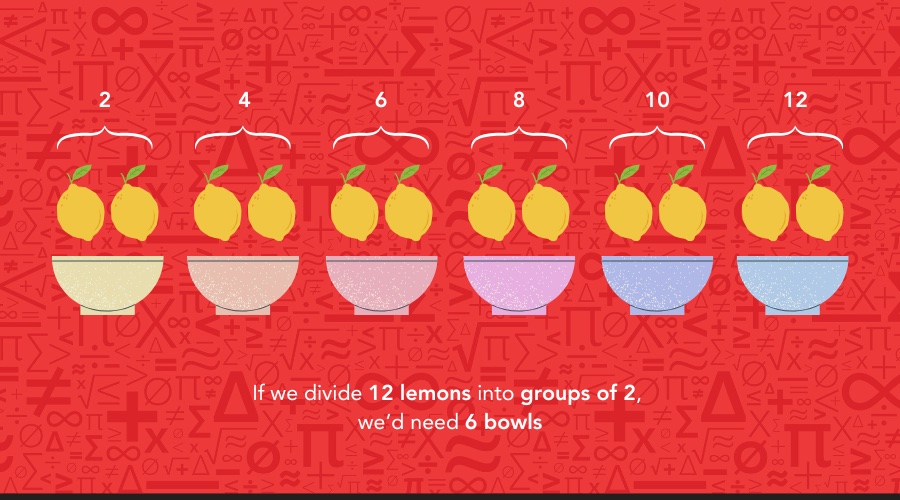
Twelve lemons, six bowls, two in each. Division answers: “How many in each group?”
We use number lines, arrays, and simple group models to make those ideas click. When students can see it, they understand it.
We also encourage students to explain their choices. If they can say, “I divided because I was splitting something up,” that tells us their reasoning. And once that kind of thinking starts to stick, we see fewer mistakes.
These small shifts in how students approach multiplication and division can lead to big changes across all kinds of math.
📕 You May Also Like: How to Nurture Math Thinkers, Not Just Answer-Getters

Our specially trained math tutors make core mathematical concepts more tangible and easier to understand.
How Mathnasium Helps Students Apply the 80/20 Rule
Mathnasium is a math-only learning center designed to help kids really understand math. We help them focus on the concepts that matter most, the ones that drive real progress.
It starts with a diagnostic assessment, a detailed process that helps us identify exactly what a student knows, where they’re getting stuck, and which key skills are missing. From there, we create a personalized learning plan that targets the highest-impact areas first.
This is the heart of the Mathnasium Method™, our proprietary approach built around teaching for understanding. We use face-to-face tutoring, natural language, and multi-sensory techniques to make math feel clear and approachable.
Our math tutors are specially trained to slow down where it counts and move forward when a concept truly clicks. That clarity helps students build confidence, solve problems more independently, and retain what they’ve learned without needing to review it again and again.
And the results speak for themselves:
-
94% of parents report improvement in their child’s math skills and understanding
-
93% see a better attitude toward math
-
90% of students show growth in school performance
With a network of over 1,100 learning centers across the U.S., we bring our proven teaching approach and top-rated tutors close to your community.
For families based in or near Chester, VA, Mathnasium of Chester is a trusted local center with years of experience helping students reach their goals in math.
Whether your student is looking to catch up, keep up, or even get ahead in math, our learning center is delighted to help.
Ready to get started?
📅 Schedule a Free Diagnostic Assessment at Mathansium of Chester!
Not near Chester?
📍 Find Mathnasium Learning Centers Near You


 (804) 706-4321