Generally, when parents think about summer math learning programs, it’s in the context of catching up. And while this is a perfectly common and reasonable assumption, summer programs are just as valuable for students who are ahead of the material as opposed to behind it.
In fact, in our experience, students striving for accelerated or honors math courses can greatly benefit from the extra practice over the summer, which can help them enroll and thrive in those environments.
So, today we’ll go over why summer learning programs are so valuable, how students can benefit, and how they can be better prepared for these advanced programs.

How Students Can Advance in Math Over the Summer
Besides at-home practice routines, families have a few options for structured math support over the summer.
In Denver, families in and near the Highland neighborhood can explore our Summer Program.
Our summer sessions run on personalized learning plans, meaning an advanced student isn't working through generic grade-level material but through the specific concepts their next course will demand.
Sessions are flexible enough to fit around summer schedules, and the environment is lower-stakes than the school year by design, which is exactly what makes it the right setting for the kind of exploratory learning that gets students ahead.
📕 You May Also Like: Math Enrichment vs. Acceleration: Which Does Your Child Need?
1. Students Can Move at Their Own Pace
In a summer program, the pace is set by the student's actual readiness.
This means that a concept that your student has already internalized can be confirmed quickly and left behind. On the other hand, a concept that requires development gets the time it needs.
To thrive in math, we need to dedicate time and care to mastering each concept, we need to expand our foundations, as every new topic relies on what came before it. So, by fully exploring and understanding, let’s say multiplication, moving on to fractions is a much smoother process.
This matters most at the transitions between grade levels, where the conceptual jumps are the largest.
If your student is to start Grade 7 and is already comfortable with proportional reasoning, they can spend the summer extending that foundation into linear equations, negative numbers, and the early algebraic thinking that seventh grade will formalize.
They arrive in September having already lived with that material, rather than meeting it for the first time in class.
The same principle applies across all grade levels, of course.
2. Exploration Comes More Naturally Without Grades
The school year attaches consequences to mathematical errors.
Our children’s mistakes affect grades, and grades affect course placement. That layer of stakes makes them less willing to attempt material that is at the edge of their current understanding.
However, accelerated learning requires exactly that: exploration of new concepts.
Moving ahead means working with concepts that are not yet fully solid, making errors, revising understanding, and trying again. That process is how mathematical thinking develops at a deeper level, and it is far more accessible when the cost of a wrong answer is simply another attempt.
So, if your student is working through pre-algebra concepts in July, without a test on Friday and a grade to protect, they will be more willing to sit with a difficult problem and learn from what happens.
It’s also during this free exploration that students are the most likely to notice patterns between different concepts, further deepening their understanding of the material.
📕 You May Also Like: How to Keep Advanced Students Motivated & Challenged in Math
What Getting Ahead Looks Like in Practice
For students targeting an accelerated or honors track, summer preparation can help tackle two distinct requirements.
1. Developing Relevant Content Knowledge
Accelerated courses do not just move faster. They also begin further along.
So, if your student is entering an honors algebra course in Grade 8, they are expected to arrive with fluency in proportional reasoning, comfort with expressions and equations, and a working understanding of functions.
The course builds from there and typically won’t revisit old ground to build up the fundamentals, as they should already be in place.
It’s also important to understand the difference between surface familiarity and real understanding in this regard.
It’s one thing to have seen ratio problems before and another to move freely between equivalent forms, unit rates, and proportional relationships.
Summer is the window to close that gap between where your student currently is and where the course assumes they will be. That means working deliberately through the specific content the track will assess, whether through a placement test, a teacher recommendation, or both.
📕 You May Also Like: How to Go from Catching up to Getting Ahead in Math
2. Developing Reasoning Habits
Content knowledge is the entry requirement. Reasoning habits are what determine how our kids perform once enrolled in the course.
Accelerated and honors tracks expect students to work through unfamiliar problems independently, handle ambiguity, and self-correct.
These are not natural byproducts of knowing the material.
Your student has to develop these habits deliberately, and summer is the right environment to do just that because there are no grade consequences attached to the process of getting it wrong and trying again.
If your student spends the summer working through truly challenging problems, pushing past the point of comfort, and building the habit of independent problem-solving, they will arrive at an accelerated course in a fundamentally different position than someone who has only reviewed the content.
Both students may know the same material, but only one has practiced thinking the way the course will require.
📕 You May Also Like: How to Nurture Confident Math Thinkers, Not Just Answer-Getters

Mathnasium summer programs help students both catch up and get ahead on their current grade material.
How Mathnasium Helps Students Get Ahead Over Summer
Mathnasium is a math-only learning center dedicated to helping K-12 students learn and master math at every level, including students who are ready to move beyond grade-level content and pursue accelerated tracks.
When students come to us with advancement goals, we do not hand them generic enrichment material and call it acceleration. Our proprietary approach, the Mathnasium Method™, works differently. It is personalized and designed to build the kind of deep mathematical understanding that advanced coursework demands.
To foster lasting mastery, our approach relies on six core principles:
-
Personalization on a granular level: Each student begins with a diagnostic assessment that identifies their strengths, knowledge gaps, and how they approach math. Tutors then follow personalized learning plans that guide progress at the pace the student's understanding actually supports.
-
Teaching for understanding: We explain math using clear, everyday language and support each concept with visual, verbal, written, mental, and hands-on techniques so students develop genuine understanding rather than surface familiarity with procedures.
-
Caring instruction: Our tutors provide caring guidance in a fun group environment where students feel supported as they work through material that challenges them.
-
Independent problem solving and critical thinking: Each session includes time for students to work through problems on their own. Tutors guide them to understand both how and why a concept works, building the independent reasoning habits that accelerated tracks demand.
-
Singular focus on math: Math is all we do. Our curriculum spans thousands of pages and has been continuously refined over 20+ years of working exclusively with K–12 math learners. That singular focus gives us a deep understanding of how students at every grade level absorb, internalize, and retain mathematical concepts
-
Empowering, fun learning environment: Our environment is designed to be both engaging and fun. Our materials are game-based, and students have the opportunity to earn rewards to keep them motivated as they advance to higher levels of achievement.
And the results speak for themselves:
-
94% of parents report an improvement in their child's math skills and understanding
-
93% of parents report an improved attitude toward math after attending Mathnasium
-
90% of students saw an improvement in their school grades
With over 1,100 centers, we bring the Mathnasium Method™ close to your community.
For families in Denver, Mathnasium of Denver Highland is your trusted local learning center with years of experience in transforming how students think and feel about math.
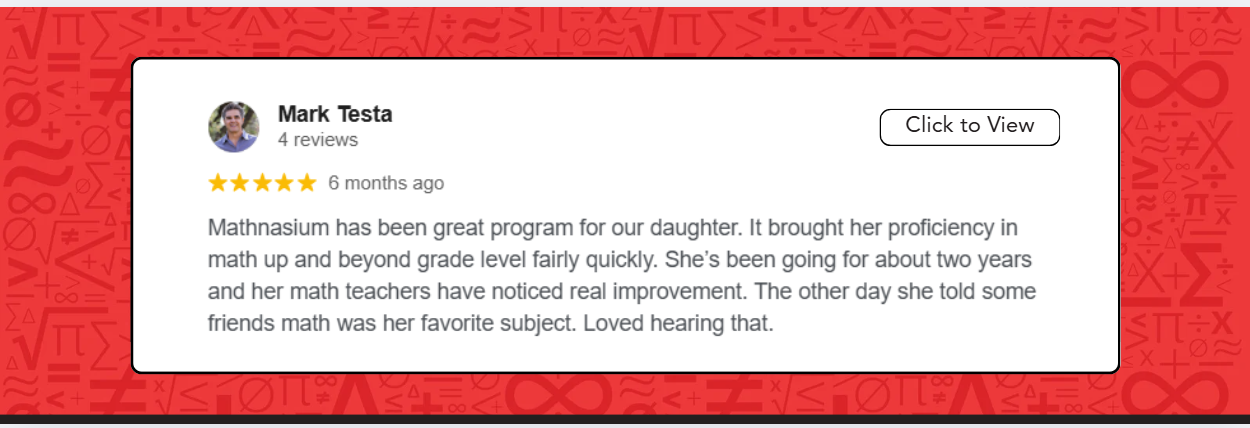
Here’s what one Denver parent shared about their experience with Mathnasium:
Whether your student is looking to catch up, keep up, or get ahead on their math journey, we can help!
Ready to get started?
📅 Schedule a Free Diagnostic Assessment at Mathnasium of Denver Highland
Not near Denver?
📍 Find Mathnasium Learning Centers Near You


 (720) 524-4763
 (720) 524-4763