It's almost impossible for students to go through school without comparing themselves to their peers, and the younger they are, the harder it hits.
Math is no exception; if anything, it's one of the subjects where it happens most.
And while comparison might seem harmless, it can have real consequences on a child's self-esteem and relationship with learning.
At Mathnasium, we understand this well. That's why our experienced tutors put together this look at how peer comparison affects math confidence and practical tips for parents on what to do when it happens.
How Peer Comparison Affects Math Confidence
A little healthy competition can be a good thing. It can motivate students to push themselves and stay engaged.
But when comparison becomes constant, it can do the opposite, specifically when a child hits a rough patch in math. Instead of seeing a challenge as something to work through, they start seeing it as proof that they don't measure up.
And the effects on confidence? They can run deeper than they appear:
A. It Creates Unhealthy Academic Pressure
For students who are constantly aware of how their peers are performing, the focus moves away from actually understanding math and toward outperforming others.
Instead of asking, "Do I get this?" the question becomes, "Am I keeping up?" And in a subject as cumulative as math, that change in mindset can create gaps that are hard to close later on.
B. It Fuels Math Anxiety
Relentless comparison can tip into genuine anxiety over time. Math stops feeling like something to explore and starts feeling like something to fear.
Research from the University of Tennessee found that a major trigger for math anxiety is peer performance pressure, particularly in moments where students are asked to solve problems in front of others.
For a child who already feels behind, those moments feel not only uncomfortable but also confirming.
And once anxiety takes hold, avoidance tends to follow, which only makes things harder down the road.
📕 You May Also Like: Understanding Math Anxiety and How to Overcome It
C. It Chips Away at Math Identity
Children are quick to turn observations into conclusions about themselves.
Say a child sees a classmate solving problems faster or scoring higher. That one moment can easily become "They're a math person, and I'm not."
This is exactly what Carol Dweck's research on fixed mindset warns about: the tendency to treat ability as something you either have or you don't, rather than something you build.
And the thing is, the moment a child pins that label on themselves, they stop trying to grow and start trying to avoid being exposed.
Speaking from our tutors' experience, that's one of the most damaging shifts a young learner can make.
📕 You May Also Like: 5 Reasons Why Students Lose Interest in Math (+ Solutions)
D. It Disregards Individual Pace
Math is not a race, even though it can feel like one.
Every child builds understanding differently. Some need more time with certain concepts; others move quickly through some areas and more slowly through others.
That's completely normal.
Comparison, though, flattens all of that. It holds one child's timeline up against another's and calls it a measure of ability.
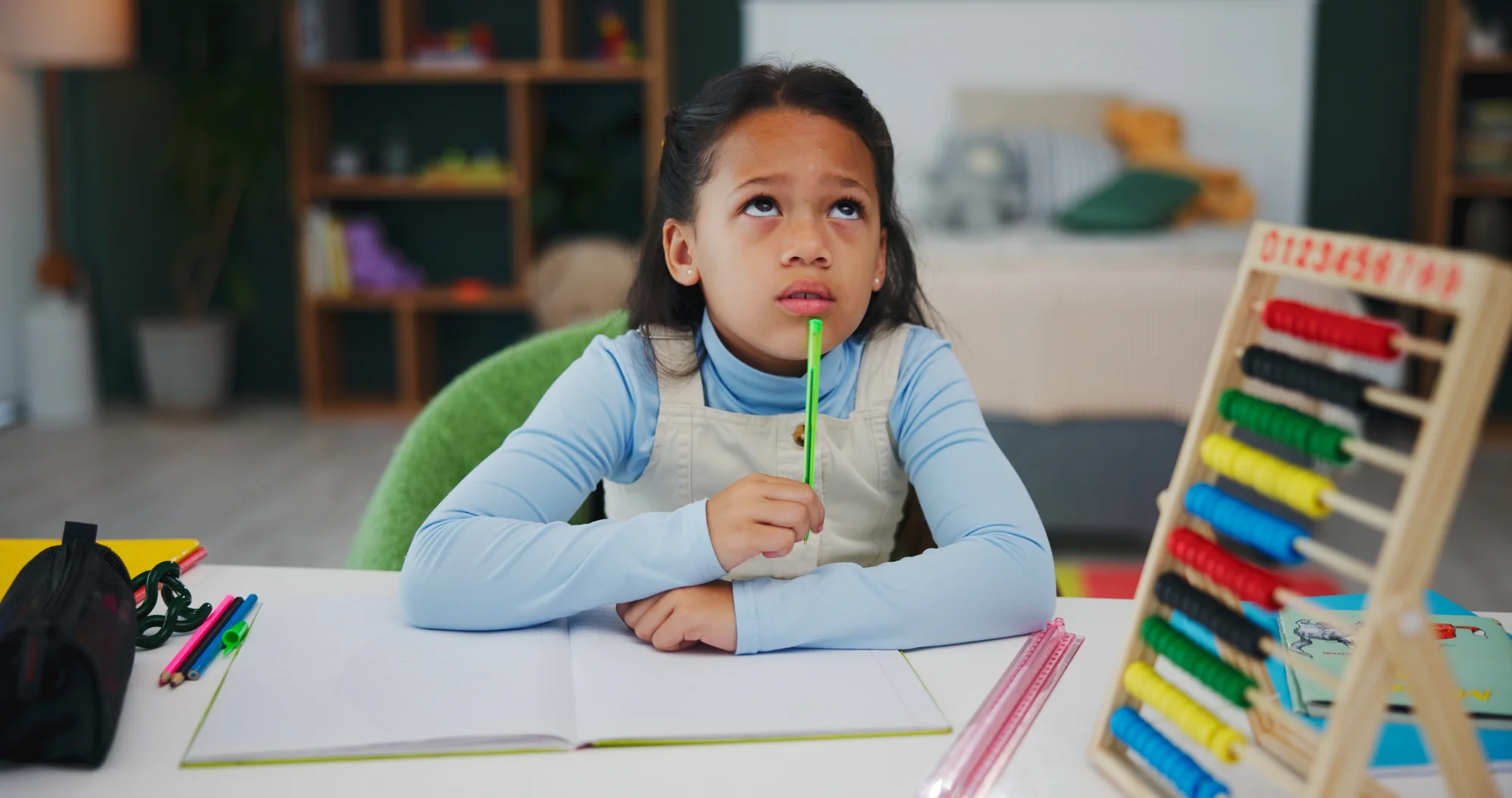
Every child works through math at their own pace, and that's perfectly okay.
What Parents Can Do: Tips to Reframe and Rebuild Confidence
The conversations happening at home shape the way a child feels in the classroom more than most people realize.
A few small changes in how you approach math—the questions you ask, the way you respond to a bad grade, the comparisons you make without even realizing it—can make a real difference.
1. Watch for Signs of Math Comparison Anxiety
Before you can help, you need to know what you're looking at. Some signs are easy to miss because they look like general disinterest or attitude, but they're worth paying attention to:
-
Saying things like "I'm just bad at math" or "everyone gets it except me"
-
Dreading math class specifically, not school in general
-
Giving up on a problem almost immediately rather than sitting with it
-
Refusing to do homework without heavy prompting, particularly after a test or graded assignment
-
Getting unusually upset about mistakes or a grade that isn't perfect
2. Swap Performance Talk for Process Talk
Children take their cues from the adults around them. When the first question after school is about a grade or a score, it signals, without meaning to, that the result is what counts.
Instead, asking "What did you work on today?" or "Was there anything that surprised you?" keeps the focus on curiosity and effort, which is exactly the mindset you want your child to bring to math.
3. Celebrate Effort and Consistency Over Grades
A good grade feels great, but it's the habits behind it that actually move the needle. Try making a point of noticing and praising the effort your child puts in, not just where they land:
-
Getting through a tough chapter on fractions, even if the quiz didn't go perfectly
-
Sitting with a word problem instead of giving up on it
-
Asking for help when something isn't clicking: in long division, geometry, or anything else that feels out of reach
-
Trying a different approach when the first one didn't work
Those are the moments worth celebrating, because those are the habits that build real confidence in math over time.
4. Reframe How You Talk About Mistakes
In math, mistakes are not a dead end, but a window into how your child is thinking.
Imagine your child is working on distribution and solves 3(x + 4) as 3x + 4 instead of 3x + 12. They knew the first step; they just didn't carry it all the way through.
That's not a child who doesn't understand; that's a child who's halfway there. Something like "You got the right idea, you just stopped one step too soon" lands very differently than "That's wrong."
The goal is to move away from "You got it wrong" and toward "Let's see how far you got" because that's where the real learning happens.
📕 You May Also Like: Why Parents Should Teach Kids to Embrace Math Mistakes
5. Make Question-Asking Feel Safe at Home
If your child is holding back questions in class, chances are they're worried about how it looks in front of their peers. The antidote to that starts at home.
When they come to you with something they don't understand, meet it with genuine curiosity rather than concern: "Good, let's figure that out together" rather than "You don't know this yet?"
A child who feels safe not knowing something at home is a lot more likely to raise their hand in class.
📕 You May Also Like: How to Encourage Your Child to Ask Questions in Math
6. Remind Your Child That Their Pace Is the Right Pace
This one takes a little more effort because it means actively countering something your child hears implicitly every day at school.
Math is cumulative, which means rushing through a concept just to keep up can leave real gaps underneath. Every child builds understanding on a different timeline, and that's not a flaw in how they learn; it's just how learning works.
It's worth having that conversation directly with your child. Help them see that the right benchmark isn't the classmate who finished first, it's whether they understood today's concept better than they did yesterday.
That's the kind of progress that actually sticks. It's also the same principle that shapes how we teach at Mathnasium. We build a personalized learning plan for each student based on where they actually are, letting them work through concepts at their own pace before moving on.
📕 You May Also Like: Why Personalized Math Tutoring Makes All the Difference
7. Keep the Home Environment Comparison-Free
This is arguably one of the most important habits on this list.
Even well-meaning comments like "Your sister always found math easy" or "Your friend is already doing algebra?" can land harder than intended.
Home should be the one place where your child isn't measured against anyone else.
It doesn't take much to undo the pressure they've been carrying all day, but it does take awareness, and making that a conscious effort is one of the most meaningful things you can do for your child's confidence in math.

Through personalized learning plans and interactive teaching, Mathnasium helps students (re)build both skills and confidence.
How Mathnasium Helps Students Build Skills and Confidence
Mathnasium is a math-only tutoring center dedicated to helping students of all skill levels learn and truly master math.
And in our years working with students, we've met plenty of children who walk through our doors with their confidence shaken, often by exactly the kind of peer comparison we've been talking about.
Our goal goes beyond improving grades. We want to transform the way your child understands math, feels about math, and sees themselves in relation to math. In other words, we work to take them from anxious, comparison-worn students to confident math thinkers who trust their own abilities.
Behind that process is our proprietary teaching approach, the Mathnasium Method™. Built on decades of experience, it's designed to give students a deep understanding and lasting confidence in math.
To make that happen, our approach draws on:
-
Personalized learning: Each student begins with a diagnostic assessment that helps us identify current skills, knowledge gaps, and how they naturally think through math. We use those insights to build a custom learning plan tailored to their needs.
-
Teaching for understanding: We explain math in natural, everyday language, using a mix of verbal, visual, mental, tactile, and written techniques. This allows students to approach each concept in the way that makes the most sense to them.
-
Caring, responsive tutors: Our tutors are specially trained in math but also in both the technical and emotional aspects of teaching. They know when to guide, when to challenge, and how to help students regain trust in their thinking.
-
Independent problem-solving and critical thinking: We give students space to work through challenges on their own, then rejoin them to check their reasoning. Instead of just giving the answer, we help them understand the how and why. This helps them develop problem-solving skills and critical thinking tools they can use in math and life.
-
A singular focus on math: We specialize in math and math only. Our robust, continually refined proprietary curriculum spans thousands of custom materials built around how students actually learn and retain math skills.
-
A supportive, fun environment: Many of our activities are hands-on or game-based. We use reward systems and consistent encouragement to keep students engaged. And we celebrate progress because confidence grows with every win.
Our method brings measurable results:
-
94% of parents report improvement in their child’s math skills and understanding
-
93% of parents notice a more positive attitude toward math
-
90% of students see higher grades in school
Mathnasium operates over 1,100 learning centers across the U.S., bringing top-rated math instruction close to you.
For families in or near Frisco, TX, Mathnasium of Frisco East is a trusted local center with years of experience transforming how students think and feel about math. With over 100 stellar Google reviews and multiple Reader’s Choice Awards from Living Magazine, our center has been recognized for:
If your student is looking to catch up, keep up, or get ahead in math, our team is happy to help.
📅 Schedule a Free Diagnostic Assessment at Mathnasium of Frisco East
Not near Frisco?
📍 Find a Mathnasium Learning Center Near You


 (972) 292-9886
 (972) 292-9886