6th grade is a common point when families turn to Mathnasium for math support. That doesn’t come as a surprise because sixth grade marks a major academic transition, from arithmetic to prealgebra, from concrete numbers to abstract reasoning.
Students begin working with integers, ratios, variables, and multi-step problem solving, often within the same unit or grading period. At this stage, even confident students can hit unexpected roadblocks.
Based on our work with 6th graders across the centers, our seasoned tutors have identified several core challenges that tend to surface during this transition.
Today, we’ll walk through the most common 6th-grade math problems and share proven strategies parents can use to help their child get back on track and build lasting understanding.
Common 6th Grade Math Challenges
While every student’s path is different, these are the challenges our tutors see when 6th-grade math begins to shift gears. As students take on more abstract concepts, even previously confident learners can hit some unexpected bumps.
Parents who understand where those struggles come from are in a better position to help. With the right tools and guidance, these challenges can lead to real progress and a renewed sense of confidence.
A. Struggling With Ratios and Proportions
This is one of the earliest sticking points we see in 6th-grade math. Students who were comfortable with multiplication and division tend to hit a wall when asked to think in terms of relationships instead of totals.
These are the signs to look for:
-
Misunderstands “___ out of ___” language: Doesn’t recognize this as a ratio or connect it to a fractional relationship.
-
Mixes up part-to-part and part-to-whole comparisons: Might say the ratio of apples to total fruit is “2:3” instead of “2:5.”
-
Struggles with scaling problems: Gets stuck on questions like “If 3 notebooks cost $6, how much do 5 cost?”
-
Guesses at unit rates or skips ratio tables: Treats ratio problems like random number puzzles rather than relationships.
So why is this such a common challenge?
Ratios require relational thinking and go beyond just calculation. That’s a major change, specifically when students are still gaining confidence with fractions.
It doesn’t help that terms like ratio, rate, proportion, and percent are used inconsistently across assignments and textbooks.
We typically find that ratio trouble stems from unfinished fraction understanding. If students don’t see that “2 out of 3” means \(\Large\frac{2}{3}\), or that 25 out of 100 connects directly to 25%, it’s hard to approach ratio questions with clarity.
This is when many parents start searching for “ratios help” and with good reason. Ratio problems tend to reveal gaps that weren’t obvious in earlier grades, particularly once students are expected to apply their understanding in unfamiliar formats or multi-step word problems.
📕 You May Also Like: 6 Ways to Help Your Middle Schooler Understand Proportionality
B. Confusion With Integers
Integers are often the concept that makes students second-guess what they thought they knew about math. After years of working with only positive numbers, the rules they’ve relied on suddenly stop working, and that throws them off.
This usually shows up through:
-
Confusing “negative” with “minus”: For example, reading –3 as “subtract 3” instead of recognizing it as a negative value.
-
Refusing negative answers: Insisting the result “can’t be negative” and changing –4 to 4 because it feels more familiar.
-
Moving in the wrong direction on a number line: Going right instead of left when solving something like –2 – 5.
-
Misusing memorized rules: Applying “two negatives make a positive” in the wrong context, leading to sign errors even when the math seems straightforward.
Patterns like these reflect how students are approaching the math. Students might rely on memorized rules without fully understanding what the numbers represent. Additionally, number lines are overlooked, even though they’re essential for developing directional reasoning.
📕 You May Also Like: Subtracting Integers – Kid-Friendly Guide, Rules & Examples
C. Multi-Step Word Problems and Translating Language to Math
Word problems become more demanding in 6th grade. Students are expected to read carefully, sort through extra information, and apply multiple steps before they even begin calculating. Many who are confident with operations still hesitate when asked to translate real-world scenarios into math.
This usually shows up through:
-
Misinterpreting key details: A student sees “$12 per hour for 3 hours a day, 5 days a week” and might multiply 12 × 3, stopping at $36. They overlook the weekly structure and miss the final step to find the full total.
-
Incorrect operation selection: When asked, “A school orders 6 packs of pencils, with 24 pencils in each pack,” the student might add 6 + 24 instead of multiplying. They choose a familiar operation without considering how the quantities relate.
-
Incomplete planning: Say a problem describes a 20% discount applied after a $15 shipping fee. The student calculates the discount first, then adds shipping, reversing the intended order and getting a final total that doesn’t match the question.
These struggles usually trace back to how students have been taught to approach problem solving.
In earlier grades, students are typically given single-step problems with clear keywords and predictable formats. As the problems become more layered, they’re still searching for shortcuts like circling numbers or scanning for action words because they’ve never been taught to analyze structure or map out relationships.
Without consistent modeling, students don’t develop habits like rereading, sketching, or planning across steps. As a result, they treat multi-step problems like a series of isolated tasks, rather than a connected sequence.
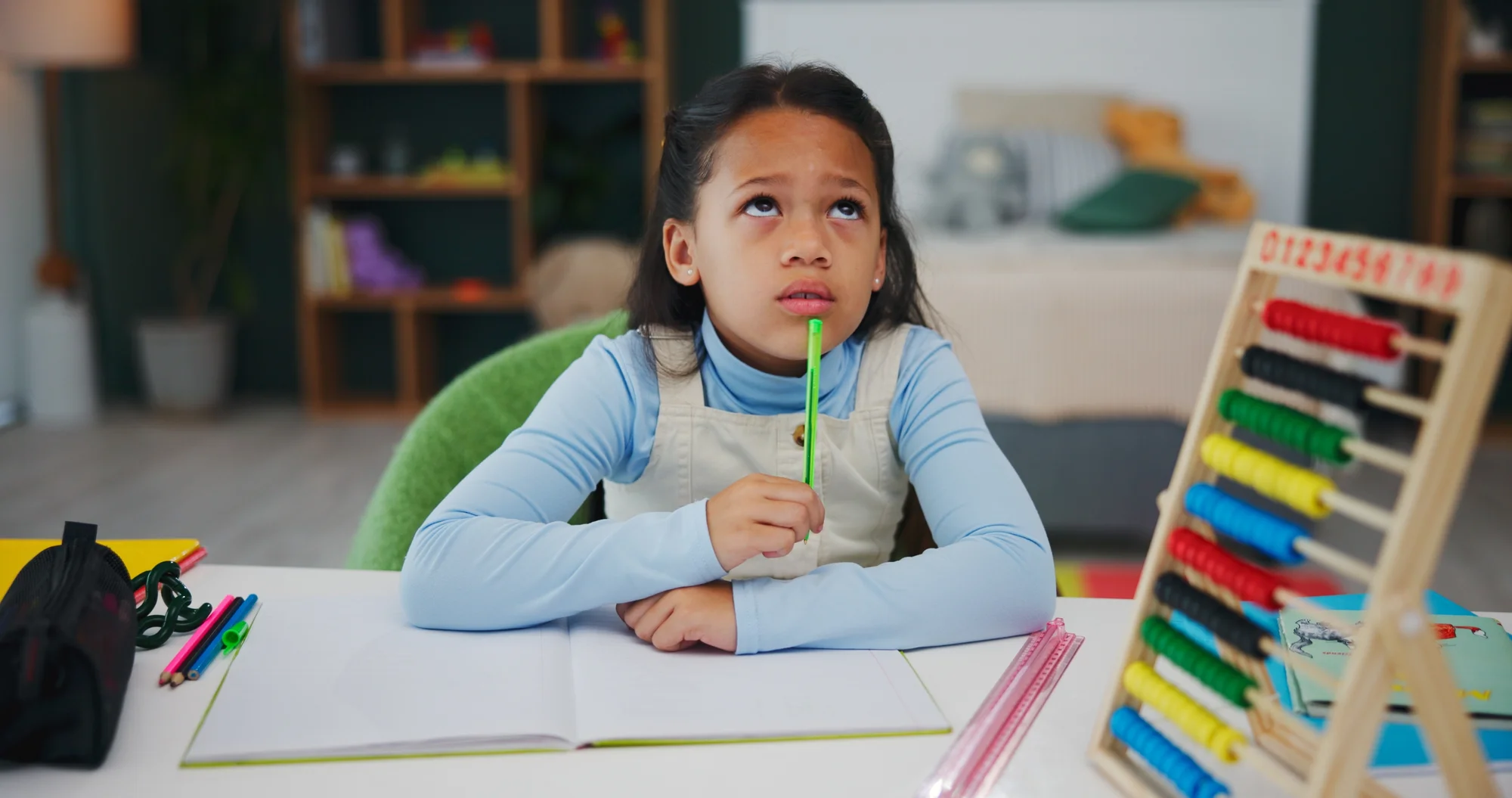
Multi-step problems may cause students to freeze when they’re unsure how to begin or what the question is really asking.
D. Fractions, Decimals, and Percents—Connecting the Dots
By 6th grade, students are expected to move comfortably between fractions, decimals, and percents. On paper, these topics may look familiar. In practice, the connections between them usually fall apart.
Students commonly:
-
Use procedures without a clear sense of purpose: A student adds two fractions correctly but doesn’t realize the problem actually calls for a percent, or chooses decimals at random because they seem simpler.
-
See each form as unrelated: 0.25, 14, and 25% are treated as entirely different values, making conversions feel like new problems rather than equivalent expressions.
-
Make comparisons based on digits, not value: A student decides that 18 is larger than 15 because “eight is more than five,” overlooking the actual size of the parts.
-
Struggle to apply knowledge in real-world settings: When solving for a sale price or tax amount, the student hesitates, not because of the math itself, but because they’re unsure which form to use or how to switch between them.
Much of this stems from how these ideas are taught. When taught in isolation, fractions, decimals, and percents lose their shared meaning, and students miss the chance to see how they represent the same values in different forms.
In many cases, the focus has been on steps and rules, not relationships. When 6th grade asks students to use these forms interchangeably, the lack of flexibility becomes a barrier to progress.
📕 You May Also Like: How to Convert Fractions to Decimals (& Vice Versa)
E. Early Algebraic Thinking and Using Variables
6th grade introduces formal algebra for the first time. Students begin working with variables, unknowns, and simple equations, without the kind of reasoning experience this transition requires.
Algebra relies on structure, relationships, and symbolic thinking, which can feel unfamiliar even to students who compute fluently.
The most common patterns we see are:
-
Focusing on solving instead of understanding: A student solves 3x = 24 correctly but doesn’t recognize how it connects to the idea of “3 bags with the same number of apples.” They reach an answer without grasping the relationship the equation models.
-
Misinterpreting the equal sign: When working with 7 + x = 20, a student adds 7 and 20 because they assume everything on the left should combine into the right. They treat the equal sign as a signal to compute, not as a symbol of balance.
-
Difficulty translating language into equations: In a word problem that says “twice a number plus 5 is 15,” a student writes 2x + 5 = 15 but doesn’t know what the variable stands for or how to use the equation once it’s written.
Such misunderstandings may come from how students have been taught to think about math up to this point.
In earlier grades, most math problems are direct: compute the answer and write it down. There's little focus on structure, reasoning, or interpreting what an equation represents.
When variables and expressions show up, students carry that same mindset into algebra, looking for steps, not meaning. Without consistent exposure to patterns, models, or balance-based reasoning, symbolic math feels disconnected from anything they’ve done before.
📕 You May Also Like: Is Your Student Ready for Their Algebra Class? [+Quiz]
Practical Strategies to Help Your 6th Grader
As challenging as the move into more abstract math can be for a 6th grader, parents have the tools to support it without stepping into the role of teacher.
A few targeted strategies can help students keep their focus, make sense of problems, and feel more capable of tackling unfamiliar formats with confidence.
1. Use Visual Models for Ratios and Fractions
At Mathnasium, we often see things click when students stop trying to calculate their way through ratios and start drawing them out.
Visual models—like bar diagrams and fraction grids—help students make sense of relationships that were confusing just moments earlier. Instead of guessing or memorizing steps, they begin to see how the numbers actually fit together.
You can use the same approach at home with very simple steps:
-
Draw simple bar models for ratio questions: If a problem says “2 red marbles for every 3 blue marbles,” help your child draw two boxes labeled “red” and three labeled “blue.” Ask them to describe what the ratio shows before they start solving.
-
Set up a table to show how quantities scale: For example, “If 3 notebooks cost $6, how much do 5 cost?” Write two rows: one for notebooks (3 and 5) and one for cost ($6 and ?). Let your child explain how the numbers are changing before doing any calculations.
-
Use a 100-square grid to connect fractions, decimals, and percents: For 25%, shade 25 squares. Then ask your child to name the fraction and decimal that match (\(\Large\frac{1}{4}\) and 0.25). Let them see the values side by side, not just as conversions.
Visual models like these give students a way to slow down and work with understanding. That habit becomes really useful when they start tackling percent discounts, scaling, and word problems in algebra.
2. Make Integers Concrete With Number Lines and Context
When integers start causing confusion, one of the most meaningful remedies is to return to number lines or real-world context. Number lines help students think in terms of direction and distance, not just signs. And familiar settings like temperature or money make negative values easier to grasp.
You can support this at home by:
-
Drawing a quick number line for problems that include negative numbers, with zero clearly marked and both directions labeled
-
Framing problems in real terms: “It’s 3 degrees and drops to –2, what’s the change?”
“If you owe $5 and pay back $3, what’s your new balance?”
-
Describing steps as movement: “I moved 3 spaces left from –1” or “I’m 6 units away from zero”
These strategies take the pressure off memorizing rules like “a negative and a negative make a positive.” Instead, students start reasoning through what the numbers actually mean, which builds greater number sense and fewer errors.
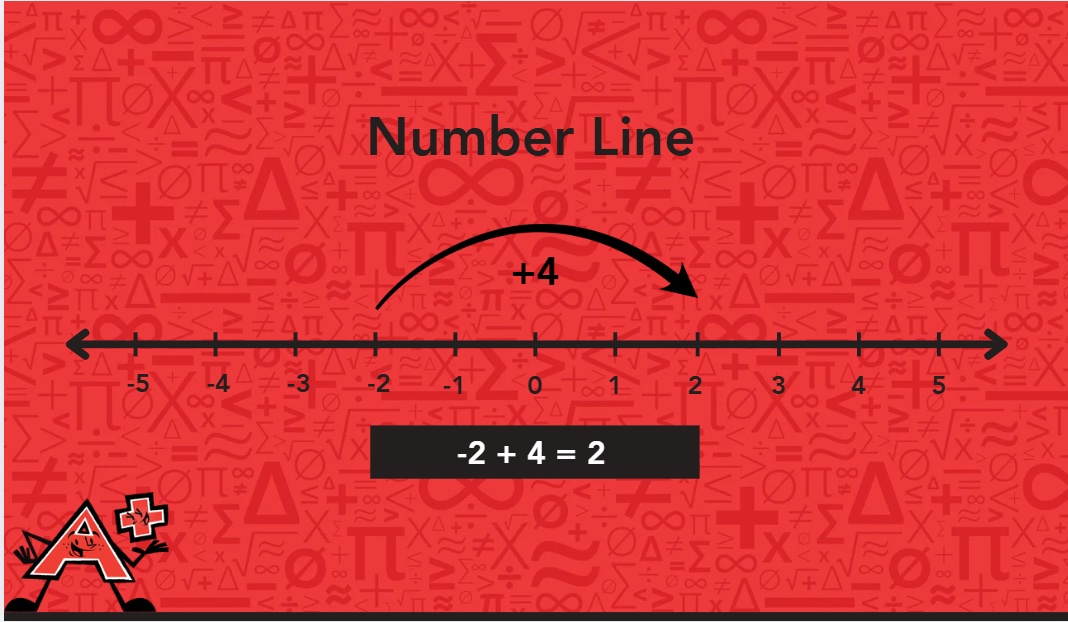
A number line helps students visualize integer problems as movement and distance, instead of relying on fragile sign rules.
3. Teach a Simple Plan for Word Problems
Let’s say the word problem is: A music subscription costs $12 per month. There’s a $5 one-time signup fee. How much will it cost for 3 months?
Instead of jumping straight into calculations, guide your child to:
-
Read once for the story, once for the question: On first read, it’s about monthly fees and a one-time cost. On second read, the question asks for the total cost of 3 months.
-
Underline what’s being asked: How much will it cost for 3 months?
-
List what they know: $12 per month, $5 signup fee, 3 months total
-
Pick a strategy: Draw a picture, write a clear equation, or break it into steps. For example: 12 × 3 = 36, then 36 + 5 = 41
-
Ask guiding questions: “What do we know?” or “Could you draw this out?”
This routine gives students a way to stay focused and work step by step, even when the problem includes extra information or unfamiliar wording.
4. Create “Connection Moments” Between Fractions, Decimals, and Percents
When students treat these forms as unrelated, they get stuck converting or don’t recognize when to use which. You can help by making those connections feel familiar and automatic.
-
Use real-life prompts: Ask questions like “25% less sugar—what fraction is that?” or “You saved 0.5 of your money—how much is that as a percent?”
-
Build a simple reference chart together: List common equivalents like \(\Large\frac{1}{2}\) = 0.5 = 50% and keep it near your child’s workspace.
-
Play “name all three forms” with any number. Pick a value like 0.2 and take turns naming it as a decimal, fraction, and percent. Make it quick and casual; no pencil needed.
The more students practice switching between forms, the more naturally they start to recognize that fractions, decimals, and percents all represent the same quantity.
📕 You May Also Like: Multiplying and Dividing Fractions: The Why Behind the How
5. Use “Undoing” to Make Sense of Equations
To help students understand how to solve simple equations, focus on reversing the steps that were done to the variable. Instead of memorizing procedures, students learn to think logically about what the equation is telling them.
Try this approach at home:
-
Ask aloud: “What happened to x?” then “How do we undo it?” For the equation 3x + 5 = 20, your child might say, “x was multiplied by 3, then 5 was added.” Follow up with, “So we undo the +5 by subtracting, then undo the ×3 by dividing.”
-
Use the idea of a scale or balance: Explain that both sides of the equation must stay equal. If you subtract 5 from one side, you do the same to the other to keep it balanced.
You can even draw a simple scale with numbers on both sides to visualize it.
-
Check the answer by plugging it back in: After solving, ask your child to substitute their solution for x to see if it makes both sides equal. This builds confidence and reinforces accuracy.
As students learn to systematically work backward through equations, guessing gives way to confident, methodical solutions.
📕 You May Also Like: How to Nurture Math Thinkers, Not Just Answer-Getters
6. Know When It’s Time for Structured Help
When 6th-grade challenges don’t improve with extra practice or encouragement, it may be time to bring in outside support. The only question is: how can you tell?
Watch for these common signs:
-
Your child avoids math altogether. You hear things like “I’ll do it later” or “I just don’t get it,” and assignments stay untouched.
-
Homework turns into a daily struggle. Even simple questions lead to arguments, frustration, or complete shutdown.
-
The same mistakes keep happening. Whether it’s ratios, word problems, or equations, nothing sticks, and corrections don’t carry over.
-
You’re not sure where to begin. The gaps feel scattered across topics, and progress feels out of reach without a clear plan.
At this point, it’s not about pushing harder but about working with structure.
At Mathnasium, that structure begins with a diagnostic assessment to identify exactly where your child needs support. From there, we build a personalized learning plan that targets those skill gaps directly, while helping students regain the confidence they need to move forward.

At Mathnasium, students get the personalized instruction they need to truly understand math and build lasting confidence.
How Mathnasium Helps 6th Graders Excel in Math
Mathnasium is a math-only learning center dedicated to helping K–12 students of all levels excel in math.
In our centers, we’ve worked with many 6th graders caught off guard by the new expectations in middle school math. Our middle school program is designed specifically to support learners in Grade 6 and beyond—through the critical years when concepts become more abstract and layered.
Behind each of our programs is not a one-size-fits-all curriculum, but a proprietary teaching approach called the Mathnasium Method™. Beyond rote drills or shortcuts, our method is built to help students truly make sense of what they’re learning.
We support math mastery through:
-
Personalized learning: Each student begins with a diagnostic assessment that helps us identify current skills, knowledge gaps, and how they naturally think through math. We use those insights to build a custom learning plan tailored to their needs.
-
Teaching for understanding: We explain math in clear, everyday language, using a mix of verbal, visual, mental, tactile, and written techniques. This allows students to approach each concept in the way that makes the most sense to them.
-
Caring, responsive tutors: Our tutors are specially trained in both the technical and emotional aspects of teaching. They know when to guide, when to challenge, and how to help students regain trust in their thinking.
-
Independent problem-solving and critical thinking: We give students space to work through challenges on their own, then rejoin them to check their reasoning. Instead of just giving the answer, we help them understand the how and why. This helps them develop problem-solving skills and critical thinking tools they can use in math and life.
-
A singular focus on math: We specialize in math and math only. Our robust, continually refined curriculum spans thousands of custom materials built around how students actually learn and retain math skills.
-
A supportive, fun environment: Many of our activities are hands-on or game-based. We use reward systems and consistent encouragement to keep students engaged. And we celebrate progress because confidence grows with every win.
The result? Real, measurable progress.
-
94% of parents report improvement in their child’s math skills and understanding
-
93% of parents notice a more positive attitude toward math
-
90% of students see higher grades in school
Mathnasium operates over 1,100 learning centers across the U.S., bringing our proven approach close to your community.
For families in or near Frisco, TX, Mathnasium of Frisco East is a trusted local center with years of experience transforming how students think and feel about math. With over 100 five-star Google reviews and multiple Reader’s Choice Awards from Living Magazine, it’s been recognized for:
If your 6th grader is ready to catch up, keep up, or get ahead in math, our team is happy to assist.
📅 Schedule a Free Diagnostic Assessment at Mathnasium of Frisco East
Not located near Frisco?
📍 Find a Mathnasium Learning Center Near You


 (972) 292-9886
 (972) 292-9886