Math may deal with numbers but, ultimately, it’s a language. And like any language, kids need to understand the words before they can use them fluently.
For young learners, math vocabulary is one of the most important tools they have to make sense of new concepts, follow instructions, and explain their thinking.
Words like sum, equal, less than, and pattern may sound simple, but they’re the foundation of deeper mathematical understanding.
Today, we’ll look at why math vocabulary matters, which terms are most important by grade 3, and how parents can support this kind of learning at home.
What Do We Mean by “Math Vocabulary”?
Math vocabulary are the specific words and phrases used to describe mathematical ideas, actions, and relationships. These include everyday terms like more, less, and same, as well as subject-specific words like sum, difference, multiply, half, angle, and estimate.
Math vocabulary gives students the tools to interpret questions and explain their thinking. Without it, even a simple problem can feel confusing. For example, a child might know how to count to 10, but if they don’t understand what “how many more” means in a word problem, they might not know where to start.
That’s why vocabulary isn’t just about definitions. True understanding comes when students connect math words to actions, symbols, and experiences. A child learning the word subtract, for example, might remove objects from a group, talk through what happened, and see the numbers change. The word gains meaning through doing.
Over time, this connection between language and experience builds clarity, confidence, and independence in problem-solving.
📕 You May Also Like: Common Math Misconceptions and How to Correct Them (K–8)
Why Math Vocabulary Matters
Across contexts, students perform better when they can interpret and use mathematical language with confidence. A study comparing test items with familiar versus unfamiliar terms indicates that students who possess a solid grasp of mathematical terminology perform better on assessments, as they spend less cognitive energy 'translating' the question and more energy solving it.
This pattern holds across ages and settings.
Math terms are often more precise than everyday language. Words like product, difference, and value have specific roles in math that differ from their informal meanings. When students internalize those meanings, they can access math more fluidly and spend less mental energy translating words into actions.
A deeper look at early development shows that vocabulary growth, both general and subject‑specific, supports children’s ability to engage with complex ideas and communicate their thinking.
The practical implications include:
-
Vocabulary influences strategy selection. Vocabulary acts as a roadmap for strategy; when a student understands that 'estimate' requires an approximate value rather than an exact sum, they can choose the most efficient computational path.
-
Language supports reasoning. Being able to explain why a solution works depends on having the words to express that reasoning.
-
Understanding reduces error. Misinterpreting a key term is a common source of mistakes, especially in word problems where language and math intertwine.
It’s important to highlight that building a math vocabulary is not just about memorizing definitions.
Math vocabulary is rooted in experience: seeing math terms in action, hearing them used in context, and practicing them in conversation and writing.
Let’s take a look at the terms students should master by third grade and how parents can support them in building their math vocabulary at home.
📕 You May Also Like: 3 Ways Early Spatial Skills Impact Long-Term Math Success
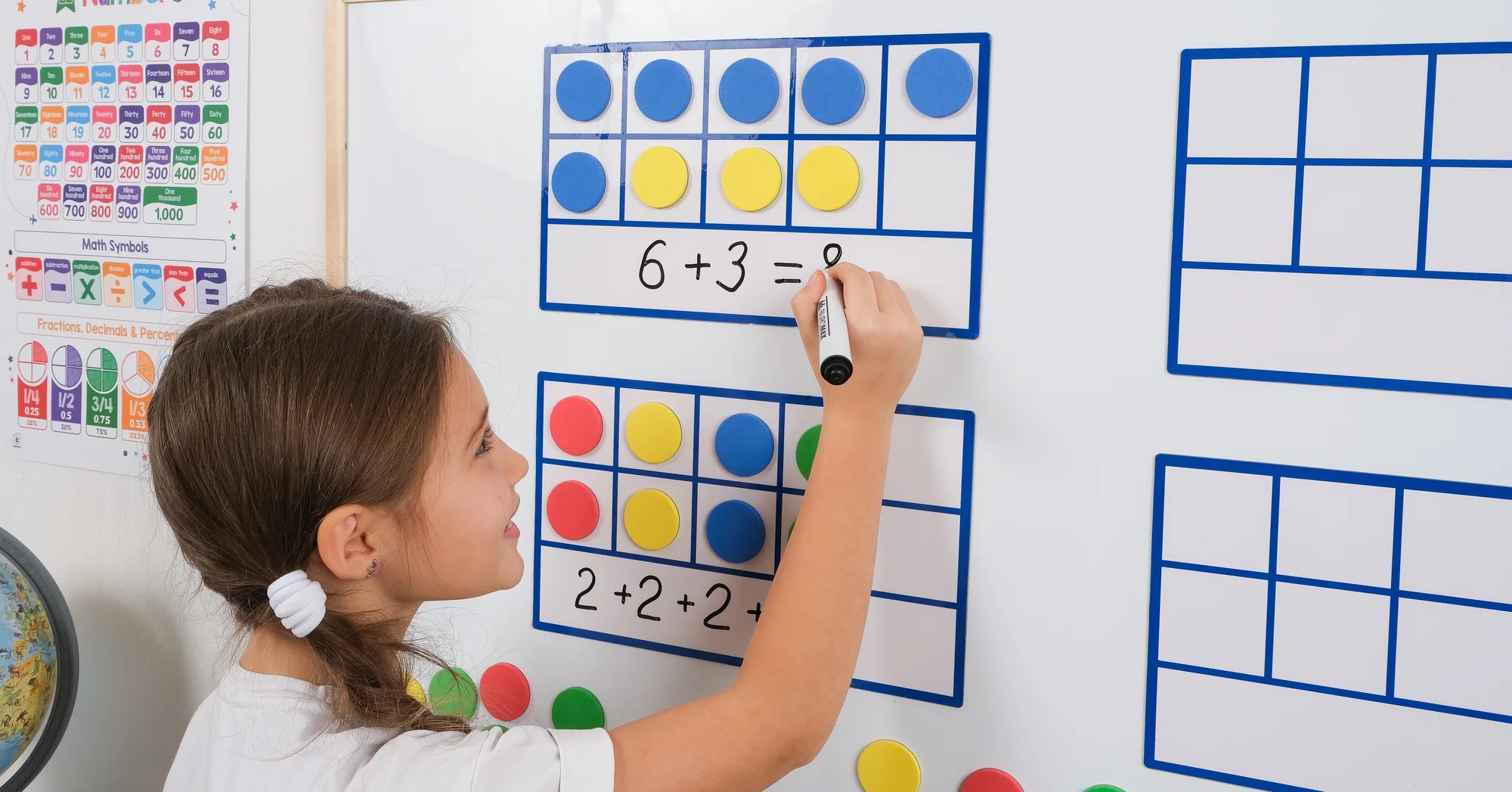
Understanding math vocabulary directly supports problem-solving, comprehension, and long-term math achievement.
Math Terms Kids Should Master by Grade 3
The vocabulary children acquire in the early elementary years lays the foundation for nearly every math concept they’ll encounter later.
In many curricula, third grade marks a pivotal transition where students are increasingly expected to apply basic operations to multi-step word problems that require higher-level reading comprehension.
Mastering these terms allows students to move beyond rote memorization of procedures and toward 'flexible thinking,' where they can explain the logic behind their answers.
Here are the most important terms students should know by the end of third grade:
-
Add: To combine two or more numbers to get a total.
-
Subtract: To take one number away from another.
-
Multiply: To find the total when you have equal groups.
-
Divide: To split into equal groups or find how many groups fit.
-
Equal: Having the same value.
-
Less: A smaller amount.
-
More: A greater amount.
-
Number line: A visual line used to represent numbers in order.
-
Odd: A number that cannot be divided evenly into pairs (e.g., 1, 3, 5).
-
Even: A number that can be divided evenly into pairs (e.g., 2, 4, 6).
-
Place value: The value of a digit based on its position in a number.
-
Sum: The result of addition.
-
Difference: The result of subtraction.
-
Product: The result of multiplication.
-
Quotient: The result of division.
-
Greater than: More than another number (>).
-
Less than: Smaller than another number (<).
-
Fraction: A part of a whole, written as one number over another.
-
Shape: A form like a square, triangle, or circle.
-
Angle: The space between two lines that meet at a point.
-
Pattern: A repeated or predictable sequence.
-
Estimate: To make a close guess.
-
Compare: To decide if numbers or quantities are the same, greater, or less.
Next, we’ll look at how families can reinforce these concepts in everyday life to strengthen math vocabulary naturally.
📕 You May Also Like: What Is Number Sense & Why It Matters in Early Math Education
How to Help Your Child Build Math Vocabulary at Home
Math vocabulary grows best through repeated exposure and everyday use. Here are ways parents can support that growth, without turning learning into a chore:
1. Use Math Talk in Daily Life
Integrate math terms naturally into conversation.
-
Ask your child to “estimate” how many minutes are left before dinner.
-
Talk about “greater than” and “less than” when comparing prices at the store.
-
Use words like “sum” and “difference” when solving real-life problems together.
-
Say things like, “What’s the product of 4 and 6?” during a game or routine task.
📕 You May Also Like: Positive Math Talk: Encouraging a Growth Mindset at Home
2. Encourage Your Child to Explain Their Thinking
When kids explain how they solved a problem, they use and reinforce math vocabulary.
-
Prompt with questions like: “How did you know that was the answer?” or “Can you describe what the question was asking in your own words?”
-
Encourage them to use words like divide, half, groups, or equal while solving.
📕 You May Also Like: How to Nurture Confident Math Thinkers, Not Just Answer-Getters
3. Read Math Picture Books Together
There are excellent children’s books that introduce math terms in friendly, relatable ways. Look for titles like Sir Cumference and the First Round Table or The Grapes of Math.
After reading, ask your child to point out or define new math words they noticed.
4. Label and Organize Math at Home
Make vocabulary visible. Use sticky notes to label objects around the house with math terms: shapes, quantities, and measurements.
Another good option is to keep a “math word wall” or vocabulary notebook and add terms throughout the year.
5. Turn Play Into Learning
Games build vocabulary in low-pressure ways.
-
Play card or dice games that involve terms like add, sum, even, or compare.
-
Try digital games or printable puzzles that include math vocabulary (e.g., math crosswords).
-
Create a scavenger hunt where your child finds objects that match vocabulary terms (e.g., find something with an angle, or something you can divide evenly).
📕 You May Also Like: 7 Active Math Games That Make Learning Fun at Home
6. Model Confidence With Math Language
Children pick up on your attitude toward math.
Avoid making statements about your own capabilities like “I was never good at math.” Instead, model curiosity and growth.
When you don’t know a term, look it up together and discuss it. This normalizes learning and reinforces that everyone can grow their math vocabulary.
📕 You May Also Like: How to Build a Growth Mindset During Holidays (Math Edition)

Mathnasium is a math-only learning center for students of all skill levels.
How Mathnasium Helps Kids Build Math Vocabulary and Beyond
If you’re looking for expert support as your child builds their math vocabulary or their overall understanding of math, we are here to help.
Mathnasium’s math-only learning centers help students of all skill levels learn and master math. Our specially trained tutors work face-to-face with kids in a caring, supportive environment, using personalized learning plans that start with what your child already knows and build from there.
Our teaching approach emphasizes conversation, real-time feedback, and deep understanding, so kids learn to explain their thinking and tackle new challenges with clarity.
And it works:
-
94% of parents report improved math skills and understanding
-
90% of students see better grades in school
-
93% of parents notice a more positive attitude toward math
Families in the Cincinnati area choose Mathnasium of Hyde Park for a reason. We’re proud to be:
Whether your child is catching up, staying on track, or ready to get ahead, we’re here to help them succeed, and feel good doing it.
Schedule a free assessment at your nearest Mathnasium center today and see how we can support your child’s growth, one word (and one problem) at a time.


 (513) 832-8773
 (513) 832-8773