Long before they start solving for x, students’ algebraic thinking begins with noticing patterns, describing change, and understanding how quantities relate.
The building blocks for algebra readiness lie in skills like graphing, identifying trends, and using math language to describe relationships.
These are both academic and, more importantly, cognitive milestones on a student’s math journey. When they can visualize how numbers interact, they’re better equipped to handle equations, variables, and functions down the line.
Today, we’ll walk you through how early graphing skills evolve into algebraic thinking, how to spot if your child is on track, and what you can do at home to support their growth, no matter what grade they’re in.
How Graphs Lay the Groundwork for Algebra
Graphs give students a way to see how numbers behave over time or across situations. Before students begin to write equations or solve for unknowns, they first need to understand the relationships between quantities, and graphs make those relationships visible.
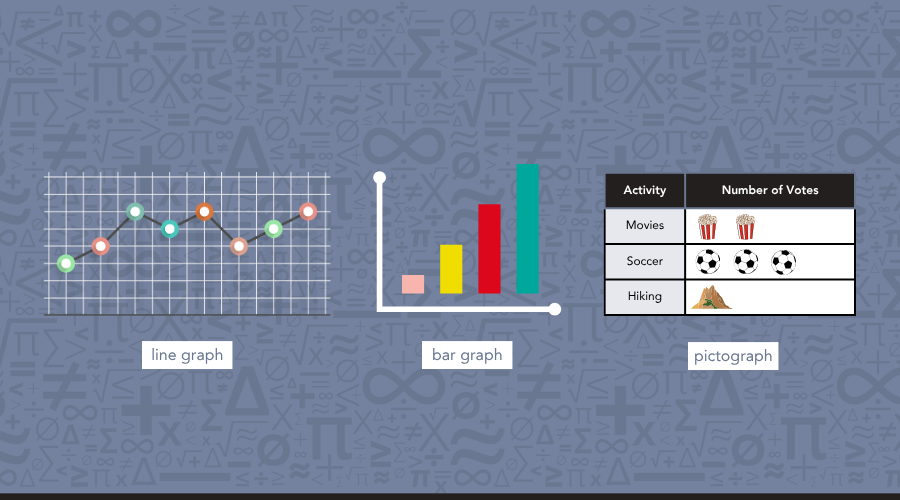
When students read and create graphs, they begin to notice patterns such as increases, decreases, and steady trends. That visual sense of movement and direction lays the foundation for thinking algebraically later on.
Here’s how different types of graphs support early algebra thinking:
-
Line Graphs: These show how one quantity changes with another, like temperature over a week or a savings account balance over time. Seeing “up and down” helps kids grasp the idea that math can describe change.
-
Bar Graphs: These make comparisons between groups easy to interpret at a glance. Whether charting favorite snacks or weekly chore completion, bar graphs help kids think about categories and how they relate.
-
Coordinate Grids: When students begin to plot points on a two‑axis grid, they’re practicing the same visual thinking they’ll use in algebra to graph equations or interpret functions.
Real‑world examples make these ideas stick. For instance, tracking how many pages your child reads each day on a chart or plotting scores from a sport or video game can turn abstract ideas into something tangible.
This early experience with visual relationships matters because it shifts math from isolated operations to meaningful patterns—exactly the kind of thinking algebra builds on.
By the time students encounter variables and equations, they’ve already started to think in terms of how quantities vary together, thanks in large part to their work with graphs.
📕 You May Also Like: Graphing Snowfall and Holiday Data for Kids (Winter Math Fun)
From Graphs to Patterns: How Graphs Help Identify Relationships
Once students are comfortable reading graphs, the next step is learning how to interpret what those visuals are showing. This is where algebraic thinking really begins to take shape with patterns and relationships.
Graphs naturally invite questions like:
-
What’s changing?
-
How fast is it changing?
-
What stays the same?
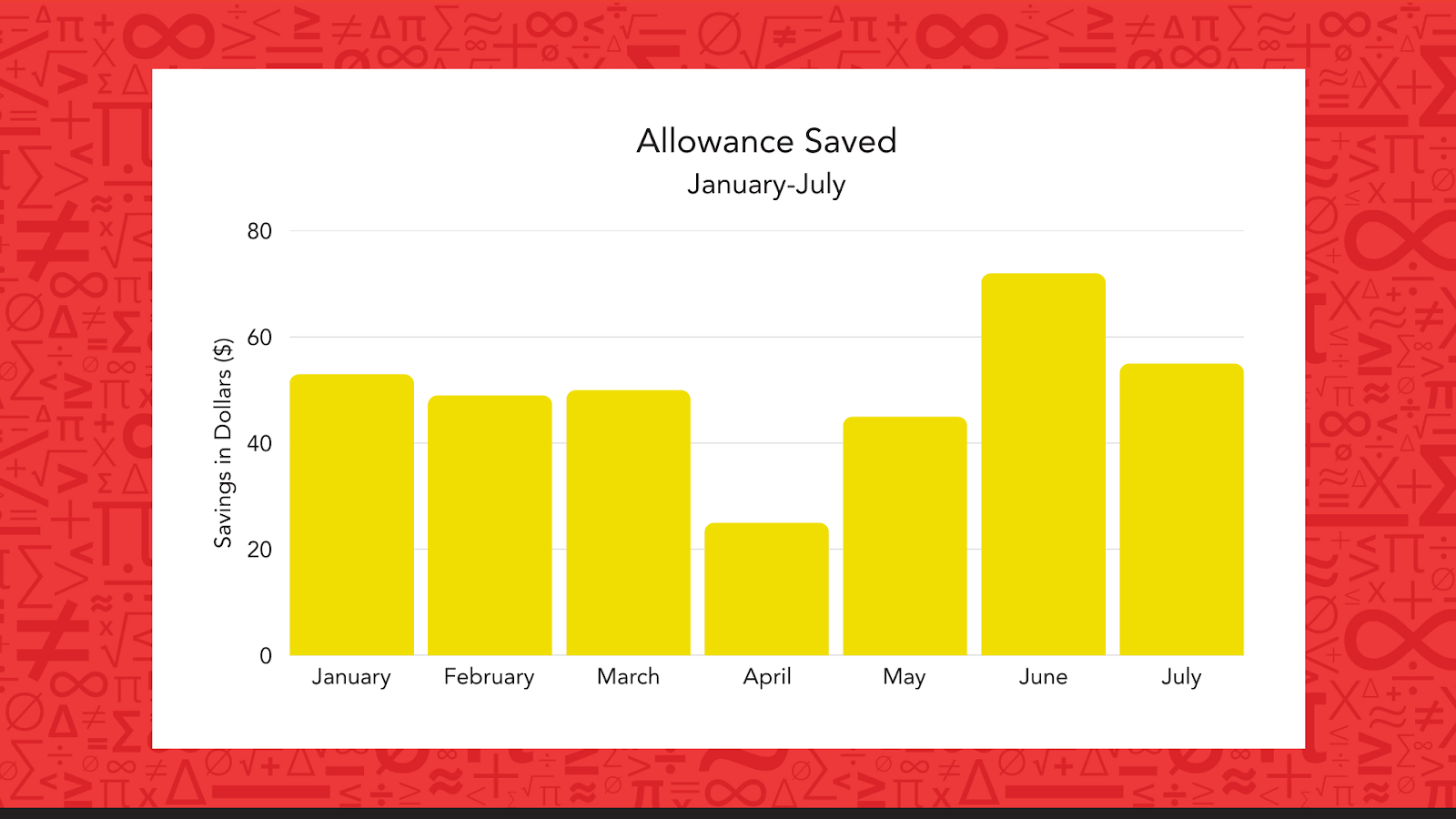
A good example could be tracking allowance savings. In this case, the student used a bar graph to represent monthly savings from January to July, which showed a clear spike in June, when their lawn mowing clients needed most help, and a dip in April, when they focused on studying for their finals.
When students start answering those questions, they move beyond reading data and into understanding how quantities relate to one another.
A helpful bridge at this stage is working back and forth between graphs and tables. Tables organize values side by side, making it easier to spot consistent relationships:
-
As one value increases, does the other increase, decrease, or stay constant?
-
Do the numbers grow by the same amount each time?
-
Is there a predictable pattern you can describe in words?
This is also where math language begins to matter more. Terms and phrases like more than, less than, double, half, increase, and decrease give students a way to talk about what they’re seeing. When a child can say, “Every time x goes up by 1, y goes up by 2,” they’re already thinking in terms of functions, even if they’ve never seen an equation.
Why does this step matter so much?
Because algebra is about understanding how one thing depends on another. By identifying patterns in graphs and tables, students begin to think functionally. They learn that math tells a story about relationships, not just isolated numbers.
This mindset makes the transition to variables far smoother. Instead of seeing letters appear out of nowhere, students recognize them as natural placeholders for the patterns they’ve already been working with.
📕 You May Also Like: How to Make Sure Your Child Is Ready for Algebra
Now, What Is a Variable? (Hint: It’s More Than Just “X”)
By the time students encounter variables in formal algebra, they’ve usually seen them in isolated expressions like “solve for x.” But for many kids, that first “x” feels random, just a letter with no clear meaning.
That’s why it’s so important to introduce variables early and in context. When students first meet variables as a way to describe a pattern or represent a changing value, the concept clicks much more easily.
So what is a variable, really?
A variable is simply a symbol (usually a letter) that stands for a number that can change.
And students see this all the time in real life:
-
If you earn $10 per hour, your pay depends on how many hours you work. If h is the number of hours, your total pay is 10h.
-
If you’re tracking the score in a game, the score changes each time a team earns points. If s is the number of goals, the total score could be 5s, 7s, or any other rate.
Introducing variables as part of real-world relationships rather than abstract problems builds understanding instead of anxiety.
It also helps students move from thinking in terms of “the answer” to thinking in terms of how quantities relate. And that’s the key to making algebra not just doable, but meaningful.
Let's Start Bringing It All Together: Equations as Representations of Relationships
Once students are comfortable identifying patterns and recognizing how one quantity affects another, they’re ready to take the next step: writing those relationships as equations.
This is where algebra truly begins.
An equation is just a sentence in math form. It tells you how two values are connected.
For example:
-
If every snack costs $2, then the total cost y depends on how many snacks x you buy: y=2x.
-
If a balloon starts at 100 inches high and loses 5 inches every hour, then the height h after t hours is: h=100−5t.
Writing equations like these helps students:
-
Model real-world situations
-
Practice reasoning with unknowns
-
Move from observing a pattern to predicting outcomes
When students can describe a relationship, translate it into a table or graph, and then write an equation to match, it’s a clear sign they’re building algebra-ready thinking.
This kind of reasoning is what prepares students not just to solve algebra problems, but to understand why their solutions work.
📕 You May Also Like: How to Nurture Confident Math Thinkers, Not Just Answer-Getters
4 Signs Your Child Is (or Isn’t) Ready for Algebra
Many students begin formal algebra instruction before they’ve developed the foundational skills needed to succeed, and that can lead to frustration or confusion later on.
Here are four telltale signs that your child is (or isn’t yet) ready for algebra-level thinking:
-
Comfort with number lines, tables, and graphs: Algebra is all about relationships, and those become easier to grasp when students can interpret data visually. If your child can confidently use a number line to show operations, read tables of values, and understand the meaning of a graph, they’re on solid footing.
-
Can identify patterns or trends in numbers: Recognizing “what’s changing” is a key Prealgebra skill. Whether it’s spotting a repeating pattern or noticing that numbers double each time, pattern recognition signals the kind of functional thinking algebra requires.
-
Uses math vocabulary like “input/output,” “rate,” or “increase/decrease”: Students who can describe relationships using the right language are better equipped to write equations or explain their reasoning, both essential in algebra.
-
Still relies on memorization over understanding: If your child is focused only on steps or rules, without understanding why those steps work, they may struggle with the flexible thinking algebra demands. This is a signal that they might benefit from more foundational support before moving forward.
At-Home Tips to Build Algebra Foundations
You don’t need to be a math expert to help your child prepare for algebra. In fact, some of the most effective learning happens through everyday conversations and activities.
Try these simple, meaningful ways to build your child’s algebra readiness at home:
-
Use real-life examples of changing values. Talk about things like weather temperatures, game scores, or elapsed time. These everyday changes are perfect starting points for discussing how and why numbers shift.
-
Ask open-ended questions. Try prompts like, “What happens if we double this?” or “How would the pattern change if we added 2 each time?” These questions spark curiosity and help kids practice functional thinking.
-
Create simple graphs and tables together. Use paper or a whiteboard to track something over time, such as minutes of reading, number of steps walked, etc. Plotting the data visually helps connect numbers to real meaning.
-
Talk through patterns and comparisons. When you notice a pattern on the clock, at the grocery store, or in a board game, pause and ask, “What do you notice?” or “Does this always happen?” Encouraging your child to verbalize their thinking deepens understanding.
These small, informal strategies build confidence and help children make the leap from arithmetic to algebra, one pattern at a time.

Mathnasium is a math-only learning center that helps students truly understand and even enjoy math.
How Mathnasium Builds Algebra-Ready Thinkers
At Mathnasium, we don’t wait until students are already in Algebra class to start preparing them; we build algebra readiness step by step, long before variables show up in homework.
Through our proven teaching approach, the Mathnasium Method™, we help students in grades K–8 develop the core thinking habits they’ll need to succeed with equations, functions, and abstract reasoning later on. That means starting with number sense, then building into patterns, relationships, and structured problem-solving.
We begin every student’s journey with a diagnostic assessment that helps us understand their strengths and gaps in skills, reasoning, and conceptual understanding. From there, we create a personalized learning plan that supports foundational growth at every stage.
Here’s how we help students become algebra-ready:
-
Visual and hands-on models that help students truly grasp how quantities relate
-
Guided instruction that connects number lines, graphs, and tables to real-world patterns
-
Strategic use of vocabulary like “rate,” “function,” and “change” in context
-
Consistent, supportive feedback that encourages flexible thinking and self-confidence
With over 1,100 centers nationwide, Mathnasium is trusted by families across the country. And here in San Diego, CA, Mathnasium of La Jolla stands out as a top choice for local math support:
Whether your child is just starting to explore patterns or is gearing up for Prealgebra, our team is here to help them think critically, grow confidently, and love learning math.
📅 Book a free assessment at your nearest Mathnasium Learning Center today to see how we can support your child’s path to algebra and beyond.


 (858) 291-8186
 (858) 291-8186