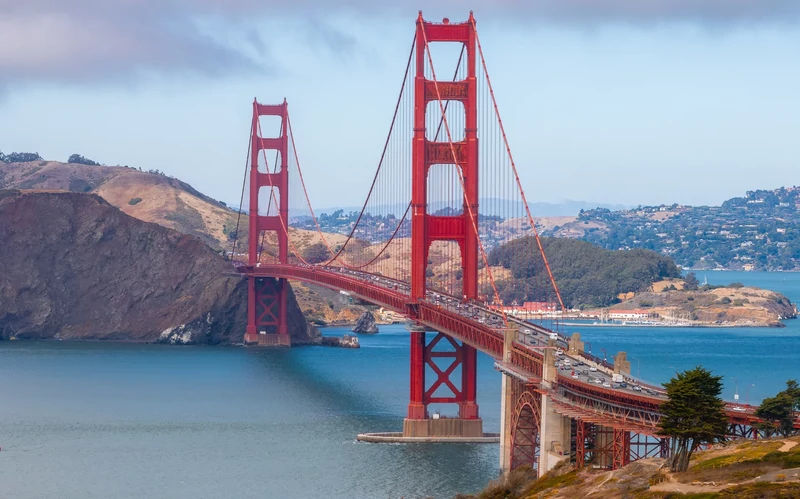
The Golden Gate Bridge is one of California's most recognizable landmarks, but it's also packed with fascinating math.
From powerful shapes to clever measurements, this bridge turns geometry in architecture into something kids can see, touch, and explore. For parents looking to make math more fun, it's a perfect real-world example.
Let’s uncover seven essential math concepts hidden in the bridge's design and share hands-on activities that bring Golden Gate Bridge math to life.

1. Scale and Measurement: Planning a 4,200-Foot Span
When you stand in front of a bridge that stretches almost two miles across water, it's hard to imagine how anyone planned something so massive.
The engineers who designed the Golden Gate Bridge in 1937 faced this exact challenge. They couldn't just start building and hope for the best.
Given that the bridge is nearly 9,000 feet long (with the main section being 4,200 feet long) and 90 feet wide, every component had to be calculated perfectly before construction even began.
So, how did they do it?
They used scale and measurement.
Do you like playing with building blocks? If so, you probably have an instruction booklet that shows a tiny picture of the model you will be building. However, the proportions between the picture and your model are exactly the same! This is scale.
Engineers do the same thing, creating scaled-down drawings where every inch on paper represents many feet in real life. If they were off by even a few feet when calculating where the cables should attach or how tall the towers need to be, the whole bridge could fail.
If you want to try playing with scale yourself, here’s a fun activity: grab a ruler, some paper, and a pen, and imagine that 1 inch on paper equals 100 feet in real life. Measure how long and wide the Golden Gate Bridge would be at this scale, and then calculate its area.
📕 You May Also Like: What Is Area in Math? A Complete & Kid-Friendly Guide

Building block booklets show a scaled-down version of the model you are building—an approach used in engineering to create a detailed plan for bridge construction.
2. Triangle Geometry: The Strongest Shape in Engineering
If you had to build a structure using only toothpicks and marshmallows, which shape would you arrange them in so they hold?
Here's a secret engineers have known for hundreds of years: triangles are the strongest shape.
The Golden Gate Bridge is packed with them! Underneath the roadway, you'll see triangular trusses holding up thousands of cars, trucks, and buses every day.
When a heavy truck drives across, the triangular trusses catch that force and spread it out, preventing sagging or bending. This is why you’ll find triangles all around you, from the Golden Gate Bridge and the Eiffel Tower to construction cranes and structures all around your neighborhood.
If you’re not convinced of how strong triangles are, here’s an experiment you can do: build a square with four toothpicks and marshmallows, then build a triangle with three. Gently press down on each shape and see how they hold up. The square probably collapsed while the triangle stayed strong.
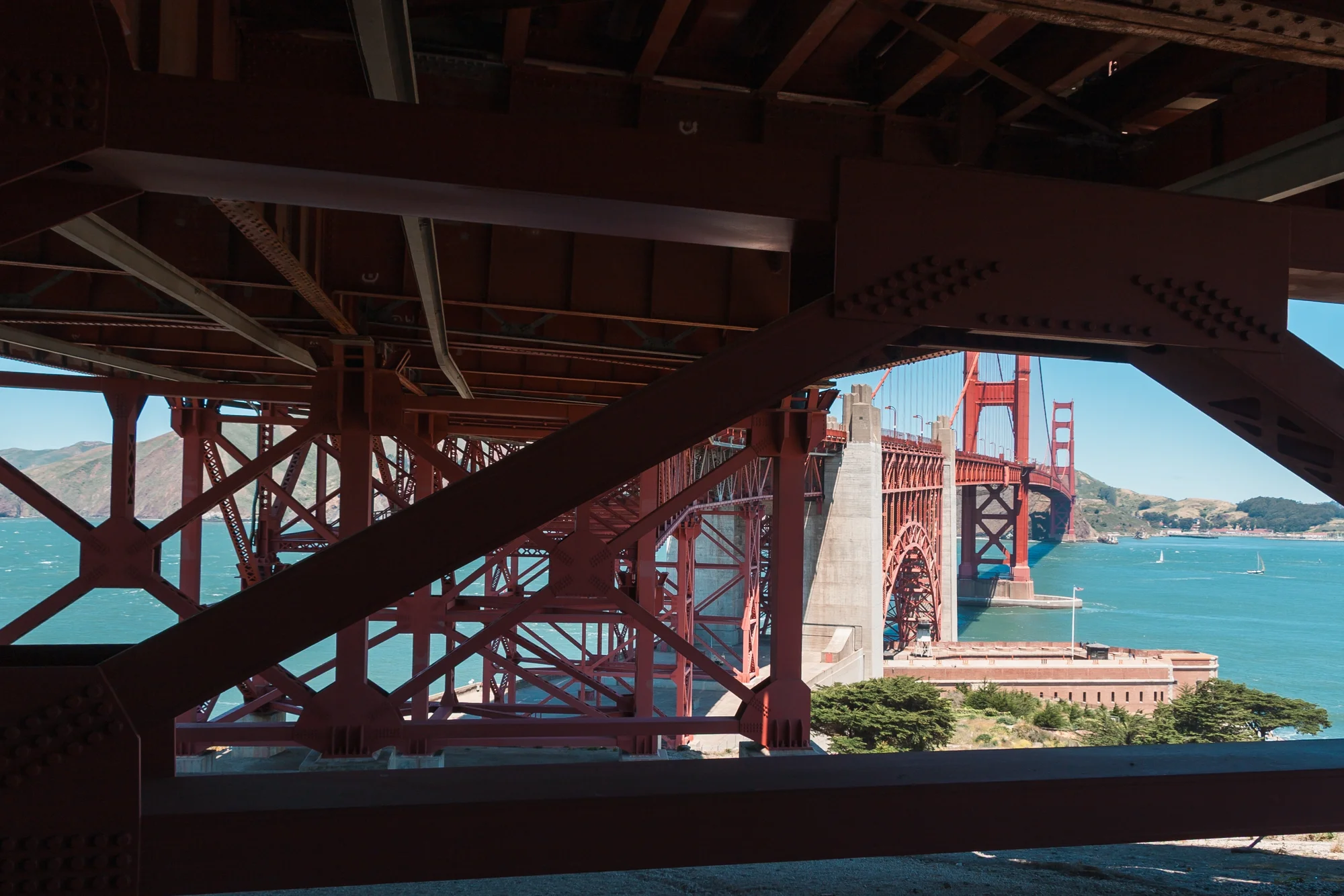
Looking from below, we can see that the Golden Gate Bridge features an intricate web of triangles that support the entire structure.
3. Symmetry: Creating Balance with Matching Measurements
How do you keep something that weighs 887,000 tons—about the weight of 5,000 blue whales—from tipping over?
The answer is symmetry.
The two towers are exactly the same height: 746 feet tall, matching each other perfectly like a giant seesaw! The cables, roadway, and forces from the wind and traffic are all balanced, keeping the bridge stable.
Try it for yourself! Have your child draw their own symmetrical bridge. Fold a piece of paper in half, draw half a bridge on one side, then unfold and trace the matching half.
📕 You May Also Like: What Is a Line of Symmetry? A Kid-Friendly Guide
4. Parabolic Curves: How Math Shapes the Distribution of Weight
Here's something surprising: the cables on the bridge aren't straight. They dip down in a smooth curve called a parabola.
You've seen parabolas before. When you toss a ball to a friend or watch water spray from a fountain, that arcing curve is a parabola.
Why this curve?
A parabola distributes weight evenly. Imagine carrying a heavy backpack. If all the weight is in one corner, it pulls uncomfortably. But spread evenly, it feels lighter.
The cables work the same way. Because they curve in a parabola, the weight gets distributed smoothly from the towers to the middle. Every part of the cable does its fair share.
For a simple demonstration of a parabola at home, find a piece of string or a thin chain (a necklace chain works great) and hold both ends in your hands, letting the middle hang down naturally. See that curve? That's called a catenary curve, and it's very similar to a parabola.
5. Angles and Flexibility: Engineering for Movement and Forces
The Golden Gate Bridge was designed to move. It can sway 27 feet from side to side and move up and down by more than 10 feet!
Why?
Let’s step into the territory of physics for a moment: flexibility is sometimes stronger than stiffness. California gets earthquakes and strong winds from the Pacific. If the bridge were completely rigid, shaking would make it crack or collapse. But because it can sway, it absorbs those forces without suffering meaningful damage.
Now let's look at the math side of things. The cables are attached at specific angles to the towers and roadway, letting the bridge move just enough, like a swing set.
To see this principle in action, take a piece of uncooked spaghetti and hold it on both ends. Try to move your hands in different directions without breaking them.
Not very easy, is it?
Now do that same task with a cooked piece of spaghetti.
6. Area and Time Calculations: The Never-Ending Painting Project
Imagine painting your bedroom. A few hours of work. Now imagine painting the Golden Gate Bridge. If you’ve already calculated the area from before, this might not surprise you as much, but it's a job that literally never ends.
(Fun fact: Painting the bridge is a continuous, year-round maintenance task. Rather than painting from end to end, crews prioritize 'touch-up' painting in areas where salt-laden fog causes the most wear and corrosion.)
The surface area includes two massive towers, the roadway, cables, and all the support beams. Millions of square feet need protection from rust and salty ocean air.
So the painters have to put on their mathematician hats as well:
This line of questioning can also make for an excellent math exercise.
Give your child this problem so that they too can experience what it’s like to plan painting this enormous bridge: "The Golden Gate Bridge has 10 sections. Each takes 2 days to paint. How many days will it take for the whole bridge?" (Answer: 20 days)
Now change the variables: "What if we had 2 crews working at the same time?" (Answer: 10 days). "What if bad weather means they can only work every other day?" (Answer: 40 days)
Talk about how project managers think about these variables: workers, time, materials, and problems. This planning happens for every big project, from painting bridges to building schools.
📕 You May Also Like: Understanding the Surface Area of a Rectangular Prism
7. Ratios and Proportions: The Golden Rectangle in Design
While painting the bridge takes forever, there’s no doubt it’s still beautiful.
Part of that beauty comes from the golden ratio, approximately 1:1.618. This means if something is 1 unit wide, it should be about 1.6 units tall to look most pleasing. Artists, architects, and designers have used this ratio for thousands of years.
Some parts of the bridge follow the golden ratio: the relationship between the tower height and the roadway width, for example.
You can also find this ratio in unexpected places: your face, pinecones, sunflower spirals, and the Parthenon in Greece!
Need proof?
Find rectangles around your house, like books, frames, and windows. Measure length and width. Divide the longer side by the shorter. Are any close to 1.6? Those are golden rectangles!
See—math is everywhere if you know where to look!
📕 You May Also Like: 9 Examples of the Golden Ratio in Nature
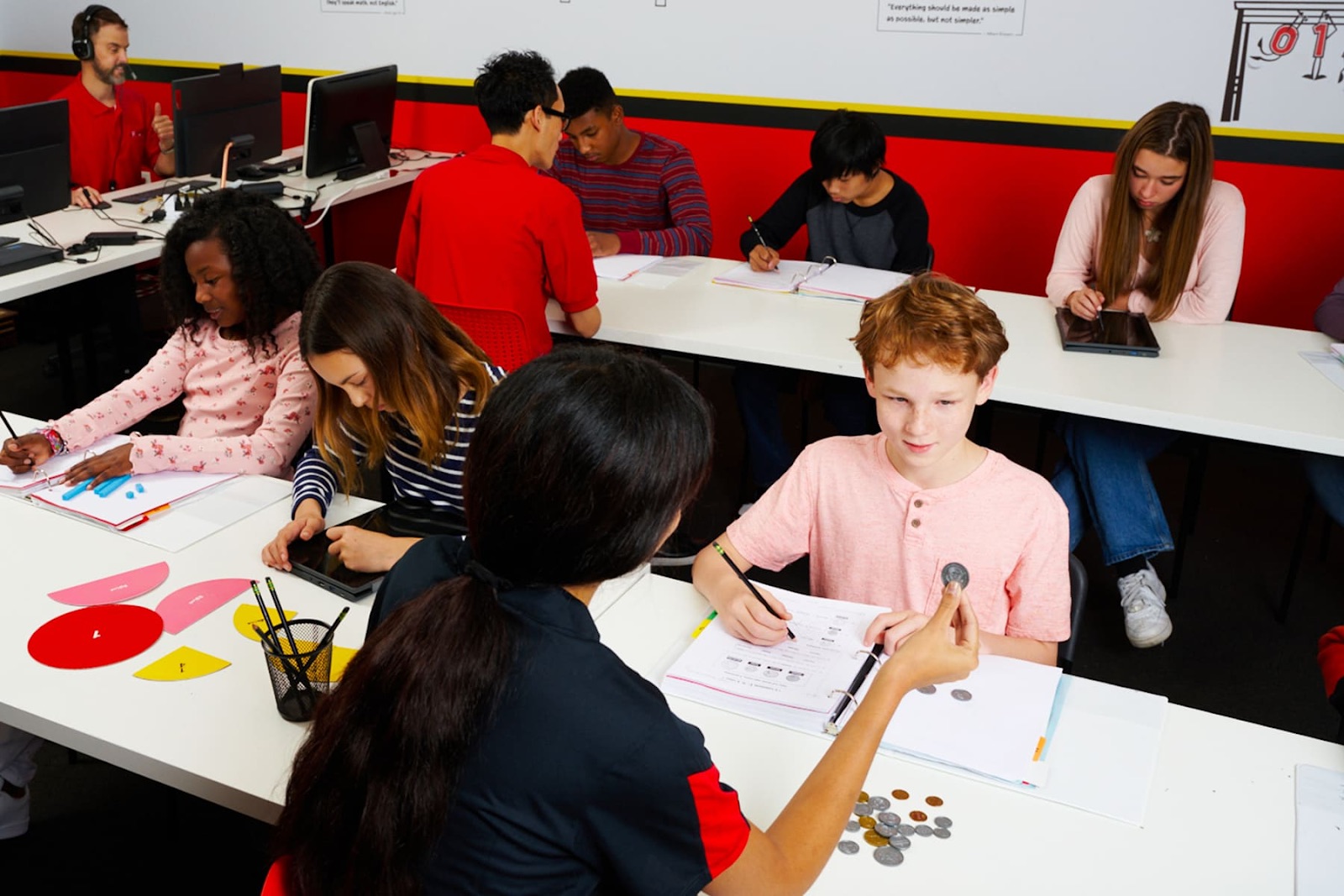
At Mathnasium, we bring math to life through exercises and examples that students can relate to and understand.
How Mathnasium Helps Kids Learn Geometry Through Real-World Examples
At Mathnasium, we believe that math becomes meaningful when students can connect it to the world around them. Using landmarks like the Golden Gate Bridge transforms abstract concepts into tangible ideas that kids can visualize and explore.
Our specially trained tutors show students how geometry shapes the bridges they cross, the buildings they visit, and the structures in their own neighborhoods.
This approach is rooted in the Mathnasium Method™, our proprietary teaching framework designed to build genuine mathematical understanding. When students explore concepts like scale and the golden ratio through real California landmarks, they're discovering why these mathematical principles matter and how engineers and architects use them to solve real problems.
Our method helps students master math through:
-
Customized learning plans: Every student begins with a diagnostic assessment that reveals their current skills, learning gaps, and natural problem-solving style. We use these insights to create a personalized path forward tailored to their unique needs.
-
Teaching that builds understanding: We explain mathematical concepts using clear, relatable language and multiple teaching techniques, including verbal, visual, hands-on, and written approaches. This lets each student grasp ideas in the way that clicks best for them.
-
Expert, caring instructors: Our tutors receive specialized training in both the academic and motivational sides of math education. They know when to guide, when to let students work independently, and how to rebuild confidence in students who've struggled.
-
Focus on reasoning, not just answers: We encourage students to think through problems on their own, then help them analyze their approach and understand the logic behind solutions. This develops critical thinking skills that extend far beyond math class.
-
Math-only specialization: We focus exclusively on mathematics, which allows us to maintain a comprehensive, constantly refined program with thousands of custom materials built around how students truly learn and retain mathematical skills.
-
An engaging, supportive atmosphere: Many of our activities incorporate hands-on exploration and game-based learning. We use encouragement and celebrate every achievement because confidence grows with each success.
The results speak for themselves:
-
94% of parents report improvement in their child's math skills and understanding
-
93% of parents notice a more positive attitude toward math
-
90% of students see higher grades in school
With over 1,100 learning centers nationwide, Mathnasium brings proven math education close to families across the country.
For families in La Jolla, California, Mathnasium of La Jolla has helped countless students build confidence and mastery in mathematics.
Whether your child needs to catch up, keep pace, or accelerate ahead in math, our team is ready to help them succeed.
📅 Schedule a Free Diagnostic Assessment at Mathnasium of La Jolla
Not located near La Jolla?
📍 Find a Mathnasium Learning Center Near You


 (858) 291-8186
 (858) 291-8186