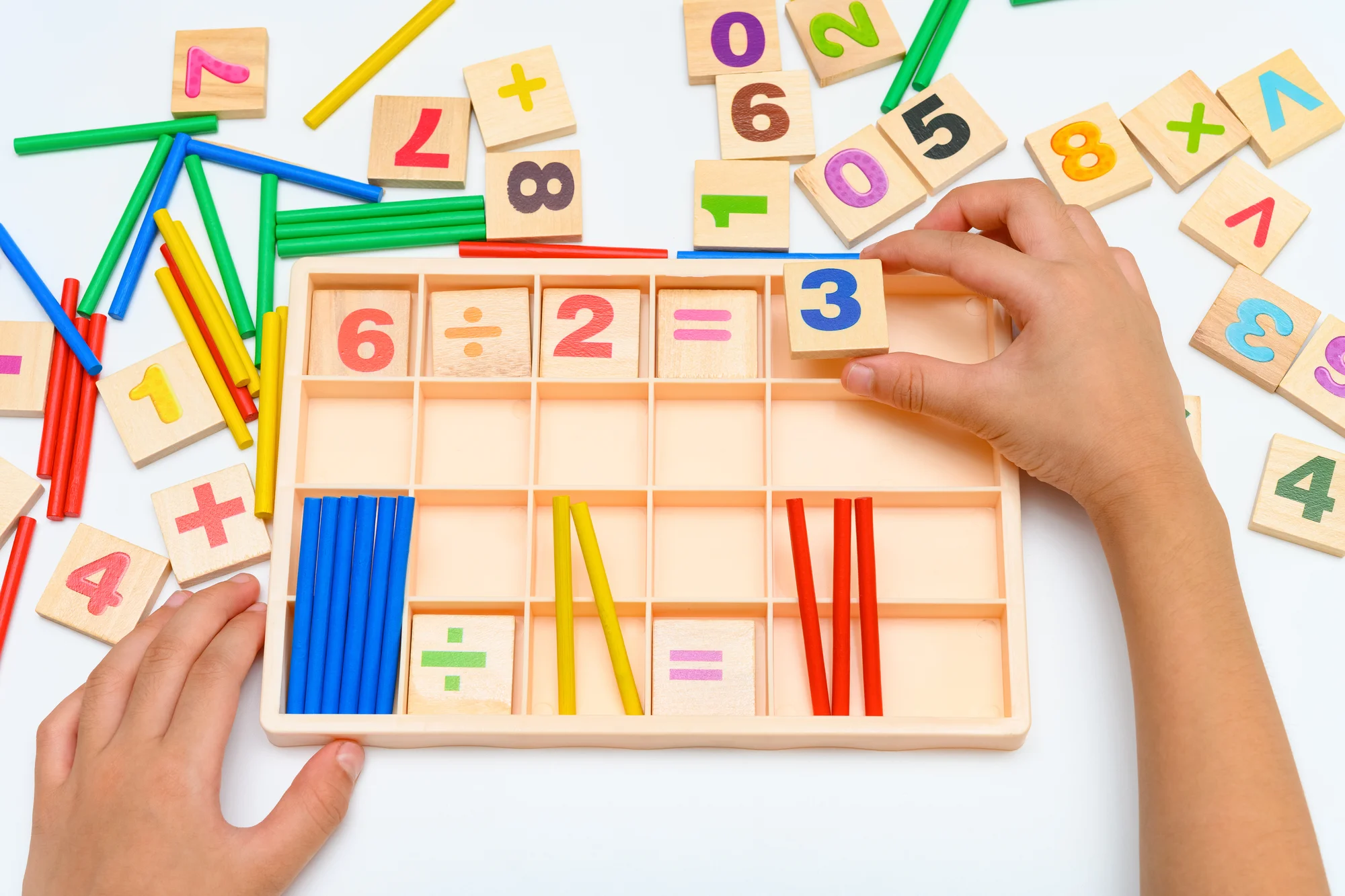
Students officially start exploring division in grade 3. Under Common Core standards, they're expected to understand division as an unknown-factor problem (for example, finding 32 ÷ 8 by determining the number that makes 8 × ? = 32) and to fluently divide within 100 by the end of the year.
Still, a great deal of students finish third grade knowing how to calculate—they can find the answer—but without truly grasping what division means or why it works. And when a student's understanding of division rests on shaky ground, trouble tends to follow with more complex concepts like long division, fractions, and ratios down the road.
At Mathnasium, division is taught for understanding first. That's why we're ripping a few pages from our book and sharing 5 strategies you can use to help your child make sense of division when you practice at home.
1. Clarify What Division Is Really Asking
We always suggest starting by making clear what a division is.
Division is counting "how many of these are there inside of that."
To put that into action, let's say we want to divide 10 by 2. We're asking: "How many 2s are inside 10?"
-
We can count by twos: 2, 4, 6, 8, 10.
-
That's five twos, so the answer is 5, or 10 ÷ 2 = 5.
Then, add another example right after, like dividing 12 by 2.
-
Ask them to picture 12 lemons in their mind.
-
Now, imagine grouping them into sets of 2.
-
We'd count: 2, 4, 6, 8, 10, 12, counting up by twos.
-
That's 6 groups. So there are 6 twos inside of 12, which means 12 ÷ 2 = 6.

This simple reframing, from "divide" to "how many of these fit inside that", helps kids see division as something concrete and countable rather than an abstract operation.
📕 You May Also Like: 7 Strategies to Help Your Child Move Beyond Memorization in Multiplication
2. Use Manipulatives and Visual Models to Build the Concept
Once your child understands what division is asking, strengthen that foundation by bringing in manipulatives and visuals.
Why?
Because when kids can see and touch division happening, they build mental pictures they can draw on later.
Start with physical objects or manipulatives. Grab whatever's handy: blocks, coins, cereal, small toys. Working on 20 ÷ 4? Hand your child 20 objects and ask, "How many groups of 4 can you make?"
Then shift to drawings. After they're comfortable manipulating objects, have them sketch it out instead. They can draw circles for groups or simple arrays. For 20 ÷ 4, they might draw 5 circles with 4 dots in each. Same idea, but now they're creating the visual themselves.
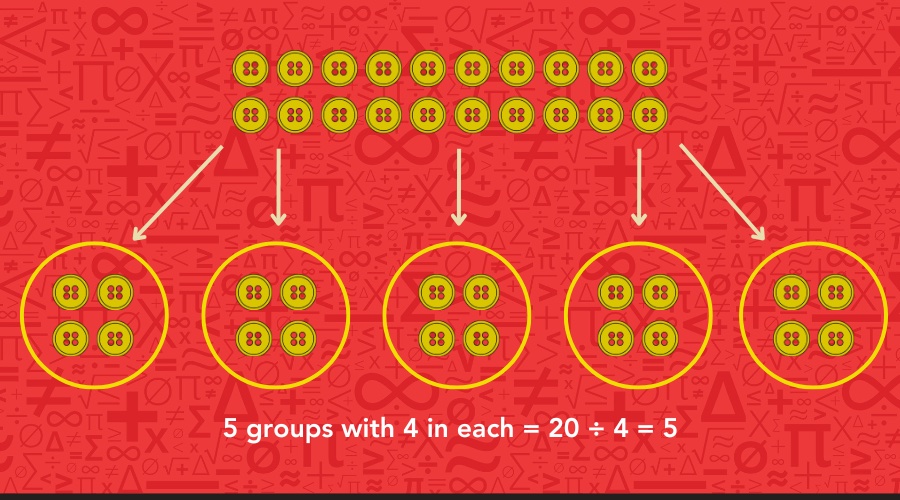
Think of this as building a bridge from abstract to concrete. By the time they work with just numbers, they already know what those numbers represent.
📕 You May Also Like: How to Teach Math to Visual Learners with Pictures & Manipulatives
3. Teach Division as Repeated Subtraction
Another way to help kids make sense of division is through repeated subtraction.
This strategy reinforces what division is really measuring: how many times one quantity fits into another.
Here's how it works.
Let's take 15 ÷ 3. Ask your child: "How many 3s are inside 15?"
Now subtract 3 repeatedly until you reach zero:
-
15 - 3 = 12
-
12 - 3 = 9
-
9 - 3 = 6
-
6 - 3 = 3
-
3 - 3 = 0
Count how many times you subtracted 3—that's 5 times. So 15 ÷ 3 = 5.
Notice how this connects directly back to our first strategy: each subtraction is finding another "3" inside the 15. You're literally counting "how many of these are in that" by removing them one group at a time.
Repeated subtraction is especially valuable when kids are rushing through problems without thinking or when they need to slow down and see the structure of division more clearly.
It's not a calculation method they'll use forever, but it's an excellent thinking tool that deepens their understanding of what's actually happening in a division problem.
📕 You May Also Like: 5 Ways Mental Math Supports Long-Term Math Success
4. Connect Division to Multiplication as an Inverse Relationship
For understanding of division to really take root, kids need to see how it connects to what they already know.
Division doesn't stand alone; it's the flip side of multiplication. Each division problem is really asking a multiplication question with a missing piece.
Using what they already know from multiplication, you can help them crack division more easily.
Reframe division as "find the missing number."
Instead of seeing 12 ÷ 3 as a brand-new operation, help your child think of it as a multiplication problem with a missing piece: "3 × ? = 12." What number times 3 gives you 12? They already know that, it's 4. So 12 ÷ 3 = 4.
Then introduce fact families. Show how three numbers, say, 3, 4, and 12, create a complete set of equations:
-
3 × 4 = 12
-
4 × 3 = 12
-
12 ÷ 3 = 4
-
12 ÷ 4 = 3
Knowing one multiplication fact unlocks two division facts automatically.
Make it concrete with this:
"If you have 5 groups with 6 items in each group, that's 30 total. Now flip it: if you take those same 30 items and sort them into groups of 6, you'll end up with 5 groups again."
Multiplication builds the total; division takes it apart to find the pieces.
📕 You May Also Like: What Are Inverse Operations? A Complete Overview
5. Turn Division Word Problems Into Meaningful Situations
Division word problems are a staple of third-grade math and they're often where even confident students hit a wall.
Why?
Because word problems require two separate skills: figuring out what the problem is asking (which operation to use) and then how to solve it.
The key is teaching them to translate the story back into that core question: "How many of these are in that?"
Start by identifying the structure. Division word problems typically fall into two categories:
-
Grouping problems (How many groups can I make?): "Maria has 24 cookies and wants to put 4 cookies in each bag. How many bags will she need?" → How many 4s are in 24?
-
Sharing problems (How many in each group?): "Maria has 24 cookies to share equally among 4 friends. How many cookies does each friend get?" → 24 divided into 4 equal groups gives us what?
Both are divisions, but they ask slightly different questions. Help your child spot which type they're dealing with.
Teach them to underline the key information. Have them mark:
-
The total amount (the bigger number)
-
The size of each group OR the number of groups
-
What the question is asking for
Draw it out or use objects. Before jumping to calculations, encourage your child to sketch the problem or grab some objects to model it. If Maria has 24 cookies and puts 4 in each bag, let them draw bags and fill them with 4 cookies each until they've used all 24. This brings the abstract story back to something concrete they can see and count.
Connect back to "how many of these in that." After they've drawn or modeled the problem, ask: "What are we counting? How many groups of 4 are inside 24?" This reinforces that division isn't some mysterious word problem operation but the same concept they've been practicing, just wrapped in a story.
Practice with real-life scenarios. The more your child sees division in everyday contexts, splitting snacks among friends, organizing toys into bins, dividing up chores, the more natural it becomes to recognize division situations when they pop up in word problems.
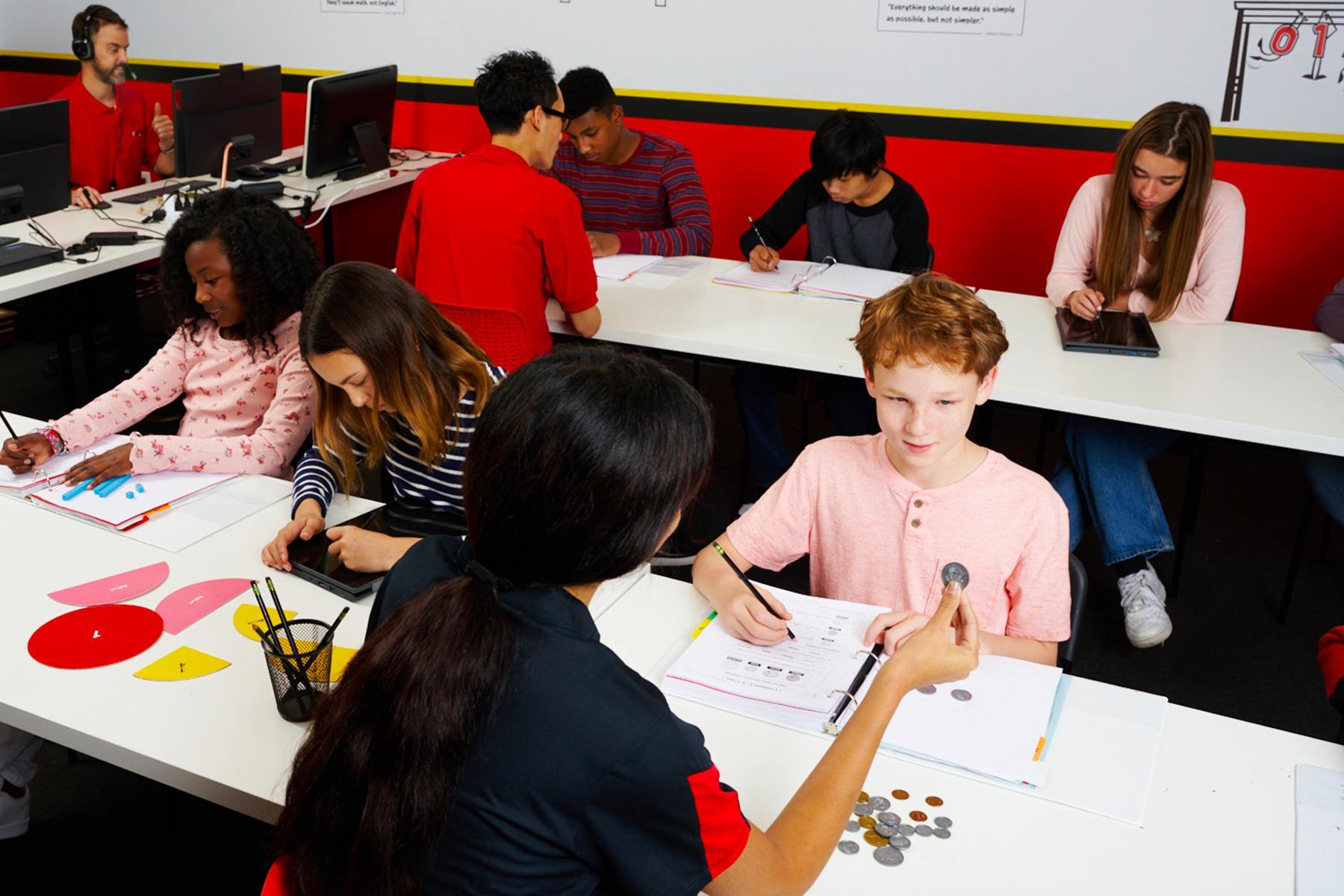
In Mathnasium centers, division is taught for meaning and mastery, helping students understand what they’re doing and why it works.
How Mathnasium Helps Students Master Any Math Skill
Mathnasium is a math-only learning center that has helped thousands of students across the U.S. build a deep understanding of math.
When students come to us, whether they're looking to develop foundational skills like division or tackle more complex problem-solving, we focus on one thing: true mastery.
For us, true mastery means a student doesn't just know the answer. They understand how and why a solution works. They can explain their thinking, catch their own mistakes, and apply what they've learned to new problems. That kind of understanding builds real confidence and makes future math topics easier to handle.
To get students there, we don't use a one-size-fits-all system. Instead, we employ our proprietary teaching approach: the Mathnasium Method™.
The Mathnasium Method™ rests on six core elements:
-
Personalized learning: Each student begins their Mathnasium journey with a diagnostic assessment. This helps us identify their strengths, knowledge gaps, and how they approach math in general. With these insights, we create a learning plan customized to each student’s needs.
-
Teaching for understanding: Our tutors use natural, everyday language to phrase math concepts. We also use a mix of verbal, visual, mental, tactile, and written teaching techniques to help students truly make sense of what they’re learning.
-
Caring, supportive tutors: Our tutors are specially trained in math as well as the technical and emotional aspects of teaching. This means they know how to encourage a student who’s overwhelmed and how to challenge one who’s ready to stretch their thinking.
-
Problem-solving and critical thinking skills: During sessions, we always allow time for productive struggle, then rejoin students to check and correct their processes. This helps them learn to rely on their own thinking. We guide them through both the how and the why behind each math problem, not only the final answer. This approach develops the problem-solving and critical thinking tools they’ll use in math and life.
-
Singular focus on math: We are dedicated to math and math only. This singular focus on math allows us to dive deeper into how students best learn, absorb, and retain math skills.
-
A confidence-building, fun learning environment: We often hear students say our sessions don’t feel like lessons at all. That’s because we incorporate game-based activities and plenty of rewards to keep students motivated and engaged.
Our method brings measurable improvement in skills and mindset:
-
94% of parents report an improvement in their child's math skills and understanding
-
93% of parents report an improved attitude towards math after attending Mathnasium
-
90% of students saw an improvement in their school grades
Mathnasium operates over 1,100 centers across the country, bringing top-rated math instruction close to your community.
If you are based in or close to Lake Forest, CA, Mathnasium of Lake Forest is a trusted local center with years of experience creating confident math thinkers.
Whether your child is looking to catch up, keep up, or get ahead on their math journey, our team is happy to help!
📅 Schedule a Diagnostic Assessment at Mathnasium of Lake Forest
Not near Lake Forest?
📍 Find a Mathnasium Learning Center Near You


 (949) 868-6488